
Key Takeaways
Coinbase’s announcement of 1:1 physically backed tokenized stocks confirms that major crypto exchanges, following Binance, are pivoting toward the financial super app model.
Unlike Binance, Coinbase is pursuing an infrastructure pre-emption strategy by placing substantive ownership rights directly on its own on-chain rail.
Regulated exchanges have opened a new front, the on-chain migration of regulated assets, to break out of the competitive squeeze between permissionless DEXs and traditional brokerage apps.

On June 16, Coinbase announced tokenized stocks backed 1:1 by underlying U.S.-listed shares. The structure brings actual shares on-chain rather than derivatives or IOUs. Dividends are paid automatically, and the tokens can be transferred directly on-chain.
The product launches outside the United States first and operates on Coinbase’s own on-chain rail. Building on proprietary on-chain infrastructure goes beyond simply adding a stock trading feature. The strategic intent is to consolidate stocks, crypto, payments, and transfers onto a single financial rail that Coinbase controls, locking in the ecosystem. Coinbase has framed this as the centerpiece of its “Everything Exchange” strategy: a declared ambition to replace brokerage, advisory, and banking functions within a single app.
Why Now
Three structural factors are driving this shift among exchanges.
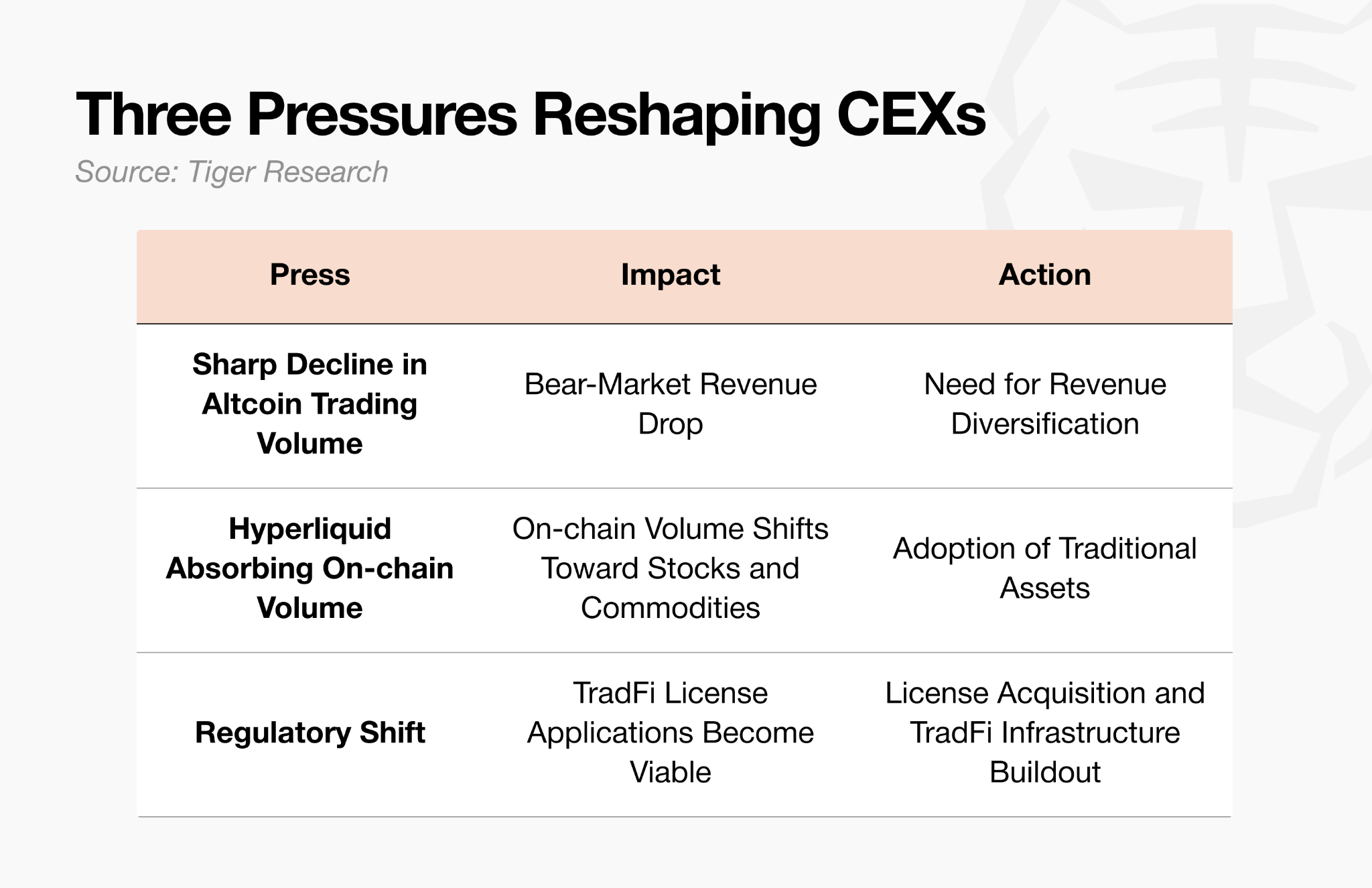
Tiger Research’s June 9 report, “CEX to Everything Store, Abandoned Altcoins,” examined the structural context behind this trend. Centralized exchanges are now facing competitive pressure from multiple directions simultaneously.
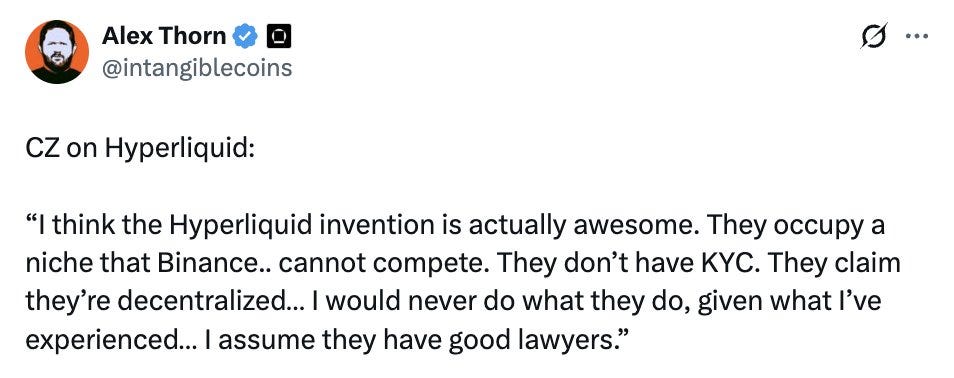
Recent comments by Changpeng Zhao (CZ) on the Galaxy Brains podcast drew attention for his remarks on Hyperliquid. He argued that while Hyperliquid occupies a niche Binance cannot compete in directly, it operates without KYC and under a decentralized model, and that based on his own experience, no exchange operating that way would be able to sustain it going forward.
The remarks point to a broader reality: the competitive arena for regulated exchanges lies elsewhere. Rather than replicating permissionless DEXs and fighting for a share of the on-chain pie, the strategy leans on what these exchanges already have, namely regulatory compliance capabilities and an established user base, to expand the range of asset classes they support.
Simple Analogy
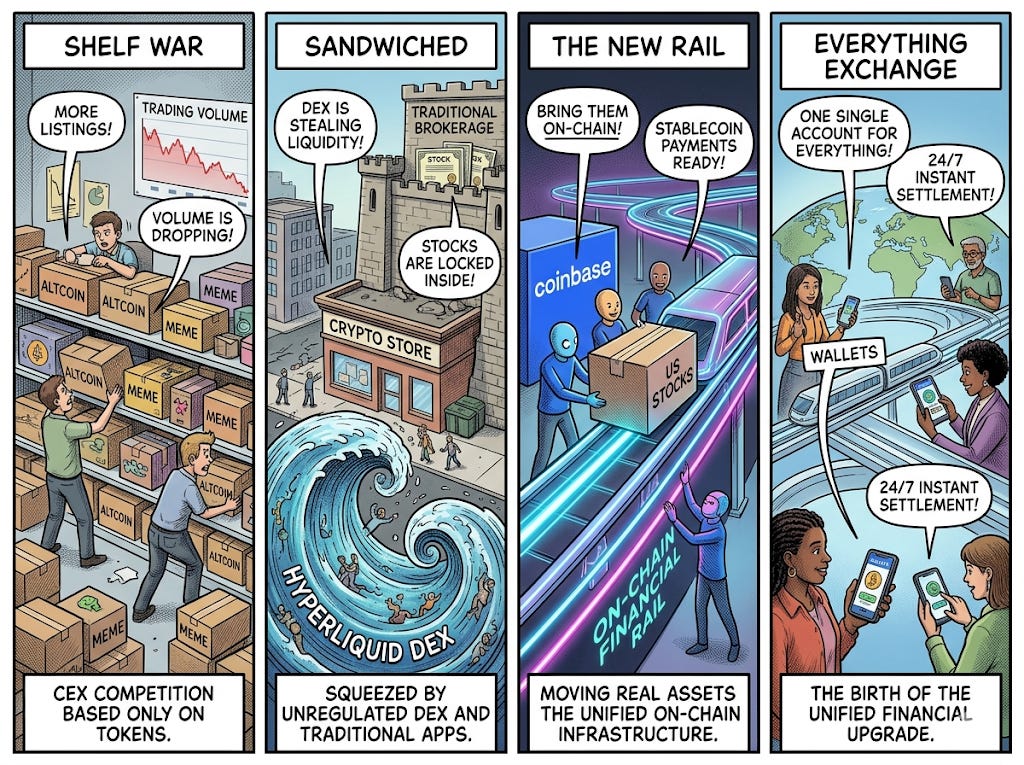
Competition among traditional exchanges resembled a battle for shelf space in a supermarket: who could list the most popular altcoins fastest, and who could generate the most trading volume. That era of filling shelves has passed.
The contest now is not about competing within the supermarket but about laying an entirely new financial rail. Capturing territory across both on-chain and traditional assets has become the core of the competition. The decisive advantage belongs to whoever can extend the efficiency of crypto trading to traditional asset classes, and Coinbase is pursuing that goal through its established strength in regulatory compliance.
Structural Differences
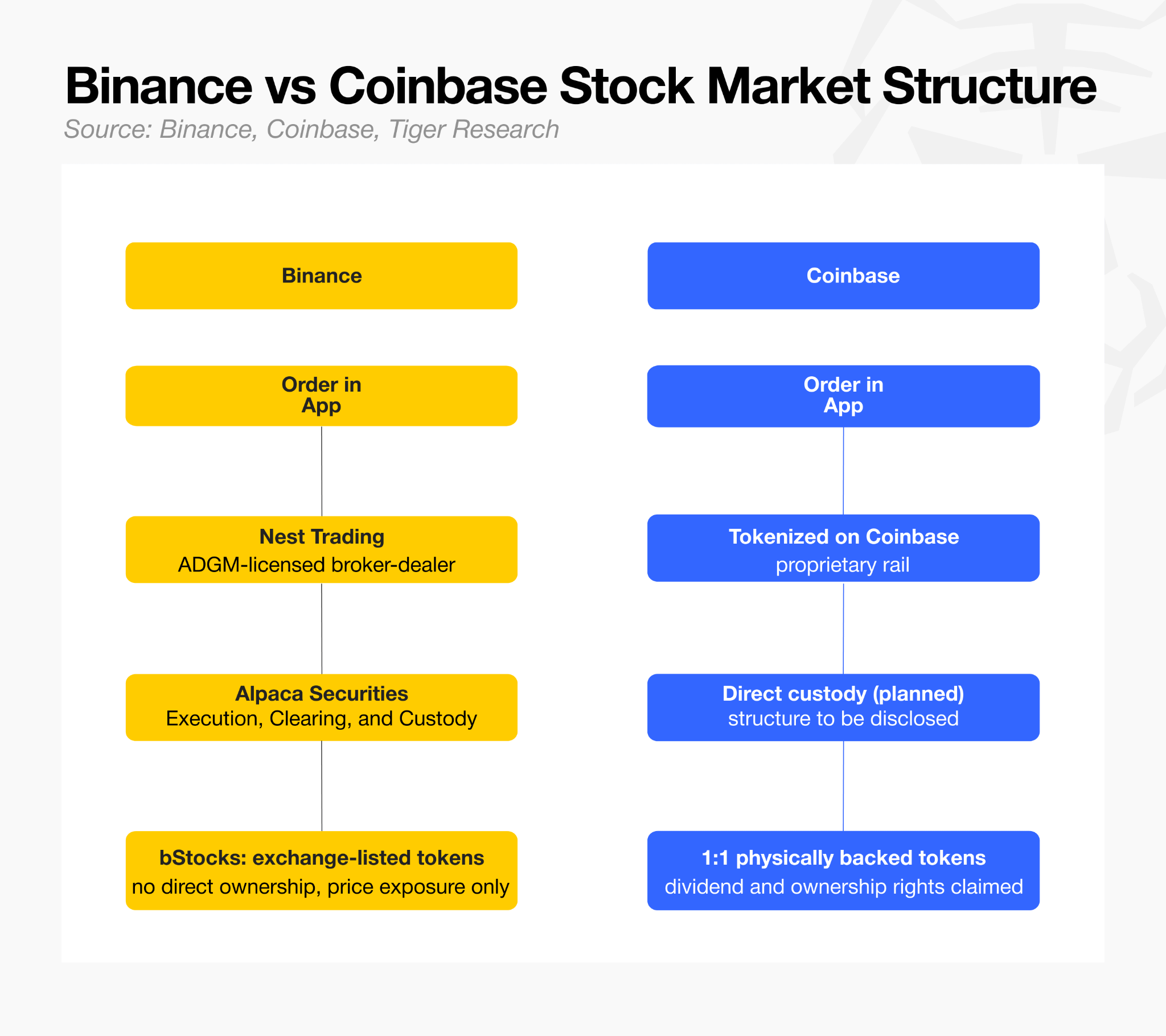
Not every exchange is taking the same approach to bringing traditional finance on-chain. The label “tokenized stocks” covers a range of implementations, and the underlying rights structures diverge considerably from one platform to the next. The contrast between Binance and Coinbase is particularly sharp.
Binance has chosen an indirect model, delegating custody, dividend processing, and corporate action handling to external securities infrastructure while the exchange app serves as the access and distribution interface. Orders flow through Nest Trading, an ADGM-licensed broker-dealer, and are executed via Alpaca Securities. Binance has stated explicitly that bStocks do not confer direct ownership of the underlying shares. The model operates at the edge of the regulatory perimeter, relying on external infrastructure throughout.
Coinbase, by contrast, is placing tokenized stocks directly on its own rail and positioning them as a product close to substantive share ownership. The trust proposition is of a different order from a structure that routes through an external broker and offers price exposure alone.
This positioning is precisely what gives Coinbase a defensible advantage in this space. Being a publicly listed, regulated exchange works in its favor during the early trust-building phase. Whether the tokenized stocks actually deliver on that trust, however, will depend on the specifics still to be disclosed: the custody structure, title arrangements, dividend handling, voting rights, and the practical mechanics of redemption.
The Future of Centralized Exchanges
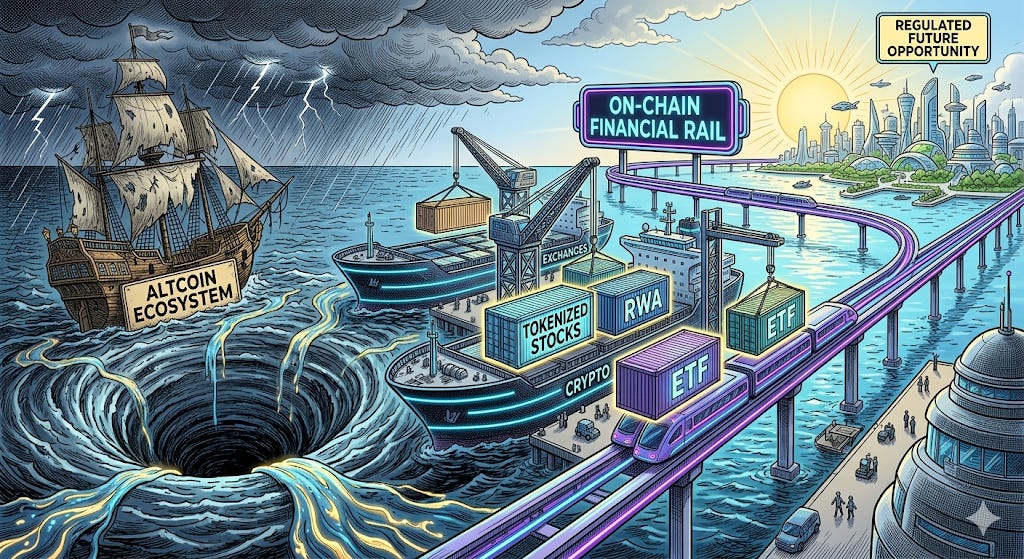
Exchanges in an earlier era were crypto markets in the narrow sense, listing altcoins and matching retail speculative flow. That model carried a structural vulnerability: when bear markets arrived, exchange fortunes moved in lockstep with the broader crypto ecosystem.
The direction has now shifted. Exchanges are reallocating resources in volume toward tokenized stocks, ETFs, RWAs, and stablecoins.
Coinbase’s tokenized stock announcement reflects an intent to remake itself entirely, from a crypto asset exchange into a global financial infrastructure provider. If that intent succeeds, the exchange of the future may pursue vertical integration of asset issuance, custody, distribution, and settlement on-chain within a regulated perimeter, positioning itself as a dominant platform capable of displacing significant portions of the existing financial system.
Disclaimer
This report has been prepared based on materials believed to be reliable. However, we do not expressly or impliedly warrant the accuracy, completeness, and suitability of the information. We disclaim any liability for any losses arising from the use of this report or its contents. The conclusions and recommendations in this report are based on information available at the time of preparation and are subject to change without notice. All projects, estimates, forecasts, objectives, opinions, and views expressed in this report are subject to change without notice and may differ from or be contrary to the opinions of others or other organizations.
This document is for informational purposes only and should not be considered legal, business, investment, or tax advice. Any references to securities or digital assets are for illustrative purposes only and do not constitute an investment recommendation or an offer to provide investment advisory services. This material is not directed at investors or potential investors.
Terms of Usage
Tiger Research allows the fair use of its reports. ‘Fair use’ is a principle that broadly permits the use of specific content for public interest purposes, as long as it doesn’t harm the commercial value of the material. If the use aligns with the purpose of fair use, the reports can be utilized without prior permission. However, when citing Tiger Research’s reports, it is mandatory to 1) clearly state ‘Tiger Research’ as the source, 2) include the Tiger Research logo. If the material is to be restructured and published, separate negotiations are required. Unauthorized use of the reports may result in legal action.