
Key Takeaways
Rebranding is usually not a signal of recovery. It is closer to an admission that the existing strategy has failed. Past cases show that when a name change fails to bring back the product, its users, and its liquidity, the outcome is ultimately failure.
Judging failure by price alone, however, can lead to a misreading. If on-chain evidence of execution remains after the rebrand, calling it a failure is premature.
The real test of success is the pattern seen when ETHLend became Aave: users and TVL, total value locked, grow first, and price follows.
Whether Story’s pivot from $IP to $DATA amounts to a genuine restructuring or one last marketing push will be proven by its execution going forward.
1. The Market Reacted to the Rebrand: Not Necessarily a Good Sign
Source: Coingecko
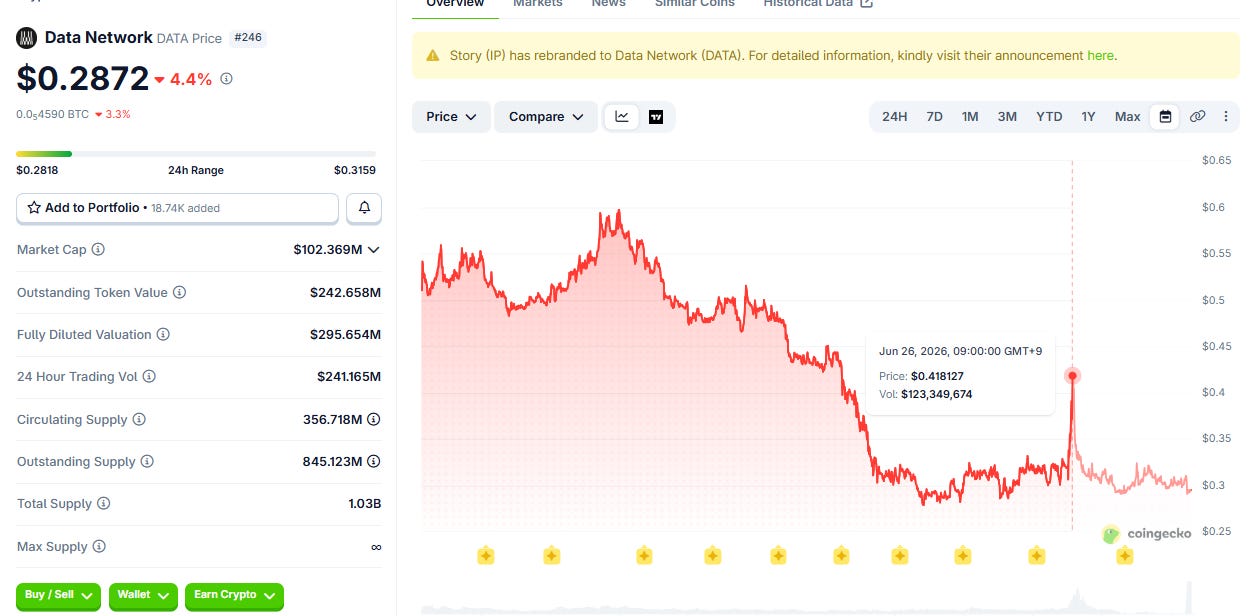
On June 25, Story Protocol announced its transition to the DATA Foundation, revealing plans to swap its token from $IP to $DATA. Expectations were high given that a16z had led the project’s funding rounds one after another, but the $IP price could not withstand the bear market and fell about 98% from its all-time high.
The token went on to set a new all-time low, and the rebrand was announced not long after. Price rose briefly in response to the announcement, but it soon drifted back toward that record low.
In fact, it is difficult to read the rebrand as a positive long-term signal for the project. If anything, the announcement amounts to an indirect admission that the project had reached a dead end.
Overhauling a brand entirely carries substantial tangible and intangible costs. Some of the time and capital already invested in building brand recognition becomes a sunk cost, and changing the token ticker and project name brings additional internal and external communication costs along with the risk of migrating on-chain assets. This means the decision carries real weight, because a rebrand is not a cosmetic change but a reworking of infrastructure across both on-chain and off-chain systems.
Before expecting a short-term rebound in token value from the ticker change, it is worth asking what fundamental problem forced the project to give up the brand equity it had built and go through with the rebrand in the first place.
2. What Failed Rebrands Have in Common
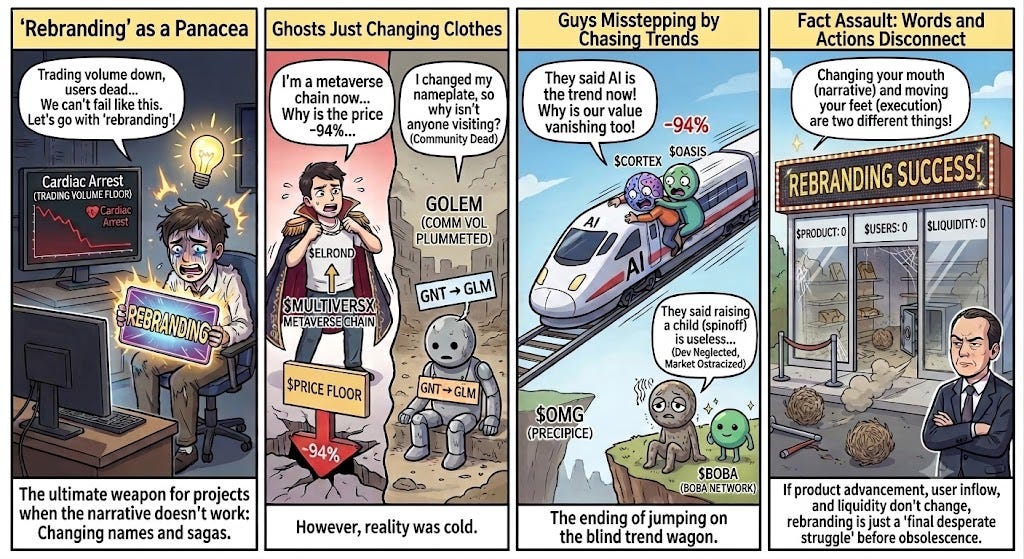
On the surface, a rebrand looks like a change of project name and ticker, but it actually amounts to a shift in the product and its core idea. Data on failed rebrands show that most projects unable to demonstrate real improvement in their metrics were eventually pushed out of the market.
MultiversX (Elrond to MultiversX): The project kept its existing ticker, EGLD, and shifted its narrative to a metaverse theme, but its token value has fallen about 94% since the rebrand.
Golem (GNT to GLM): The project carried out a rebrand that included a token migration. Even so, the price fell 92.7% from its peak, and trading volume and development activity dropped sharply, leaving the project with essentially no remaining interest.
Cortex (CTXC) and Oasis (ROSE): As the AI blockchain narrative faded, Cortex’s value effectively disappeared, and Oasis, which pivoted toward AI privacy, also recorded a decline of about 94% since its rebrand.
OMG Network: After spinning off the Boba Network, development of the core network and management of its ecosystem were neglected, and the project was left behind by the market.
What these failures have in common is that no real change followed the rebrand in product development, user acquisition, or liquidity supply. Revising the narrative and executing the business are separate matters.
3. Why Token Price Alone Is Not Enough
There are limits, of course, to judging a project’s success or failure by its price decline alone, because post-rebrand returns are entangled with the broader bear market and the accompanying downturn. To avoid the error of classifying as failures those projects whose execution data has remained solid even after rebranding, the following cases are worth examining.
3.1. Cases Where Operations Have Continued
Source: Kaia Twitter
Kaia (KLAY and FNS merging into KAIA): The token price fell about 73% after the merger, but the project demonstrated strong underlying activity through partnerships with KB Kookmin Bank and BNK Busan Bank on a Korean won stablecoin, and through its LINE mini-dApp, a decentralized application on LINE, which reached 35 million users and 7.3 million new wallets in its first month.
Polygon (MATIC to POL): The token fell about 81% after the rebrand, but the project has kept its underlying business running through the operation of AggLayer, its multichain settlement infrastructure, and by retaining a large ecosystem.
Render (RNDR to RENDER) and ASI: Market performance has been weak, but both are excluded from the failure category because they have a clear real-world use case, supplying AI computing power and operating core AI products, backed by demonstrated technical execution.
3.2. Cases Where Rebranding Succeeded
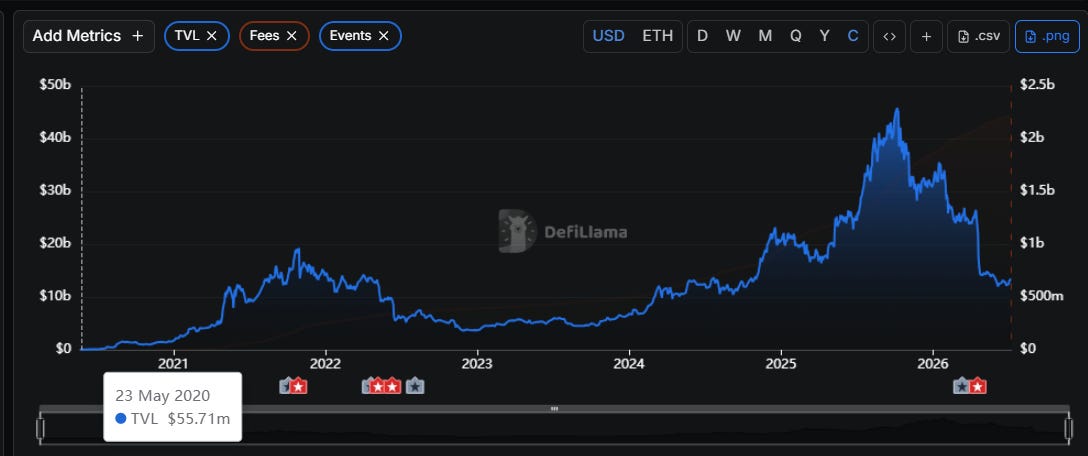
The benchmark for a successful rebrand comes from the transition of ETHLend into Aave.
Source: Defillama
Since its name change in 2020, Aave has seen steady growth in TVL, expanded its product lineup by diversifying the assets it supports for lending, and grown its user base meaningfully. It has become virtually synonymous with the lending protocol sector, the name that comes to mind first, and it plays a role akin to a central bank in setting benchmark lending rates on-chain. This is a typical case of improving business metrics driving an increase in brand value.
The transition from MakerDAO to Sky tells a similar story: what matters is not the roughly 20% decline in token price since the rebrand, but the project’s performance relative to the broader market and the clarity of its execution, running the decentralized stablecoins USDS and sUSDS. These cases suggest that a rebrand should be judged by whether the rationale given for it is actually being carried out, and by what happens afterward, not by the price movement alone. Rebrands that lack genuine growth in their underlying metrics are ultimately pushed out of the market once their short-term marketing effect wears off.
4. Story Protocol’s Rebrand
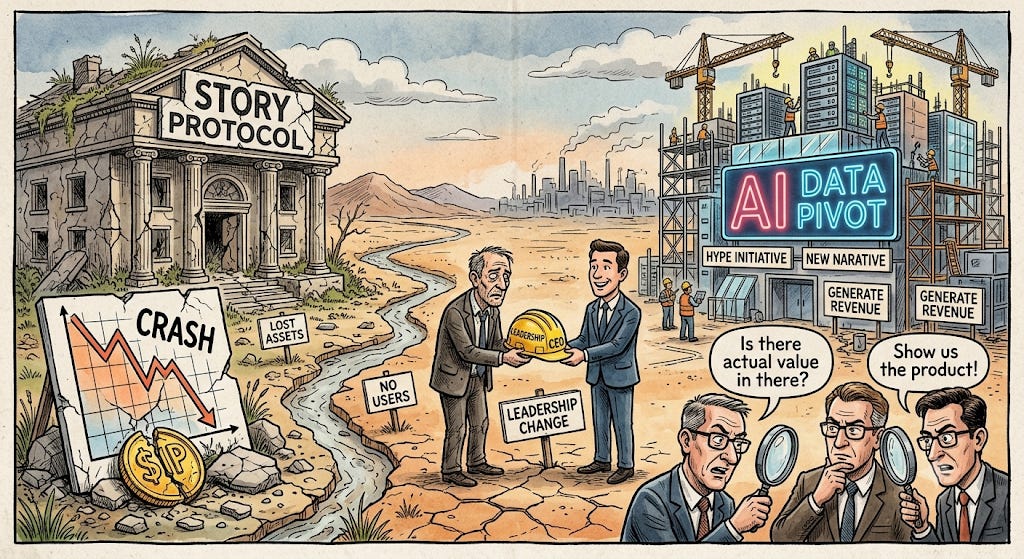
Story’s original $IP token listed in February 2025 and reached an all-time high (ATH) of about $14.78 that September, after which it entered a period of stagnation.
The timing stands out. The token hit an all-time low of $0.275 on June 10, 2026, and just two weeks later, on June 25, the project announced its shift toward AI training data infrastructure.
Because the rebrand came near an all-time low, the market has raised doubts about whether it is simply a last card played to prop up the token price. For Story to prove the rebrand was justified, three indicators need to be tracked going forward.
Whether the token’s relative strength against the broader market recovers
The path of on-chain liquidity and trading volume following the token swap
Whether the new AI data narrative translates into an actual increase in on-chain users and settlement revenue
The restructuring of core leadership also deserves attention. Seung Yoon Lee, who had led the project’s original narrative, has stepped back from running the foundation and moved into an advisory role overseeing strategy, while Andrea Muttoni, the former CPO, chief product officer, has taken over as the new CEO of the DATA Foundation.
Lee remains CEO of PIP Labs, the project’s development company, but his stepping back from the foundation suggests that the chapter built around him, the Korean founder who secured a16z’s lead investment three times running under the original Story ($IP) narrative, has come to a close.
Based on the data available so far, the rebrand to $DATA looks more like a defensive pivot than a long-term restructuring. Reversing that impression will require actual results in liquidity, users, and settlement revenue following the token swap. If it does not, the project will be left behind as another failed rebrand, its brief moment of past glory behind it.
Disclaimer
This report has been prepared based on materials believed to be reliable. However, we do not expressly or impliedly warrant the accuracy, completeness, and suitability of the information. We disclaim any liability for any losses arising from the use of this report or its contents. The conclusions and recommendations in this report are based on information available at the time of preparation and are subject to change without notice. All projects, estimates, forecasts, objectives, opinions, and views expressed in this report are subject to change without notice and may differ from or be contrary to the opinions of others or other organizations.
This document is for informational purposes only and should not be considered legal, business, investment, or tax advice. Any references to securities or digital assets are for illustrative purposes only and do not constitute an investment recommendation or an offer to provide investment advisory services. This material is not directed at investors or potential investors.
Terms of Usage
Tiger Research allows the fair use of its reports. ‘Fair use’ is a principle that broadly permits the use of specific content for public interest purposes, as long as it doesn’t harm the commercial value of the material. If the use aligns with the purpose of fair use, the reports can be utilized without prior permission. However, when citing Tiger Research’s reports, it is mandatory to 1) clearly state ‘Tiger Research’ as the source, 2) include the Tiger Research logo. If the material is to be restructured and published, separate negotiations are required. Unauthorized use of the reports may result in legal action.