
Key Takeaways
Orca, a Solana DEX, and Loopscale, a lending protocol, have merged to form Formation, which brings trading, lending, and vaults under one organization.
Tokenization runs through five stages: asset origination, issuance, trading, collateral and lending, and asset management. Formation has combined the three stages that follow issuance and plans to extend into issuance itself.
Trading and lending help each other grow, so when one organization designs both functions, tokenized assets can be put to use more quickly. The points to watch are the first live case, permissioned markets, the link to token value, and entry into the US market.
1. From Issuance to Use: Post-Issuance Infrastructure at the Core of Tokenization
Listing is not the end point for a stock. A listed stock needs a market where it can trade, it needs to be accepted as collateral, and funds need to be able to hold and manage it. Only after these steps does it become an asset that is actually used.
The same applies to tokenized assets. Tokenization records the rights to assets such as stocks, bonds, and funds on a blockchain so that they can be transferred. Tokenization is not a cure-all, however. A token cannot be sold without a market of buyers, and it cannot serve as collateral without a lender willing to accept it, which is why what happens after issuance matters more.
Against this backdrop, Orca, a Solana DEX, and Loopscale, a lending protocol, merged on October 8, 2026, to form Formation, a combined company focused on the stage after issuance. The merger is intended to combine the two companies’ strengths in that stage, and Formation plans to handle the entire post-issuance process in one place.
2. The Five-Stage Process for a Complete Token Ecosystem
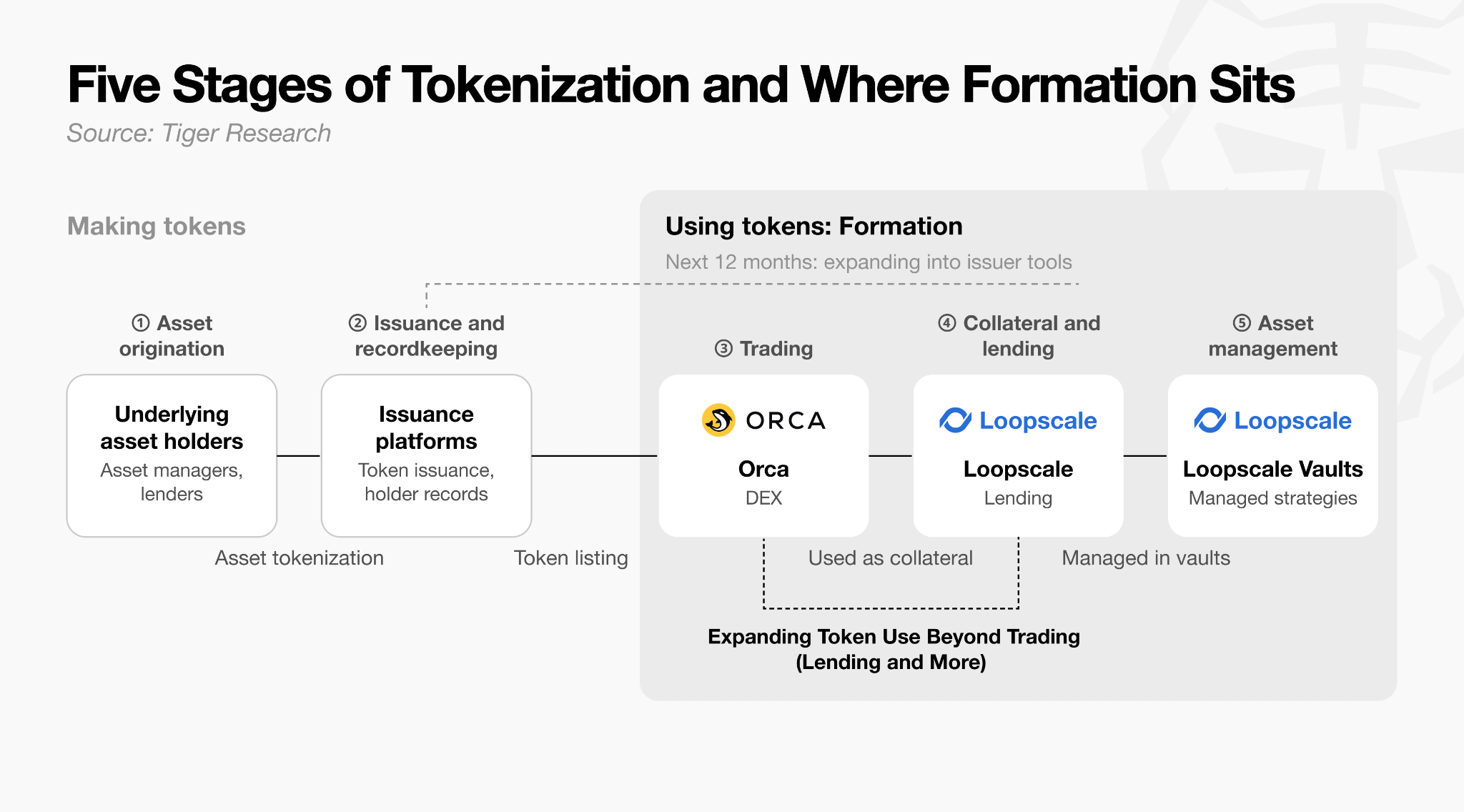
If the first two stages are where tokens are made, the last three are where they are used. Orca has handled trading since 2021, and Loopscale has handled collateral, lending, and asset management. With the merger, all of the stages where tokens are used now sit within one organization.
Formation plans to go further. It has said it will release tools for issuers within the next 12 months and extend into the stages where tokens are made. The plan is to expand from where tokens are used back to where they are made.
3. What Formation Changes as a Combined Protocol
3.1. Using the Trading Market to Maximize Lending Liquidity
Lending against tokens as collateral requires two things. The first is reliable price tracking, and the second is a trading market where the collateral can be sold for cash at any time if something goes wrong. The more actively a token trades, the more value lenders assign to it as collateral.
The relationship also runs the other way. Once tokens can be posted as collateral to borrow funds, holders tend to keep them longer, and as that demand grows, the trading market grows with it. In other words, trading and lending help each other grow.
Orca and Loopscale had already launched a feature that lets users borrow against Orca liquidity positions as collateral. With the merger, the two functions can be fully integrated into a single system from the design stage onward.
3.2. Diversifying Revenue: From Trading Fees to Loan Interest and Management Fees
Orca has processed more than $500 billion in trading volume to date, but trading fees alone have generated limited revenue. For every $10,000 traded, the protocol has kept only about $1.80 in revenue.
Adding lending and asset management (vaults) changes this picture. Loan interest and management fees become new revenue sources on top of the existing trading liquidity, giving the combined company a more stable and diversified revenue base.
3.3. A One-Stop Solution for Token Issuers
The process also becomes much simpler for token issuers. Previously, after creating a token, an issuer had to find a trading venue, a lending platform, and an asset management service separately. With Formation, trading, collateral, lending, and asset management can all be handled in one place, so a token can be put to active use from its first day on the market.
4. Three Points to Watch for Market Adoption and Expansion
First live case: Tracking when an asset issued outside Formation will move through all of its trading, lending, and vault services.
Growth and integration of permissioned markets: Understanding how permissioned liquidity pools, which require KYC checks and serve as a core feature for institutional users, will be integrated with Loopscale.
Entry into the US market: Evaluating Formation’s goal to enter regulated US capital markets.
So far, the tokenization market has focused on the question “What should be tokenized?” Formation is an organization set up to answer a different one: “Where will the tokens that have been created be used?”
If the market starts judging tokenization by how much is used rather than how much is created, Formation, having brought the usage stages together first, is likely to be ahead of the curve.
Disclaimer
This report has been prepared based on materials believed to be reliable. However, we do not expressly or impliedly warrant the accuracy, completeness, and suitability of the information. We disclaim any liability for any losses arising from the use of this report or its contents. The conclusions and recommendations in this report are based on information available at the time of preparation and are subject to change without notice. All projects, estimates, forecasts, objectives, opinions, and views expressed in this report are subject to change without notice and may differ from or be contrary to the opinions of others or other organizations.
This document is for informational purposes only and should not be considered legal, business, investment, or tax advice. Any references to securities or digital assets are for illustrative purposes only and do not constitute an investment recommendation or an offer to provide investment advisory services. This material is not directed at investors or potential investors.
Terms of Usage
Tiger Research allows the fair use of its reports. ‘Fair use’ is a principle that broadly permits the use of specific content for public interest purposes, as long as it doesn’t harm the commercial value of the material. If the use aligns with the purpose of fair use, the reports can be utilized without prior permission. However, when citing Tiger Research’s reports, it is mandatory to 1) clearly state ‘Tiger Research’ as the source, 2) include the Tiger Research logo. If the material is to be restructured and published, separate negotiations are required. Unauthorized use of the reports may result in legal action.