

1. The State of Korea’s Crypto Market
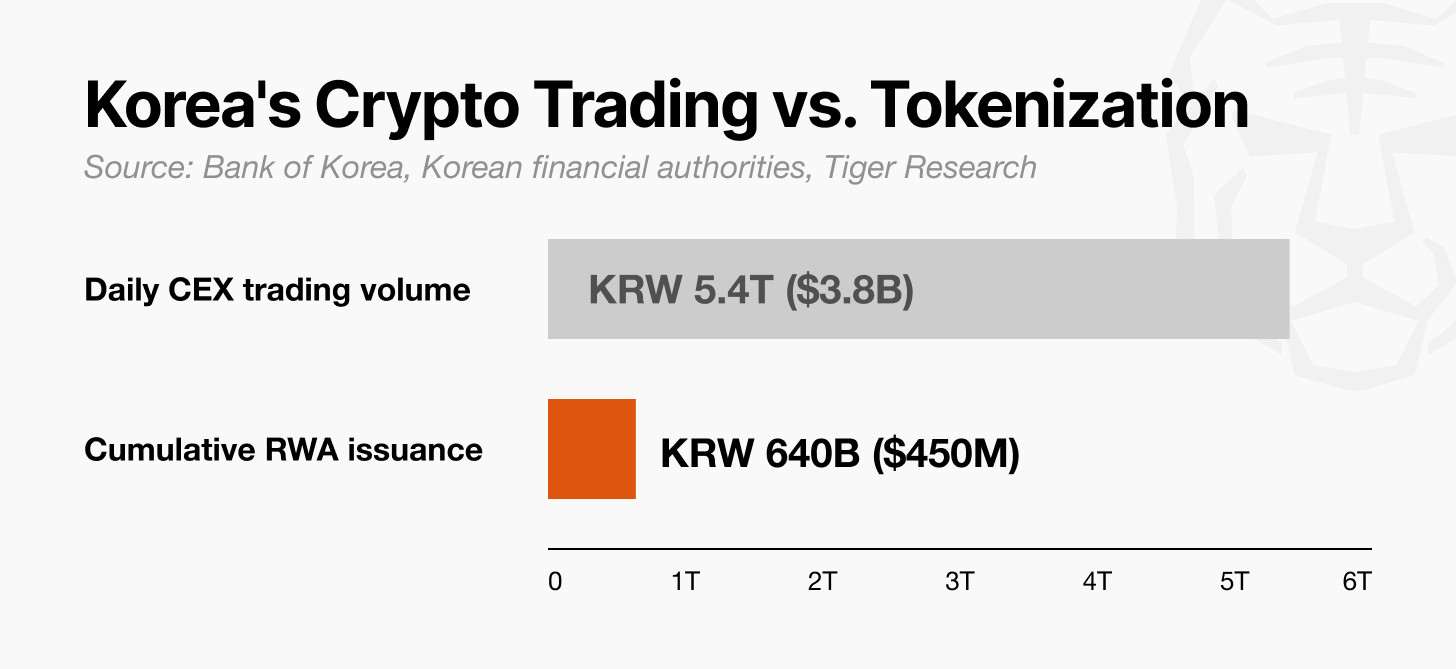
Korea has tokenized about 640 billion won (roughly $450 million) of real-world assets, according to the Bank of Korea(BoK). That is less than one-eighth of what Korea’s CEXs trade on an average day. That heavy investor interest, however, remains concentrated in trading, and the industry built around real-world use cases remains underdeveloped.
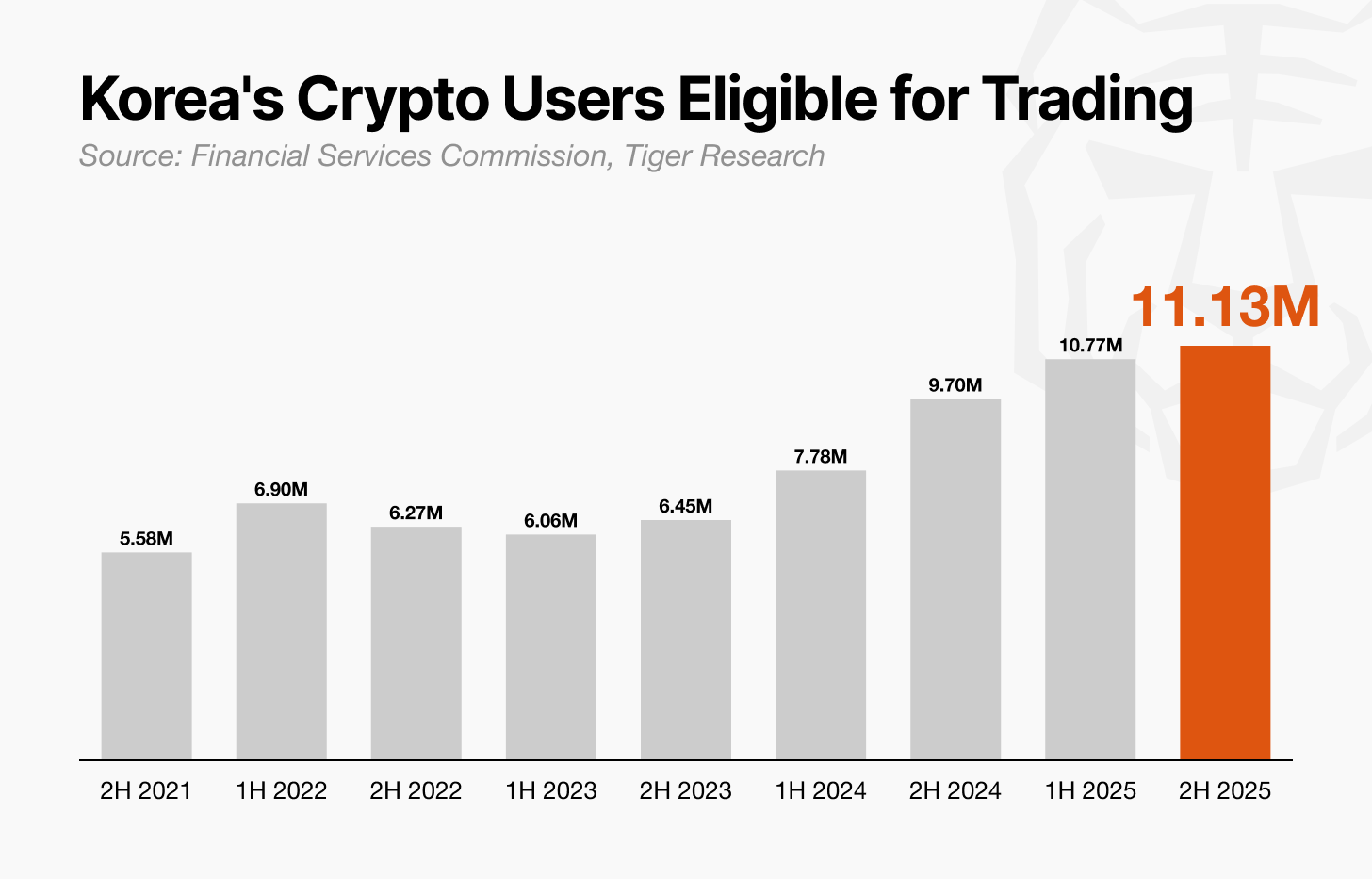
By trading volume, the Korean crypto market already ranks among the largest in the world. According to a survey released by the financial authorities in March 2026, Korea had 11.13 million accounts eligible for trading as of the end of 2025, equal to more than 20% of the population, and average daily trading volume in the second half of the year reached 5.4 trillion won (about $3.8 billion) despite the market downturn.
RWA tokenization, the industry’s main use case beyond trading, has grown slowly. Cumulative token issuance in Korea stands at only about 640 billion won (about $450 million), and most of it is in non-standard assets such as music royalties (65%) and artwork (17%). Tokenizations of standardized traditional financial assets such as bonds and funds remain rare. (According to the BoK, March 2026)
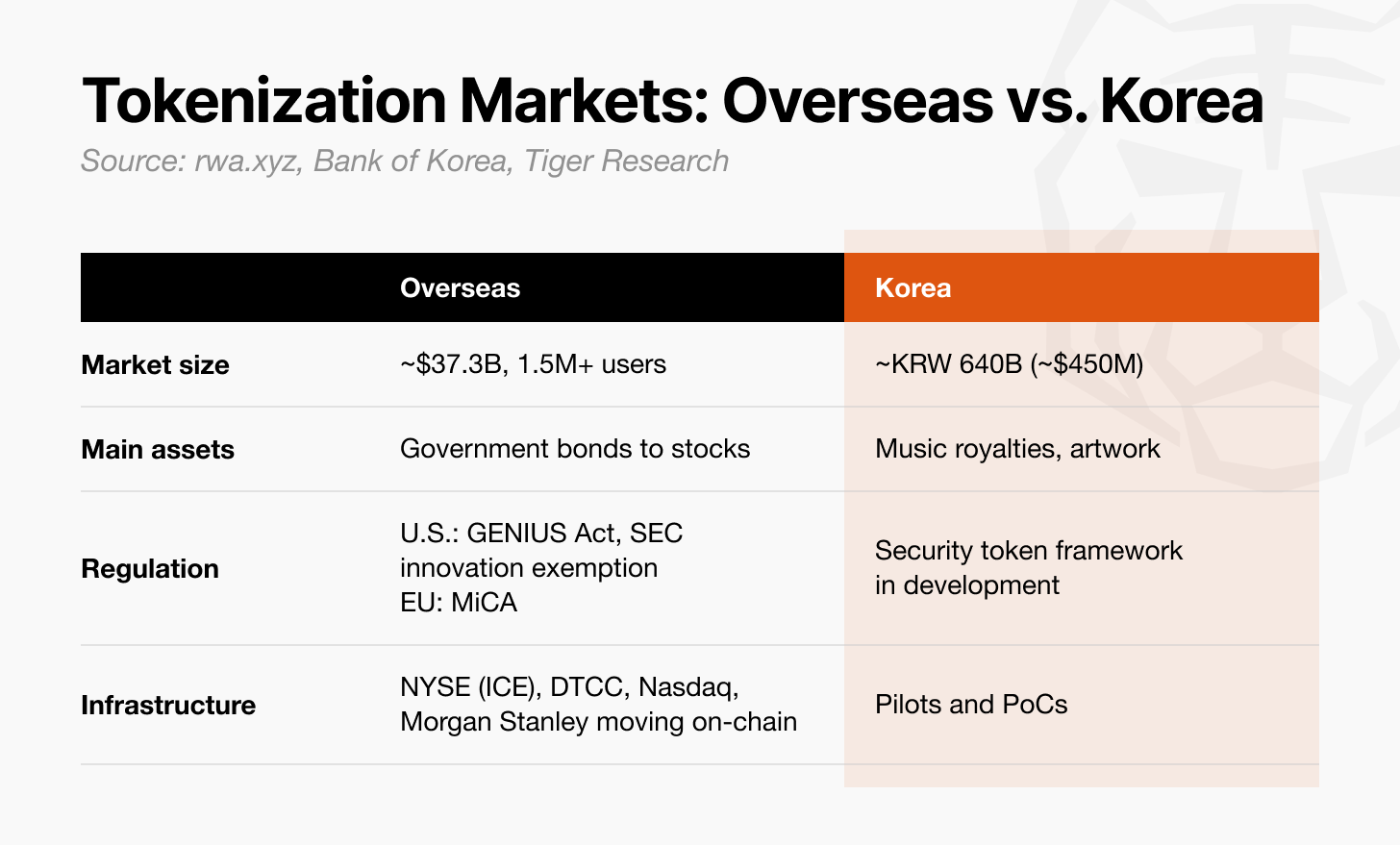
Overseas, tokenization has moved from crypto experiment to financial infrastructure, driven by regulatory progress and institutional participation.
Overseas tokenization markets are far larger than Korea’s. According to rwa.xyz for August 2026, tokenized assets worldwide total about $37.3 billion, with more than 1.5 million users. A widening range of assets is moving on-chain, from cash equivalents such as government bonds to stocks.
Regulation supporting the sector is also developing quickly. The United States enacted the GENIUS Act to regulate stablecoins and then moved forward with the CLARITY Act. Although the CLARITY Act did not pass a Senate vote, the SEC immediately introduced an innovation exemption that waives exchange registration requirements for tokenized securities trading venues for five years. Europe has also established a unified regulatory framework through MiCA, its core crypto-asset law.
Existing financial infrastructure has already started to move on-chain. The New York Stock Exchange, owned by ICE, is building a platform for 24/7 tokenized securities trading, and DTCC, which clears and settles most U.S. securities trades, has received SEC clearance to run its own tokenization service. Nasdaq, Morgan Stanley, and other major exchanges and banks are moving in the same direction.
A market that once grew mainly from the bottom up is now being shaped by major financial firms entering it directly.
In response to these global shifts, the Korean market has also begun to move past its earlier limits.
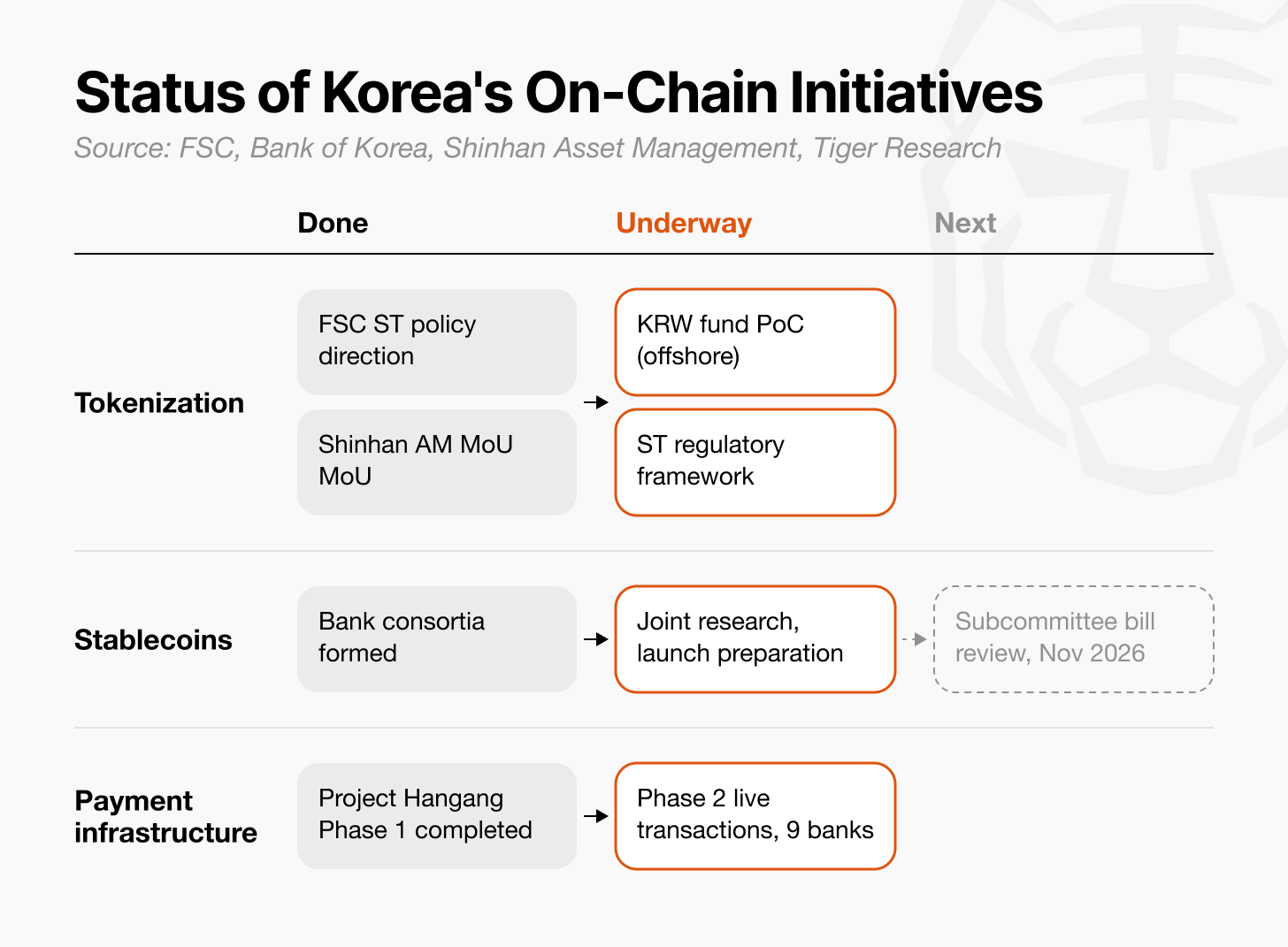
In tokenization, Shinhan Asset Management has worked with an overseas partner on a proof of concept (PoC) for issuing and distributing a KRW-denominated fund on-chain, and many financial institutions are expanding partnerships through their overseas offices. On the policy side, the Financial Services Commission has set out its policy direction for security tokens and begun building a regulatory framework.
In stablecoins, major financial firms have formed consortia to research a KRW-based stablecoin jointly and are speeding up preparations for its launch. Legislative discussion is ongoing: the relevant National Assembly subcommittee is scheduled to take up the bill in November 2026, and the timing of passage remains uncertain. The market and regulators nonetheless broadly agree that stablecoins are needed, which makes their regulation and market launch a question of when rather than whether.
In payment infrastructure, the Bank of Korea completed the first phase of Project Hangang, in which it issued wholesale CBDC to participating banks and those banks converted customer deposits into deposit tokens for circulation. The project has since expanded to nine participating banks and entered a second phase of testing with live transactions.
Korea’s crypto market started later than overseas markets, but it is making steady progress. A market at this early stage is unlikely to close the gap with more developed markets through speed alone; however, questions such as who may issue, how ownership is divided among participants, and how asset tokenization should be structured cannot be rushed.
The current approach of building up pilots step by step is therefore the right one, and the task is to find new opportunities within that process.
2. Korea’s Crypto Market in 2030
Consider a day in 2030. A customer pays for coffee at a convenience store with a KRW stablecoin. A bank app shows a salary that arrived as a token transfer rather than a traditional account transfer. An employee at a New York asset manager buys KRW-denominated government bonds using nothing more than a wallet.
These look like small, everyday changes, but they signal a much larger shift underway in the financial system. Taken together, the pace of infrastructure development in major economies and the PoCs and regulatory discussions underway in Korea suggest that stablecoins will become part of Korea’s financial system within a few years.
2.1. Stablecoins: Coexisting with Existing Payments
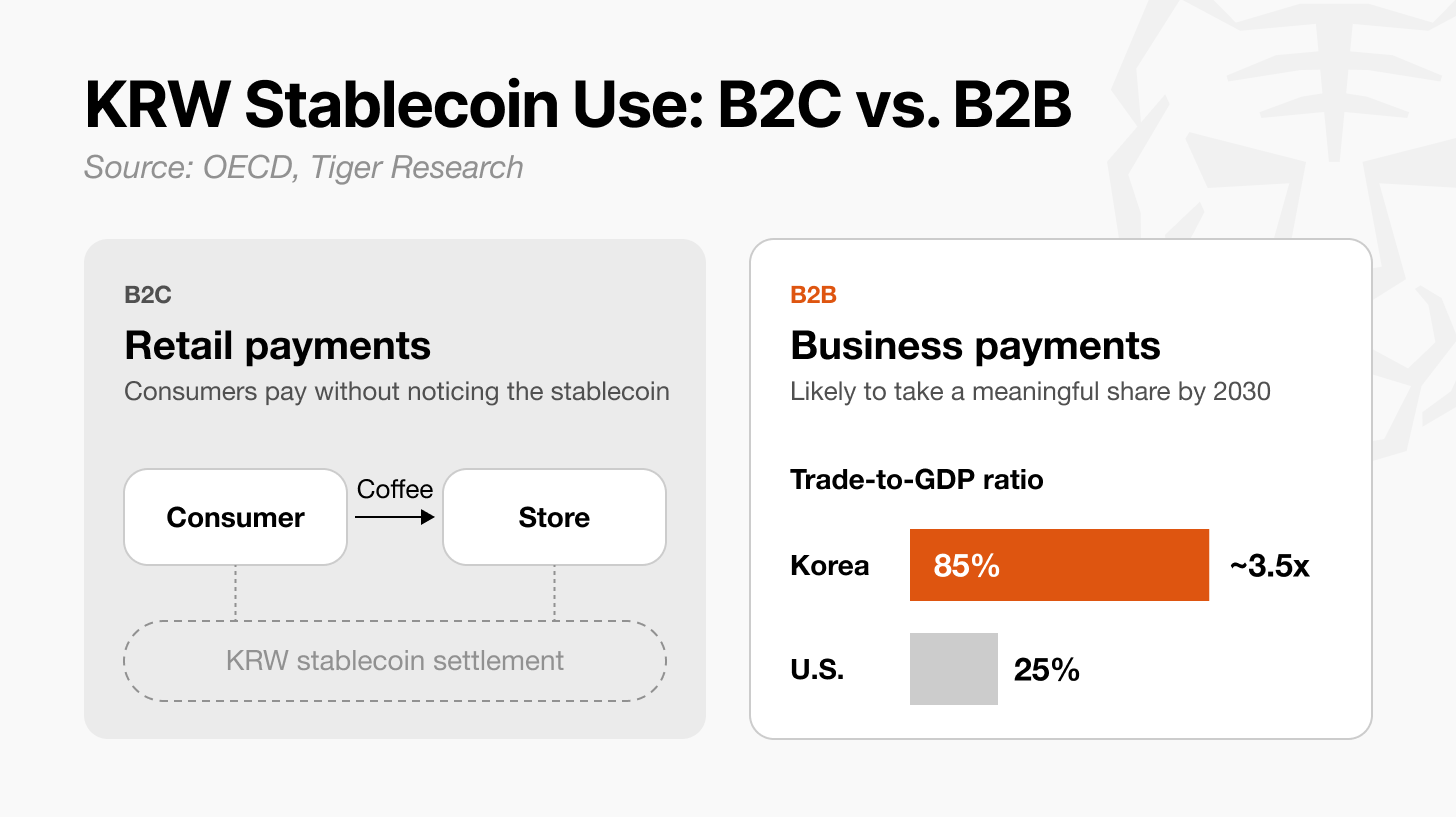
By 2030, consumers are expected to pay for coffee at the local convenience store with a KRW stablecoin without noticing the stablecoin behind the transaction, and KRW stablecoins are also likely to take a meaningful share of business-to-business (B2B) payments.
The case for B2B is especially strong given Korea’s trade-to-GDP ratio of about 85%, roughly three and a half times the United States’ 25%, according to OECD data.
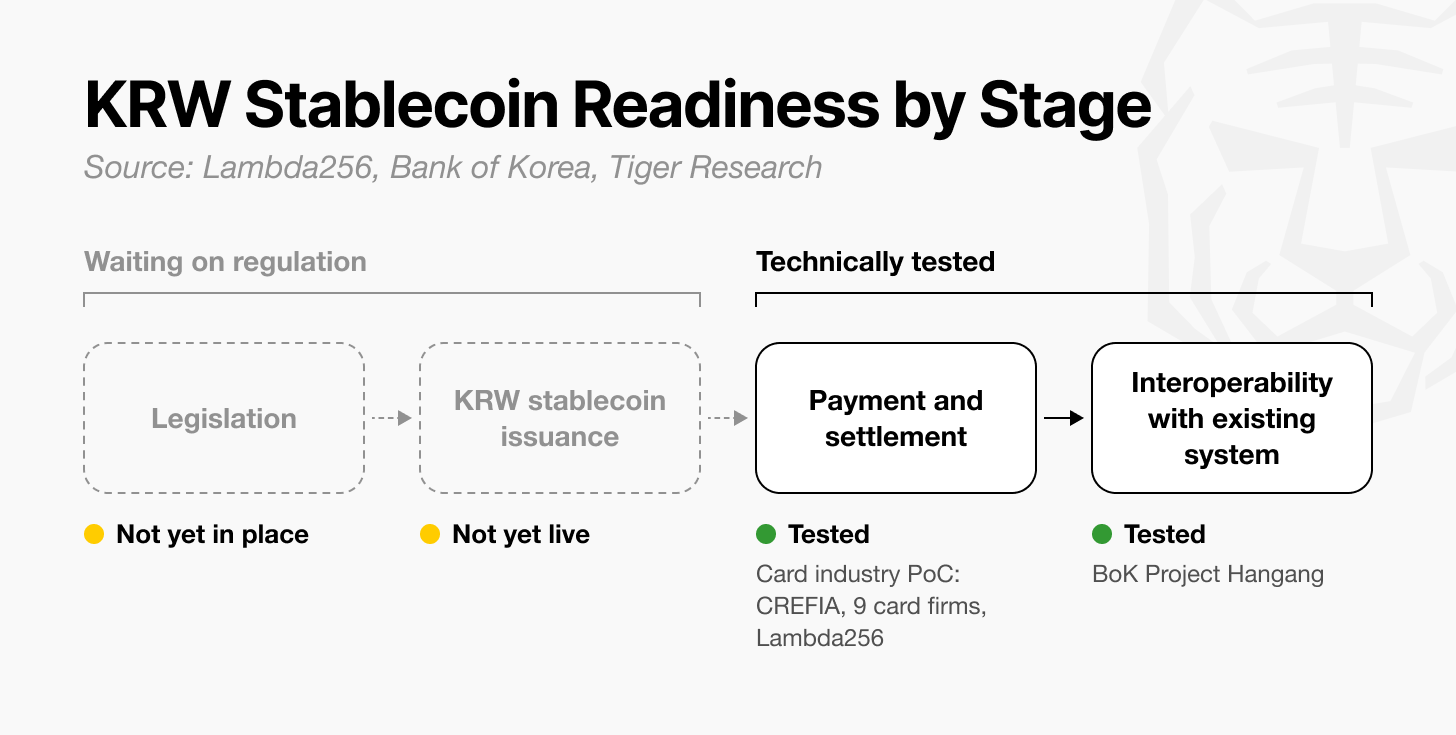
Even before KRW stablecoins were formally regulated, the underlying blockchain technology has been tested for commercial use from several angles. In a card industry PoC run jointly by the Credit Finance Association, major card companies, and Lambda256, a KRW stablecoin worked as a means of payment while the existing authorization and settlement systems stayed in place.
The Bank of Korea’s CBDC-based Project Hangang has also verified interoperability between a distributed ledger payment network and the existing financial system. With the technology this well tested, KRW stablecoins are likely to be adopted quickly once the regulatory framework is in place, and their arrival depends mainly on when regulation is finalized.
KRW stablecoin adoption in Korea falls into two areas: retail (B2C) and business-to-business (B2B) transactions.
Retail (B2C): Consistent with how payment infrastructure has evolved so far, consumers will keep the same payment experience without being aware that a KRW stablecoin is involved. Because KRW stablecoins will coexist with fiat currency and other payment methods, however, B2C retail models are likely to have limited scalability and profitability in the short term.
Business-to-business (B2B): Given how much intermediaries slow down and add cost to cross-border B2B payments today, stablecoins offer the largest benefit here through lower costs and faster settlement on large trade transactions.
By 2030, KRW stablecoins will run in parallel with existing card and settlement infrastructure, growing into a core part of the payment system rather than replacing it.
2.2. Payments: Settlement Operations, Not the Pay Button
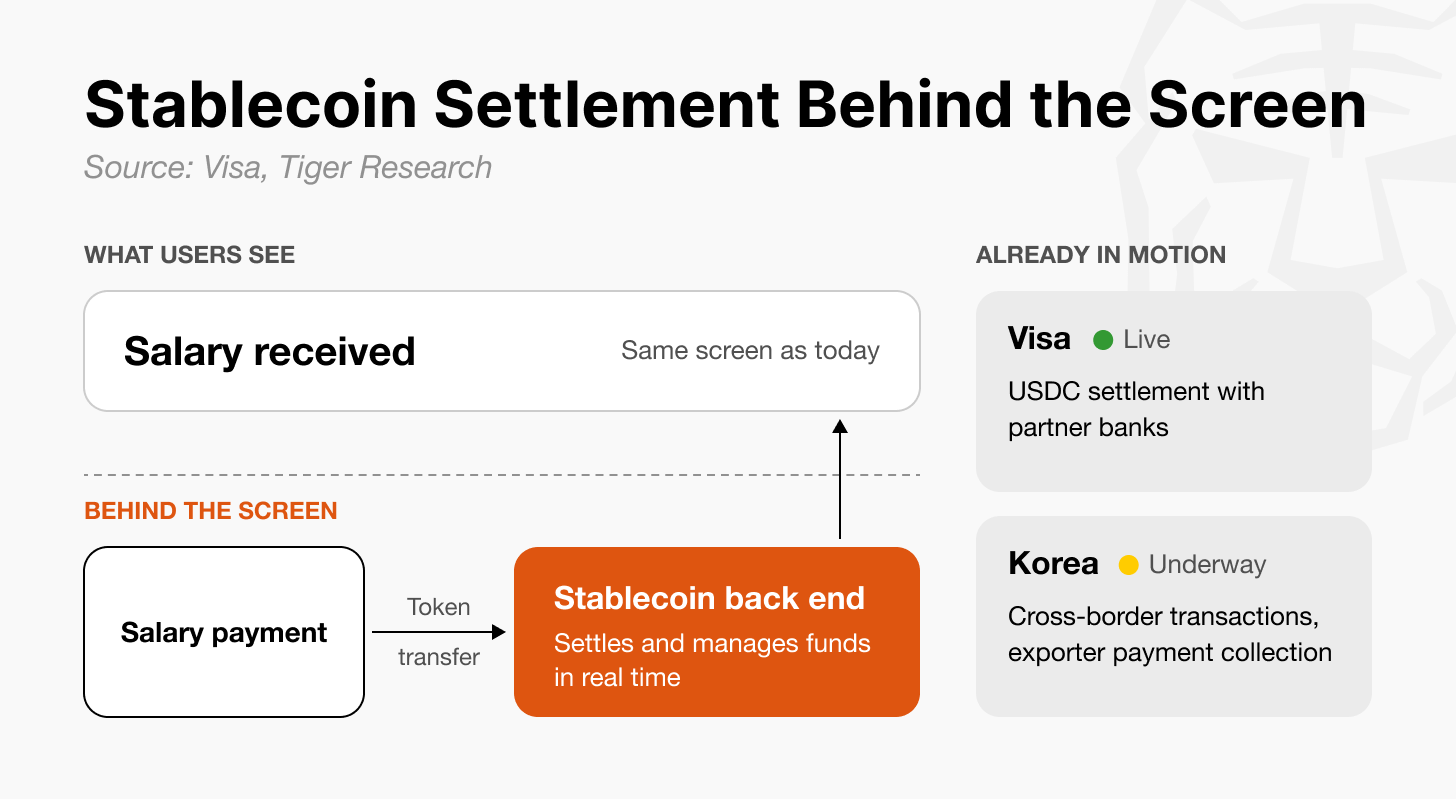
By 2030, a salary will appear in a bank app as a token transfer rather than an account transfer. If stablecoins are new money, the harder problem is running it: the screen will look the same as it does today, while a back-end process built on stablecoins settles and manages funds in real time behind it.
Technical testing of payment infrastructure is already well advanced. Visa’s USDC settlement pilot has moved into live settlement with partner financial institutions. Comparable initiatives are also underway in Korea, focusing on cross-border transactions and exporter payment collection.
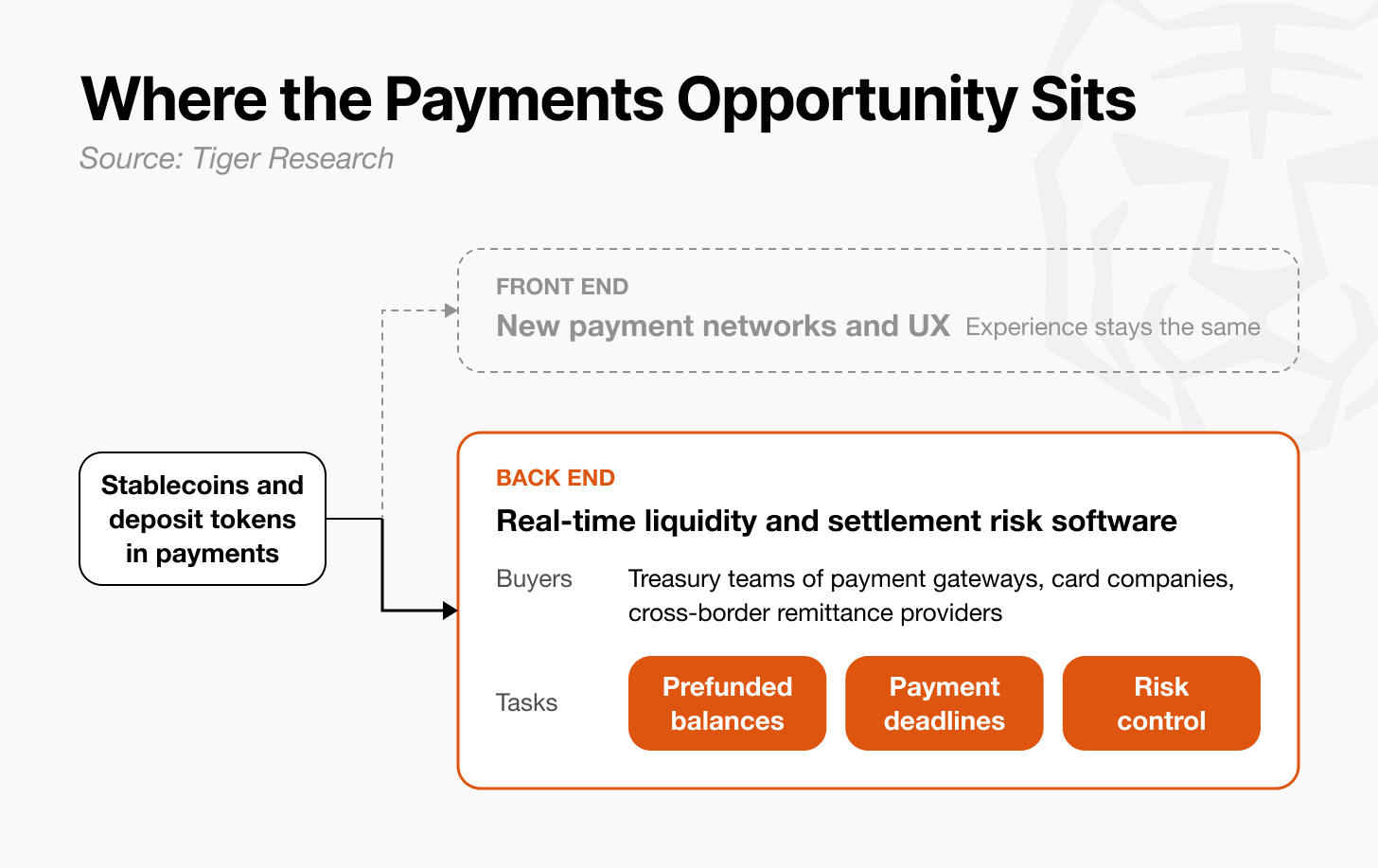
Opportunities in payments fall into two areas: the front end and the back end.
Front end (payment UX): The card and payment experience that consumers see will stay the same, while deposit tokens and stablecoins handle settlement behind it, so the new tools will work alongside existing methods.
Back end (settlement fund operations): A key opportunity is expected to be dedicated B2B software for the treasury teams of payment gateways, card companies, and cross-border remittance providers, handling tasks such as managing prefunded balances, meeting payment deadlines, and controlling risk.
By 2030, the payments market is expected to develop less around new payment networks and more around software and infrastructure that manage liquidity and settlement risk in real time for the treasury teams of existing payment companies.
2.3. RWA: From Issuance to Global Distribution
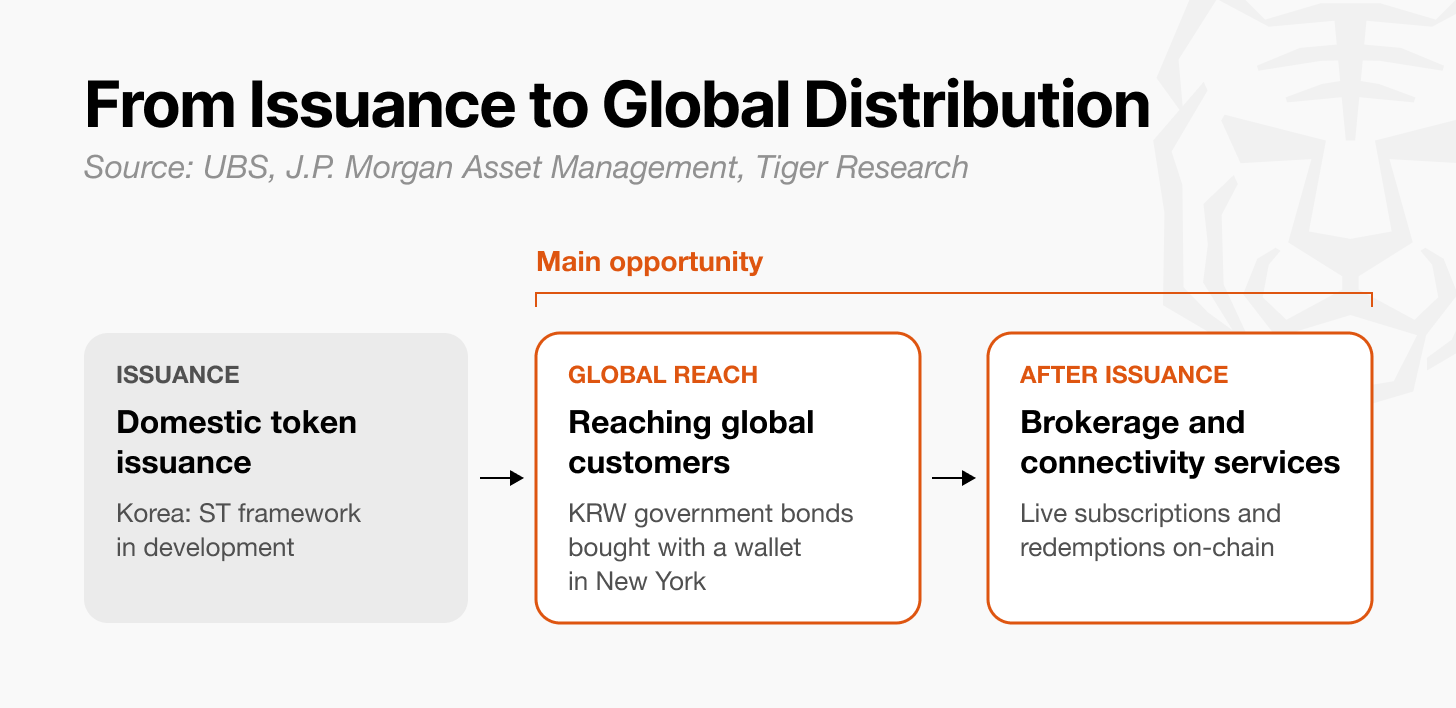
By 2030, an employee at a New York asset manager will be able to buy KRW-denominated government bonds with nothing more than a wallet. This suggests that the main opportunity in the RWA market lies not in domestic token issuance alone but in reaching global customers and in brokerage and connectivity services that continue after issuance.
Global financial institutions have already shown that tokenized assets can work commercially. Examples such as UBS’s tokenized fund uMINT and J.P. Morgan’s JLTXX, which process subscriptions and redemptions in a live on-chain environment, are increasing. In Korea, discussion of bringing a range of financial assets on-chain is active as the financial authorities build the security token (ST) regulatory framework.
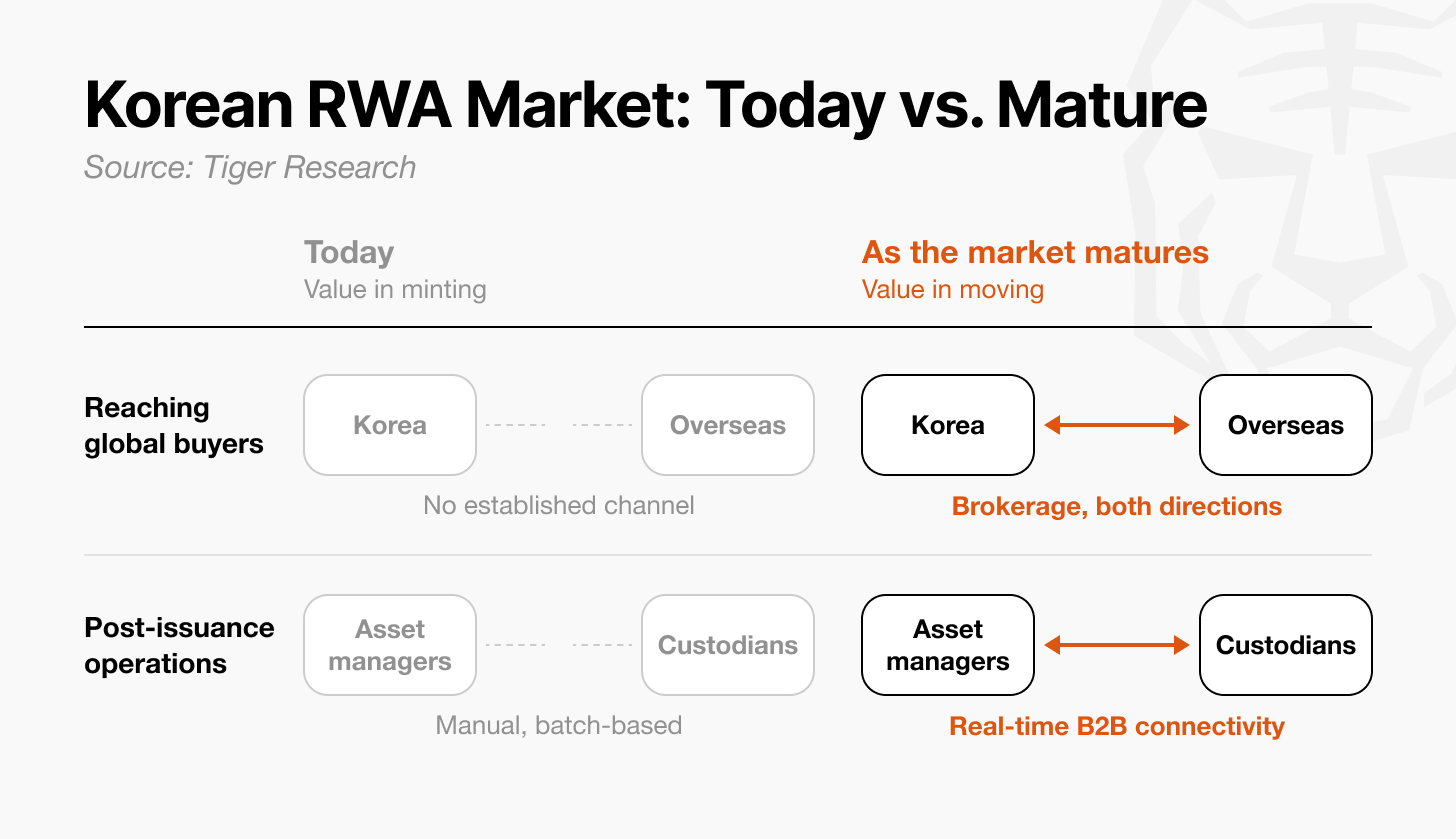
Opportunities in the RWA market fall into two areas: domestic issuance and global expansion and brokerage.
Domestic issuance: Issuance is the first step, and it still matters. Securities firms and other financial institutions will steadily build the infrastructure to tokenize and issue underlying assets reliably.
Global expansion and brokerage: Two areas are expected to become key opportunities. The first is brokerage services that connect Korean tokenized assets to overseas investors or bring offshore RWA products to Korea, because Korean-issued assets have no established channel to global buyers today. The second is B2B connectivity infrastructure for real-time subscriptions, redemptions, and balance updates between asset managers and custodians after issuance. Without it, these still run through manual, batch-based workflows, and tokenization loses its efficiency gains.
As Korea’s RWA market matures, more of its value is expected to sit in moving tokenized assets than in minting them, through specialized brokerage and operations infrastructure that reaches global buyers and connects post-issuance B2B operations in real time.
3. Opportunities in Korea Through 2030
As the Korean crypto market grows in size and maturity through 2030, a range of business opportunities tied to the on-chain transition is expected to emerge. Each of these opportunities is still closer to a pilot than a business, proven under test conditions but not yet operating at commercial scale.
Timing matters here. Institutions that move now, while the rules are still being written, are best positioned to lead once those rules are set.
3.1. KRW Stablecoins: Modular Issuance on Shared Infrastructure
As of September 2026, the central unresolved question in Korea’s Digital Asset Basic Act is still who is allowed to issue a KRW stablecoin at all. Distribution, custody, and payment services built on top of a stablecoin cannot take shape until that is settled.
For a KRW stablecoin to take hold, the business must first be designed so that the issuer, the party at its center, can earn a sustainable profit. A stablecoin issuer’s main revenue is typically interest on reserve assets, so the business depends on scale. If reserves are held only as bank deposits, returns fall, and growth is clearly limited.
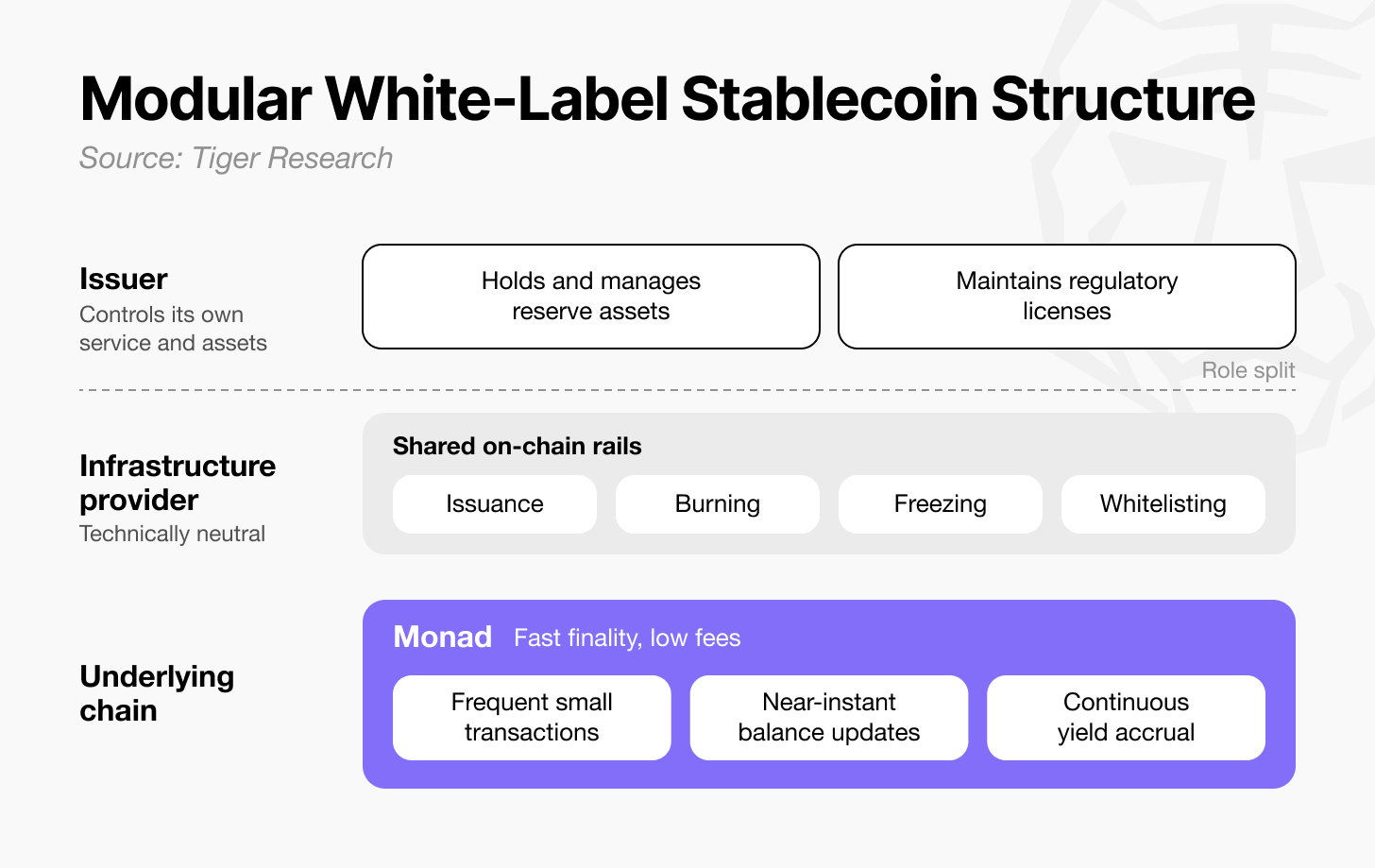
A modular, white-label model that shares technical infrastructure and separates roles is drawing attention as a way around this limit. The issuer holds and manages reserve assets and maintains regulatory licenses. The infrastructure provider supplies the shared on-chain rails for issuance, burning, freezing, and whitelisting. It stays strictly neutral on the technical side, leaving the issuer in control of its own service and assets.
This split only works if the underlying chain can settle at the speed and cost a consumer account requires: frequent small transactions, near-instant balance updates, and yield that accrues continuously rather than in batches. Monad is designed for this profile, with fast finality and fees low enough that a small daily payment and a large transfer cost roughly the same to settle.
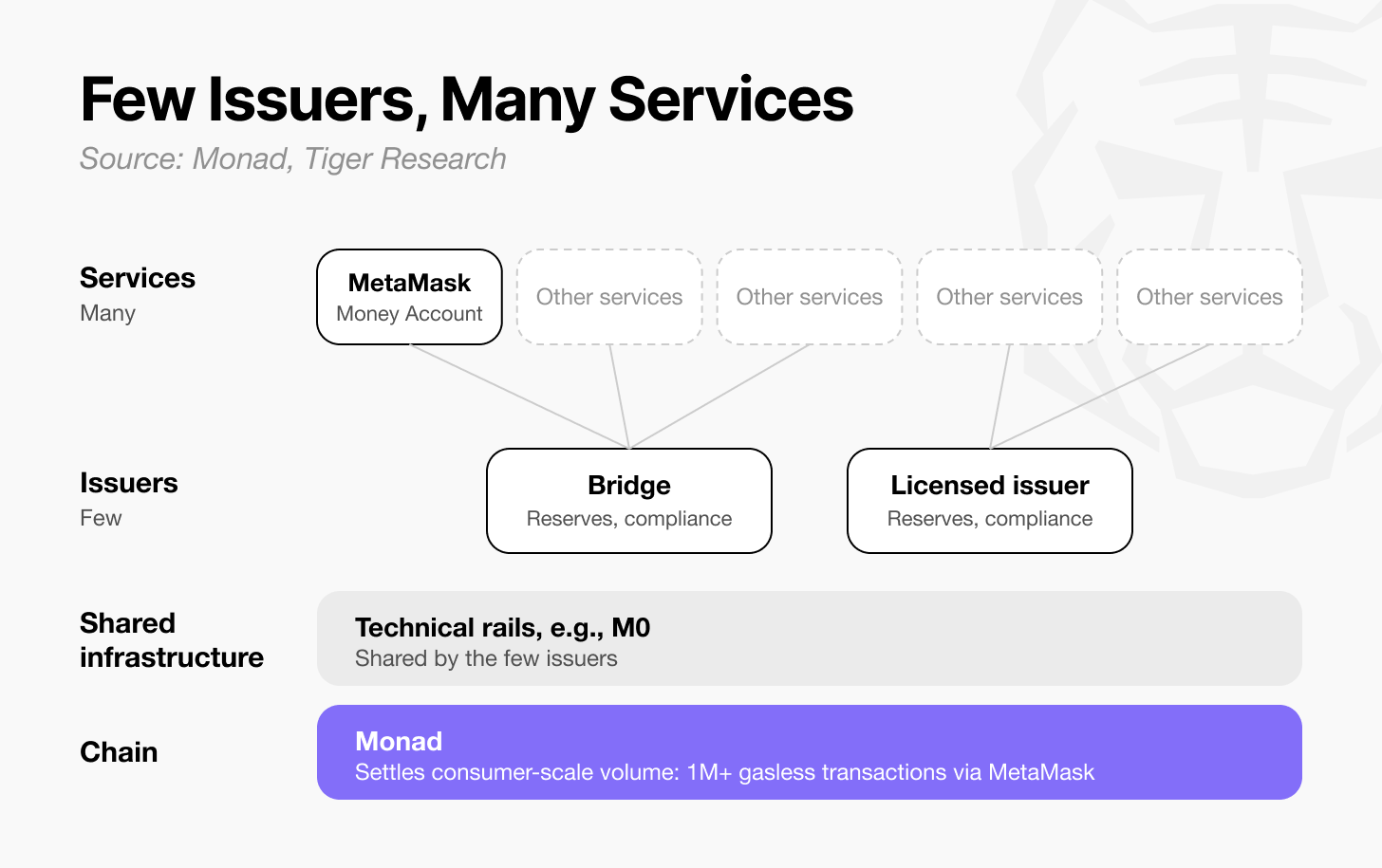
The mUSD model shows this split working in practice. Bridge, a Stripe subsidiary, is the issuer and handles reserve management and legal compliance. M0, a stablecoin infrastructure provider, supplies the technical rails. MetaMask built its Money Account directly on top of this split: users hold mUSD balances that earn yield automatically and spend through a linked card, without MetaMask itself handling reserves or licensing.
By August 2026, MetaMask’s broader integration with Monad had processed more than one million gasless transactions. This is one sign that the infrastructure can handle real consumer volume and is more than a technical demonstration.
Whether that exact split, a non-bank issuer paired with a separate infrastructure provider, can operate in Korea is still an open question. The Digital Asset Basic Act now under discussion has floated a requirement that banks hold a majority of KRW stablecoin issuers, meaning 50 percent plus one share of the issuing entity. That structure would push a Bridge-equivalent into a subordinate technical role rather than the issuer role.
Under either version, however, few entities are likely to end up as issuers. This is where the modular model matters: the few issuers can share technical infrastructure, while other companies build the services that actually use the stablecoin.
3.2. Payments: The Back-End Opportunity
For a payments business to capture opportunity, it needs to be designed around a specific split. The front end stays with existing payment gateways, card companies, and remittance providers, each with its own user experience.
The back end is where the opportunity actually sits: dedicated tools for the treasury teams of those same companies, built to track prefunded balances, meet settlement deadlines, and manage risk in real time rather than in daily or weekly batches.
Running that back end in real time puts specific demands on the underlying chain. Card networks settle within tight timing windows, so a chain that cannot keep pace with authorization and settlement volume would recreate the batching problem in a different form.
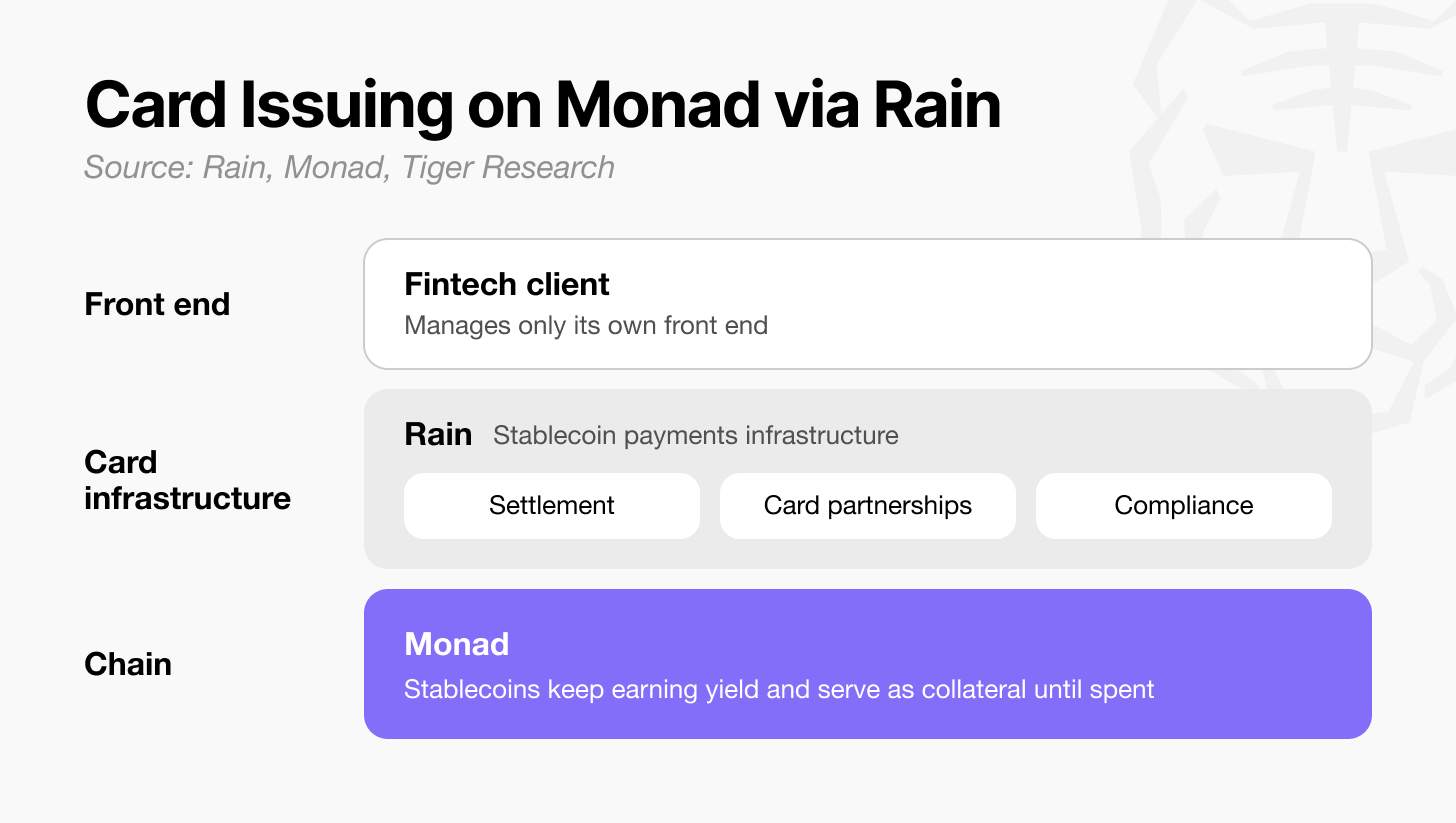
Rain, a stablecoin payments infrastructure company, has built a card-issuing product on Monad. Rain handles settlement, card partnerships, and compliance, so a fintech client only has to manage its own front end. Stablecoins spent through these cards keep earning yield and remain usable as collateral until they are spent, rather than sitting idle in a prefunded settlement account.
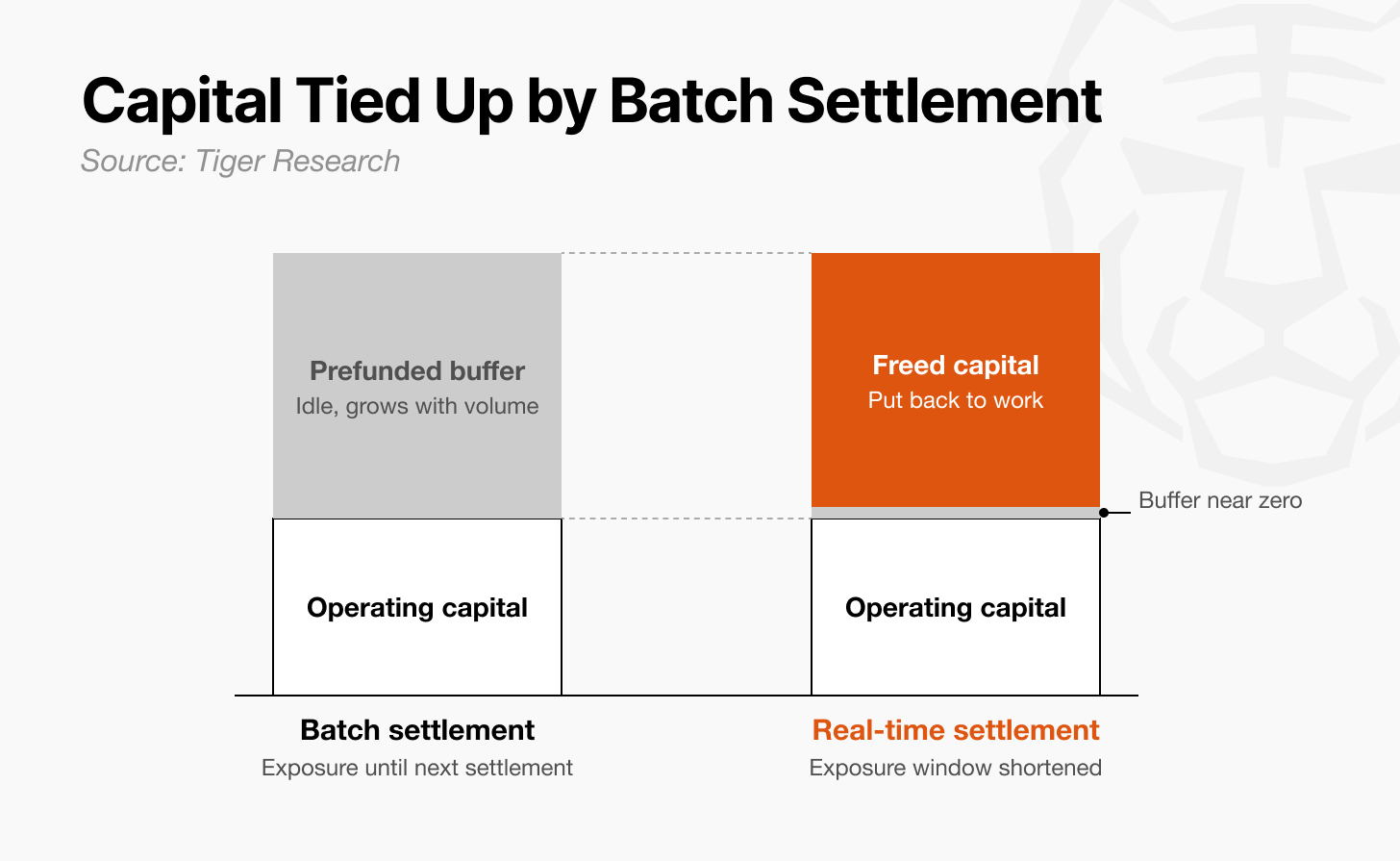
Rain’s model matters beyond cards because of what batch settlement costs. A payment company that settles once or twice a day has to hold prefunded capital to cover the gap between accepting a payment and settling it. That capital earns nothing while it sits idle, and it grows with transaction volume. Real-time settlement shrinks the buffer close to zero, which frees the capital and shortens the window in which a counterparty default or currency move can turn into a loss.
The cost is especially visible in Korea, where cross-border payment volume is large relative to the size of the economy. The buffer therefore grows with every increase in daily settlement volume. This is where the back-end opportunity lies: the treasury teams that carry that cost are the natural buyers of a solution that removes it.
3.3. RWA: Structuring Products, Not Just Tokens
Korea’s RWA opportunity increasingly sits in what happens after issuance rather than in issuance itself. Tokenization changes the form of an asset, not its nature. A tokenized private equity stake is still hard to sell quickly, and investors still need a way to get their money in and out.
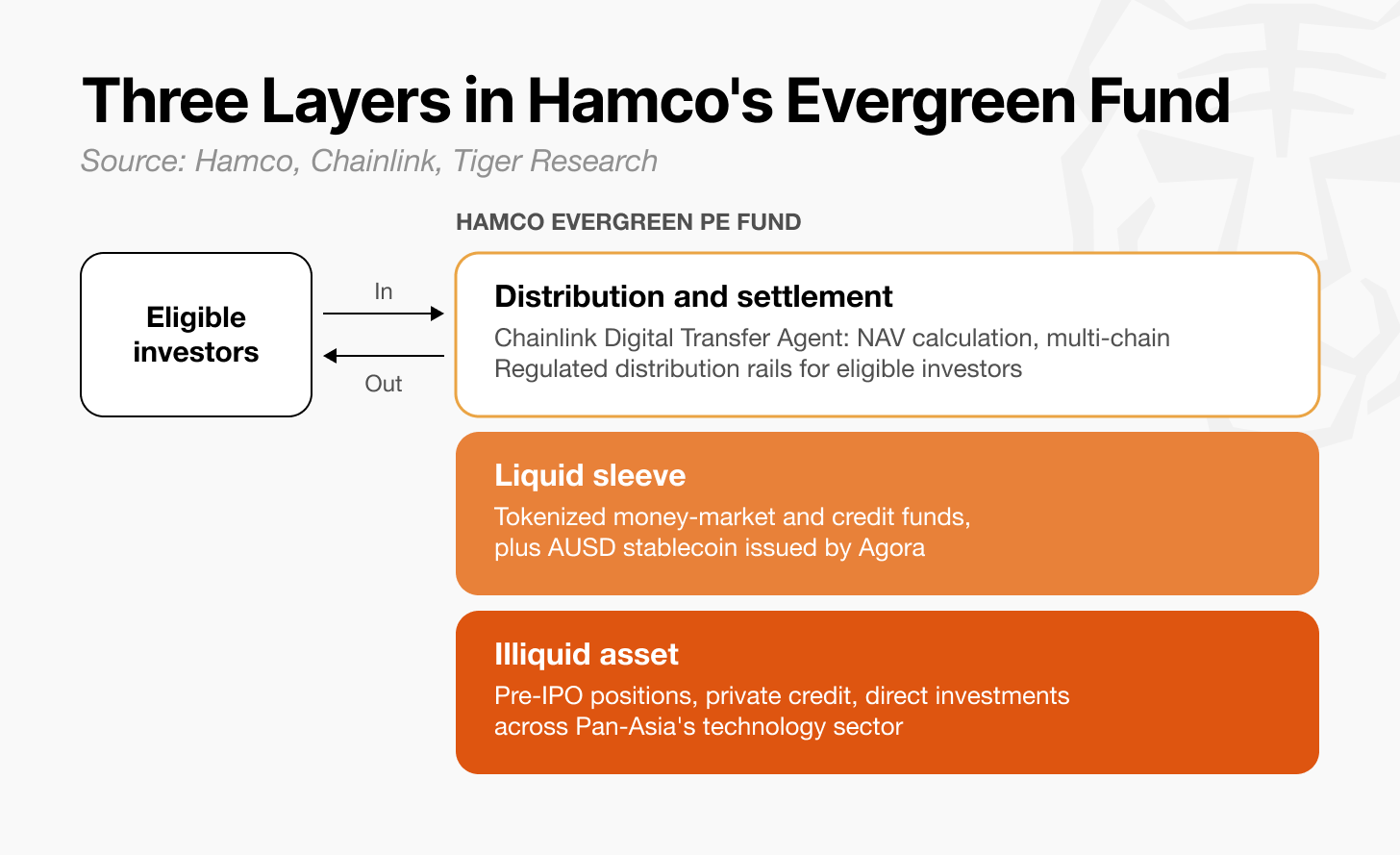
Consider someone whose wealth is mostly a building. When a large bill arrives, they must sell a floor quickly, often at a discount. A person who also keeps cash on hand can pay the bill and keep the building. Because the underlying asset’s problems remain after tokenization, an RWA product needs to work like the second person, and it is built from three layers.
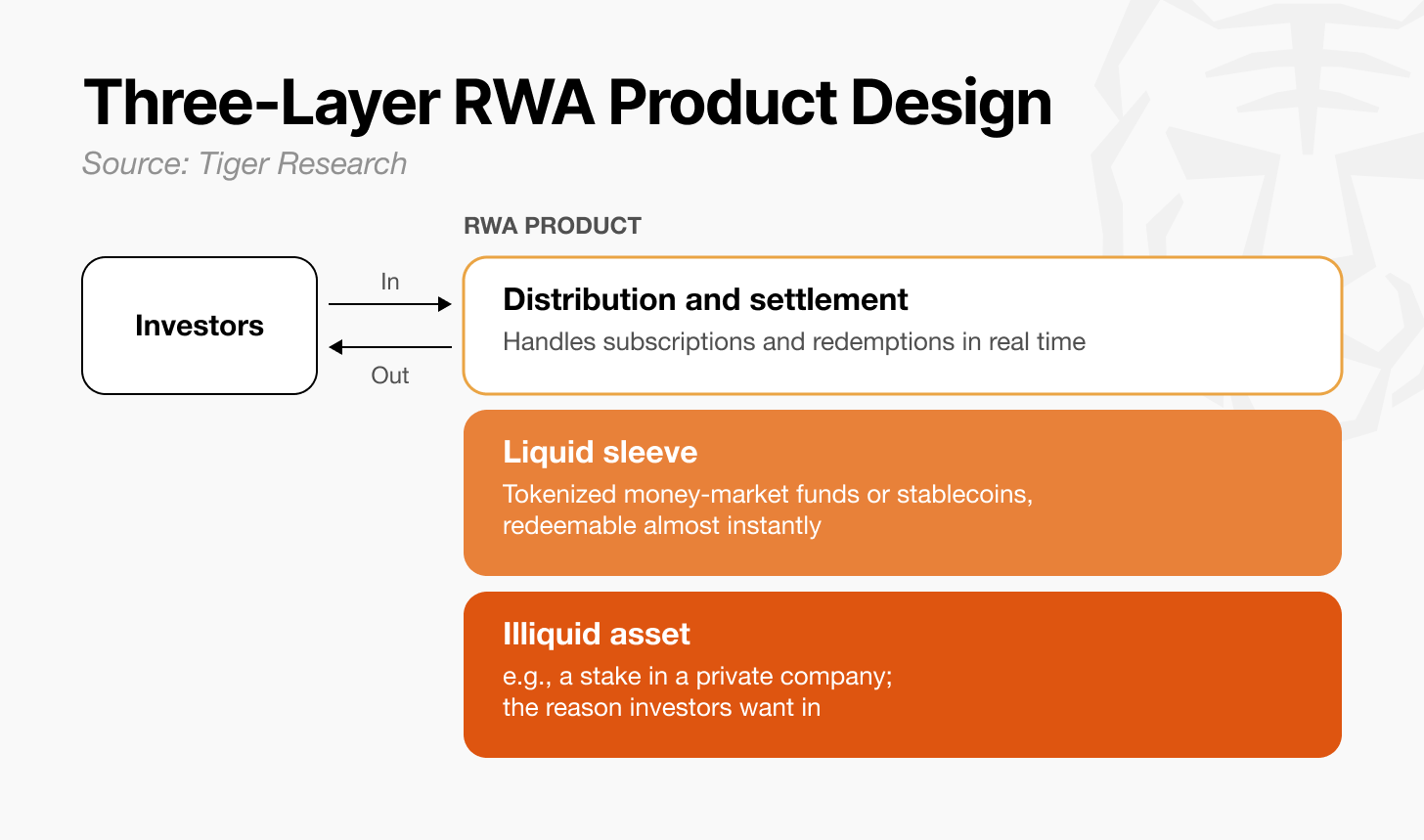
Illiquid asset: the actual investment, such as a stake in a private company, and the reason an investor wants in.
Liquid sleeve: a separate pool of assets, such as tokenized money-market funds or stablecoins, that can be sold or redeemed almost instantly. When an investor wants to withdraw, the product draws from this sleeve rather than selling off the illiquid holdings.
Distribution and settlement: the infrastructure that handles investors joining and leaving, what the industry calls subscriptions and redemptions, in real time.
Issuance is a single event, but what follows is a continuing process. Investors subscribe and redeem, the product has to be priced, cash has to move between the sleeve and investors, and records have to stay consistent across managers, custodians, and chains.
This process is more complex than issuance, and its steps depend on one another. A redemption cannot be paid without an accurate price, a price cannot be trusted if records lag, and settlement speed decides whether the sleeve can pay on demand. The three layers therefore work only as one connected structure.
Hamco, a Cayman Islands-regulated asset manager, shows how this structure works in a single live product. In September 2026, Hamco launched a tokenized evergreen private equity fund, meaning a fund with no fixed maturity that, unlike a typical PE fund, lets investors redeem on an ongoing basis instead of locking up capital until a one-time exit.
Illiquid asset: pre-IPO positions, private credit, and direct investments across Pan-Asia’s technology sector.
Liquid sleeve: tokenized money-market and credit funds, plus the stablecoin AUSD, which Agora issues.
Distribution and settlement: Chainlink’s Digital Transfer Agent standard, which calculates the fund’s net asset value and lets it operate across multiple blockchains rather than being tied to regulated distribution rails that let eligible investors subscribe.
Each layer hands off to the next. Synthesys’s rails bring an investor in, and the net asset value that Chainlink’s standard calculates is what subscriptions and redemptions are priced against. When an investor redeems, the liquid sleeve pays out, so Hamco never has to sell a stake in a private company.
Removing any one piece breaks the structure. Without the sleeve, redemptions force sales of private stakes. Without accurate pricing and multi-chain settlement, the sleeve cannot pay at the speed redemptions require. Without regulated distribution, eligible investors cannot get in. Managing this connection between asset managers, custodians, and distributors is where the post-issuance opportunity lies.
Korea can already build the first layer but not the rest. Once its ST framework takes effect in February 2027, Korean securities firms can tokenize the illiquid asset and, in its first phase, pair it with a tokenized money-market or bond sleeve through institutional-only private placement, close to the illiquid-plus-liquid combination Hamco uses. What Korea cannot yet supply is the stablecoin leg of that sleeve, since no KRW stablecoin issuance framework exists, or a channel that reaches investors outside Korea.
Building on a structure like Hamco’s fills those two gaps now rather than waiting for them to close. Monad already carries this kind of infrastructure: Etherfuse’s tokenized Korean Treasury Bonds, Centrifuge’s institutional credit funds, and Valos’s credit vault all depend on the same stablecoin liquidity and cross-chain settlement Hamco’s structure needs, and all run on Monad today.
A Korean asset connected to that kind of structure gets its stablecoin liquidity and global distribution from partners who already have it, while the domestic pieces, the tokenized asset and the licensed issuer, get built and tested in parallel. When Korea’s own stablecoin and distribution rules do arrive, the institution is not starting from zero: it already has a live structure to plug the domestic pieces into.
4. Monad’s Place in Korea’s Progress
Building a real business to capture these opportunities takes substantial effort, and the first step is choosing the right architecture.
Financial services are closely tied to everyday payments and transactions, so institutions need a high-performance architecture that can process high-frequency transactions in real time without bottlenecks.
Monad is an EVM-compatible layer 1 blockchain, meaning it runs the same smart contracts and tooling as Ethereum. It launched its mainnet in November 2025. Its parallel execution engine processes multiple transactions at once rather than one at a time. This design targets the speed and cost that financial applications require.
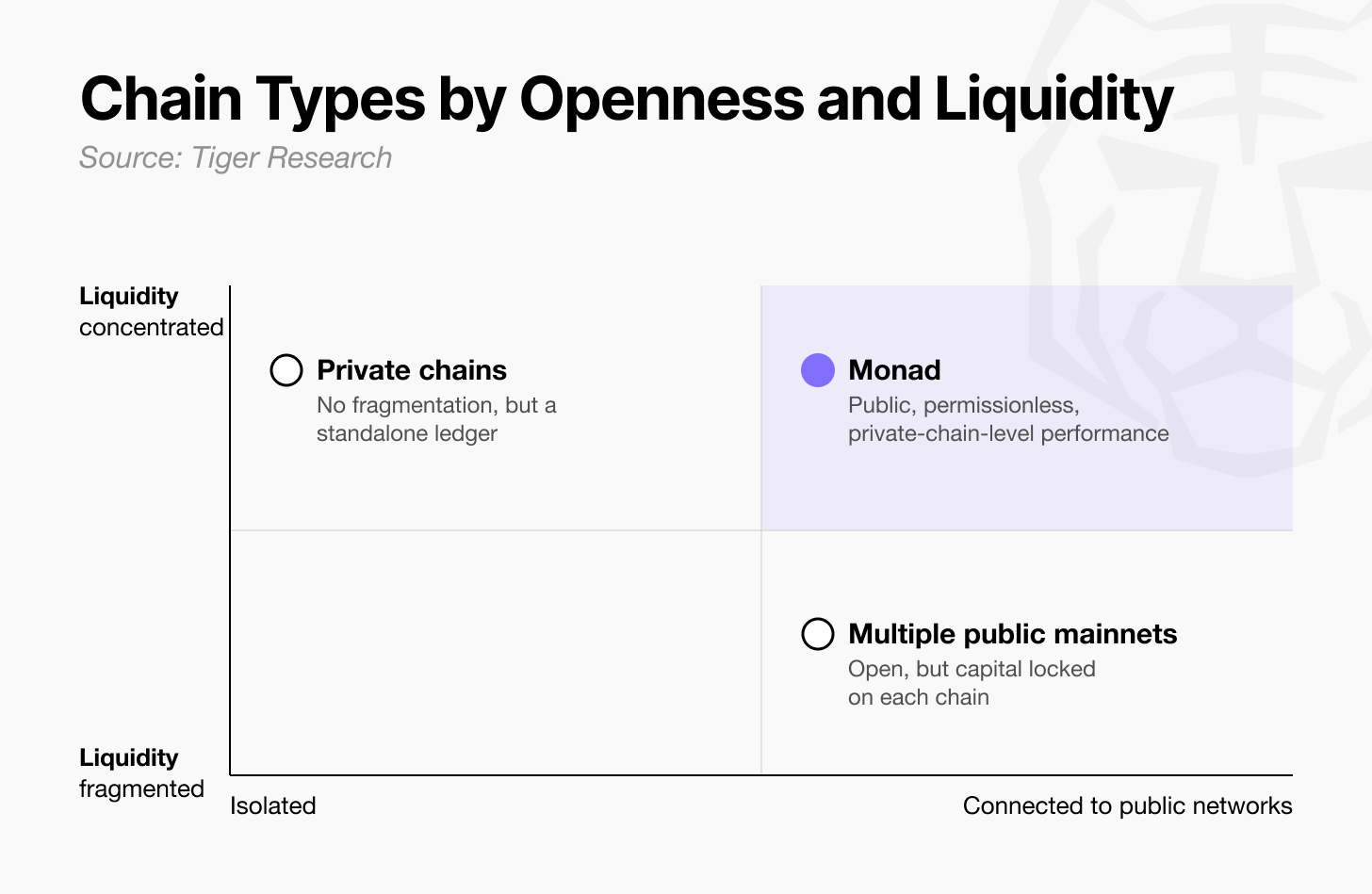
Speed alone, however, does not make a chain usable for institutions. Even on high-performance infrastructure, they run into two limits.
Liquidity fragmentation across public mainnets: Spreading liquidity across multiple chains locks up capital, increasing operational costs and opportunity costs during real-time settlement and rebalancing.
Isolation of private chains: While private chains meet internal regulatory needs and prevent fragmentation, operating as a standalone ledger disconnects them from public networks and global cross-border liquidity.
Monad takes the opposite approach. It is a public, permissionless network that any institution can build on without anyone’s approval, and it still offers the performance that has historically been the private chain’s advantage.
5. A Hub Chain for High-Frequency Finance
More specifically, Monad proposes a hub chain architecture to address these limits. A hub chain is a central network where on-chain fund flows from payment networks, CEXs, and other mainnets converge. When an institution handles its core financial operations, including settlement, bridging, liquidity reallocation, and treasury management, on a hub chain, it no longer needs to spread deposits across multiple blockchains, which removes the source of that capital inefficiency.
The structure closely resembles international air travel, where routes between major cities connect through a central hub airport. Rather than leaving funds idle on individual chains, a hub chain moves them quickly to where they are needed, when they are needed, which makes it infrastructure suited to running an actual on-chain business rather than a technical test.
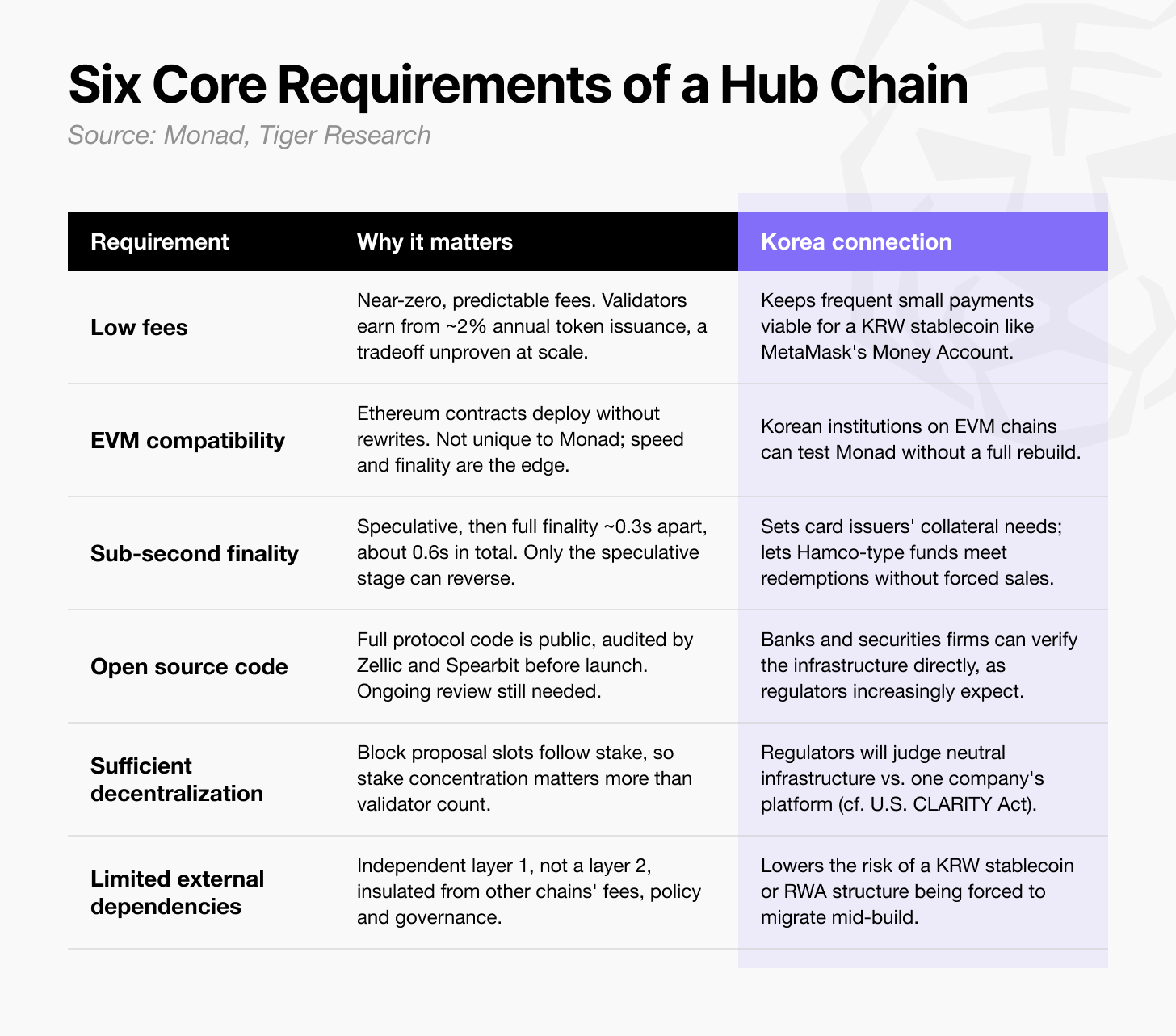
These six requirements form the technical foundation at the protocol level. Institutional due diligence also needs to cover operational factors beyond them, such as regulatory compliance, custody support, liquidity depth, and network uptime.
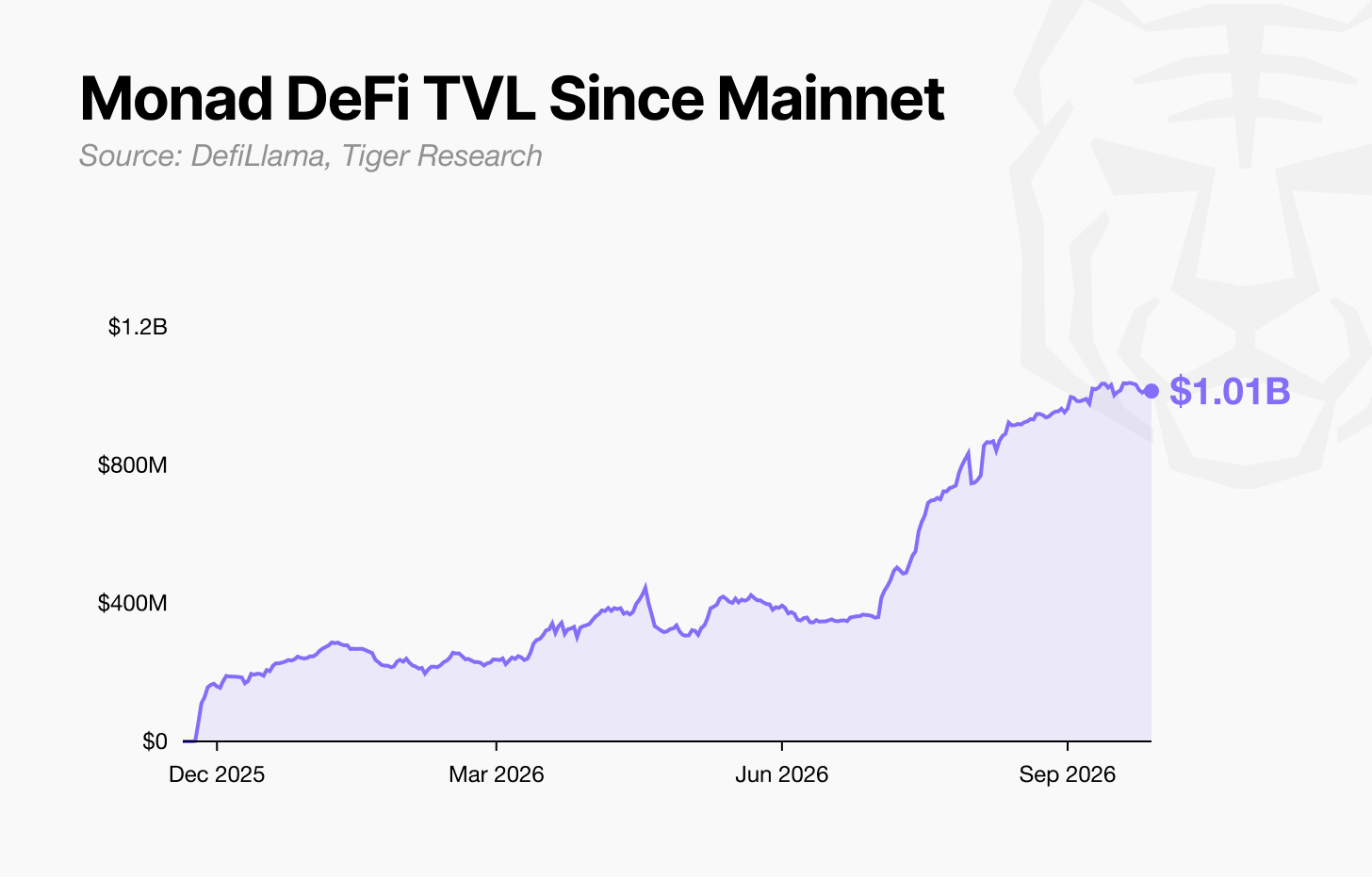
In the ten months since its mainnet launched, the hub chain thesis has moved from architecture to measurable activity. Monad holds roughly $1 billion in DeFi total value locked and has processed more than 750 million transactions. Its partners include MetaMask and Rain in consumer finance, Centrifuge and Valos in institutional credit, and Aave in DeFi infrastructure.
That $1 billion is spread across lending markets, decentralized exchanges, and stablecoin pools rather than held in a single product. A new entrant can use this existing liquidity instead of building trading depth and counterparties from zero.
The stablecoin, payments, and RWA opportunities in this report each depend on a hub chain of this kind. A stablecoin issuer needs a chain that settles frequent small transactions at low cost, and a payments company needs one that does not bring back batch settlement. An RWA structure needs settlement fast enough for its liquid sleeve to fund redemptions on demand.
For all three, the question is less whether to use blockchain than whether the chain underneath can meet these requirements.
6. Korean FI Playbook
A study of 6,848 banks in 29 countries in Europe and the Americas (Scott, Van Reenen and Zachariadis, 2017) found that adopting SWIFT, the interbank messaging network, raised bank profitability by around 40 percent over the following ten years. The effect was small in the early years and grew as more banks joined. For small banks, it was about six times larger than for large ones, which the authors attribute to access to counterparties they could not reach before.
Korea’s regional banks and mid-sized securities firms have fewer overseas branches and correspondent relationships than the largest financial groups. Shared on-chain infrastructure could give them a similar kind of access. Two tracks are open to them today, and each runs under different rules.
Track 1: Domestic Strategy: Building Internal Infrastructure
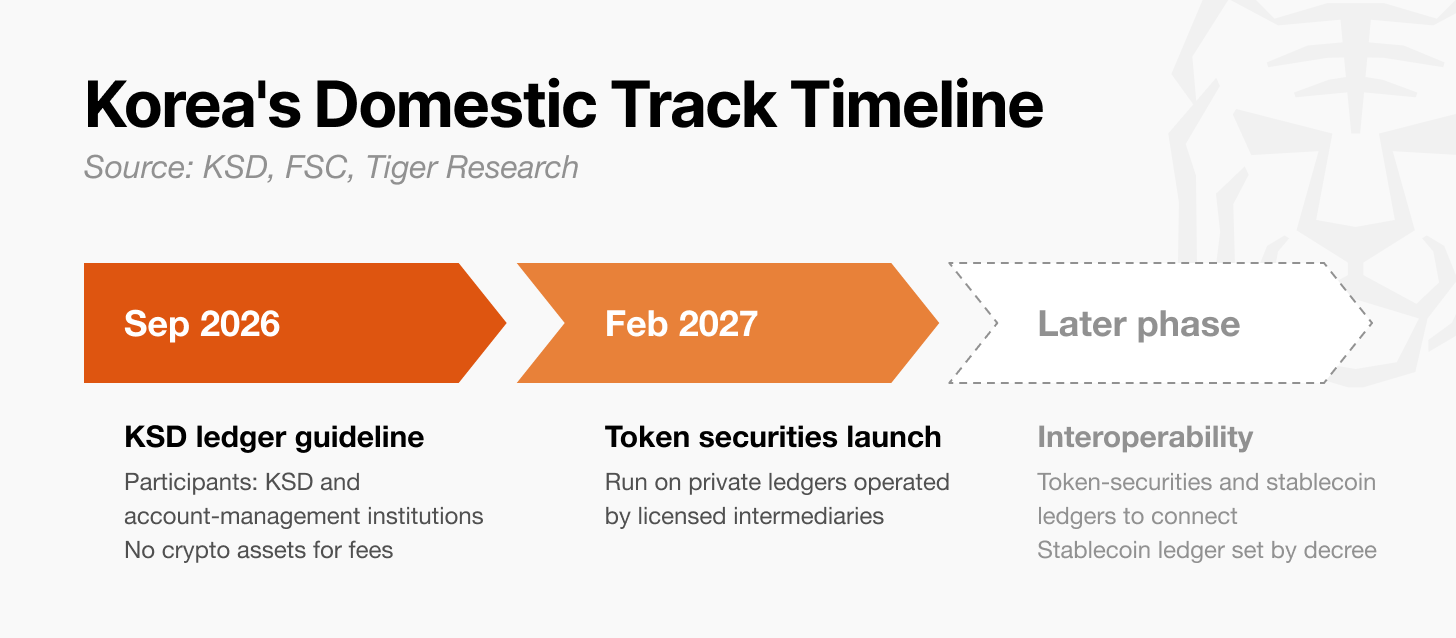
Under current guidelines, the domestic token securities regime excludes public blockchains. The Korea Securities Depository’s September 2026 ledger guideline limits ledger participants to the depository and account-management institutions, prohibiting the use of crypto assets for transaction fees. Starting February 2027, tokenized securities in Korea will run exclusively on private ledgers operated by licensed intermediaries.
While financial companies remain barred from holding crypto assets directly under 2017 regulatory guidance, domestic preparation is essential. Comparative precedents in Asia show how financial institutions have actively prepared in advance of full market rollout:
Hong Kong: The HKMA conducted a stablecoin issuer sandbox starting in 2024 (including Standard Chartered) and granted its first two licenses to HSBC and Anchorpoint in April 2026.
Japan: Megabanks (MUFG, Mizuho, SMBC) established a joint council in June 2026 following a 2025 PoC to standardize stablecoin issuance infrastructure.
Korea: Phase two of Project Hangang is currently testing deposit tokens across nine participating commercial banks.
Concrete Actionable Steps for Domestic Execution:
Secure Account-Management Status: Apply under the amended Electronic Securities Act to participate directly on private ledgers rather than via intermediaries. File in parallel with the offshore pilot so both are in place by the February 2027 start date.
Launch a Pilot Product in 2027: Deploy an institutional private money market fund or private bond on the compliant domestic ledger, using the same team and the same operating playbook proven offshore.
Form Stablecoin Consortia: Align early with reserve custody, issuance, and compliance partners before the formal passage of the Digital Asset Basic Act. The FSC roadmap requires token-securities ledgers to interoperate with stablecoin ledgers in a later phase, and the institution already running a product on a public chain enters that phase with the operating knowledge it demands.
Track 2: Offshore Strategy: Immediate Global Distribution
The offshore route provides an immediate legal path to reach international capital. In August 2026, the FSC clarified that the Electronic Securities Act does not apply when an offshore entity tokenizes an offshore fund holding Korean underlying assets, sells privately to non-residents, and restricts resale to Korean residents.
Market demand for this structure is supported by two major macro tailwinds:
Offshore Won Network: The Bank of Korea’s planned January 2027 opening allows foreign banks to participate in won settlement, expanding offshore liquidity windows.
WGBI Capital Inflows: Korea’s inclusion in the FTSE World Government Bond Index is projected to drive 70 to 90 trillion won in foreign passive inflows.
Leading institutions have already executed on this structure. Shinhan Asset Management is structuring an offshore KRW MMF token, while Mirae Asset’s Hong Kong arm launched a tokenized share class of a Global X ETF in August 2026.
Actionable Steps:
Select Target Assets: Focus on KRW MMFs or government bond funds aligning with FSC exemptions and institutional foreign demand.
Establish Offshore Vehicles: Set up or partner with legal entities in financial hubs such as Hong Kong or Singapore.
Partner with Regulated Distributors: Contract global distributors to enforce investor accreditation and prevent secondary flows to domestic residents.
Integrate Settlement & Liquidity Infrastructure: Utilize existing public hub-chain infrastructure (e.g., sub-second settlement layers, multi-chain interoperability protocols) to ensure real-time subscription and redemption capabilities.
How Monad Connects the Two Tracks
For a Korean institution executing either track, Monad supplies the underlying execution and settlement layer needed to move from pilot to production. Rather than requiring firms to build custom interoperability solutions, the core infrastructure required for both domestic preparation and immediate offshore distribution already operates on the network.
For Track 1 (Domestic Strategy), Monad provides the EVM-compatible testing ground and sub-second finality necessary to simulate real-time settlement between private token-security ledgers and future stablecoin rails. For Track 2 (Offshore Strategy), Monad delivers active global distribution components out of the box: MonadBFT ensures sub-second finality at near-zero fees, AUSD (the stablecoin powering institutional liquid sleeves) already circulates on-chain, and Chainlink’s Cross-Chain Interoperability Protocol (CCIP) is live on Monad to connect offshore fund structures across public networks.
This leaves the institution to focus solely on what only it can supply: the underlying Korean asset and the regulatory or legal wrapper around it. The technical stack for global distribution and real-time B2B settlement is already in place.
The two tracks are complementary phases of a single strategy. Track 1 builds the institutional capabilities and account-management status required for when domestic tokenized securities and KRW stablecoins merge onto interoperable ledgers. Track 2 reaches international investors today under current FSC exemptions, utilizing established public-chain liquidity and cross-chain messaging.
An institution advancing along both tracks simultaneously secures immediate revenue and operational experience offshore while positioning itself to lead the domestic market as regulatory milestones arrive.
Korea’s crypto market by 2030 will be defined by the institutions that start building now, while the rules are still being written and the infrastructure is already in place. The legal route exists, the settlement layer works, and the first Korean asset managers have already moved. What remains is not another study or another pilot, but the decision to put a Korean asset on that infrastructure and run it. The institutions that make that decision in the next year will be the ones that define the market when 2030 arrives.
Disclaimer
This report was partially funded by Monad. It was independently produced by our researchers using credible sources. The findings, recommendations, and opinions are based on information available at publication time and may change without notice. We disclaim liability for any losses from using this report or its contents and do not warrant its accuracy or completeness. The information may differ from others’ views. This report is for informational purposes only and is not legal, business, investment, or tax advice. References to securities or digital assets are for illustration only, not investment advice or offers. This material is not intended for investors.
Terms of Usage
Tiger Research allows the fair use of its reports. ‘Fair use’ is a principle that broadly permits the use of specific content for public interest purposes, as long as it doesn’t harm the commercial value of the material. If the use aligns with the purpose of fair use, the reports can be utilized without prior permission. However, when citing Tiger Research’s reports, it is mandatory to 1) clearly state ‘Tiger Research’ as the source, 2) include the Tiger Research logo following brand guideline. If the material is to be restructured and published, separate negotiations are required. Unauthorized use of the reports may result in legal action


