
Key Takeaways
The Dunamu-Naver Financial share exchange has been delayed from June to September due to extended KFTC review; an FSS correction order has added further uncertainty.
The merger unites exchange (Upbit), payments (Naver Pay), and AI into a single structure, a strategic move positioning Korea for the stablecoin and RWA era.
Caution matters. But so does timing. When regulation cannot keep pace with industry, opportunity moves elsewhere.
At Dunamu’s shareholder meeting on March 31, 2026, the company reaffirmed its plan to pursue an IPO immediately following completion of the share exchange with Naver Financial. The exchange ratio is set at 2.54:1, with Naver Financial’s post-merger valuation estimated at approximately KRW 20 trillion (~$13.7B).
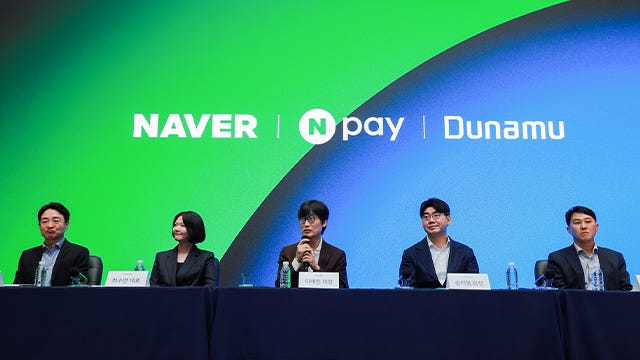
The schedule has already slipped once. The original target of June 30 for share exchange completion was pushed back three months to September 30, as the KFTC’s merger review took longer than anticipated. CEO Oh Kyung-seok cited the deal’s scale and lack of precedent as reasons for the extended regulatory process.
On April 3, 2026, the FSS issued a correction order to Dunamu, adding another layer of uncertainty. The FSS identified material omissions or misstatements in Dunamu’s March 30 material disclosure report, specifically in sections covering future corporate restructuring plans and other investment-relevant disclosures. The correction order was disclosed to Dunamu only; no separate disclosure was issued to Naver Financial. The FSS noted that report content may change as a result, and advised investors to take this into account.
Why Now
Dunamu (Upbit) holds over 70% of domestic crypto trading volume, making it the dominant player in Korea’s crypto market. Naver Financial operates the country’s largest online and offline payment network. Combined, the two would bring exchange infrastructure, payments, and AI under a single corporate structure.
Both stablecoin-based payments and RWA tokenization require exchange infrastructure and a payment network simultaneously. Dunamu lacks the payment network; Naver Financial lacks the digital asset infrastructure. This merger is an attempt to close that gap.
The Simple Picture
Consider a world where you buy crypto on Upbit and pay at a convenience store via Naver Pay. Today, these two actions are entirely separate. Post-merger, the connection becomes possible within a single company: stablecoins issued at the exchange level, circulated through Naver’s merchant network at the point of sale.
Caution vs. the Cost of Delay
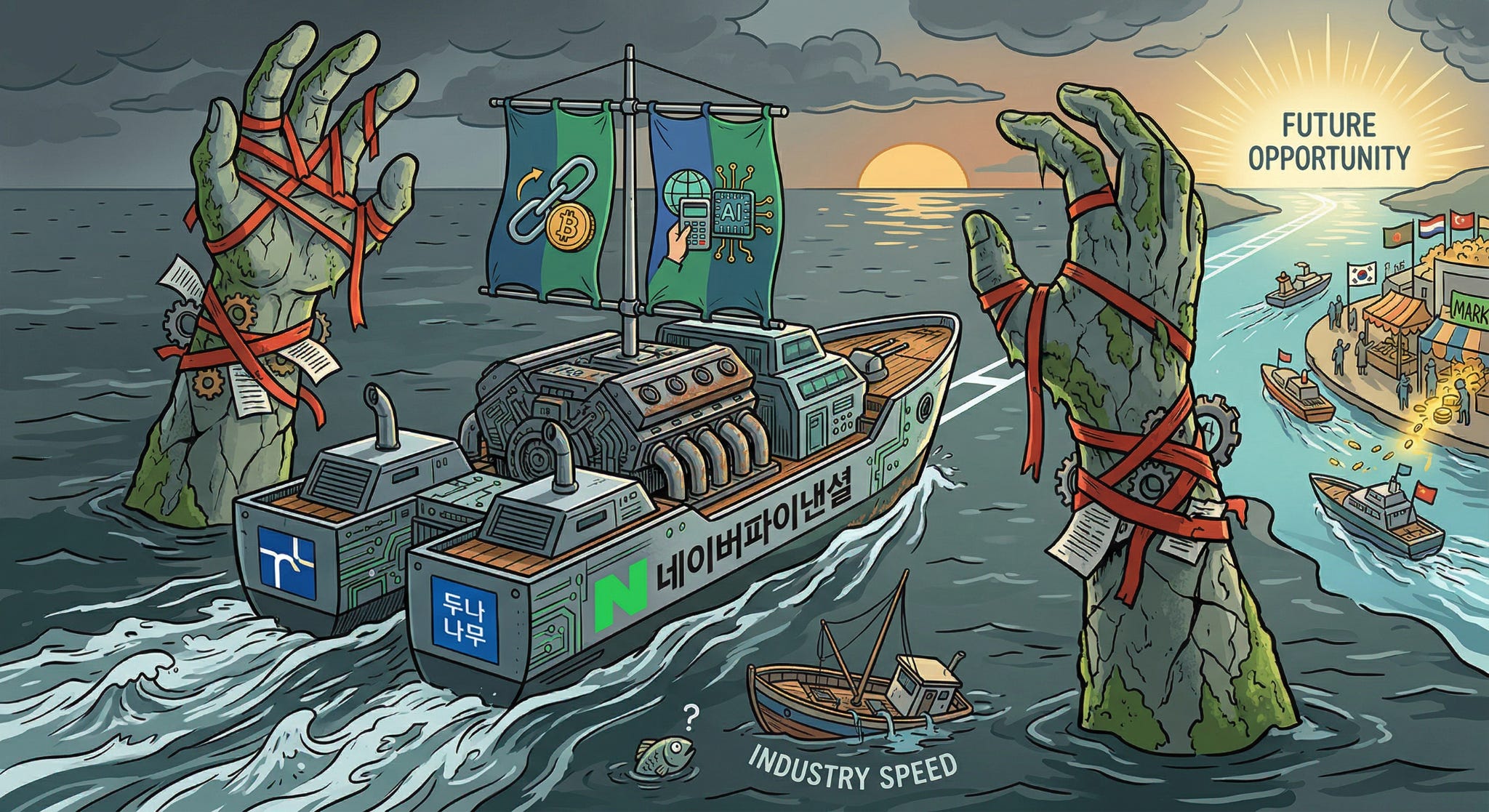
If completed, this merger would make Korea the first Asian market to integrate exchange, payments, and stablecoin distribution into a single ecosystem. The concern is that financial regulators view this structure as a monopolistic business.
The concern is that this structure would be effectively monopolistic domestically. The KFTC’s extended review reflects precisely this: adding Naver Financial’s payment network to Upbit’s existing dominance would raise barriers to entry significantly. The April 3 FSS correction order has added further uncertainty around the closing timeline.
The Digital Asset Basic Act introduces an additional variable. A provision capping corporate major shareholders at 34% stake in exchanges would require structural adjustment if Naver Financial’s post-merger stake in Dunamu exceeds this threshold. Until the bill is finalized, the deal structure carries unresolved regulatory risk.
Korea’s caution is grounded in context. The 2022 Terra-Luna collapse wiped out tens of trillions of won almost instantly, shifting the regulatory posture toward conservatism and slowing industry momentum.
Over the same period, the U.S. and Singapore completed major M&A deals and scaled stablecoin and RWA-based services. Korea remained exchange-centric. The ecosystem is thin.
The lesson from Terra-Luna should be “do it right,” not “don’t do it.” There is no time to wait for an organic ecosystem to form. Large players like Dunamu and Naver Financial need to lay the foundation, creating a structure on which more operators and services can grow.
When regulation cannot keep pace with industry, opportunity moves to other markets quietly.
Disclaimer
This report has been prepared based on materials believed to be reliable. However, we do not expressly or impliedly warrant the accuracy, completeness, and suitability of the information. We disclaim any liability for any losses arising from the use of this report or its contents. The conclusions and recommendations in this report are based on information available at the time of preparation and are subject to change without notice. All projects, estimates, forecasts, objectives, opinions, and views expressed in this report are subject to change without notice and may differ from or be contrary to the opinions of others or other organizations.
This document is for informational purposes only and should not be considered legal, business, investment, or tax advice. Any references to securities or digital assets are for illustrative purposes only and do not constitute an investment recommendation or an offer to provide investment advisory services. This material is not directed at investors or potential investors.
Terms of Usage
Tiger Research allows the fair use of its reports. ‘Fair use’ is a principle that broadly permits the use of specific content for public interest purposes, as long as it doesn’t harm the commercial value of the material. If the use aligns with the purpose of fair use, the reports can be utilized without prior permission. However, when citing Tiger Research’s reports, it is mandatory to 1) clearly state ‘Tiger Research’ as the source, 2) include the Tiger Research logo. If the material is to be restructured and published, separate negotiations are required. Unauthorized use of the reports may result in legal action.