
Key Takeaways
Just after RAVE surged 4,500%, ZachXBT exposed 90% supply concentration in team wallets and coordinated moves to exchanges. Binance and Bitget launched investigations; the token collapsed more than 90% in a single day.
But an uncomfortable question follows. If the market were cleaned up overnight, the extreme volatility that draws retail in would disappear along with it.
Many investors are not here for S&P’ 10% annual return. They are here for 4,500% overnight. ZachXBT’s work is commendable. But do degens actually want that kind of market? The question deserves an honest answer.
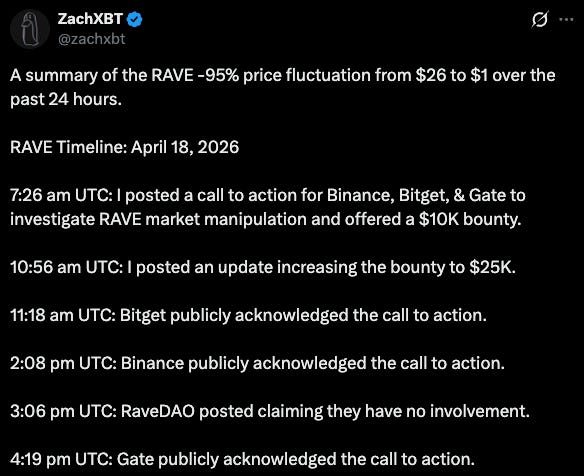
In April 2026, just after RAVE token surged 4,500%, onchain investigator ZachXBT went public with allegations of manipulation.
Three wallets linked to the team held 90% of the 1 billion token supply, and the price spiked immediately after those wallets moved holdings to major exchanges. Liquidations reached $44M. ZachXBT called on Binance, Bitget, and Gate to investigate and offered a $25,000 bounty for information.
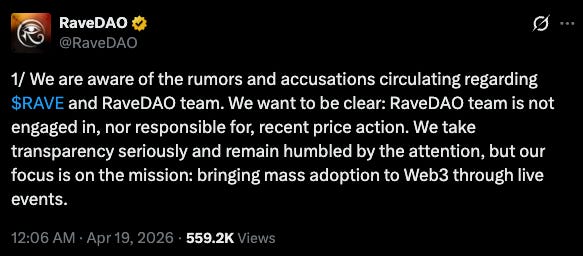
Binance and Bitget then launched investigations, and RAVE collapsed from $26 to $1, a 90% drop. $5.7B in market cap was erased in a single day. RaveDAO pushed back, claiming no team involvement.
Why Now
Institutional capital is flowing into crypto in earnest, yet hacks do not stop and price manipulation repeats. The question of whether this market can be trusted has resurfaced.
What is notable is that the resolution came not from the SEC or any financial regulator. A single anonymous onchain investigator moved two exchanges and erased approximately $6B in market cap within a day. Individual action moved faster than regulation. But that structure cannot hold. Market integrity cannot rest on individual goodwill.
And a more uncomfortable question remains. Do degens actually want this kind of self-correction?
A Simple Analogy
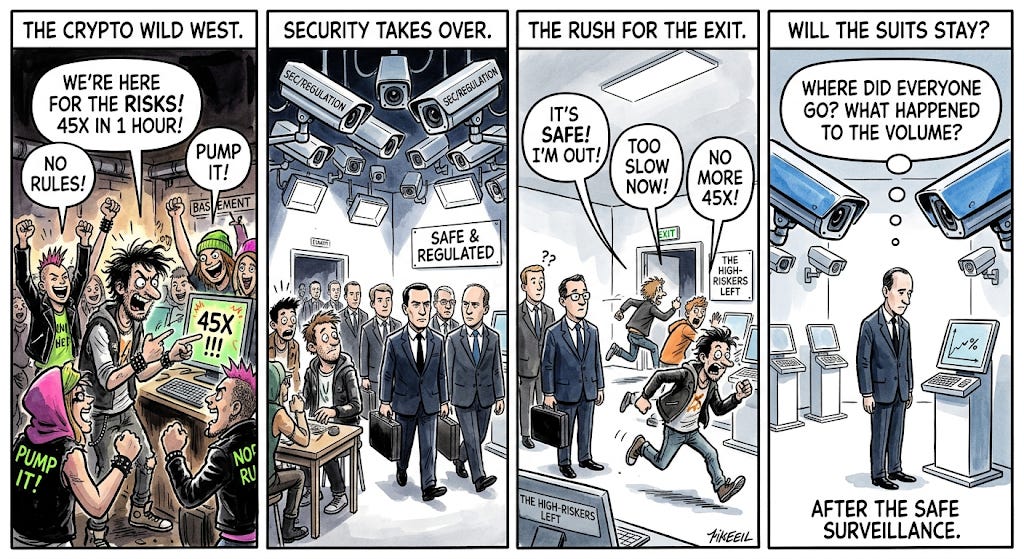
Crypto is starting to resemble a regulated stock exchange.
Surveillance cameras are going up, and institutional clients in suits are walking through the door. But the people who filled those seats originally did not come because it was safe. They came because 45x in an hour was possible.
The moment cameras cover every table, the 45x disappears. So does the original crowd.
After that, do the suited clients stay?
The Uncomfortable Truth
The effort to identify and stop manipulation like RAVE is necessary. When team wallets hold 90% of supply and the price spikes the moment that supply moves to exchanges, it is close to manipulation. Illegal manipulation should be removed from the market.
But why do most retail participants choose crypto over equities? Not for the S&P 500’s 10% annually. They come for the possibility of 4,500% in a day. There are many strong projects, but the market’s extreme volatility frequently originates from information asymmetry, liquidity manipulation, and supply concentration.
So imagine a crypto market where SEC-style surveillance operates fully. Team wallets are disclosed. Projects with heavily concentrated supply are filtered out before listing. Liquidity manipulation is flagged in real time. In that market, can any project still trigger retail’s adrenaline? That is no longer crypto. It is a slow-moving equity market.
ZachXBT’s work deserves recognition. We agree. A safer market is necessary.
But the uncomfortable truth remains, right now. Many say they want a clean crypto market, while in practice many degens are drawn to exactly the volatility that produces. The day regulation is complete, crypto is more likely to become boring than clean. And the projects that survive will be held to the same standard of proof as listed equities.
ZachXBT’s work is appreciated. But many degens are still out there looking for the next RAVE-style chart.
A gap exists today between the future we envision and the market we actually have. If more projects could prove themselves on their own merits, this kind of volatility would not have been necessary in the first place.
That is the uncomfortable truth.
Disclaimer
This report has been prepared based on materials believed to be reliable. However, we do not expressly or impliedly warrant the accuracy, completeness, and suitability of the information. We disclaim any liability for any losses arising from the use of this report or its contents. The conclusions and recommendations in this report are based on information available at the time of preparation and are subject to change without notice. All projects, estimates, forecasts, objectives, opinions, and views expressed in this report are subject to change without notice and may differ from or be contrary to the opinions of others or other organizations.
This document is for informational purposes only and should not be considered legal, business, investment, or tax advice. Any references to securities or digital assets are for illustrative purposes only and do not constitute an investment recommendation or an offer to provide investment advisory services. This material is not directed at investors or potential investors.
Terms of Usage
Tiger Research allows the fair use of its reports. ‘Fair use’ is a principle that broadly permits the use of specific content for public interest purposes, as long as it doesn’t harm the commercial value of the material. If the use aligns with the purpose of fair use, the reports can be utilized without prior permission. However, when citing Tiger Research’s reports, it is mandatory to 1) clearly state ‘Tiger Research’ as the source, 2) include the Tiger Research logo. If the material is to be restructured and published, separate negotiations are required. Unauthorized use of the reports may result in legal action.