
Key Takeaways
Korea’s crypto market needs to move beyond its reliance on trading fees and rebuild around tokenized assets (RWA) and stablecoins.
Based on global forecasts scaled to the size of Korea’s economy, the domestic market is projected to reach KRW 360 trillion (about $253 billion) by 2030: KRW 315 trillion in tokenized assets and KRW 45 trillion in stablecoins.
Ahead of the 2027 regulatory rollout, major financial institutions such as Shinhan, KB, Hana, and Kyobo Securities are building infrastructure, taking equity stakes, and forming global partnerships, laying the groundwork for a KRW 360 trillion market.
1. The Limits of Trading-Driven Growth
Korea’s crypto market has stopped growing because it depends on trading volume and fee income, while global markets are shifting toward tokenized assets (RWA) and stablecoins that bring traditional financial assets on-chain.
As of the first half of 2026, Korea had 11.18 million tradable crypto accounts, equivalent to more than 20% of the population, but the number grew only 0.4% from the previous half. Average daily trading volume fell from KRW 7.3 trillion (about $5.1 billion) in the second half of 2024 to KRW 3.1 trillion (about $2.2 billion) in the first half of 2026. Growth built on trading has reached its limits.
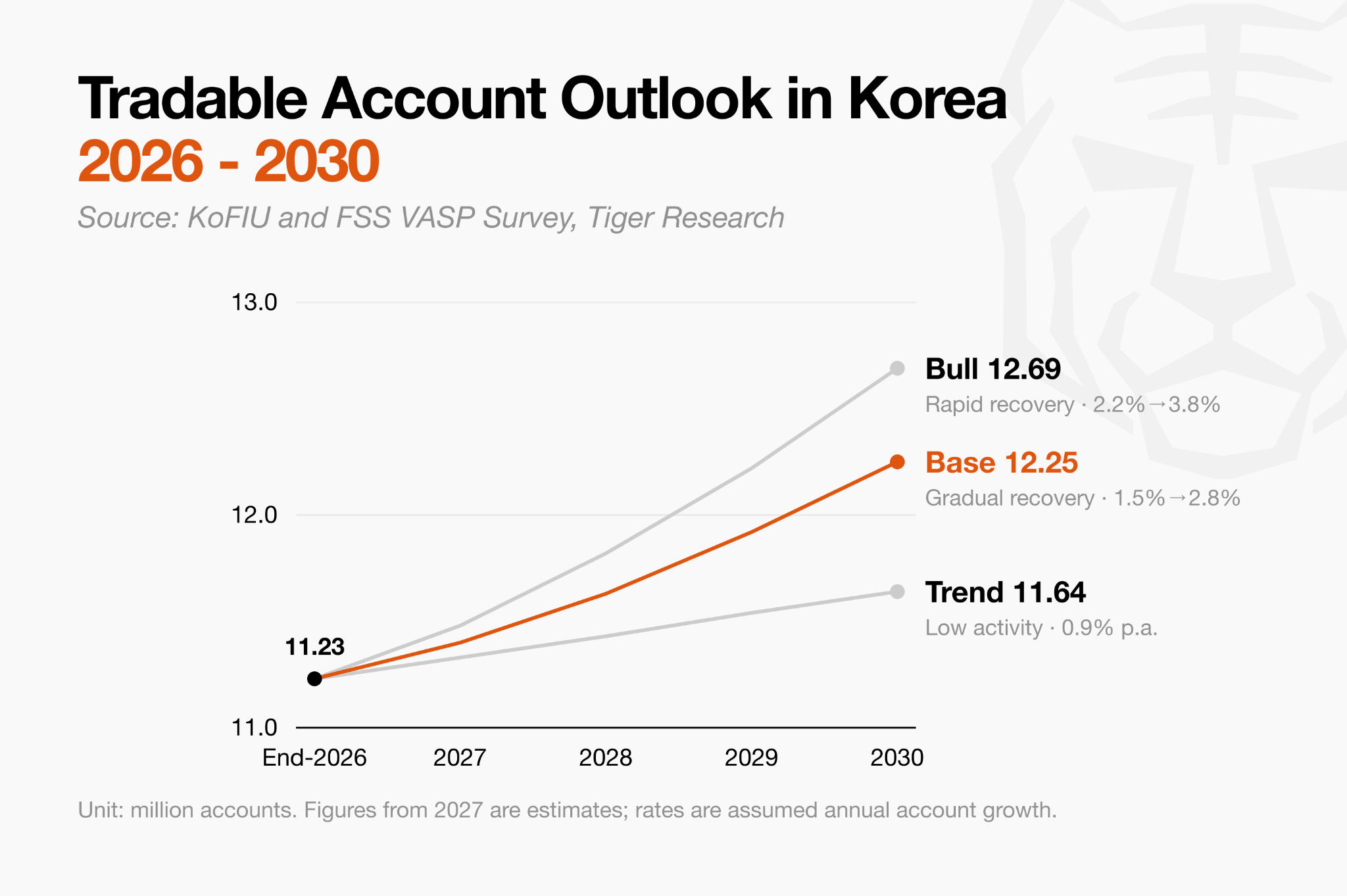
Account projections show that even in the most optimistic Bull scenario, the number of accounts in 2030 would be only about 13% higher than in 2026. The market therefore needs new sources of growth beyond trading fees: tokenized real-world assets (RWA) and stablecoins used for payment and settlement.
This report examines the outlook for tokenized assets (RWA) and stablecoins, a market in which traditional financial assets themselves move on-chain.
2. Sizing Korea’s Tokenized Asset and Stablecoin Market
In its February 2023 report “The Opening of the Token Securities Era,” Hana Institute of Finance estimated Korea’s token securities market at KRW 367 trillion (about $258 billion) by 2030, including real estate, based on BCG’s 2022 global forecast. Because that analysis relies on older data, the estimate needs to be revised to reflect current market trends and BCG’s new 2026 forecast.
Tiger Research recalculated the size of Korea’s tokenized asset market using BCG’s latest 2026 report and current economic indicators. It also added the stablecoin market, which the Hana Institute of Finance estimate did not cover, using a global forecast from Standard Chartered.
The main sources and assumptions behind the global forecasts are as follows.
Tokenized assets: According to BCG’s Global Asset Management Report 2026 (middle-of-the-road scenario), the global market capitalization of tokenized real-world assets (RWA) is projected to grow from $2.3 trillion in 2027 to $14 trillion in 2030. The figures cover government bonds, corporate bonds, securitized debt, money market instruments, commodities, listed stocks, and alternatives, and exclude real estate and stablecoins. These assets currently total less than $25 billion.
Stablecoins: Based on Standard Chartered’s October 2026 estimate, global stablecoin supply is projected to grow from about $309 billion today to $2 trillion by 2030. Figures for 2027 to 2029 are interpolated assuming compound annual growth of about 60%.
Domestic market size formula: global market forecast × Korea’s share of global GDP (1.58%) × KRW/USD exchange rate (KRW 1,422.44).
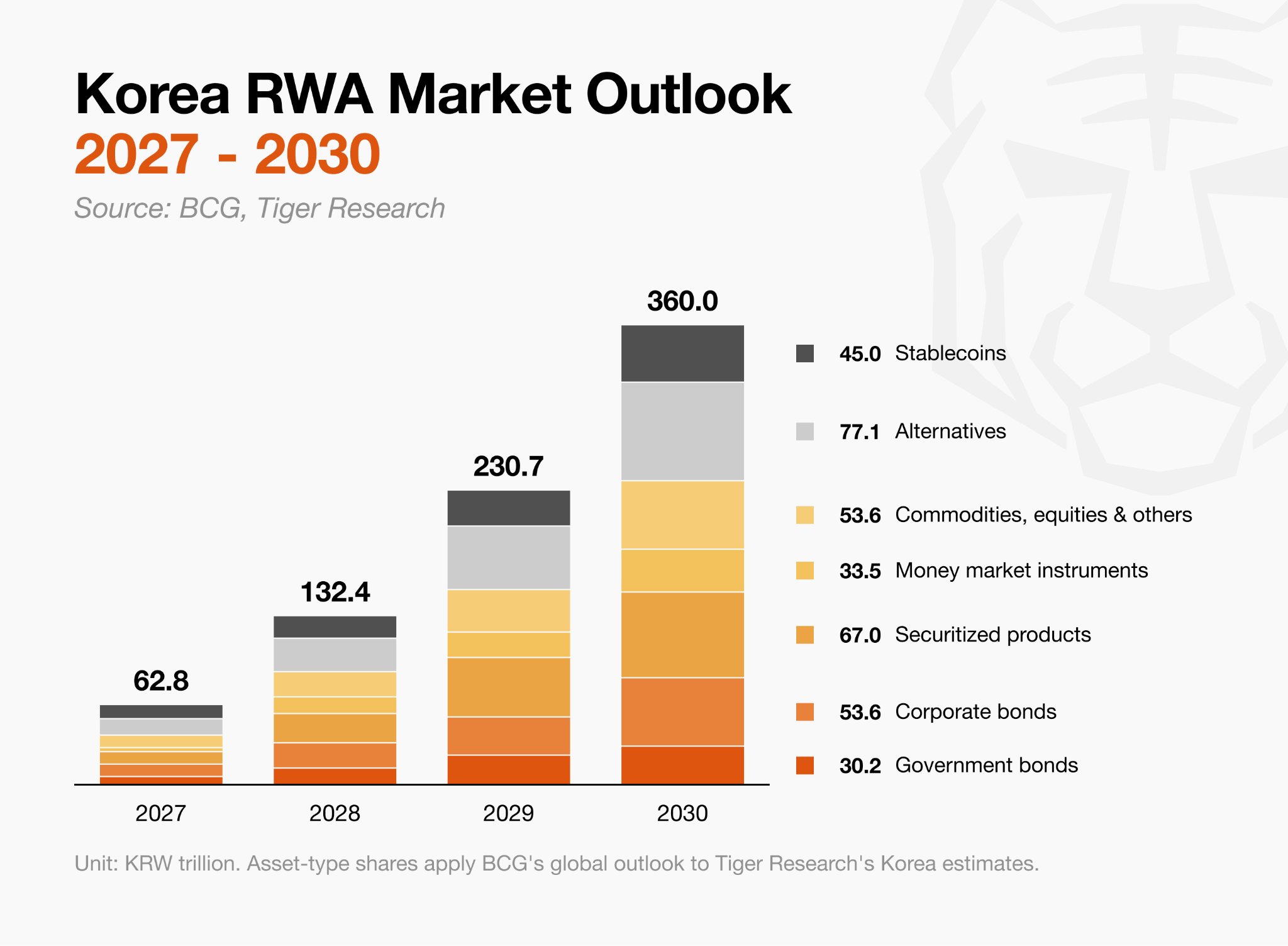
By 2030, tokenized assets are estimated at KRW 315.0 trillion (about $221.5 billion) and stablecoins at KRW 45.0 trillion (about $31.6 billion).
The KRW 360 trillion figure for 2030 is the potential market size if Korea’s share of global tokenization matches its share of the world economy. Actual growth may differ depending on when the implementing regulations under the Electronic Securities Act and the Capital Markets Act are finalized and how broadly they allow tokenization.
3. How Korean Financial Institutions Are Preparing
Korea’s financial sector is adapting quickly as digital assets enter the regulatory framework. In January 2026, the token securities bills (amendments to the Electronic Securities Act and the Capital Markets Act) passed the National Assembly, with implementation set for February 2027. The Financial Services Commission has also announced that standardized securities such as private MMFs and corporate bonds sold only to institutional investors will be the first allowed to be tokenized.
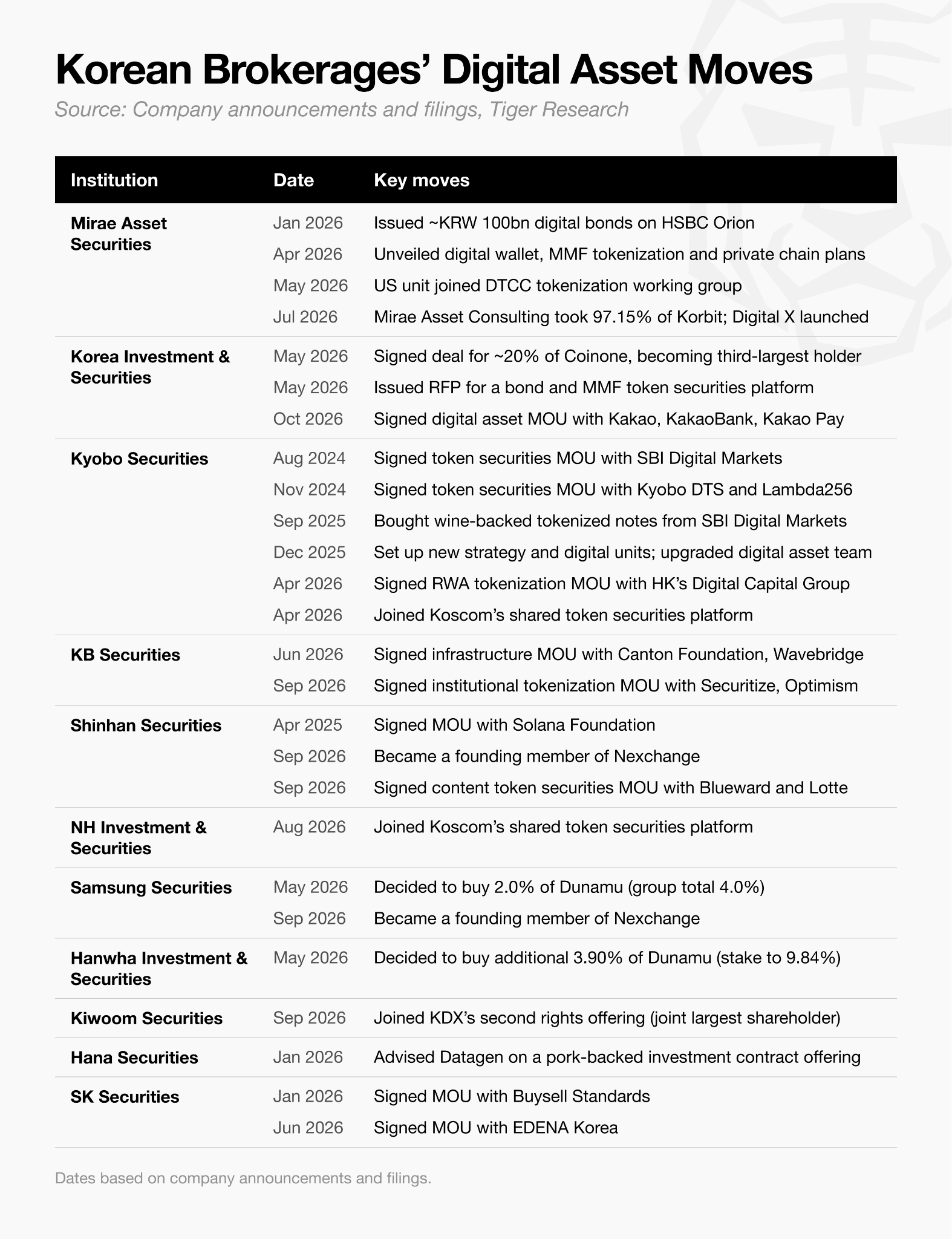
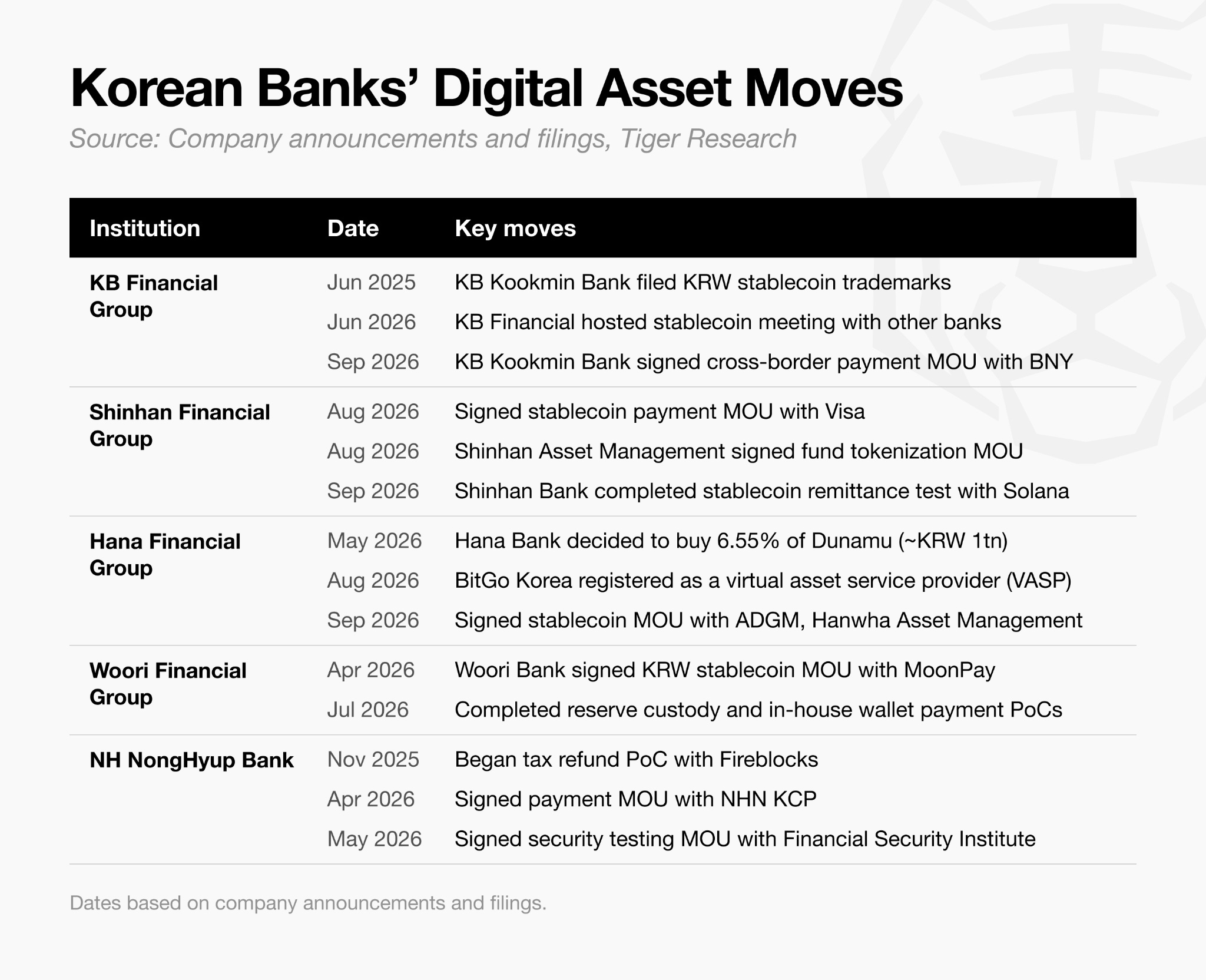
Major traditional financial institutions are building infrastructure and testing it in practice ahead of the new rules. Their response can be grouped into four areas.
Sector infrastructure and pilots: Securities firms are focusing on issuance and distribution infrastructure for token securities (STO), while banks, card companies, and insurers are running payment and settlement proofs of concept (PoCs) using KRW stablecoins and tokenized deposits.
Strategic equity stakes: Financial institutions have invested about KRW 2.35 trillion (about $1.7 billion) in stakes in crypto exchanges, and the entry of regulated financial capital is intensifying competition for market leadership.
Shift toward traditional financial assets: Firms are moving away from fractional investment in non-standard assets such as real estate and art, where profitability was limited, toward tokenizing traditional financial assets with large issuance volumes and existing liquidity.
Tokenization of standardized securities and high-value real-world assets: Firms are competing to tokenize not only standardized securities such as government bonds, corporate bonds, and private MMFs, but also real-world assets that retain value, such as intellectual property (IP) and wine.
Korean financial institutions are working with global blockchain and technology companies to make their systems interoperable with global networks and to test infrastructure that meets regulatory requirements.
Shinhan Financial Group has partnered with Solana, Visa, and Etherfuse; KB Financial Group with Securitize, Canton, and BNY; Hana Financial Group with BitGo; and the Kyobo group (Kyobo Life and Kyobo Securities) with Ripple, Circle, and SBI. Through these partnerships, Korean institutions are building systems that work with global standards.
These partnerships are likely to be a major factor in the market reaching KRW 360 trillion by 2030. Korea’s crypto market is preparing to move past fee-driven stagnation, and that transition will depend on building infrastructure and compliance systems in time for the 2027 regulatory rollout.
🐯 More from Tiger Research
Read more reports related to this research.Disclaimer
This report has been prepared based on materials believed to be reliable. However, we do not expressly or impliedly warrant the accuracy, completeness, and suitability of the information. We disclaim any liability for any losses arising from the use of this report or its contents. The conclusions and recommendations in this report are based on information available at the time of preparation and are subject to change without notice. All projects, estimates, forecasts, objectives, opinions, and views expressed in this report are subject to change without notice and may differ from or be contrary to the opinions of others or other organizations.
This document is for informational purposes only and should not be considered legal, business, investment, or tax advice. Any references to securities or digital assets are for illustrative purposes only and do not constitute an investment recommendation or an offer to provide investment advisory services. This material is not directed at investors or potential investors.
Terms of Usage
Tiger Research allows the fair use of its reports. ‘Fair use’ is a principle that broadly permits the use of specific content for public interest purposes, as long as it doesn’t harm the commercial value of the material. If the use aligns with the purpose of fair use, the reports can be utilized without prior permission. However, when citing Tiger Research’s reports, it is mandatory to 1) clearly state ‘Tiger Research’ as the source, 2) include the Tiger Research logo. If the material is to be restructured and published, separate negotiations are required. Unauthorized use of the reports may result in legal action.


