
Key Takeaways
Chaos Labs’ departure is not an isolated event. It follows the exits of BGD Labs and ACI, forming a chain of core contributor departures driven by six months of accumulated conflict.
The stated causes are budget disputes and V4 architecture disagreements. But the deeper issue is structural: Aave Labs is believed to have exercised de facto decision-making power behind the facade of DAO governance.
The more urgent question is not the retreat of decentralization. It is whether Aave, a core piece of EVM infrastructure, can fill the gaps in risk management and protocol development fast enough.
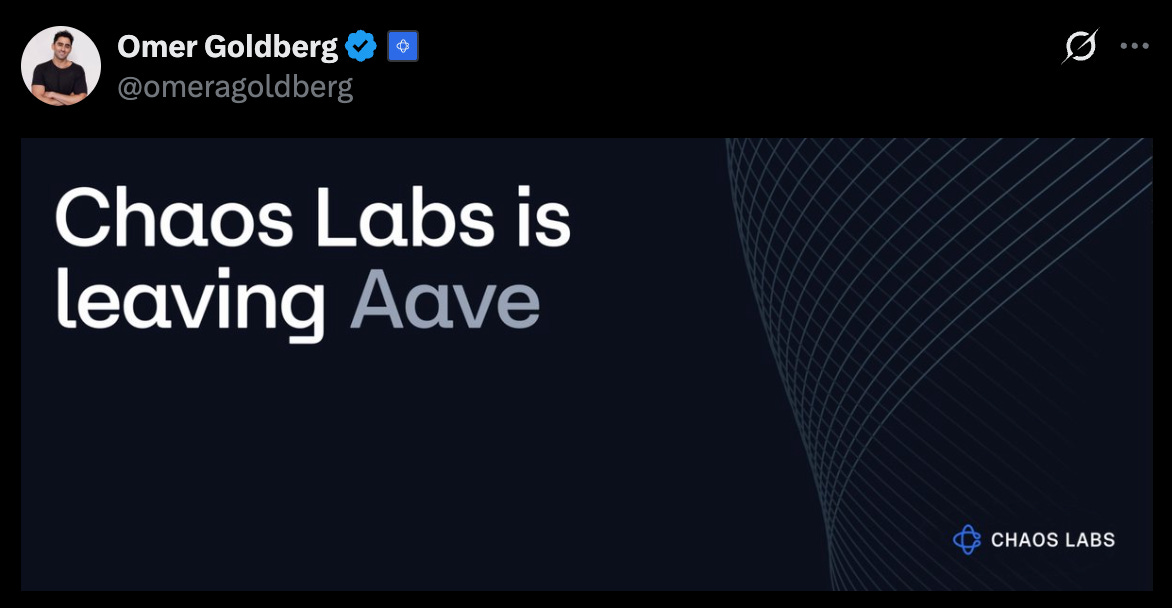
On April 6, Chaos Labs, Aave’s risk curator, announced its departure, citing disagreements over risk management direction. The team gave three reasons:
Rising operational risk: The successive departures of core contributors erased three years of operational expertise. The resulting burden fell squarely on Chaos Labs.
Opposition to V4 architecture: V4 is an entirely new protocol with different smart contracts, architecture, and liquidation logic from V3. Risk infrastructure must be rebuilt from scratch, but V3 must also continue running in parallel, effectively doubling the workload during the transition.
Structural deficit: Chaos Labs operated the Aave contract at a loss for three years. Even with a budget increase to $5M, profitability would not be achieved. The minimum risk budget Chaos Labs estimated for V3+V4 combined was $8M.

Aave founder Stani Kulechov acknowledged Chaos Labs’ decision but offered a different account. He agreed to doubling the budget to $5M but rejected three additional demands:
Sole risk manager designation: Aave has maintained a two-layer risk management model. Granting Chaos Labs exclusive control would violate this principle.
Full adoption of Chaos Labs’ proprietary oracle: Replacing Chainlink with Chaos Labs’ own oracle for all new deployments was rejected, given the existing partnership with Chainlink and user trust considerations.
Default vault adoption: Making Chaos Labs’ vault the default for all B2B integrations was rejected because it had not completed audit and would deepen vendor lock-in.
Stani stated that protocol operations remain unaffected and that a smooth transition will proceed in coordination with co-risk curator LlamaRisk.
Why Now
Dec 2025: It emerged that Aave Labs had been directing CowSwap collaboration fees to its own wallet rather than the DAO treasury. This triggered the initial conflict.
Dec 2025: BGD Labs, the external team responsible for core protocol development, proposed transferring brand assets (domain, social media, trademarks) to the DAO. The proposal was defeated with 55.29% opposition. Critics alleged that large token holdings linked to Aave Labs flipped the outcome.
Feb 2026: A compromise proposal, “Aave Will Win,” passed with 52.58% approval. It would route 100% of Aave Labs revenue to the DAO in exchange for $42.5M and 75,000 AAVE tokens paid to the Labs.
For (52.58%): Formalizes revenue structure and secures a foundation for V4 development.
Against (42%): The original problem was fees being taken without disclosure. The resolution effectively rewarded the offending party with a larger payout. ACI founder Marc Zeller claimed Labs-linked addresses again tipped the vote.
Feb 20, 2026: BGD Labs announced its departure, citing that Aave Labs had unilaterally pushed V4 transition without consulting BGD and imposed artificial constraints on V3 improvements.
Mar 3, 2026: ACI founder Marc Zeller, prompted by BGD’s exit, declared he would withdraw by July.
Mar 30, 2026: Aave V4 officially launched on Ethereum mainnet.
Apr 6, 2026: Chaos Labs formally exited, citing rising operational burden, opposition to V4 architecture, and structural deficit.
Throughout this sequence, criticism has persisted that Aave Labs exercises de facto decision-making power behind the formality of DAO governance. Chaos Labs’ departure raises the question again: Is Aave being privatized?
A Simple Analogy
Aave was created by Aave Labs, but it grew into something resembling a cooperative. External specialists like BGD Labs and Chaos Labs were brought in as operators, and a governance structure was established where token holders vote on major decisions.
The criticism is that the founder who built this cooperative still holds the largest share of votes. In Aave’s governance, more tokens mean more voting power. The founder’s side allegedly exercised that power at every critical moment. No matter how the other members aligned, the outcome could be overturned if the founder opposed it.
Core operators began leaving one by one. BGD Labs, ACI, and Chaos Labs all exited in succession. It is called a cooperative, but who actually holds the decision-making power?
Is Chaos Labs’ Exit the Privatization of Aave?
This outcome was predictable. Most foundations claim DAO status, but effective control has always sat with one actor. Aave was a rare exception: a project that genuinely attempted to make decentralized governance work.
Even cooperatives eventually consolidate decision-making into a single capable entity. Chaos Labs’ departure amounts to a privatization of Aave. Contributors outside Aave Labs have lost the ecosystem they built; holders have lost a portion of their rights.
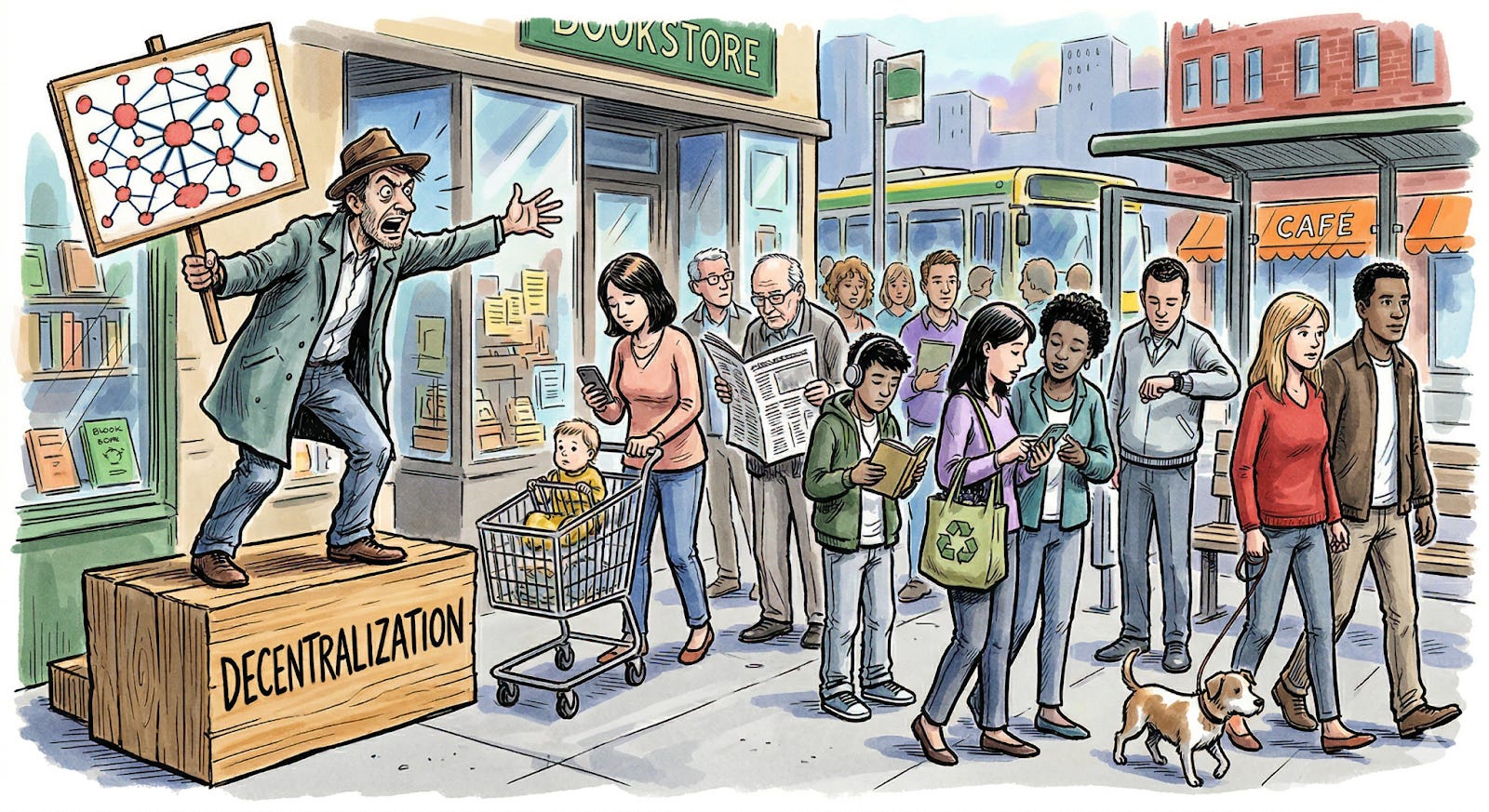
Yet the more honest question is whether right and wrong even apply here. No serious market participant treats decentralization as a real operating principle.
Decentralization is an ideology, not a tool. What users need is a protocol that runs safely and protects their assets. If centralized decision-making delivers that better, debating the ethics of decentralization’s retreat is a luxury. Most protocols have already made this choice.
The real question is not moral. It is operational: how will Aave Labs fill the gap left by its departing contributors?
Aave is core EVM infrastructure. It is the liquidity layer underpinning countless protocols and users. A major incident, beyond the risk management failures already seen, would not stay contained. It would cascade.
Contributor attrition is real and concerning. But the more urgent question for the broader ecosystem is how quickly and competently Aave Labs can close that gap.
Disclaimer
This report has been prepared based on materials believed to be reliable. However, we do not expressly or impliedly warrant the accuracy, completeness, and suitability of the information. We disclaim any liability for any losses arising from the use of this report or its contents. The conclusions and recommendations in this report are based on information available at the time of preparation and are subject to change without notice. All projects, estimates, forecasts, objectives, opinions, and views expressed in this report are subject to change without notice and may differ from or be contrary to the opinions of others or other organizations.
This document is for informational purposes only and should not be considered legal, business, investment, or tax advice. Any references to securities or digital assets are for illustrative purposes only and do not constitute an investment recommendation or an offer to provide investment advisory services. This material is not directed at investors or potential investors.
Terms of Usage
Tiger Research allows the fair use of its reports. ‘Fair use’ is a principle that broadly permits the use of specific content for public interest purposes, as long as it doesn’t harm the commercial value of the material. If the use aligns with the purpose of fair use, the reports can be utilized without prior permission. However, when citing Tiger Research’s reports, it is mandatory to 1) clearly state ‘Tiger Research’ as the source, 2) include the Tiger Research logo. If the material is to be restructured and published, separate negotiations are required. Unauthorized use of the reports may result in legal action.