

Key Takeaways
82.9% of Korean crypto investors opposed the current plan or supported a further delay. However, 63.4% would accept taxation if the system were improved, showing greater concern about readiness than taxation itself.
If the tax takes effect, 69.7% expect to reduce or stop investing, while 73.1% are likely to use Korean CEXs less. Trading volume at Korea’s three largest CEXs could fall 30.0%, from KRW 860 trillion to KRW 602 trillion.
Lower trading volume could reduce the three CEXs’ combined revenue by 29.5%, from KRW 1.033 trillion to KRW 728.2 billion, weakening the broader domestic industry.
Activity could shift to global CEXs, self-custody wallets, and DeFi. In 2025, CARF-excluded routes accounted for 59.1% to 76.6% of CEX outflows across Japan, the UK, the US, and Italy, highlighting persistent limits in transaction tracking.
1. Why Crypto Taxation Needs a Second Look
South Korea is set to introduce a tax on crypto asset income in January 2027 after three delays. With just over three months remaining, public attention is growing. A related petition to the National Assembly has already received support from more than 50,000 people. As the debate gains momentum again, the discussion should go beyond simple support or opposition. It should also examine whether the current tax plan reflects how crypto is actually traded.
The principle of taxing gains from crypto investments is separate from whether the current tax plan can be implemented as it stands. Crypto assets move across domestic exchanges, global exchanges, personal wallets, and DEXs. Investors also frequently exchange one crypto asset for another. For the tax system to work properly, it must connect fragmented transaction records and calculate acquisition costs and actual gains and losses under consistent rules.
The problem is that if these systems are not fully in place, both investors and tax authorities may bear the burden. Investors may have to verify and prove their own transaction histories and acquisition costs. Tax authorities may also struggle to identify taxable income and the tax base accurately. The key question is therefore not only whether to introduce the tax. It is also whether investors can calculate gains and losses, file their taxes, and track transaction records properly under real-world trading conditions.
For these reasons, the current debate should not stop at whether people support or oppose the tax. It should also examine how well the current plan reflects actual trading conditions, what concerns investors have, and how the tax could affect trading behavior and the domestic market.
2. What Korean Investors Think About Crypto Taxation
Tiger Research surveyed 2,423 Korean crypto investors about their views on crypto taxation. Tiger Research led the survey, and PMI, a Korean polling firm, conducted it. The survey covered not only support for the tax and its timing, but also the adequacy of the current tax plan, the readiness of the reporting and payment system, and how investors expect their trading behavior to change after implementation.
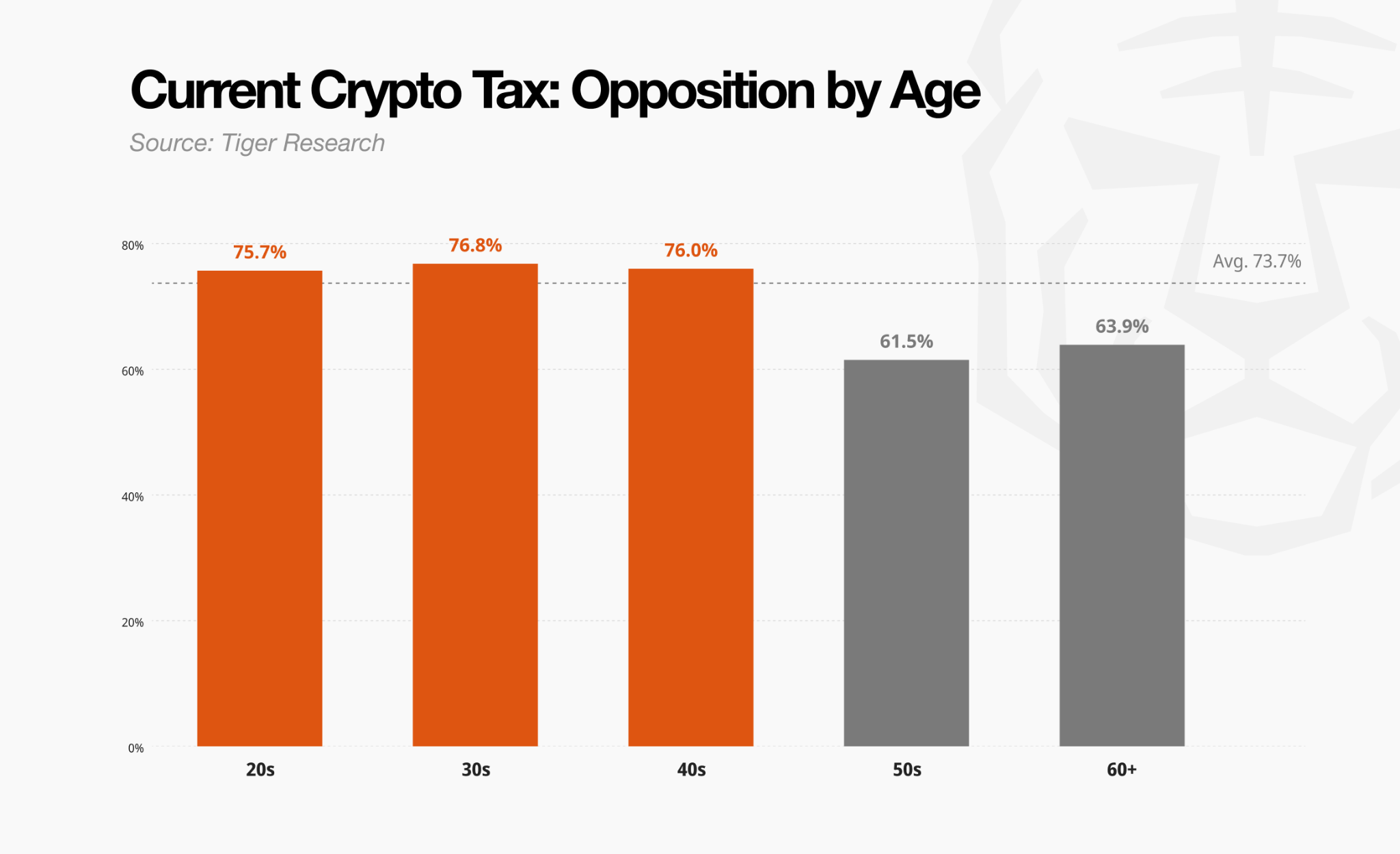
Opposition to crypto taxation appeared across all age groups. Overall, 73.7% of respondents opposed the tax. Opposition exceeded 75% among respondents in their 20s, 30s, and 40s. Among those in their 50s and those aged 60 or older, 61.5% and 63.9% opposed the tax, respectively. Opposition was strongest among respondents in their 20s to 40s, but negative views were not limited to younger investors.
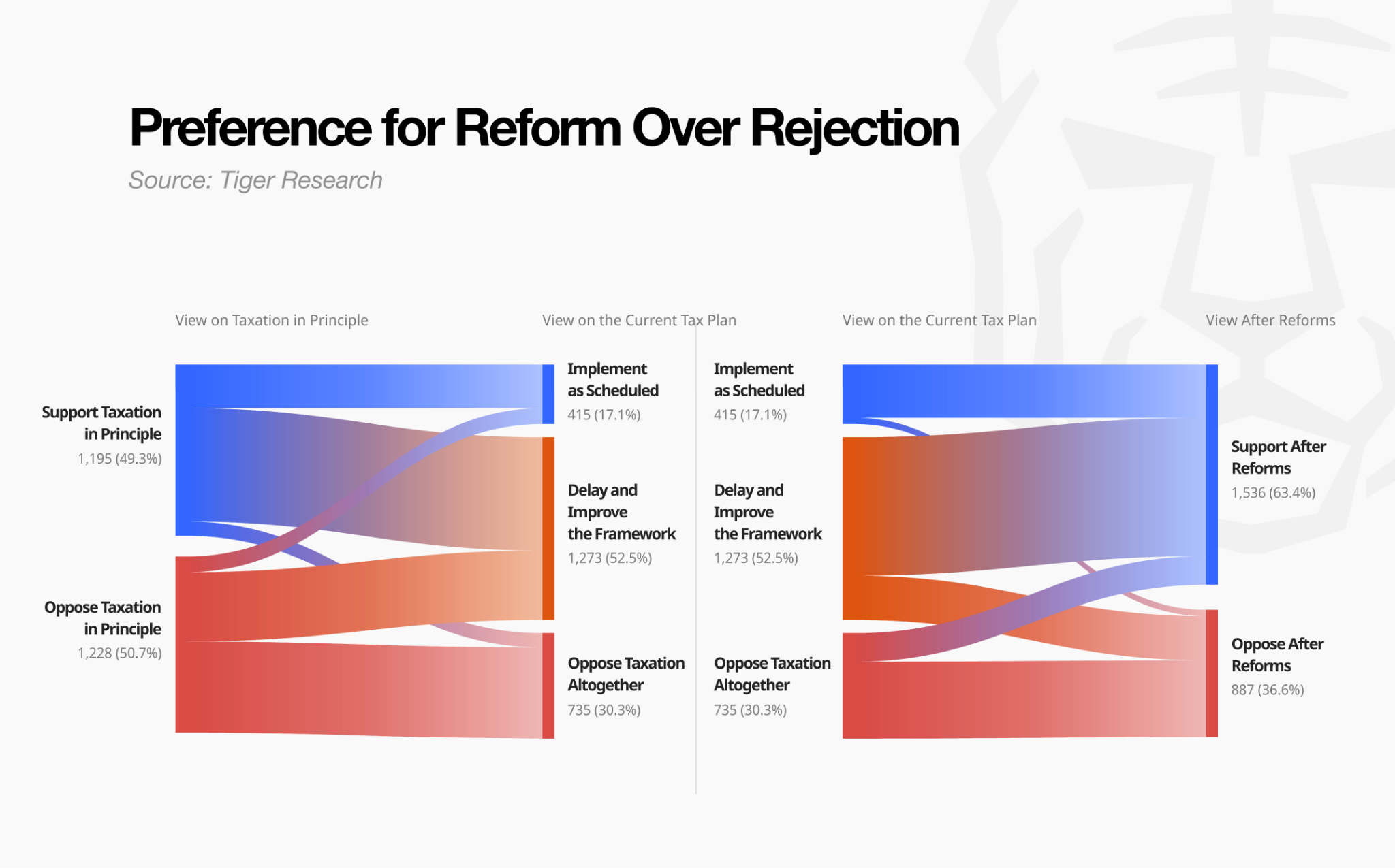
Support or opposition alone did not fully explain investors’ views. Among respondents who opposed the tax, 51.5% said they could accept it if the problems with the current plan were adequately addressed. At the same time, 74.5% of those who agreed that crypto should be taxed said the current plan should be postponed or revised rather than implemented as it stands.
These results show that many investors distinguish between crypto taxation itself and the current tax plan. Some who opposed the tax said they could accept it if the system improved. At the same time, many who agreed that crypto should be taxed did not support implementing the current plan as it stands. The gap became even clearer when investors assessed the specific rules and how ready the system is.
3. Investors' Main Concerns with the Current Tax Plan
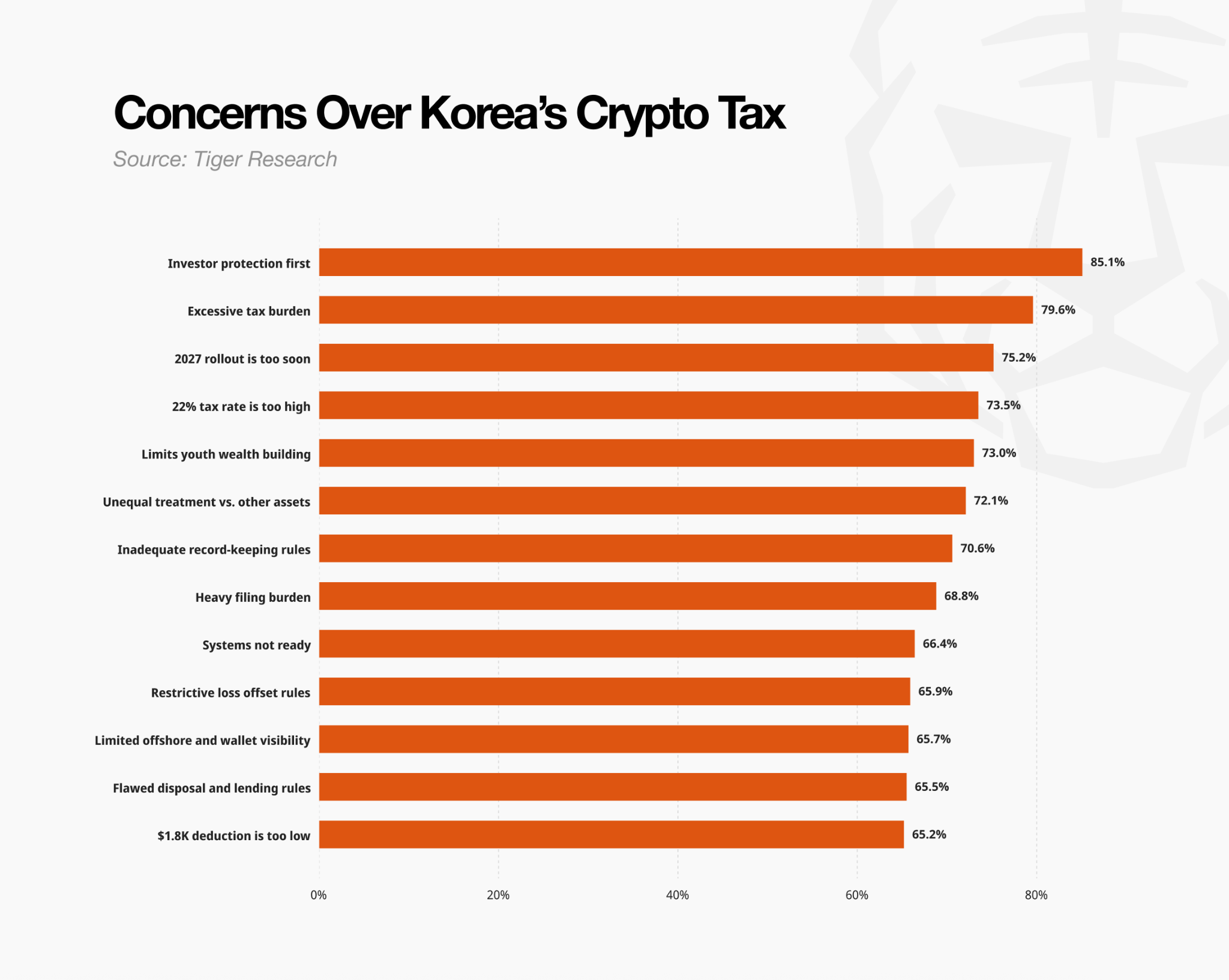
The detailed survey responses show why investors viewed crypto taxation and the current tax plan differently. Their concerns centered on three areas:
Whether the tax rate and deduction are appropriate and fair compared with other financial assets
Whether the system properly accounts for losses and acquisition costs when calculating taxable gains
Whether the system is ready to support tax filing and payment, track transactions, and protect investors
Investors looked beyond whether crypto should be taxed. They also considered how much they would pay, how the system would calculate taxable gains, and whether it was ready for implementation. The following sections examine these three issues.
3.1. Is the Tax Burden Fair?
Most respondents were critical of the tax burden under the current plan. Among all respondents, 73.5% said the 22% tax rate was too high. Another 65.2% said the annual basic deduction of about $1.8K was too low. In addition, 72.1% said the tax rules for crypto were unfair compared with those for other financial assets.
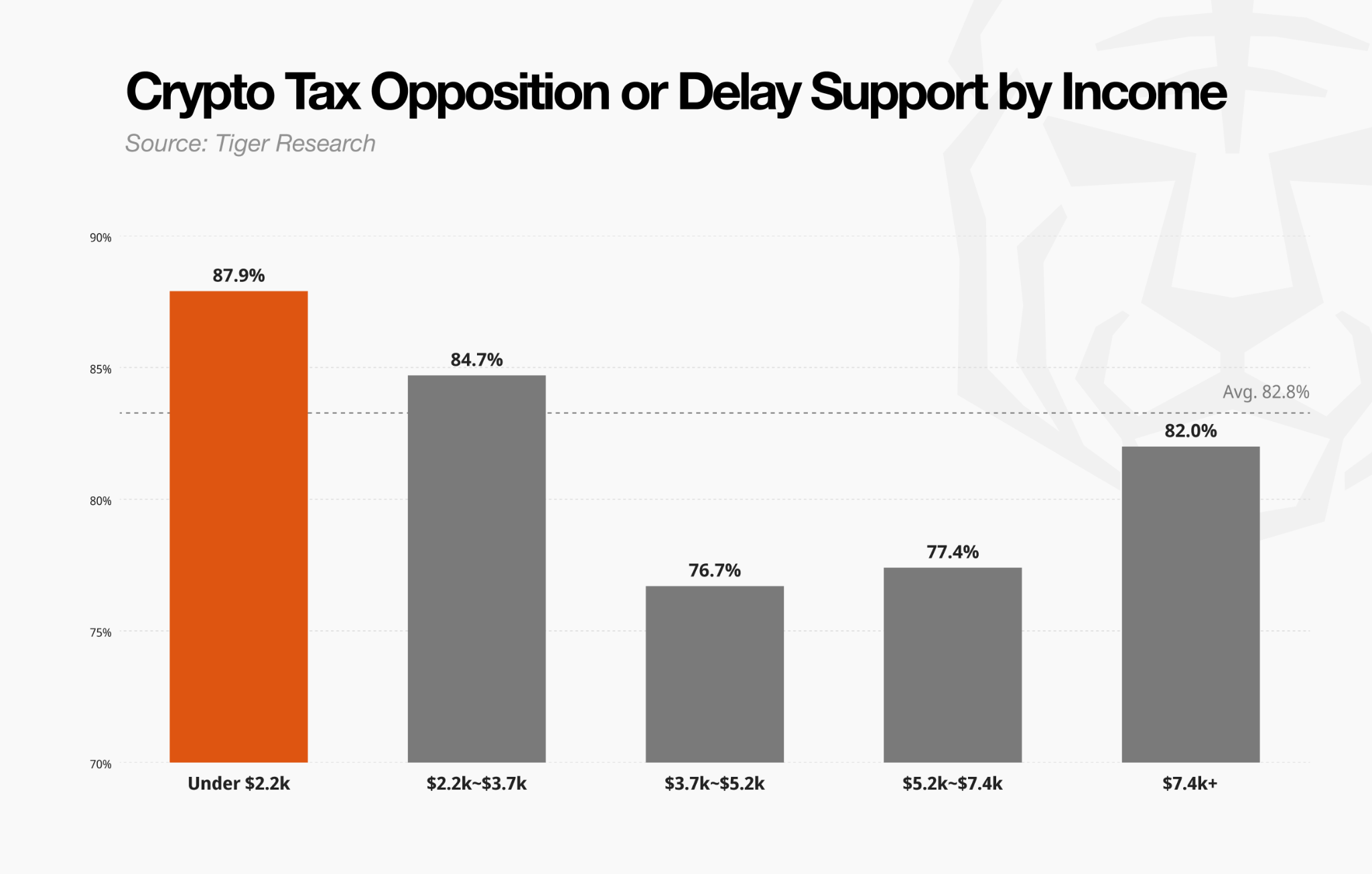
Lower-income investors also expressed strong concerns. Investors earning less than about $2.1K per month accounted for 24.9% of all respondents. Among this group, 87.9% opposed implementing the current plan as scheduled or called for another delay. This figure was higher than the 82.9% for all respondents. The results show that concerns about the current plan were not limited to higher-income investors.
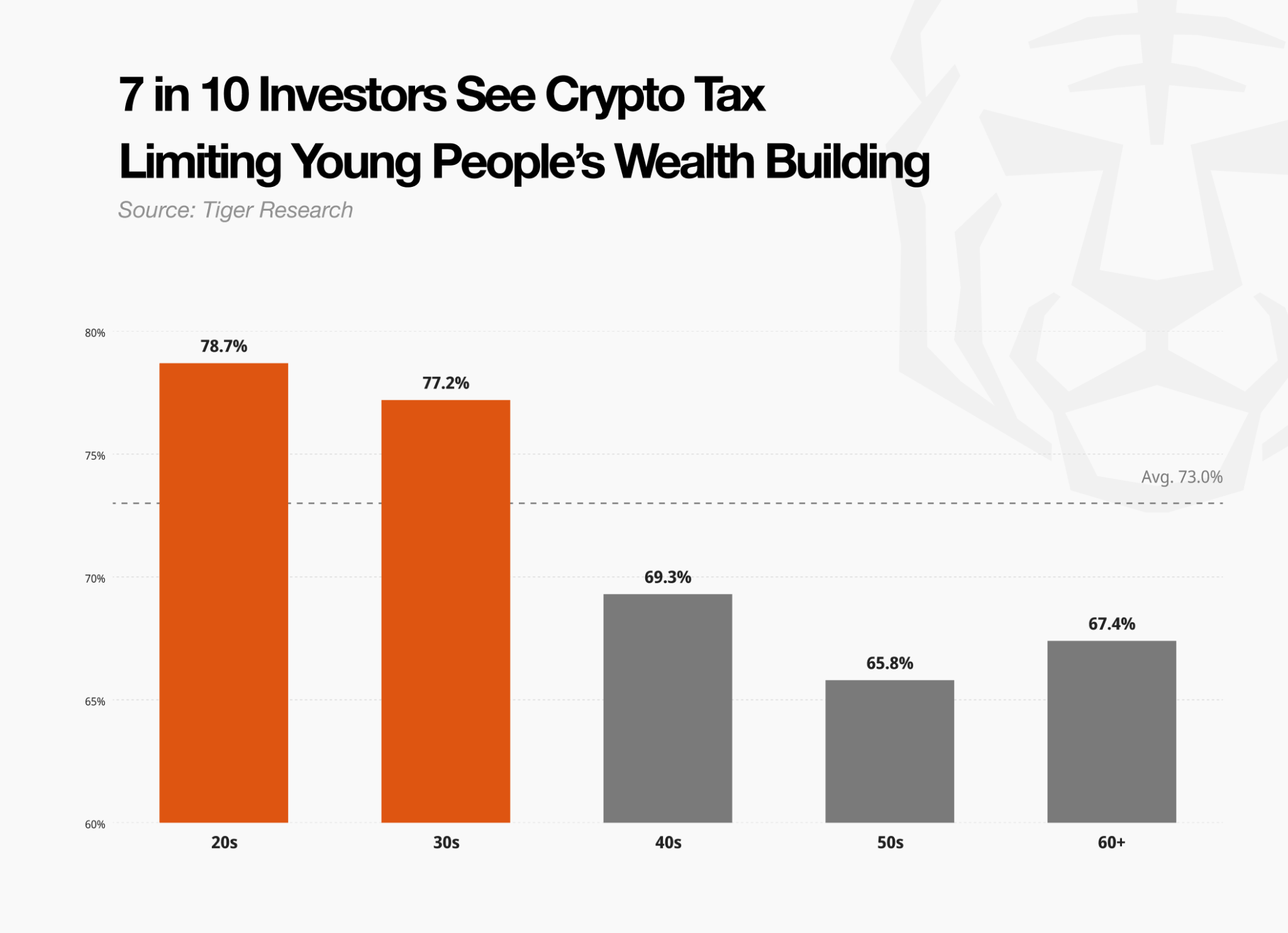
Respondents also worried about the impact on younger people’s ability to build wealth. Overall, 73.0% agreed that crypto taxation could limit wealth-building opportunities for people in their 20s and 30s. Respondents in their 20s showed the highest level of concern at 78.7%. Those in their 30s followed at 77.2%. Support for this view also exceeded 65% in every other age group.
The survey shows that investors’ concerns went beyond the tax rate and deduction. They also questioned whether the rules were fair compared with those for other financial assets. Lower-income investors shared these concerns. Respondents across age groups also worried about the impact on younger investors. Investors considered both the size of the tax burden and how the rules would affect different groups.
3.2. Can Taxable Gains Be Calculated Accurately?
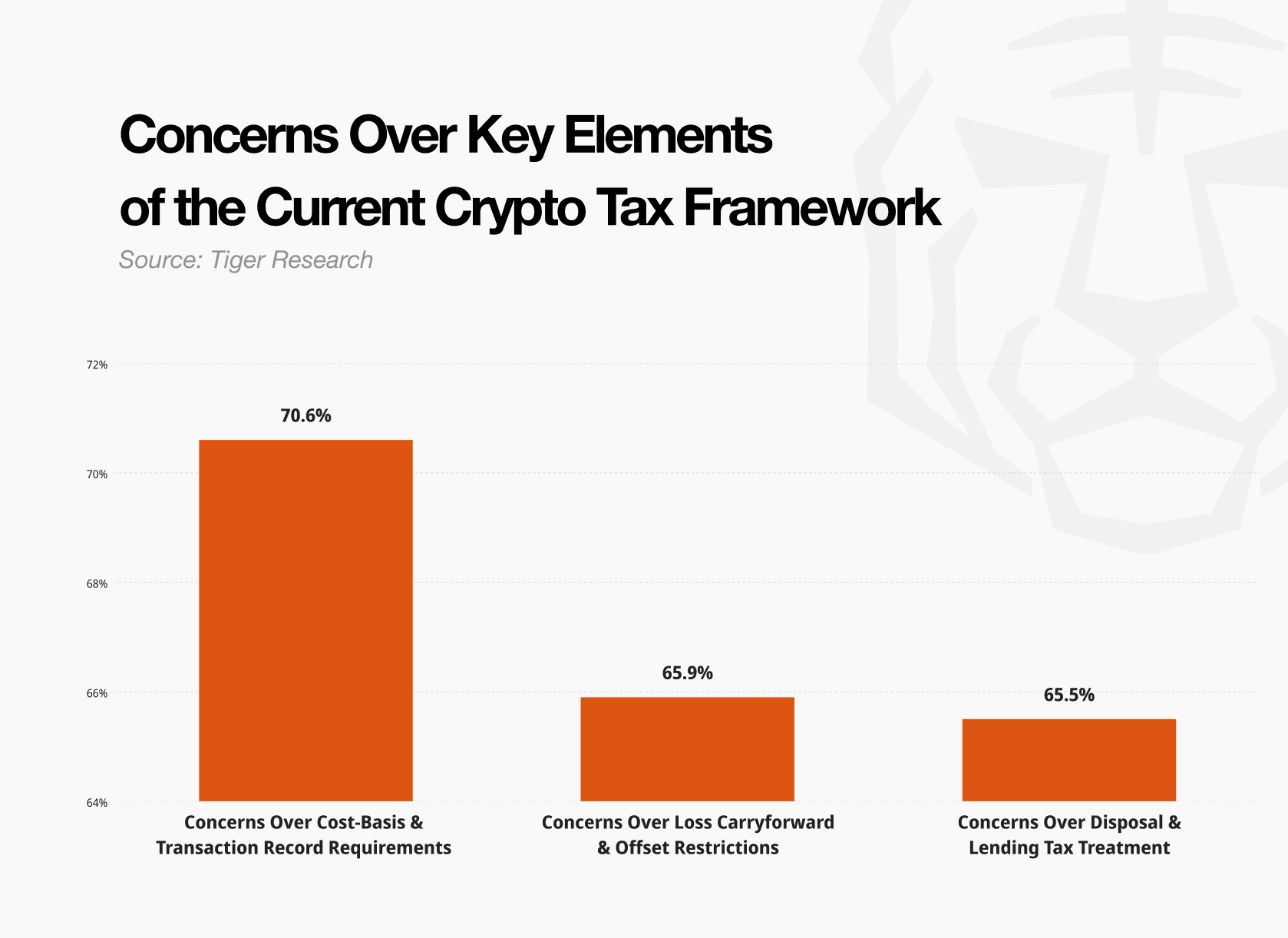
To calculate taxable gains accurately, the tax system must first determine how much an investor actually gained or lost. It also needs clear rules for losses, acquisition costs, and different types of crypto income. The survey found strong concerns in all three areas.
First, 65.9% of respondents said the current treatment of losses was inappropriate. Under the current rules, investors can offset crypto gains and losses within the same year. However, they cannot carry losses forward to offset gains in future years.
Crypto investors can experience gains and losses over several years. How the tax system treats those losses can therefore affect how accurately it calculates taxable income.
Respondents expressed even greater concern about acquisition costs and transaction records. Among respondents, 70.6% expressed concerns about the burden of calculating and reporting gains and losses based on their own transaction records and acquisition costs.
Crypto assets move across Korean and overseas CEXs and personal wallets. Investors also frequently exchange one crypto asset for another. As transaction paths become more complex, investors may find it harder to connect the original acquisition cost with later transactions.
Crypto income can also come from many different activities. These include trading, lending, staking, mining, airdrops, and liquidity provision. The current tax framework mainly covers income from transfers and lending. The rules therefore need to clarify which gains are taxable and when the tax applies. About 65% of respondents said the current framework does not adequately account for these different types of transactions.
The survey shows that investors were concerned about more than the tax rate. They also focused on how the system treats losses, determines acquisition costs, and classifies income from different transactions. These rules ultimately determine how the system calculates taxable income from an investor’s actual gains and losses.
3.3. Is the System Ready?
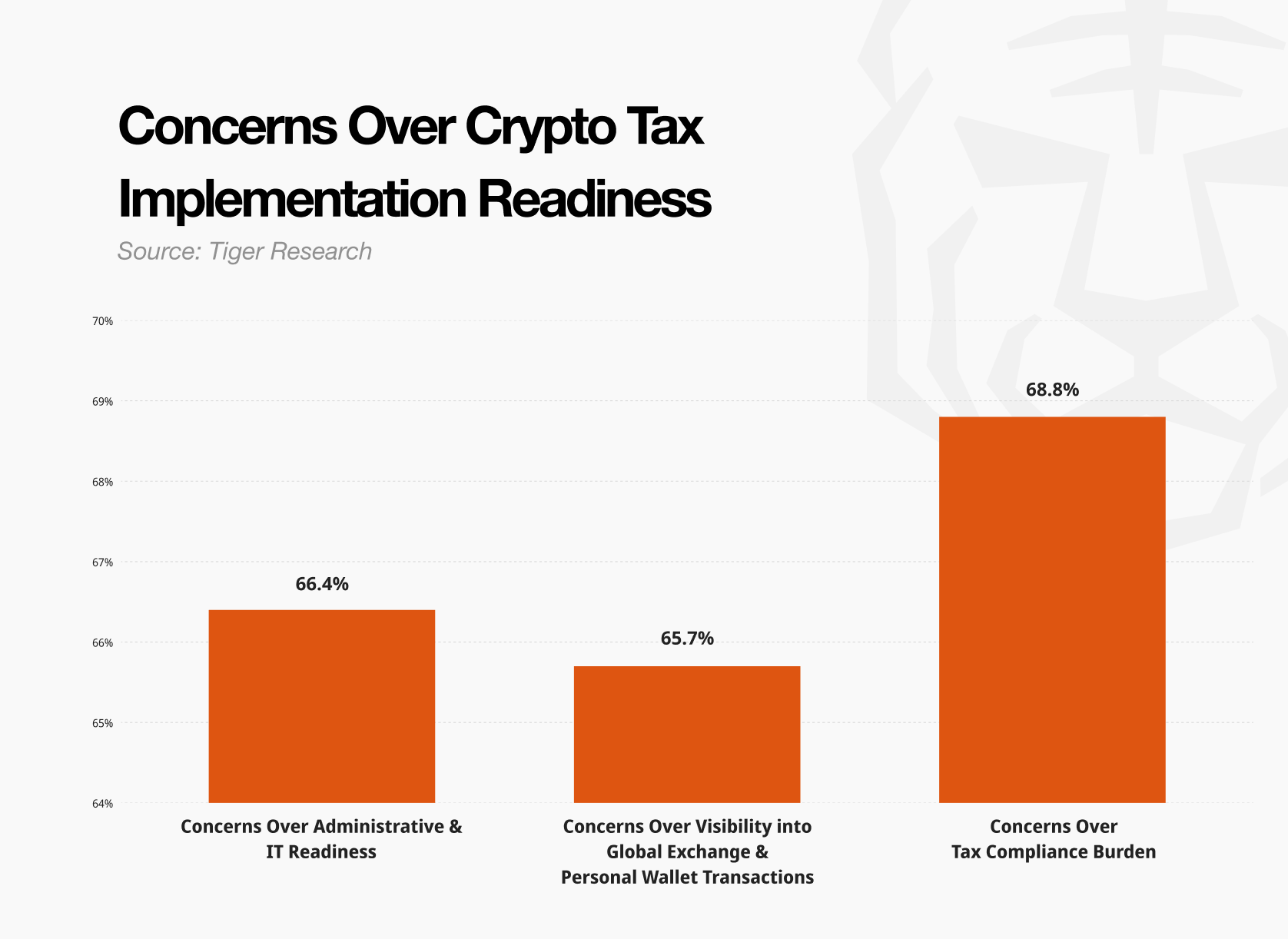
A tax system needs more than clear rules. It also needs the administrative and IT systems to put those rules into practice. In the survey, 66.4% of respondents said the government was not adequately prepared in these areas. Another 65.7% said it would be difficult to track and tax transactions accurately across Korean and overseas CEXs and personal wallets. In addition, 68.8% said investors would face a substantial burden when filing and paying the tax. Investors cared not only about the rules themselves, but also about whether the system could work in practice.
Crypto assets can move and trade outside Korean CEXs. When investors use global CEXs and personal wallets, transaction data can spread across multiple channels. This makes it harder to collect and connect the information needed for taxation. It also makes both reliable transaction tracking and the filing burden on investors important considerations.
Investors also looked beyond administrative and IT readiness. Overall, 85.1% agreed that an investor protection framework should be in place before the tax takes effect. The tax would create new tax obligations for investors. Investors saw market safeguards as part of overall readiness, alongside the government’s ability to assess and collect the tax.
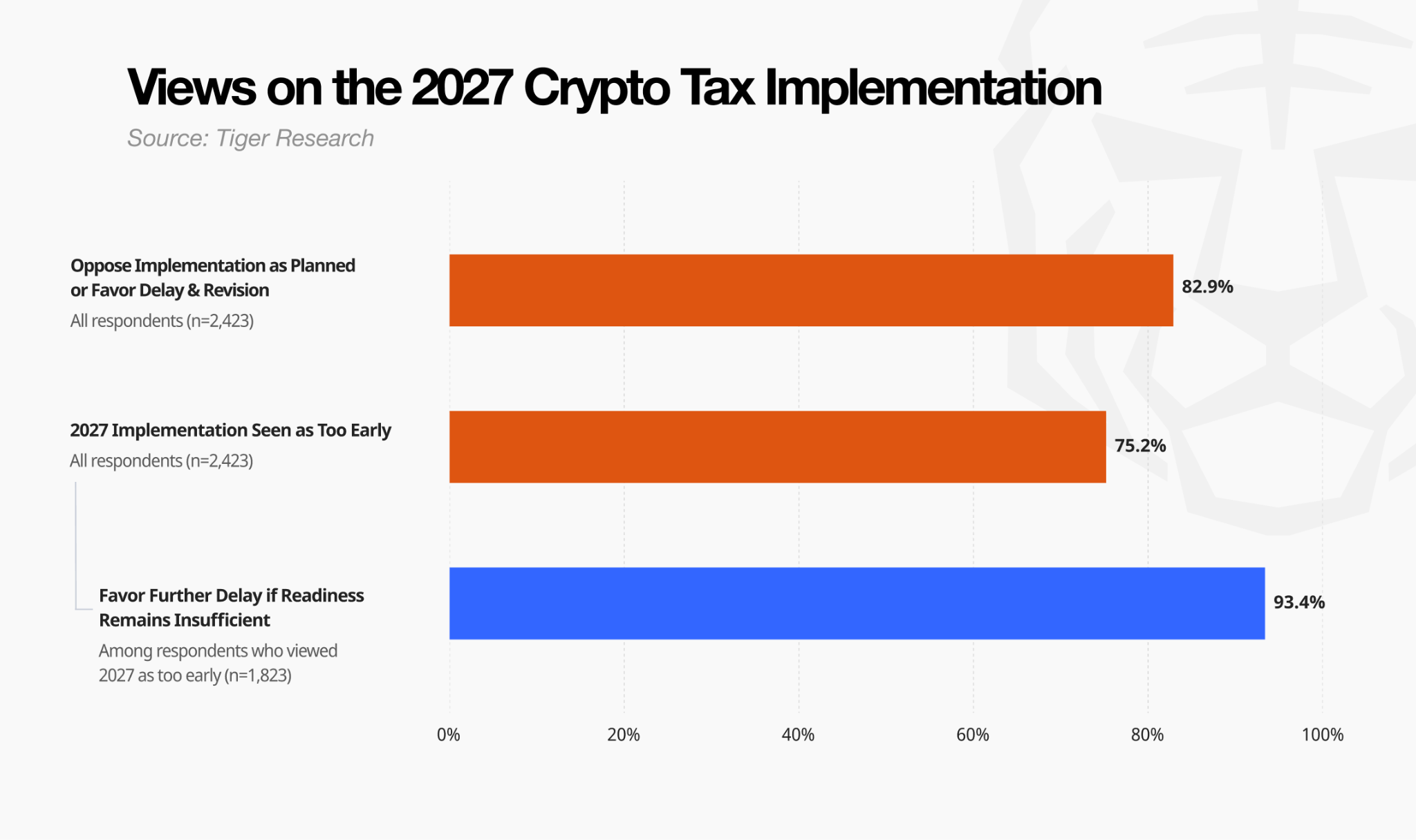
Responses on timing made this concern even clearer. Overall, 82.9% of respondents opposed implementing the current plan as scheduled or called for another delay. Another 75.2% said 2027 was too early. The survey then asked the 1,823 respondents who chose a later date what should happen if the necessary rules and preparations were still not in place by then. Among them, 93.4% said the tax should be postponed again until the system was ready.
For investors, the key issue was not simply how many years to delay the tax. They focused on whether the conditions for implementation were actually in place. These included tax administration, transaction data management, the filing system, and investor protection.
4. Impact on the Korean Market
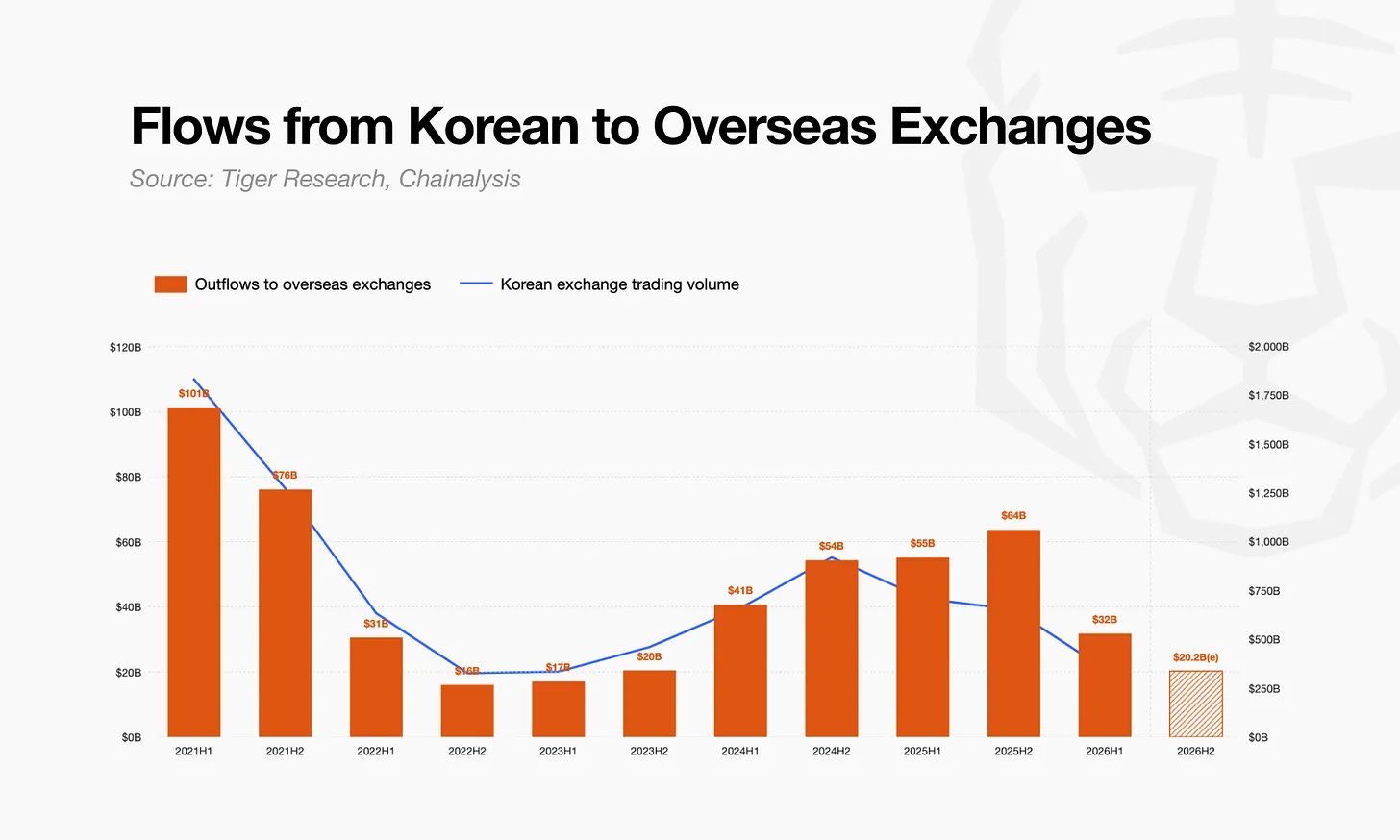
Investors’ views of the current tax plan also point to how their trading behavior could change after implementation. A substantial amount of Korean crypto investment has already moved overseas. According to estimates from a previous Tiger Research report, about KRW 700 trillion, or roughly $490 billion, moved overseas between 2021 and the first half of 2026. Investors also already make wide use of trading routes outside Korean CEXs, including global CEXs and personal wallets.
The survey also examined how investment levels and trading routes could change after the tax takes effect. The results suggest that investors may reduce their investments, use Korean CEXs less, and make greater use of other trading routes. If these intentions translate into actual behavior, the changes could weaken the trading base of the Korean crypto market. They could also make it harder for authorities to identify taxable activity and supervise the market.
4.1. Impact Beyond CEXs on Korea’s Crypto Industry
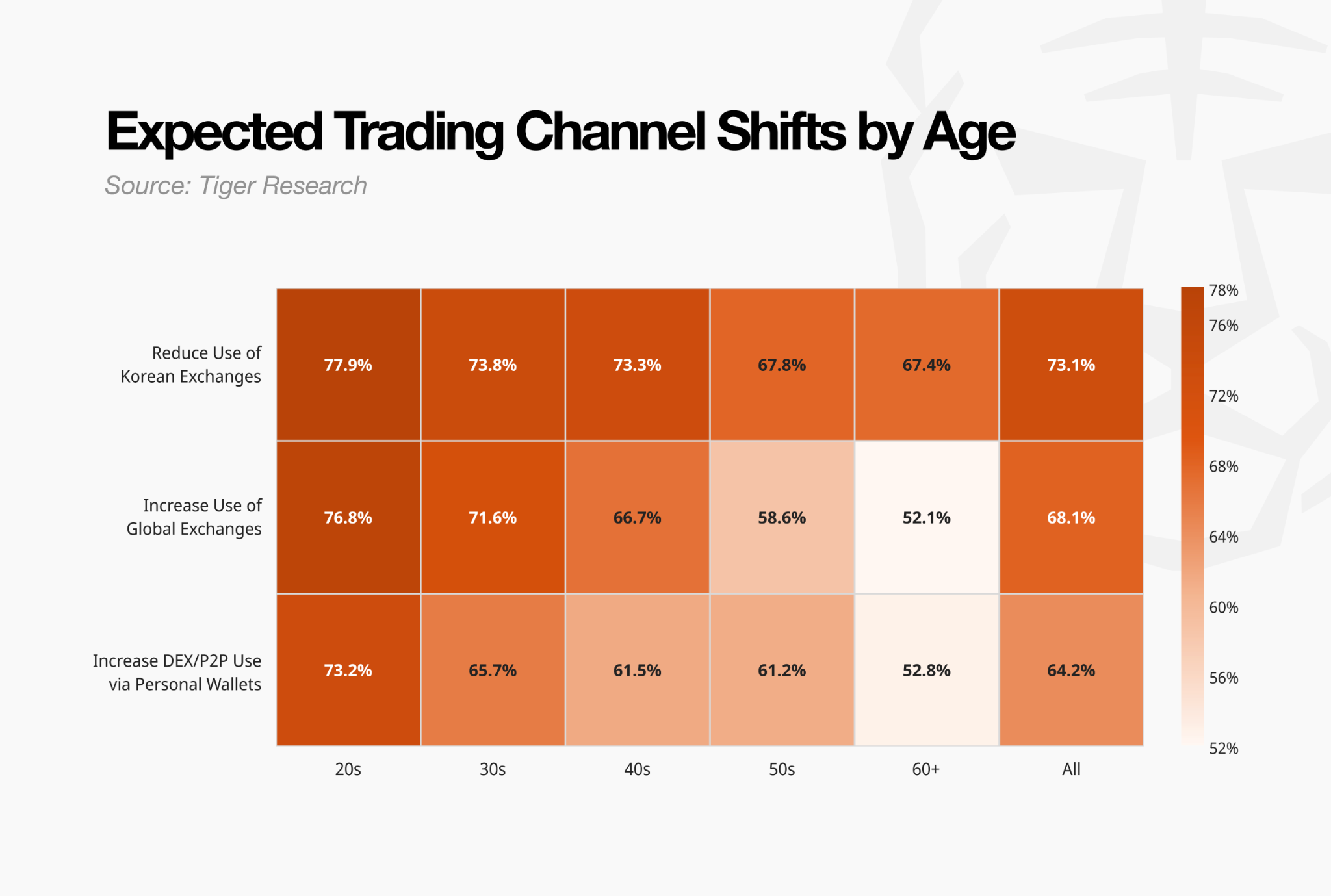
The survey suggests that the tax could reduce both crypto investment and the use of Korean CEXs. Overall, 69.7% of respondents said they expected to reduce or stop their crypto investments. Another 73.1% said they were likely to use Korean CEXs less. This could reduce both the amount of capital invested in crypto and trading activity on Korean CEXs.
Investors also expected these changes to affect the broader Korean market. Overall, 66.4% of respondents said the tax would have a negative impact on Korea’s crypto market. If investors reduce their crypto exposure or move capital to other financial assets, trading volume and liquidity in the Korean market could decline.
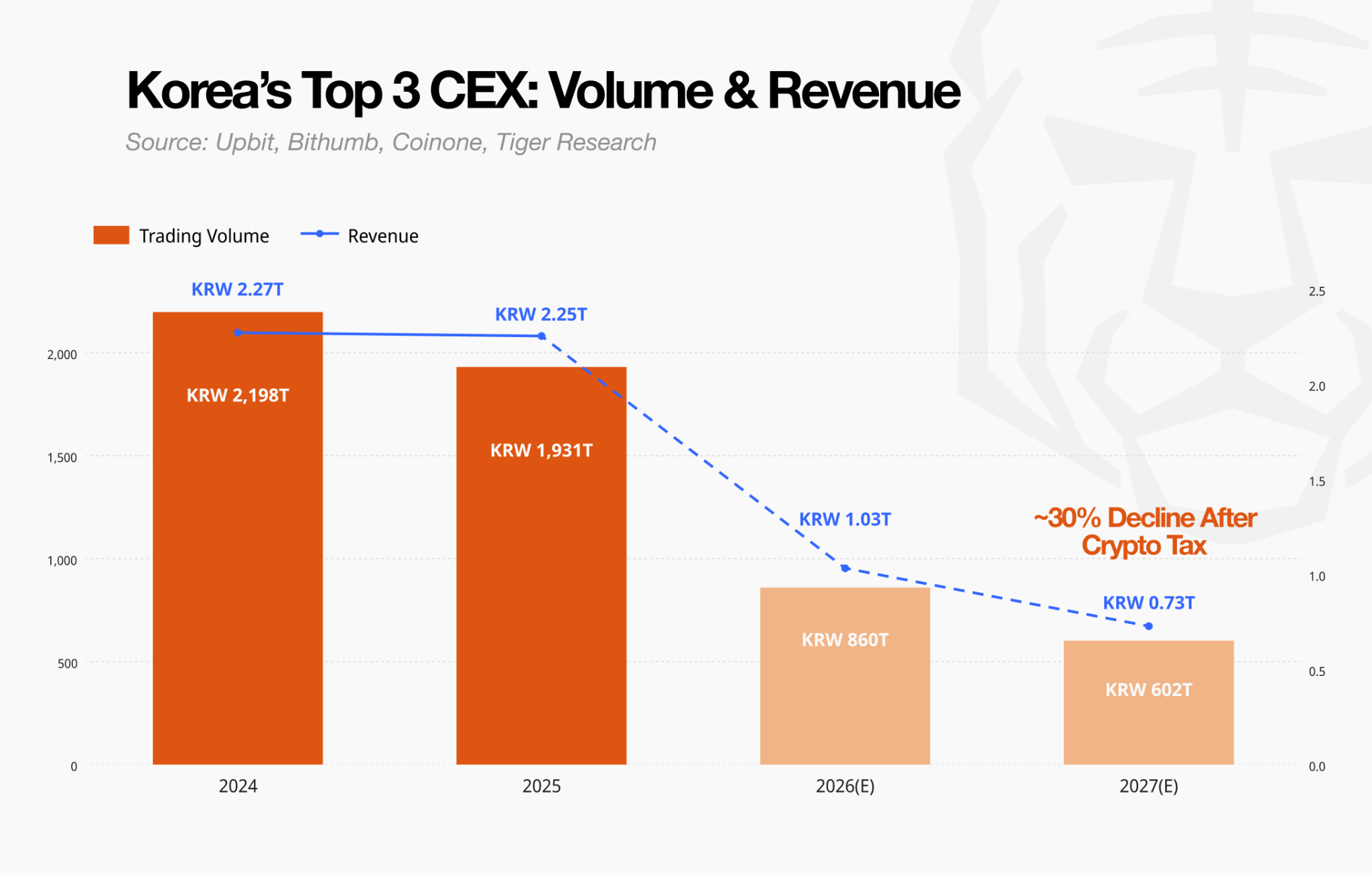
To estimate the potential scale of this impact, Tiger Research analyzed how trading volume and revenue at major Korean CEXs could change. The analysis combines the survey results with changes in crypto trading volume observed in countries that already tax crypto.
Tiger Research estimates that annual trading volume at Korea’s three largest CEXs, Upbit, Bithumb, and Coinone, could fall from about $601 billion in 2026 to $421 billion in 2027. This represents a decline of about $180 billion, or 30.0%. Over the same period, revenue at the three CEXs could fall from about $722 million to $509 million. This represents a decline of about $213 million, or 29.5%.
A decline in trading activity could also affect tax revenue and the broader crypto industry. Lower trading fees could reduce related value-added tax revenue. Lower CEX profits could also reduce corporate tax revenue.
Crypto income taxation could create a new source of tax revenue. However, a contraction in the Korean market could reduce existing tax revenues at the same time. This could weaken the overall revenue gains from the new tax. Lower liquidity and a smaller user base at Korean CEXs could also weaken the foundation for related financial services such as custody and prime brokerage.
4.2. The Shift to Offshore Trading and the Limits of CARF
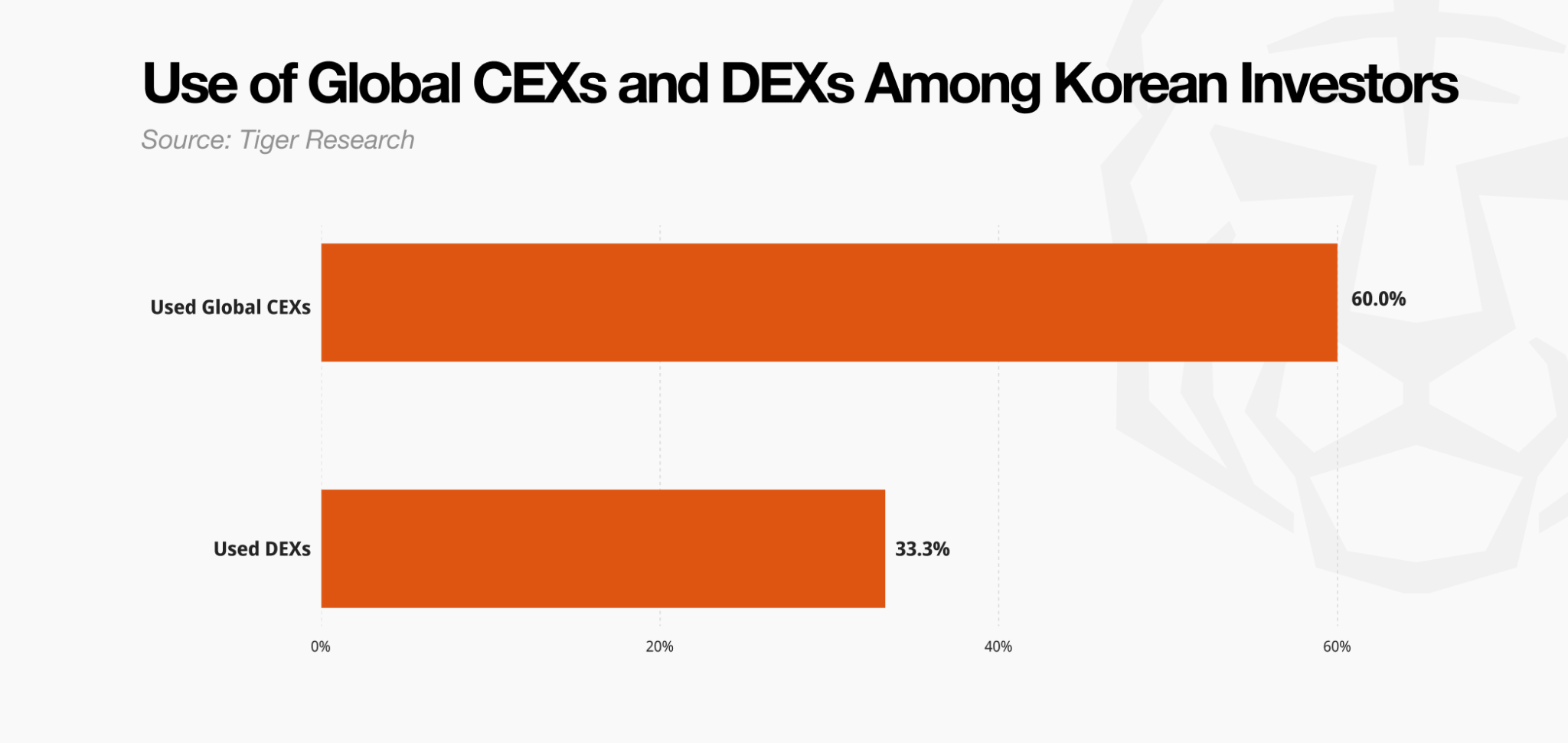
If investors use Korean CEXs less after the tax takes effect, some may shift their trading to global CEXs and personal wallets. Among investors who said they would use Korean CEXs less, 88.0% said they might increase their use of global CEXs or personal wallets. Among all respondents, 60.0% had already used a global CEX, and 33.3% had used a DEX.
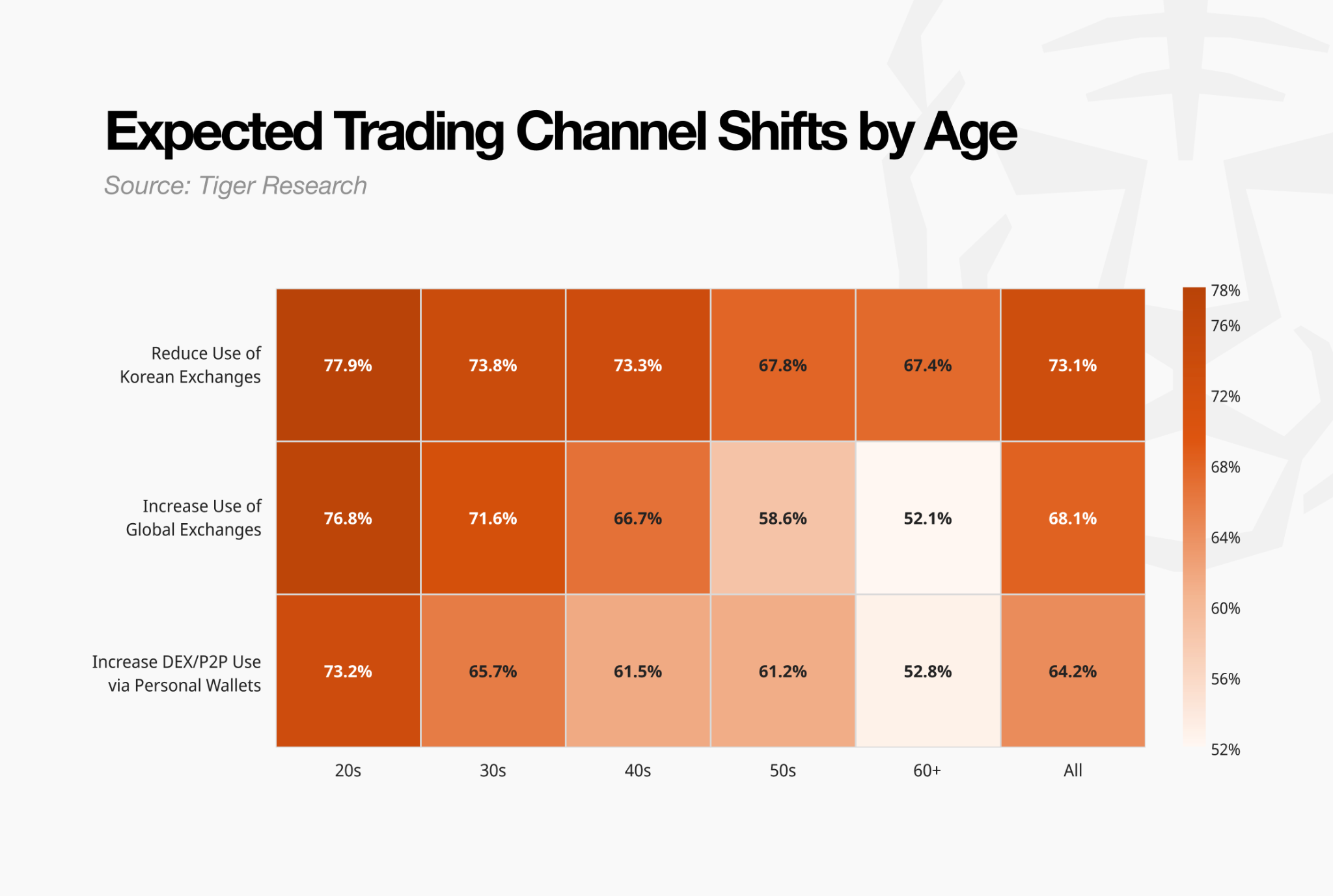
Younger investors showed the strongest tendency to shift their trading. Among respondents in their 20s, 76.8% said they would likely use global CEXs more after the tax takes effect. Another 73.2% said they would likely increase their use of DEXs or P2P transactions through personal wallets. Investors who already use overseas CEXs and on-chain services may find it relatively easy to move their trading outside Korean CEXs.
As more trading moves outside Korean service providers, tax authorities may find it harder to obtain the same level of transaction information. CARF can help address this gap. It allows tax authorities across countries to exchange transaction data reported by overseas crypto service providers.
However, countries plan to begin these exchanges at different times. Korea plans to start in 2027. Hong Kong, Singapore, and the UAE plan to start in 2028, while the United States plans to start in 2029. These different timelines could limit access to overseas transaction data during the early years of the tax.
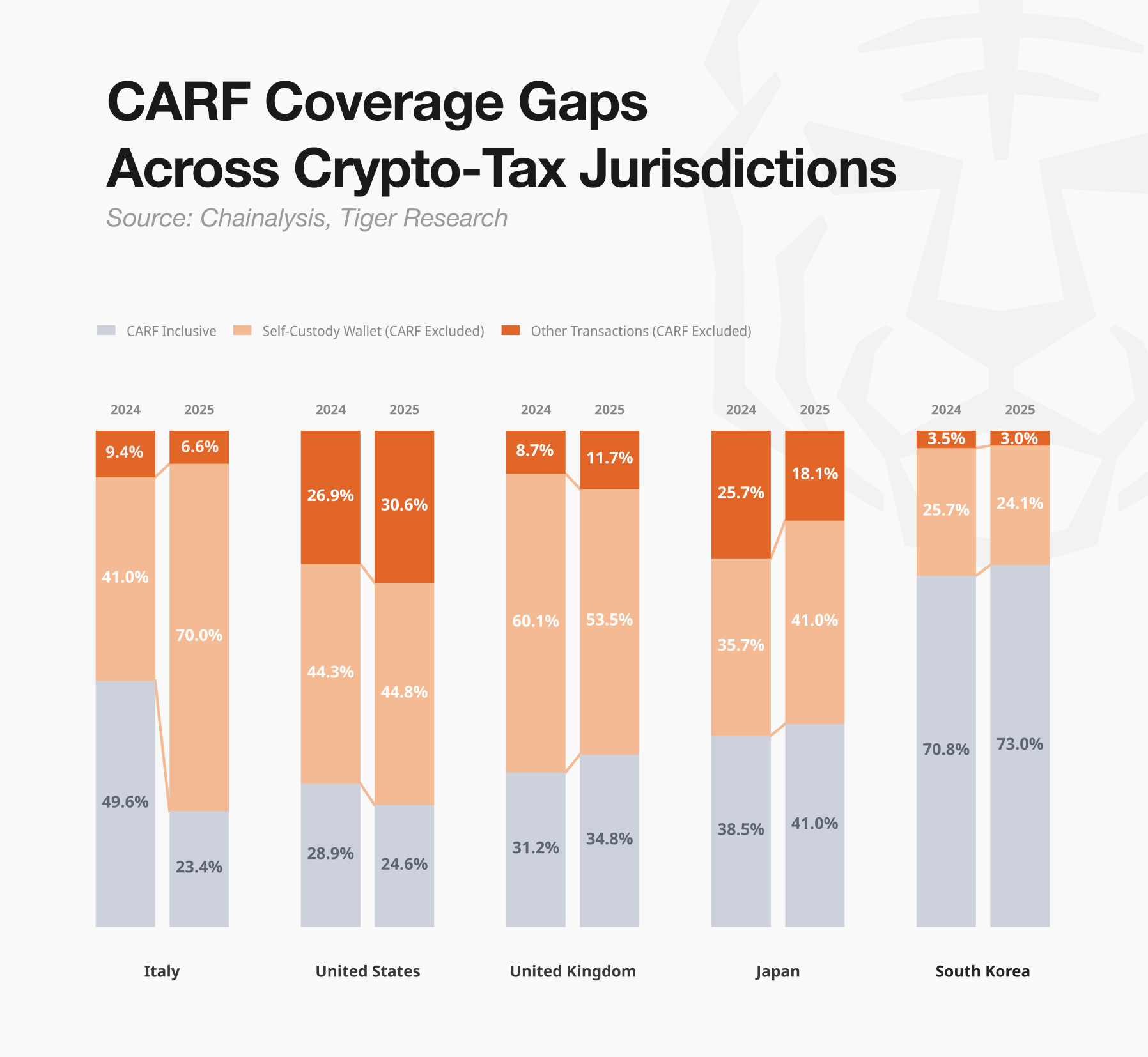
CARF also cannot capture the full flow of every transaction. According to Chainalysis, 59.1% of assets leaving CEXs in Japan moved to CARF non-covered routes in 2025. The share reached 65.2% in the United Kingdom, 75.4% in the United States, and 76.6% in Italy. In Italy, the share rose from 50.4% in 2024 to 76.6% in 2025. Transfers to personal wallets also increased by 45.7% over the same period.
These figures do not show that taxation directly caused the shift. However, they show that even in countries with crypto taxation and reporting systems, a substantial share of activity still moves through routes that service provider reporting alone cannot fully track.
This information gap could also raise concerns about tax fairness. Tax authorities can verify transactions on Korean CEXs more easily through data reported by service providers. They may need to rely more heavily on taxpayer reporting and subsequent verification for transactions through overseas CEXs and personal wallets. If investors believe that tax authorities can track some trading routes more easily than others, that perception could encourage more activity to move to overseas CEXs and DEXs.
Before the tax takes effect, the government needs to clarify the rules for acquisition costs and information reporting. It also needs to establish how tax authorities will verify gains and losses from transactions through overseas CEXs and personal wallets.
5. Rushing the Tax Risks Both the Industry and Tax Revenue
The central issue is not taxation itself. The question is whether Korea should implement the current plan in 2027 before the system is ready. Under current law, the tax on crypto income will take effect in January 2027. The survey shows that investors distinguish between the need for taxation and the current tax plan. Even supporters of crypto taxation said the rules need improvement. Some opponents also said they could accept the tax if the system improves.
Policymakers also need to consider the market impact of implementing the tax before the system is ready. As discussed above, investment and trading in Korea could decline. Some activity could also move to global CEXs and personal wallets.
These changes could weaken the trading base and competitiveness of the Korean market. They could also spread transaction data across more channels. This would make it harder for tax authorities to track the tax base. Creating a new tax base and managing it reliably in practice are separate challenges.
Policymakers should first determine whether the system can work under real market conditions. They should not set the implementation date first and address the remaining gaps later. The survey shows that investors cared more about whether the system was ready than about any specific year. Policymakers should define the conditions required for implementation before deciding when the tax should take effect.
Three areas require particular attention.
First, policymakers should assess tax readiness together with the broader state of market regulation. Tax administration alone is not enough. The market also needs clear rules, investor protection, and standards for new assets and services. Policymakers should assess both the government’s ability to collect the tax and the readiness of the market in which the tax will apply.
Second, policymakers need clear criteria to determine whether the tax can work in practice. They should assess how well the system can connect transaction data and calculate gains and losses. They should also confirm that taxpayers can correct errors when they occur. These criteria would allow policymakers to judge readiness based on actual implementation rather than a fixed schedule or the completion of IT systems alone.
Third, policymakers should conduct mock filings and pilot programs that reflect real trading conditions. The tests should cover more than simple cases involving Korean CEXs. They should also include global CEXs, personal wallets, and DEXs. Policymakers should identify missing transaction data, problems with acquisition costs, and recurring filing errors before the tax takes effect.
Policymakers should also consider public acceptance. The survey found strong concern that the tax could limit wealth-building opportunities, particularly among younger investors. Respondents across age groups also raised concerns about fairness compared with other financial assets. Technical readiness alone is not enough. Investors also need to view the tax rules and burden as fair.
The debate over the 2027 tax should go beyond whether Korea keeps the current start date. Policymakers need to assess whether the system can calculate gains and losses accurately under real trading conditions. They also need to confirm that tax authorities can obtain the necessary transaction data. Market rules and investor protection also need to be in place. Investors must also see the tax standards as fair. If Korea moves ahead before the system is ready, it could weaken both the competitiveness of the domestic market and the government’s ability to manage the tax base.
Appendix. Chainalysis-Based CARF Transaction Classification Criteria
This report uses analysis from Chainalysis to examine the share of crypto transactions that fall within CARF’s practical reporting scope across countries. Chainalysis analyzes activity across CEXs, personal wallets, DEXs, and DeFi. This allows us to examine transactions that service provider reporting alone may not fully capture.
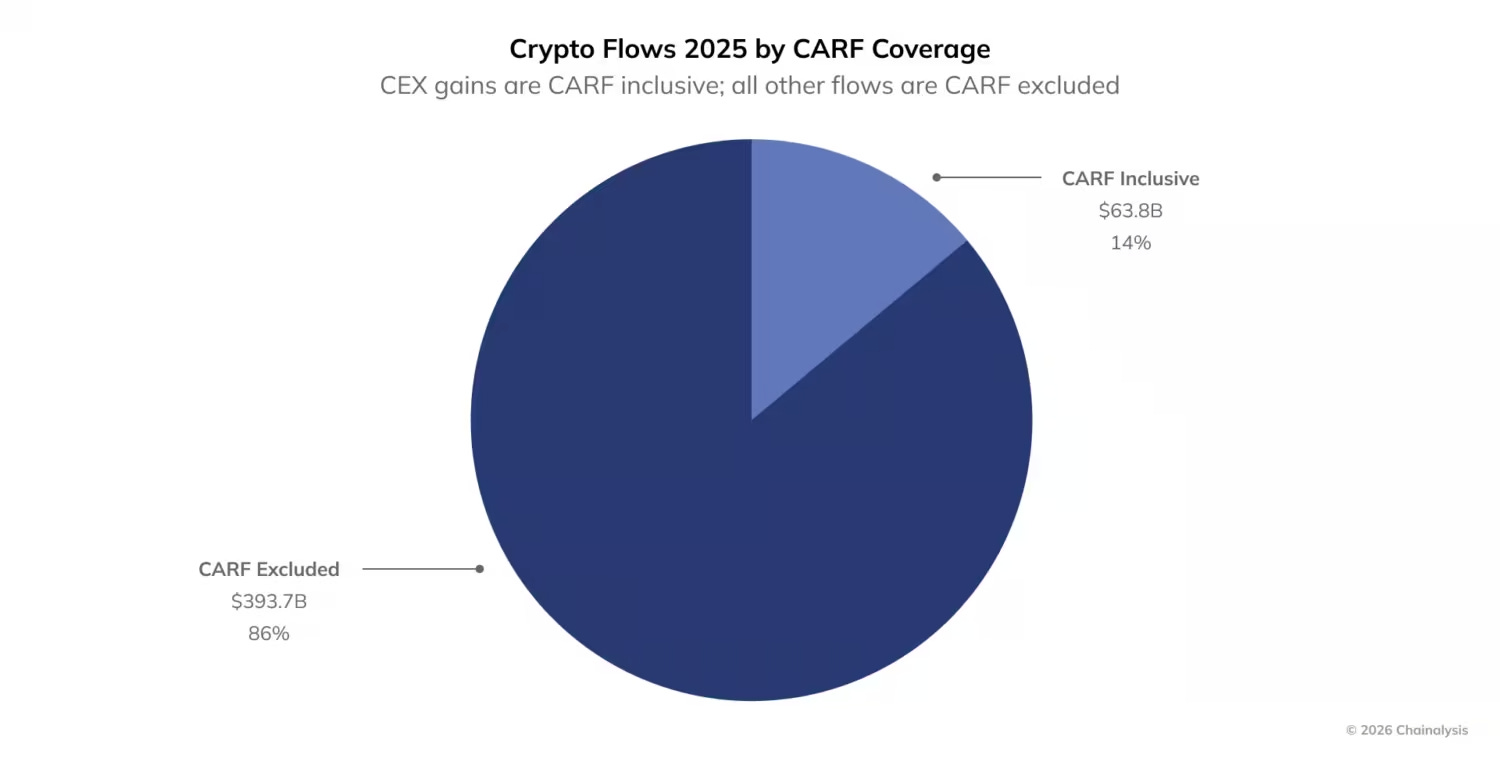
The Crypto-Asset Reporting Framework (CARF) is an international reporting framework. It requires crypto-asset service providers to report user and transaction information to tax authorities, which can then exchange the information across jurisdictions. Based on Chainalysis’ classification, this report defines transactions within CARF’s practical reporting scope as “CARF-covered” and transactions outside that scope as “CARF non-covered.” CARF non-covered activity includes some transactions after assets move to personal wallets, as well as activity involving DEXs, P2P transfers, DeFi, mining, and staking.
However, “CARF non-covered” does not mean that a taxpayer failed to report a transaction or evaded tax. A service provider may report the initial withdrawal to a personal wallet, but it may not have visibility into every transaction that follows. In this report, “CARF non-covered” refers only to the scope of transactions that service provider reporting can identify.
🐯 More from Tiger Research
Read more reports related to this research.Disclaimer
This report has been prepared based on materials believed to be reliable. However, we do not expressly or impliedly warrant the accuracy, completeness, and suitability of the information. We disclaim any liability for any losses arising from the use of this report or its contents. The conclusions and recommendations in this report are based on information available at the time of preparation and are subject to change without notice. All projects, estimates, forecasts, objectives, opinions, and views expressed in this report are subject to change without notice and may differ from or be contrary to the opinions of others or other organizations.
This document is for informational purposes only and should not be considered legal, business, investment, or tax advice. Any references to securities or digital assets are for illustrative purposes only and do not constitute an investment recommendation or an offer to provide investment advisory services. This material is not directed at investors or potential investors.
Terms of Usage
Tiger Research allows the fair use of its reports. ‘Fair use’ is a principle that broadly permits the use of specific content for public interest purposes, as long as it doesn’t harm the commercial value of the material. If the use aligns with the purpose of fair use, the reports can be utilized without prior permission. However, when citing Tiger Research’s reports, it is mandatory to 1) clearly state ‘Tiger Research’ as the source, 2) include the Tiger Research logo. If the material is to be restructured and published, separate negotiations are required. Unauthorized use of the reports may result in legal action.


