

The global digital asset market has expanded into derivatives, payments, and on-chain services, while Korea remains centered on spot trading. Korean investors have moved unmet demand overseas. Tiger Research and Chainalysis tracked roughly 120,000 Korea-linked wallets to analyze about KRW 700 trillion in outflows from 2021 to 2026.
Key Takeaways
Korean investors are moving money overseas to access products unavailable in Korea. About KRW 700 trillion left domestic exchanges between 2021 and 2026.
The money does not stop at foreign exchanges. Korean investors also trade derivatives on DEXs, participate in prediction markets, and spend stablecoins with crypto cards.
Foreign exchanges capture more than trading fees. They also gain customers, data, and operating know-how from Korean demand.
1. A Growing Global Market, a Stalled Korean One
The global digital asset market is taking a different shape. Institutional capital is entering a market that grew up around retail spot trading, and blockchain now extends across the financial value chain. Both the type of capital the market draws and the ways investors use digital assets are changing.
Bitcoin and Ethereum spot ETFs have widened institutional access to the market, and derivatives markets for perpetual futures and options are growing quickly. Stablecoins have expanded beyond a means of trading crypto into payments and remittance, and tokenization of real-world assets is changing how issuers create and distribute assets. The global market reaches well beyond trading into finance more broadly.
These changes are not moving at the same pace everywhere. The Korean market still centers on retail spot trading, and institutional participation remains limited. Derivatives and newer financial services that are growing in the global market have yet to form a meaningful market in Korea. As the global market broadens, the structural gap with Korea widens.
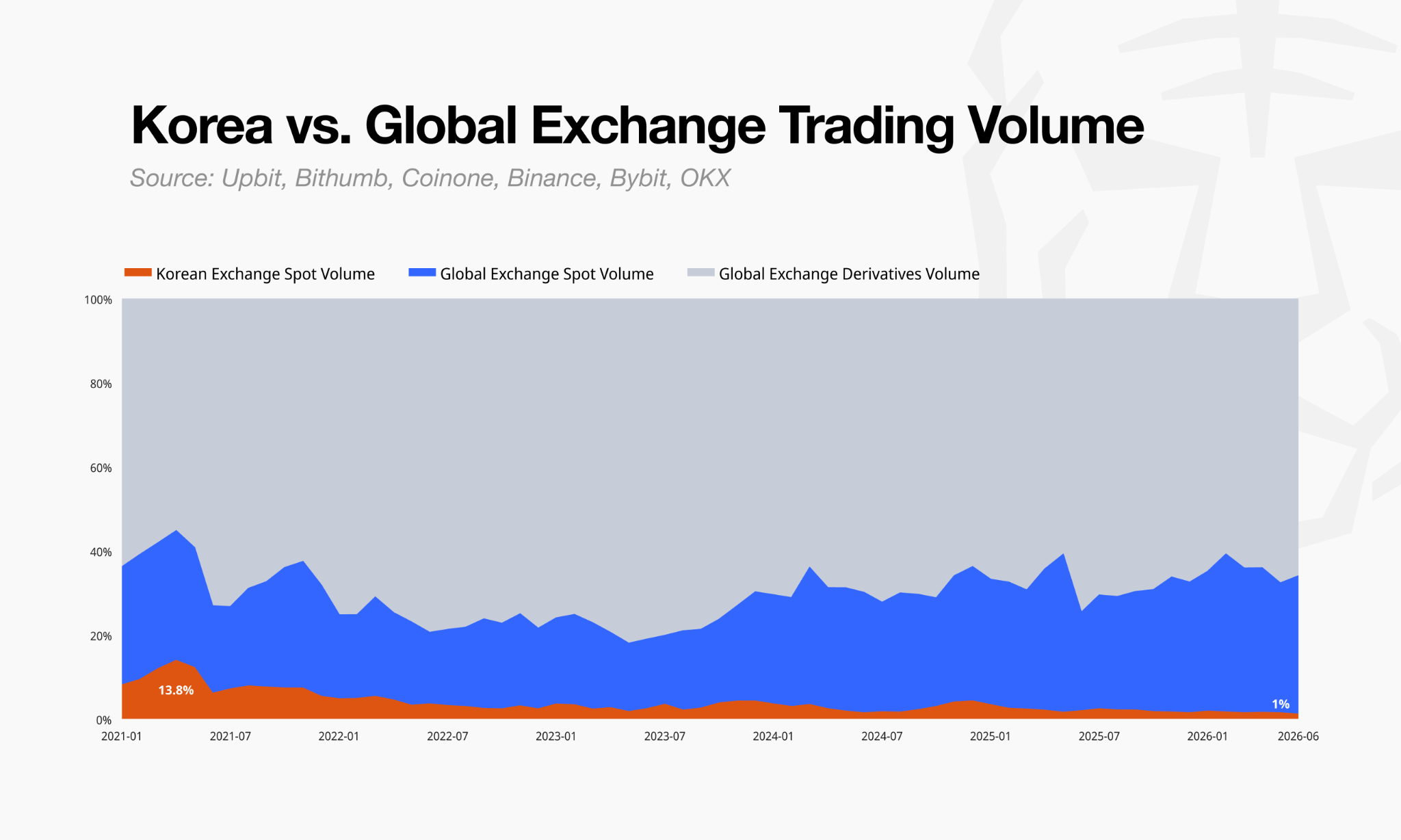
This gap is visible in trading volume as well. Global exchanges have expanded into perpetual futures and other products alongside spot, while trading in Korea remains concentrated in spot alone. Korean exchanges therefore account for a steadily smaller share of combined volume across major Korean and global venues. Volume is only one measure of a market, yet it shows that the Korean market is losing ground as the global market expands.
2. Unmet Demand, Investors Heading Offshore
The Korean market’s declining share does not mean Korean investors have lost interest. Products and services difficult to access at home have expanded rapidly abroad, and investors have moved to foreign exchanges and on-chain services to reach them. Unmet demand in Korea has not disappeared. It now shows up as actual trading and service use abroad.
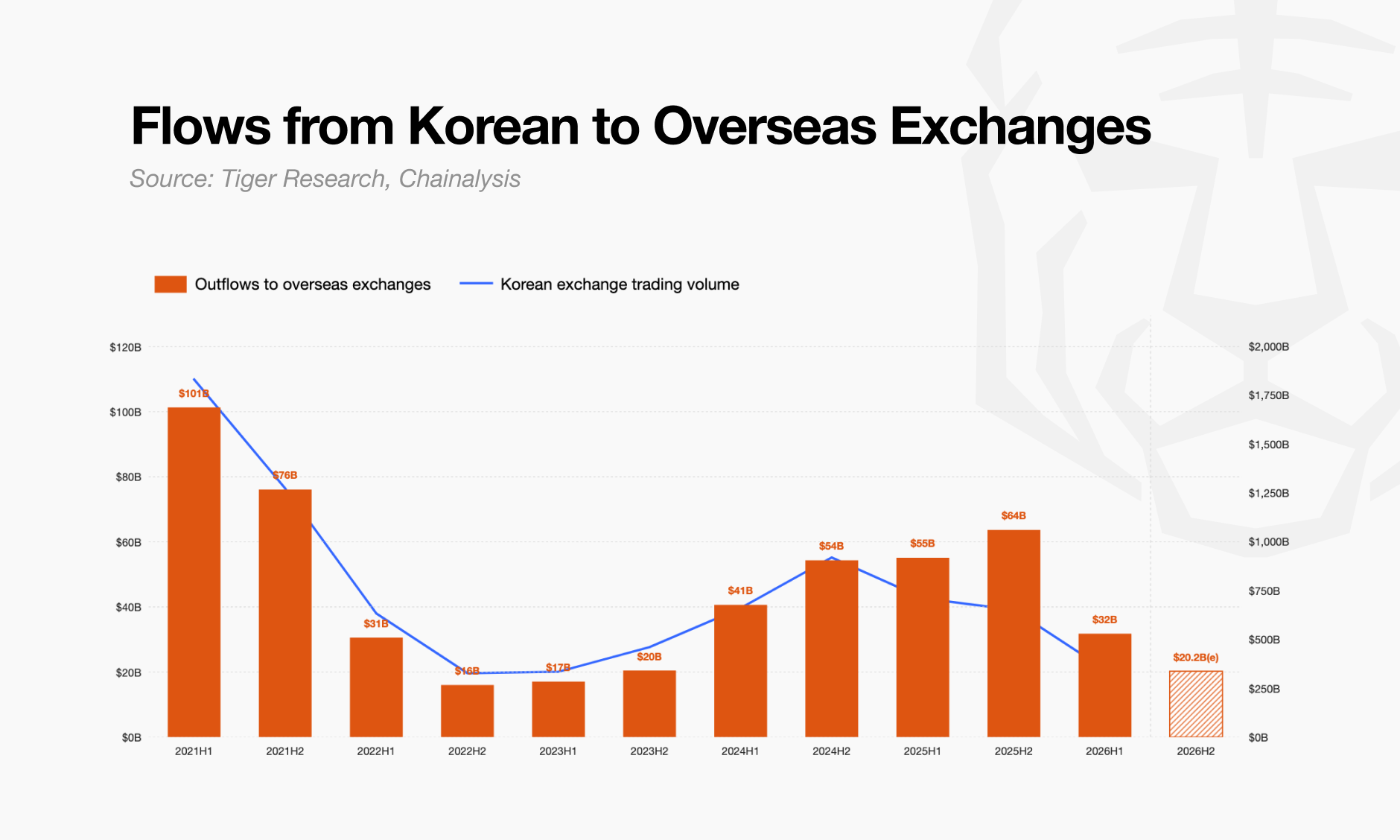
The scale is significant. Tiger Research partnered with Chainalysis to analyze on-chain data that tracks cryptocurrency flows from Korean to overseas exchanges. Between 2021 and 2026, an estimated $530 billion moved overseas through these channels. Outflows reached approximately $120 billion in 2025 and are projected to reach approximately $52 billion in 2026. These figures capture only identifiable flows, and the true scale is likely larger.
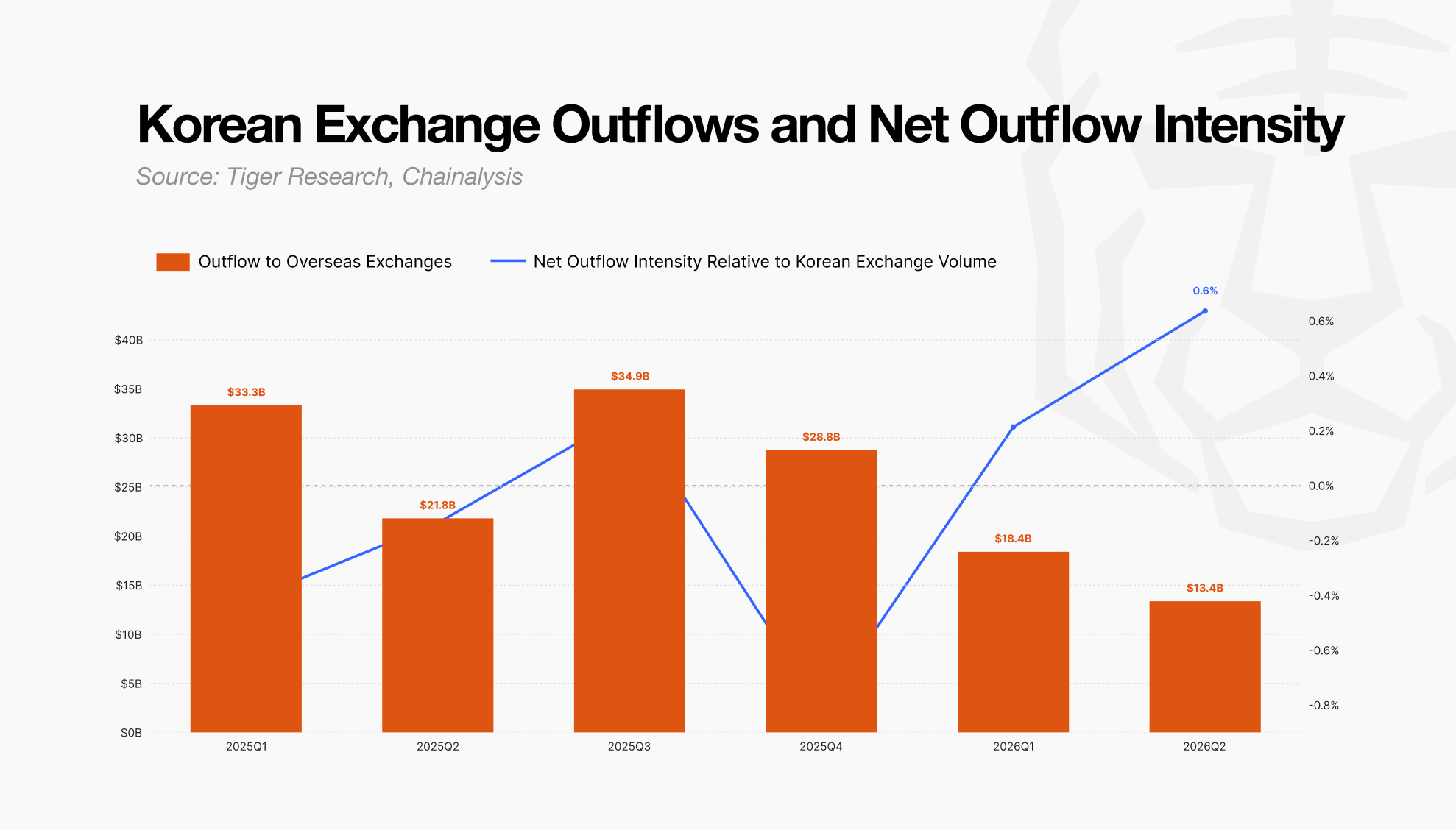
Absolute outflow figures alone can make outflows look as though they have slowed. Market-wide contraction pulls down trading volume in Korea and outflows together, so absolute amounts say little about how strong the outflow is. To measure this more accurately, the analysis introduces a net outflow ratio. The ratio divides net outflows to foreign exchanges by the combined spot volume of Korea’s three major exchanges, Upbit, Bithumb, and Coinone. Absolute outflows have declined, but the net outflow ratio has risen. Capital is leaving faster than the Korean market is shrinking.
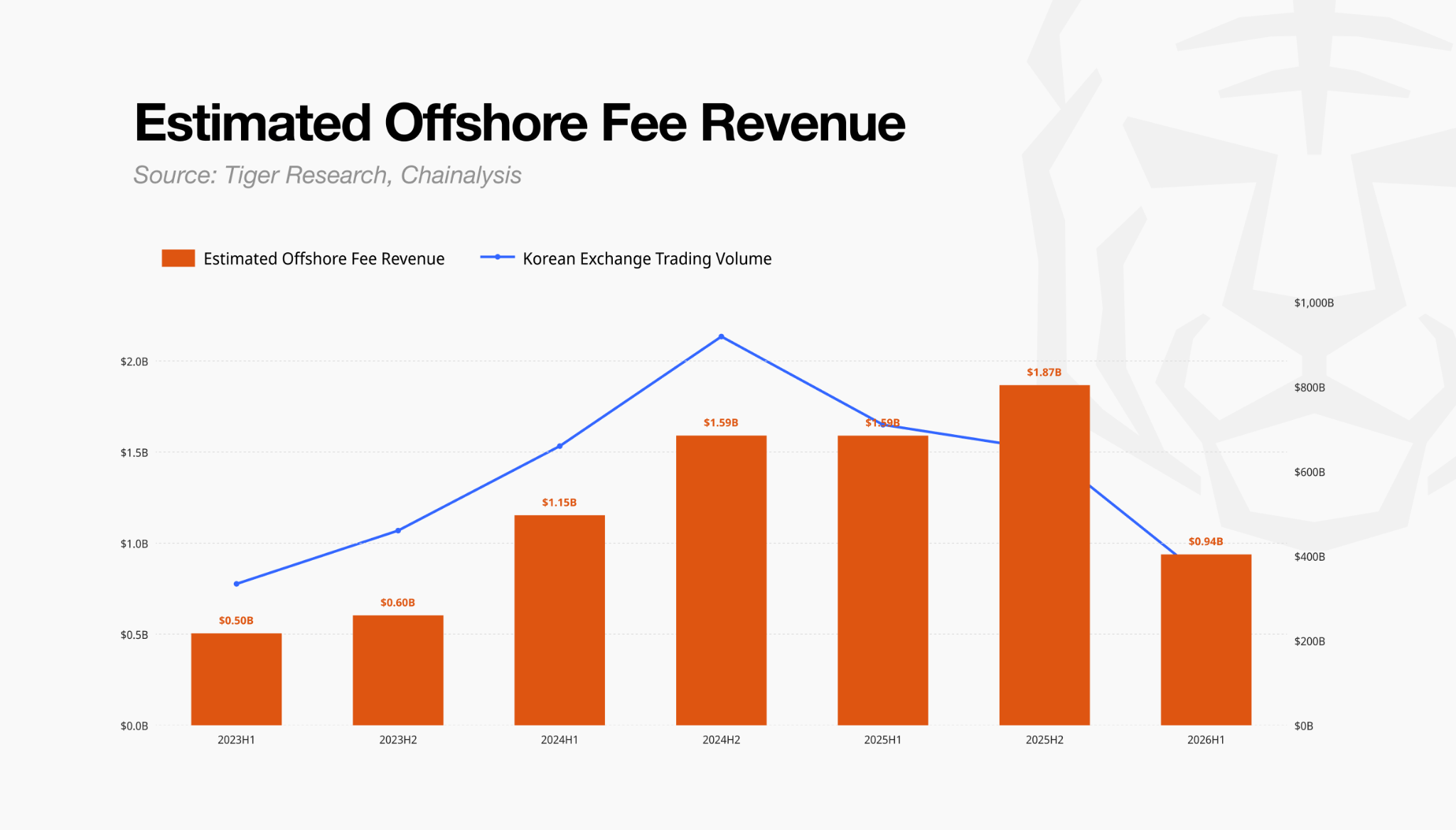
When unmet demand moves abroad, the economic value moves with it. Trading fees are the most direct case. Korean investors generated an estimated $3.5 billion in fee revenue for foreign exchanges in 2025 and another $0.9 billion in the first half of 2026, based on Tiger Research’s own methodology. Demand originating in Korea is becoming revenue for foreign operators.
The value accumulating abroad goes beyond fee revenue. The more Korean investors trade and use services abroad, the more customer relationships and transaction data accumulate with foreign operators. Those operators read Korean demand more precisely on that basis, and they build the capacity to design and run new products. Unmet demand does not only generate revenue abroad. It also builds the competitive strength foreign operators need to create and expand new businesses.
3. Beyond Foreign Exchanges: Investment Demand Moves On-Chain
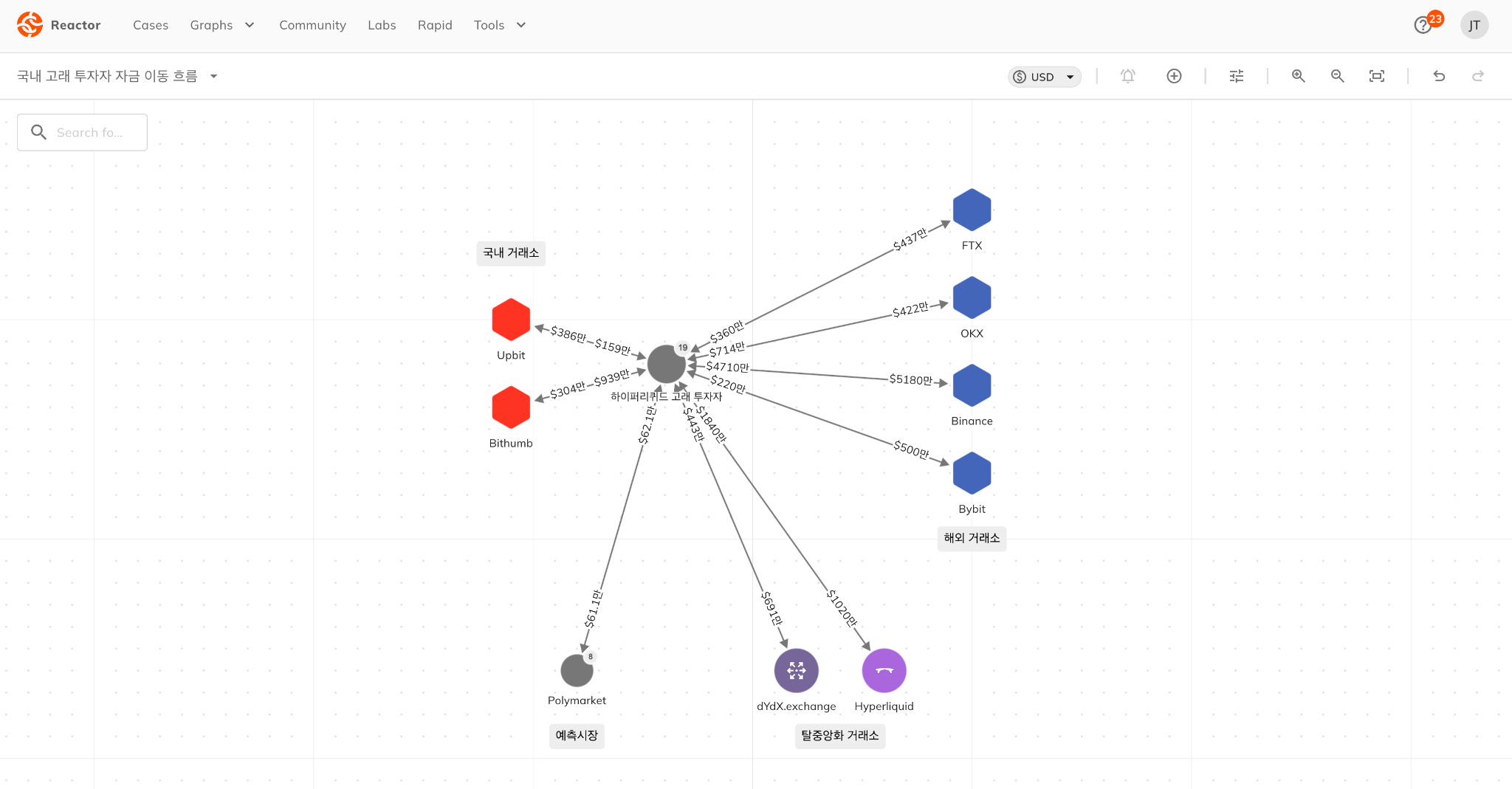
Capital leaving Korean exchanges does not stop at foreign ones. Tiger Research used Chainalysis’s fund-tracing tool, Reactor, to track fund flows from wallets it identified as Korean-owned. Funds that moved abroad did not stay at foreign exchanges. They passed through personal wallets and moved into on-chain services including decentralized exchanges and prediction markets.
To confirm this pattern went beyond a small set of wallets, the analysis extended to approximately 120,000 wallet addresses that Tiger Research attributes to Korean investors. The results showed significant investment activity outside foreign exchanges, including leveraged trading through decentralized exchanges and participation in prediction markets. Unmet demand in Korea now reaches beyond foreign exchanges into on-chain markets.
3.1. Derivatives Demand Moves to Decentralized Exchanges
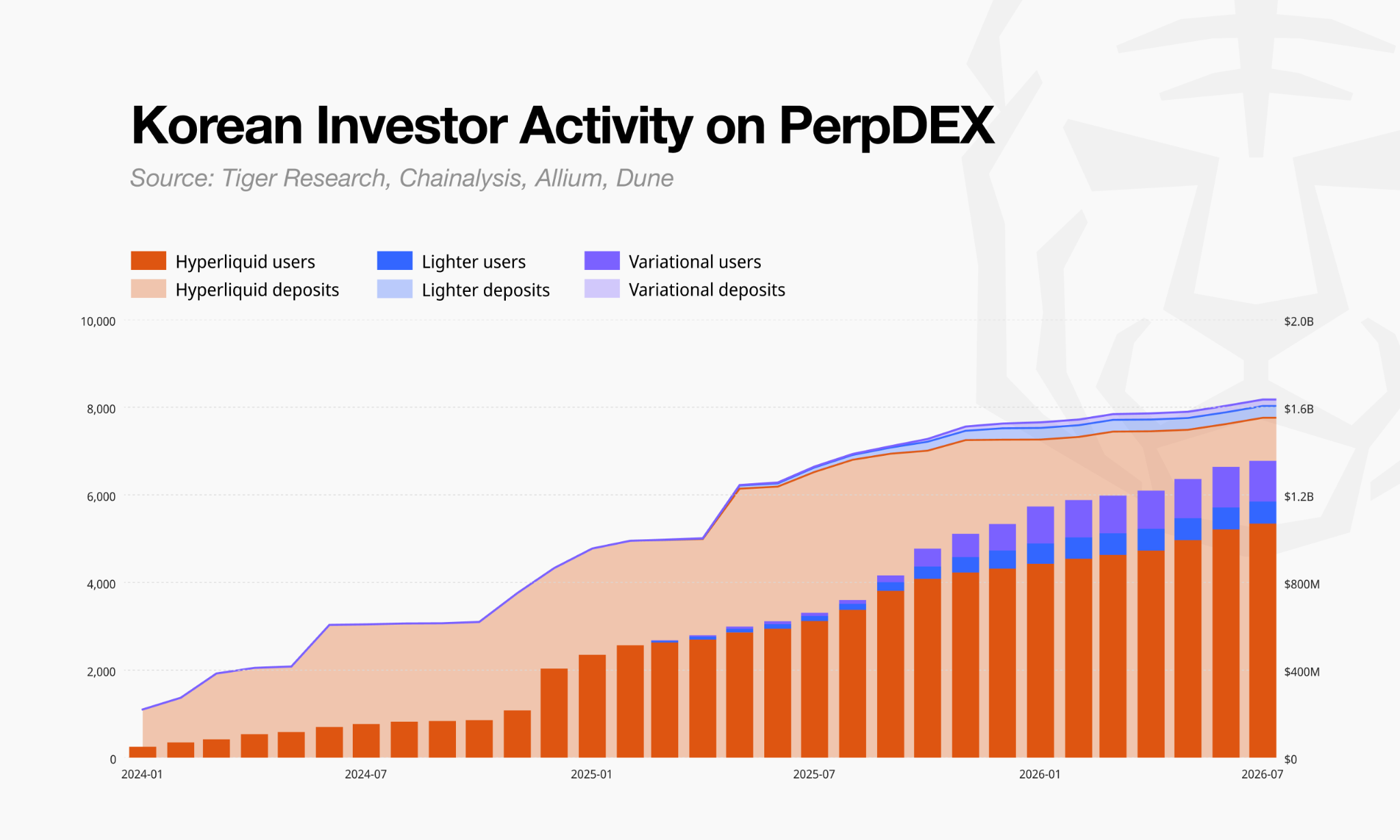
Unmet demand for derivatives trading is moving to decentralized exchanges. On-chain analysis covering January 2024 through July 2026 found that Korean-owned wallets deposited a cumulative approximately $1.64 billion into three decentralized exchanges: Hyperliquid, Lighter, and Variational. These platforms run active leveraged trading centered on perpetual futures, and they absorb demand for derivatives that Korean investors find difficult to access at home.
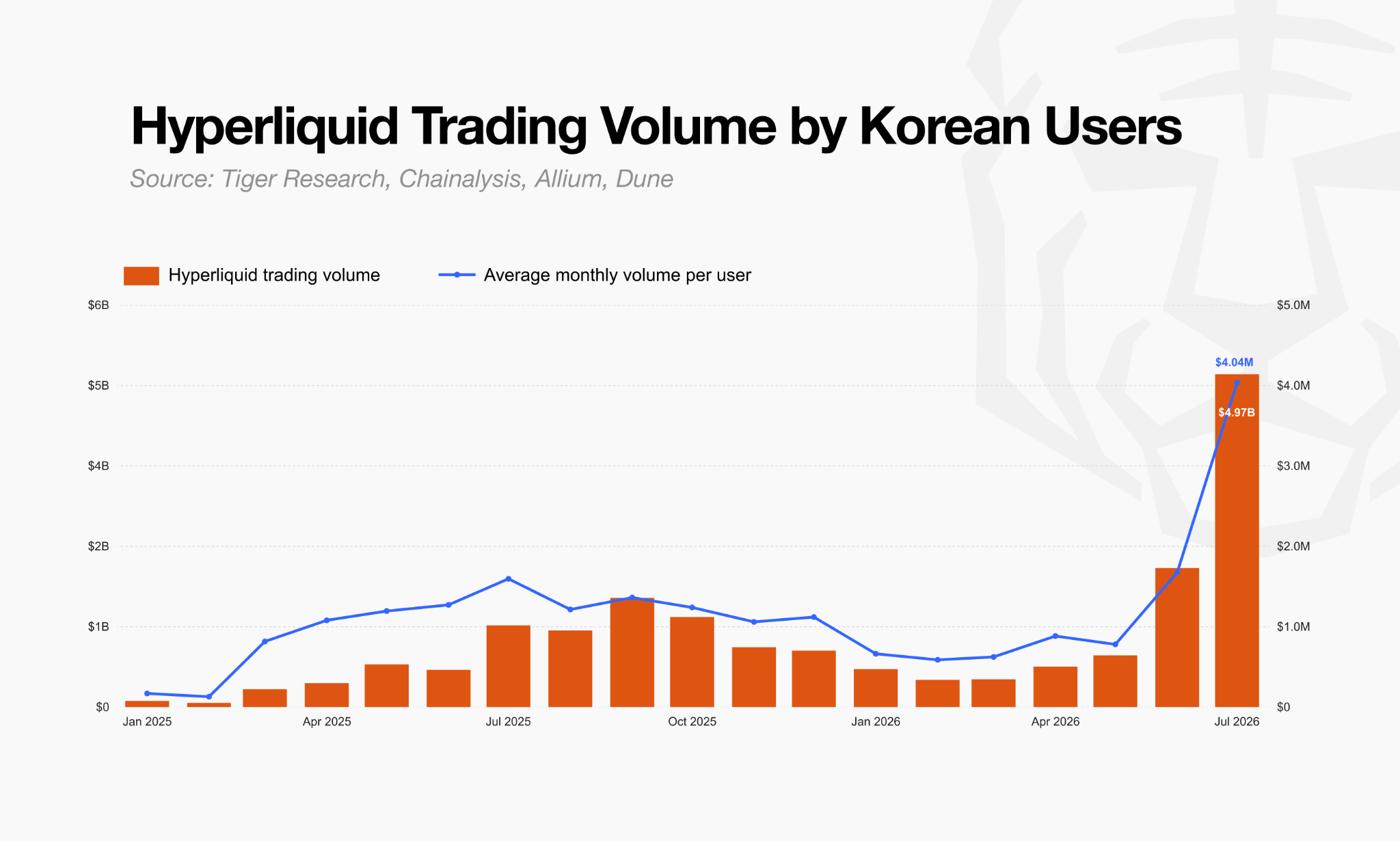
Leverage turns deposited capital into far larger trading volumes. In July 2026 alone, approximately 1,200 Korean-owned wallets generated $4.97 billion in notional trading volume on Hyperliquid. Leverage can inflate notional figures, but nearly $5 billion in a single month shows that on-chain derivatives trading by Korean investors has reached a meaningful scale.
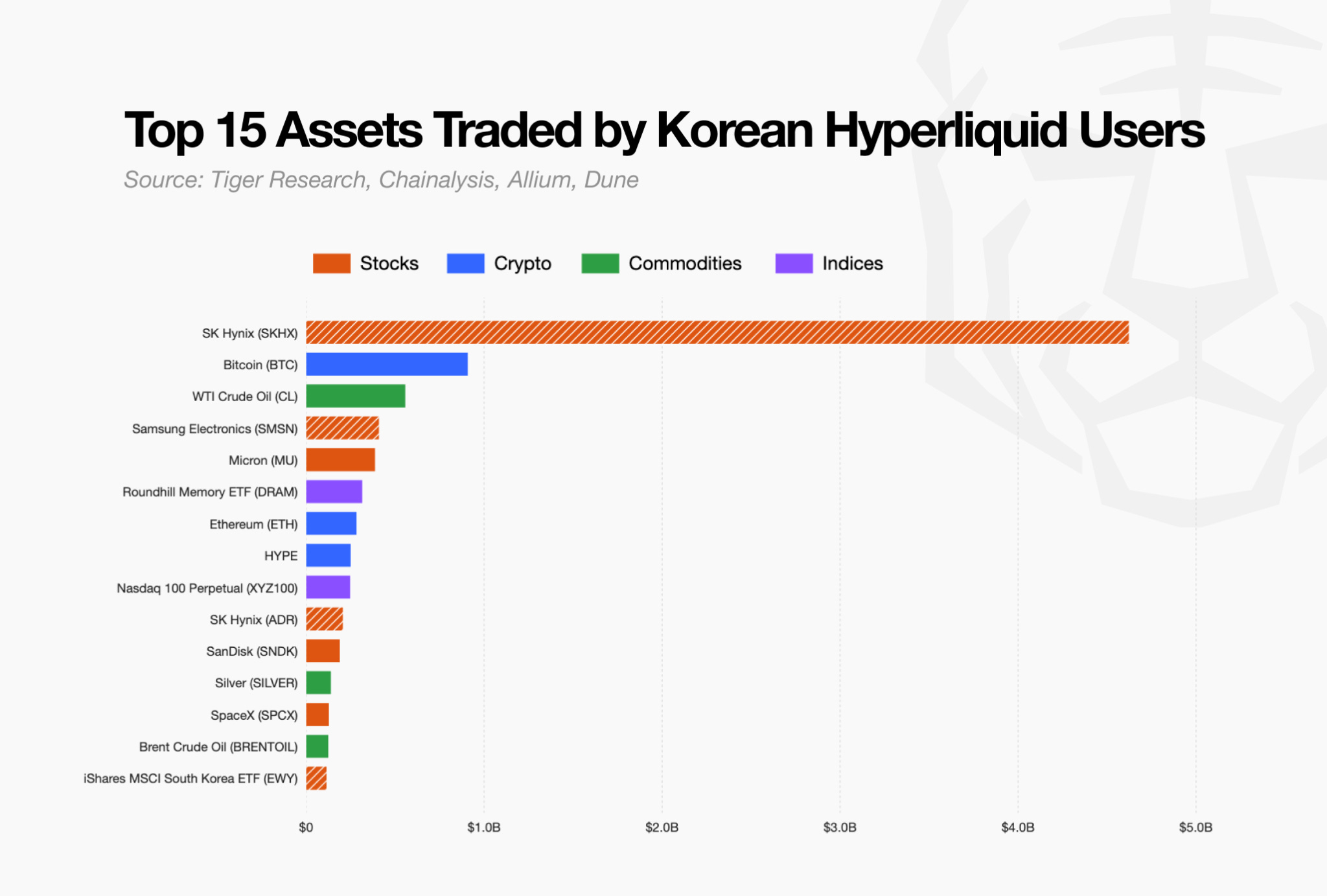
Trading on Hyperliquid reaches beyond cryptocurrency into traditional assets. Between January and July 2026, Korean-owned wallets traded products based on SK Hynix, Samsung Electronics, and crude oil among their top instruments. High leverage and access outside regular market hours appear to drive part of this demand. Investors want to trade traditional assets in ways the existing market does not offer, and that demand is finding its way on-chain.
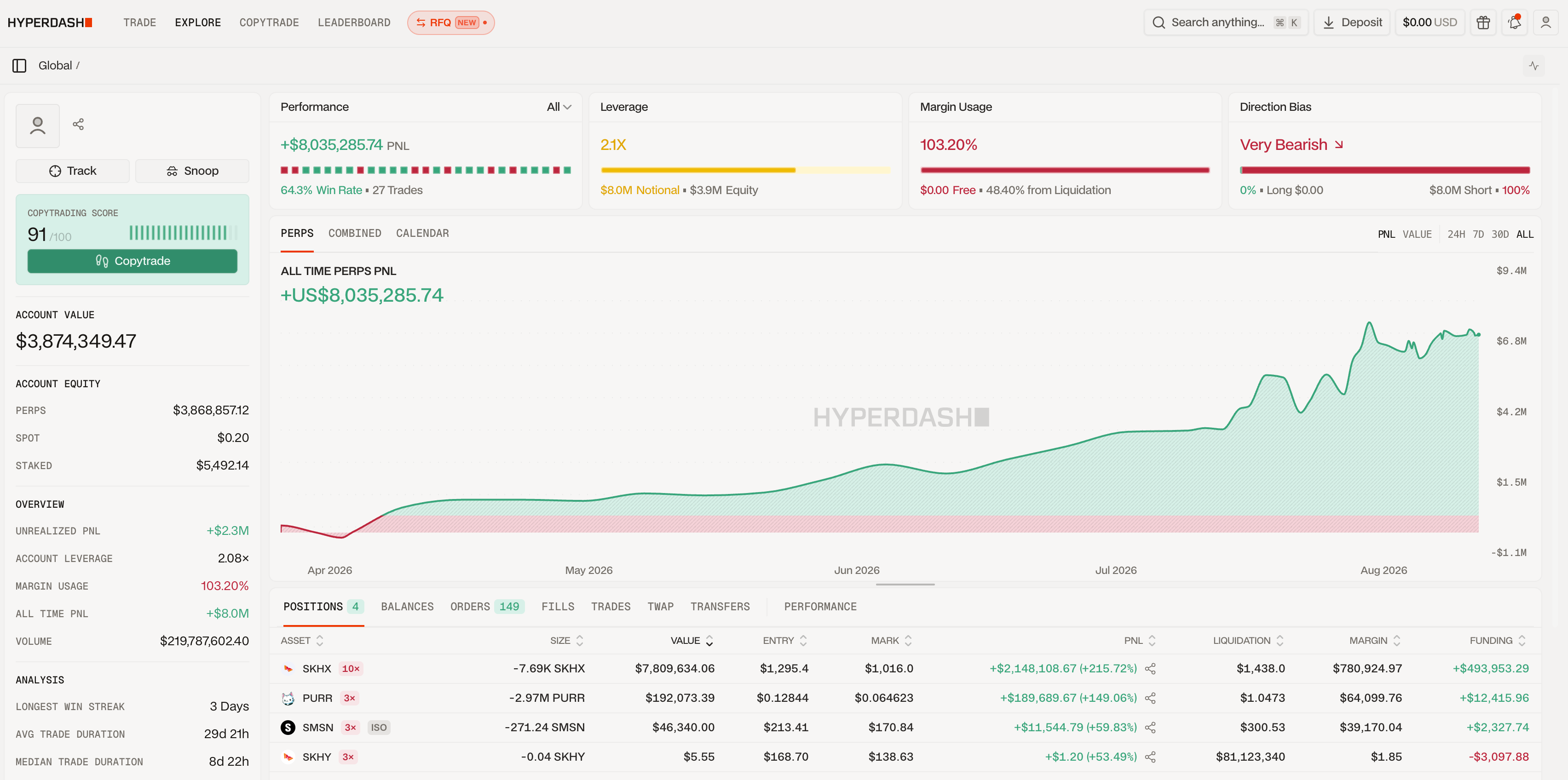
The size of capital involved varies widely. Over the analysis period, the research identified approximately 7k Korean-owned wallets, and some of them managed capital at considerable scale. One Korean-owned wallet put approximately $780k in margin behind a 10x leveraged short on an SK Hynix-based perpetual future on Hyperliquid in July 2026. Trading sizes across these wallets range broadly, and large-scale capital works in on-chain derivatives markets as well.
3.2. Prediction Markets: Another Option for Korean Investors
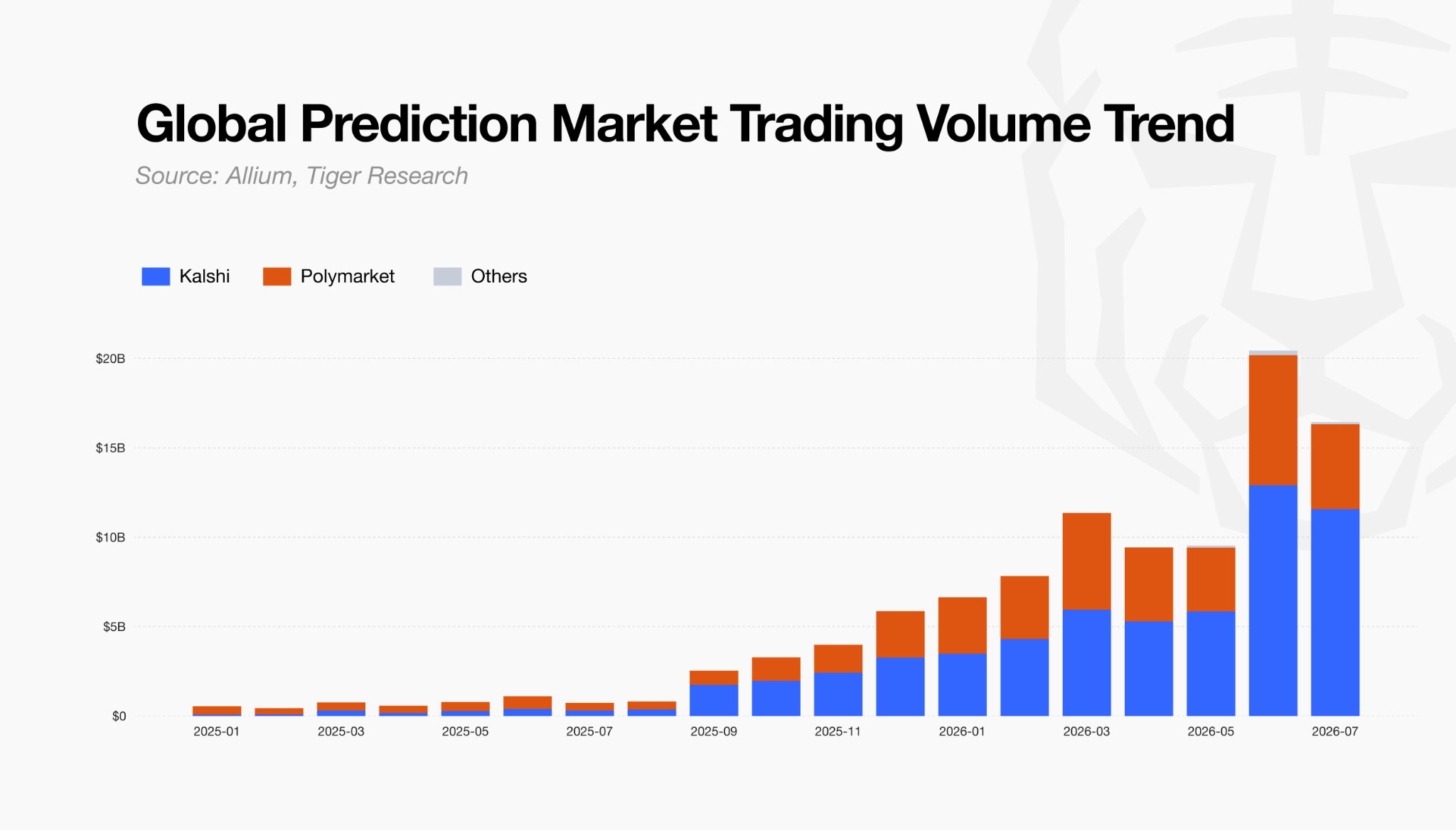
Korean investors are also active in prediction markets, one of the fastest-growing segments in global digital assets. Prediction markets let participants trade on the outcomes of future events across politics, economics, and sports. Korea restricts this type of trading, but Korean investors trade actively on Polymarket. On-chain analysis covering January 2024 through July 2026 identified approximately 3,700 Korean-owned wallets on Polymarket, and their cumulative trading volume reached approximately $438 million.
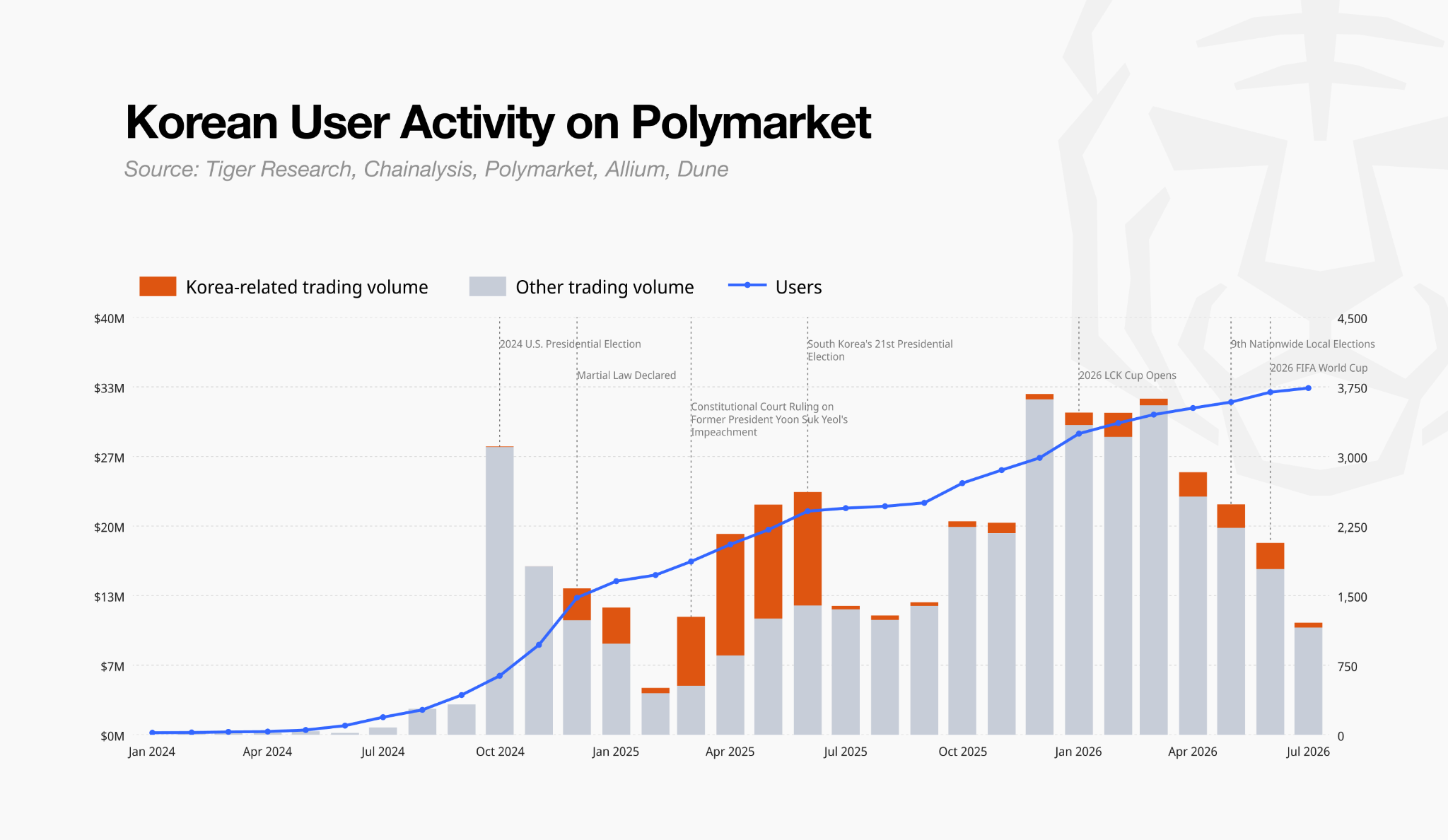
Trading rose sharply alongside major political events in Korea. Between March and June 2025, when impeachment proceedings and the presidential election followed one another, Korea-related markets accounted for more than half of total trading volume among Korean-owned wallets. Cumulative trading volume in Korea-related markets over the full analysis period reached approximately $62 million.
After the presidential election, the share of Korea-related political markets fell quickly, but trading continued across a wide range of subjects, including global affairs, the FIFA World Cup, the KBO League, the LCK, and even Seoul weather forecasts. Trading that had concentrated on Korean politics dispersed into other markets, which shows that Korean investor activity on prediction markets does not stop at specific political events.
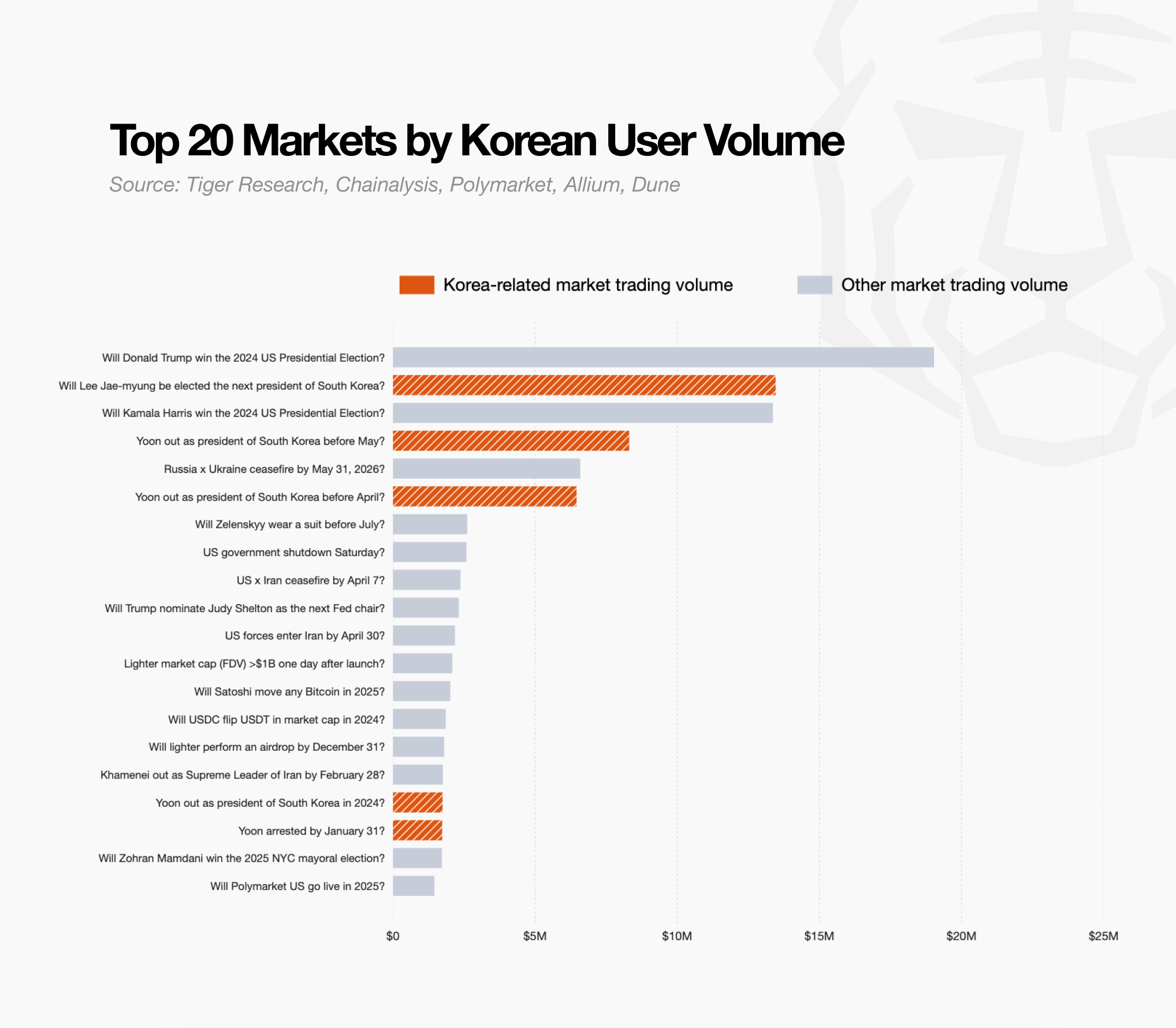
A breakdown by market shows where Korean investor interest concentrated. Global issues such as the U.S. presidential election ranked at the top by volume, and Korea-related political markets including the election of President Lee Jae-myung also drew high volumes. Korean investors traded across major global issues, and they traded Korea-related markets at meaningful size as well.
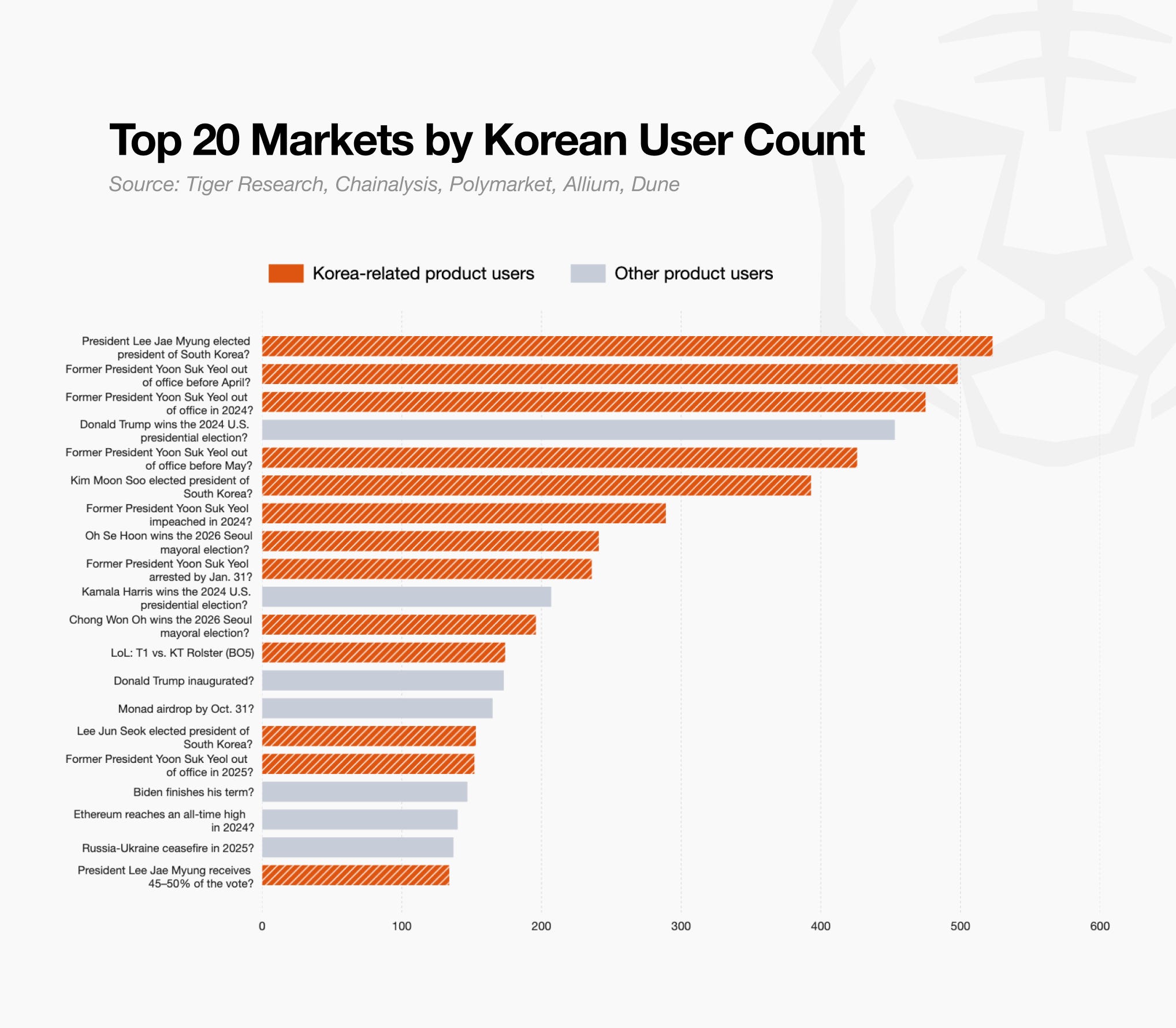
Wallet counts make the character of Korea-related markets clearer. Korea-related political markets, including the election of President Lee Jae-myung and the removal of former President Yoon Suk-yeol, drew more Korean-owned wallets than U.S. presidential election markets did. Global issues and Korea-related markets both ranked near the top by volume, but Korea-related political markets drew broader participation by wallet count.
3.3. Payment Demand Flows to Offshore Crypto Cards
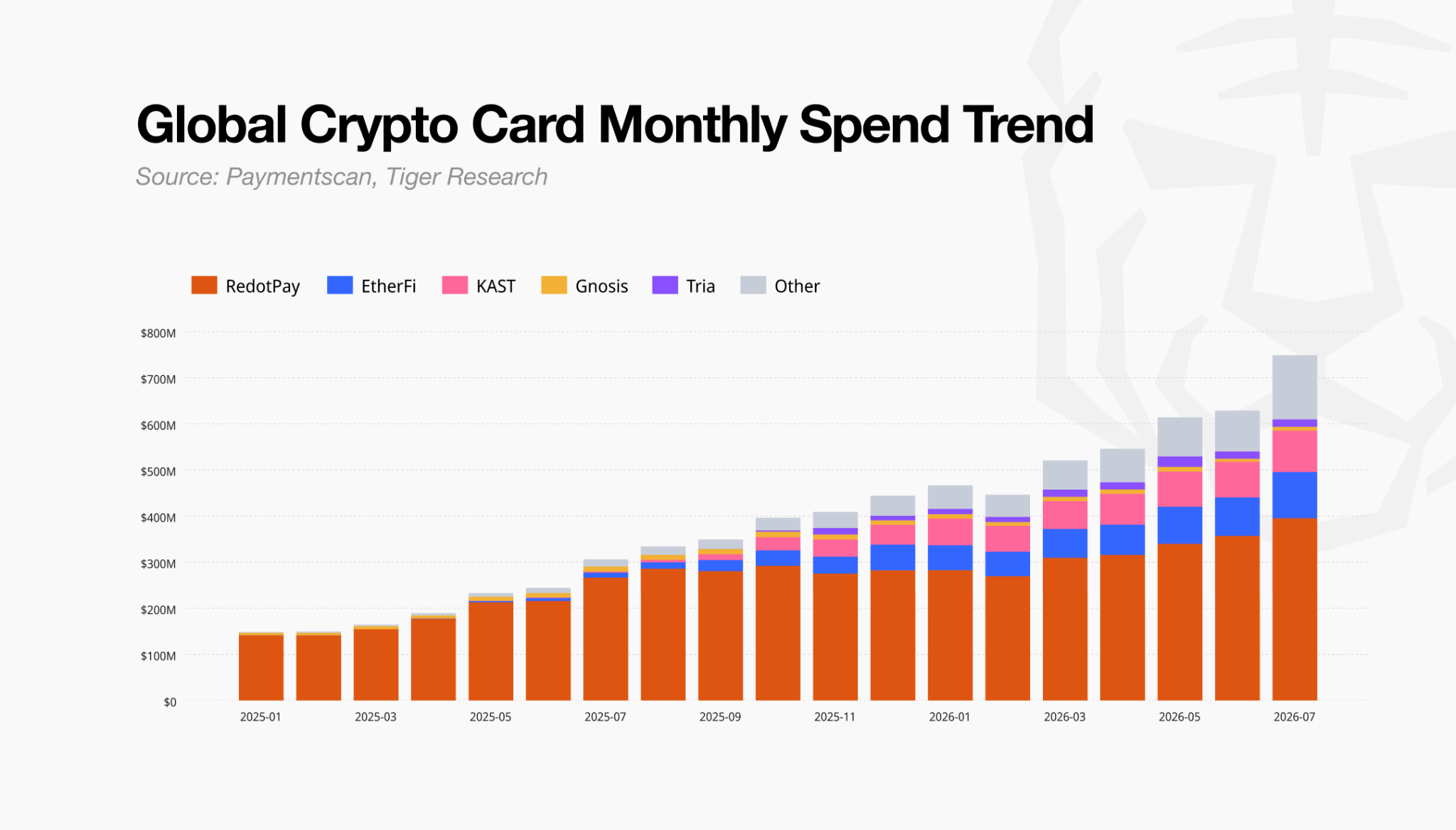
Crypto cards are spreading rapidly worldwide, and the market for spending digital assets is growing with them. A crypto card connects digital assets to existing card payment networks so users can spend much as they would with a traditional card. Users issue a virtual card through an app for online and mobile payments, and some services also provide physical cards for use at brick-and-mortar merchants. Digital assets are moving beyond trading and investment into everyday payments.
Demand for foreign crypto cards is growing in Korea as well. As of late July 2026, cumulative Korean downloads of major crypto card apps, including RedotPay, KAST, ether.fi, Tria, and Plasma, reached an estimated 38k. On-chain analysis of RedotPay and ether.fi identified approximately 1,000 Korean-owned wallets across the two services.
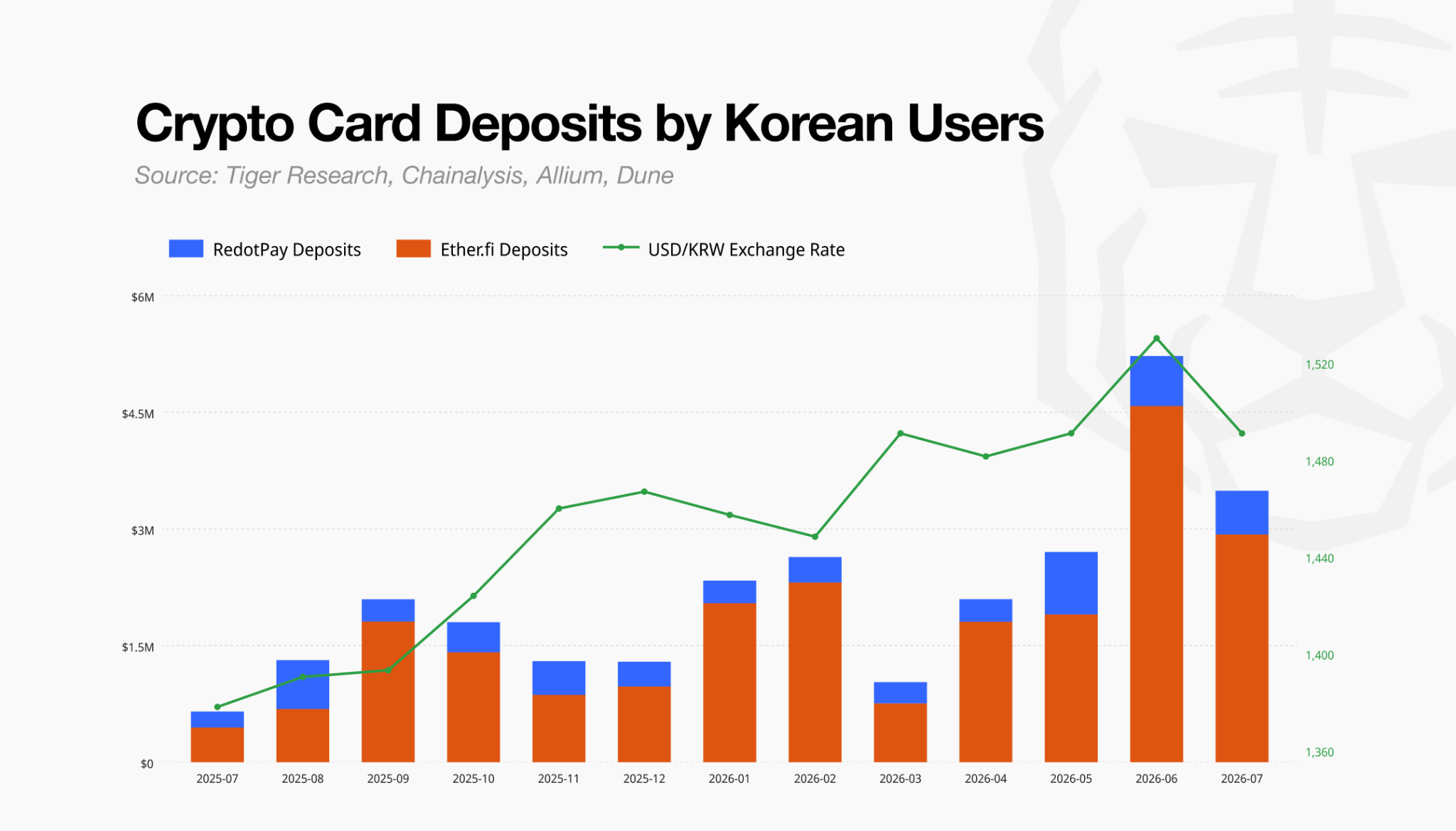
Funds flowing from these wallets into crypto cards have trended upward. Monthly top-up volumes for RedotPay and ether.fi rose notably from 2026, when the KRW/USD exchange rate stayed elevated. The data does not establish a direct causal link between the exchange rate and top-up volumes, but the pattern suggests that some users hold dollar-pegged stablecoins not only as a store of value but to fund card payments. Digital assets that moved abroad now serve as spending money as well.
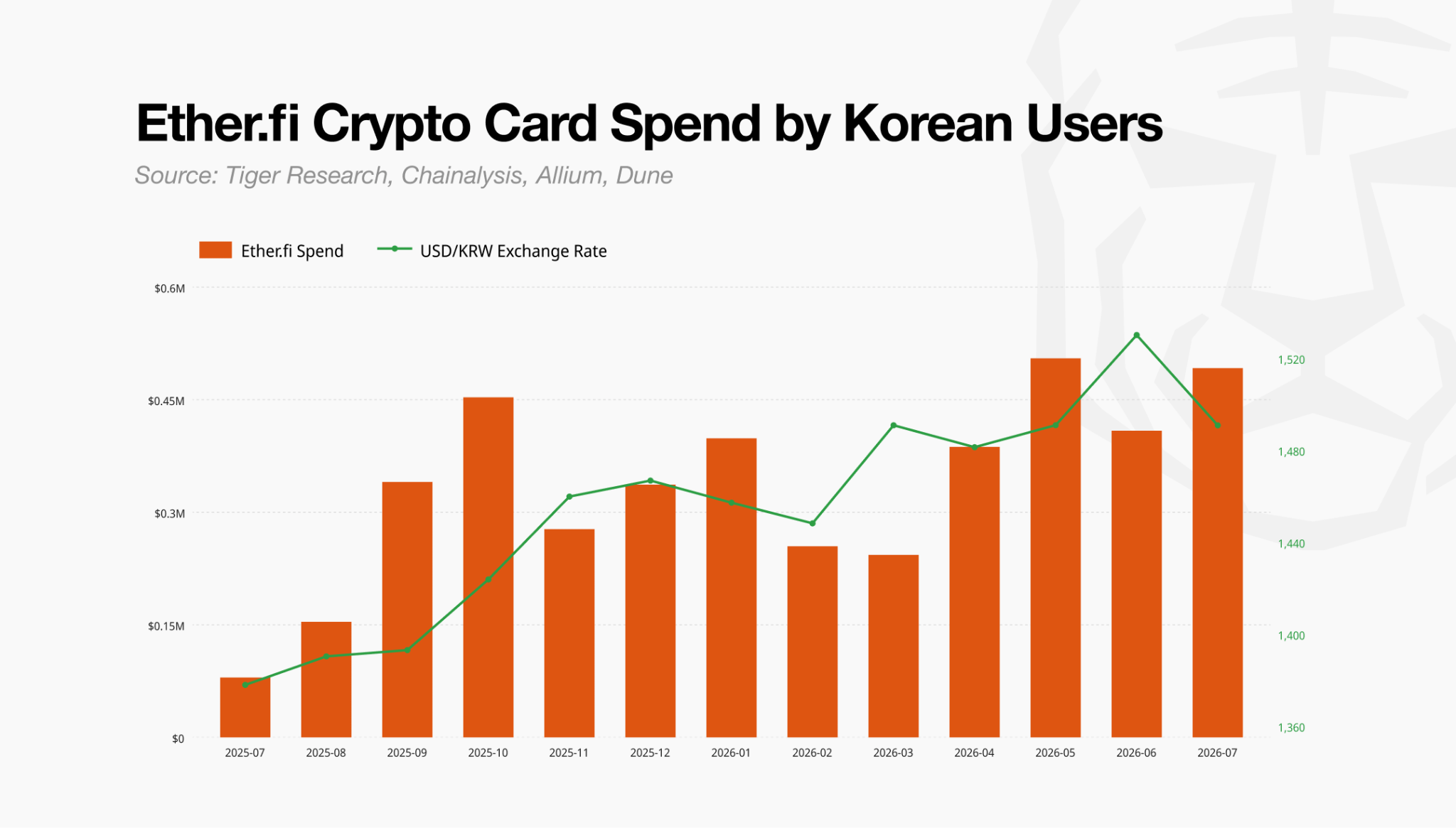
Payment volumes come into clearer view through ether.fi. Both RedotPay and ether.fi let users spend deposited digital assets by card, but the range of data visible on-chain differs between them. RedotPay data covers top-up inflows to the card. ether.fi data extends to fund flows connected to payments, which lets the analysis measure spending by Korean-owned wallets. Funds deposited into ether.fi flow through to merchant payments, which shows that stablecoins serve everyday spending as well as holding.
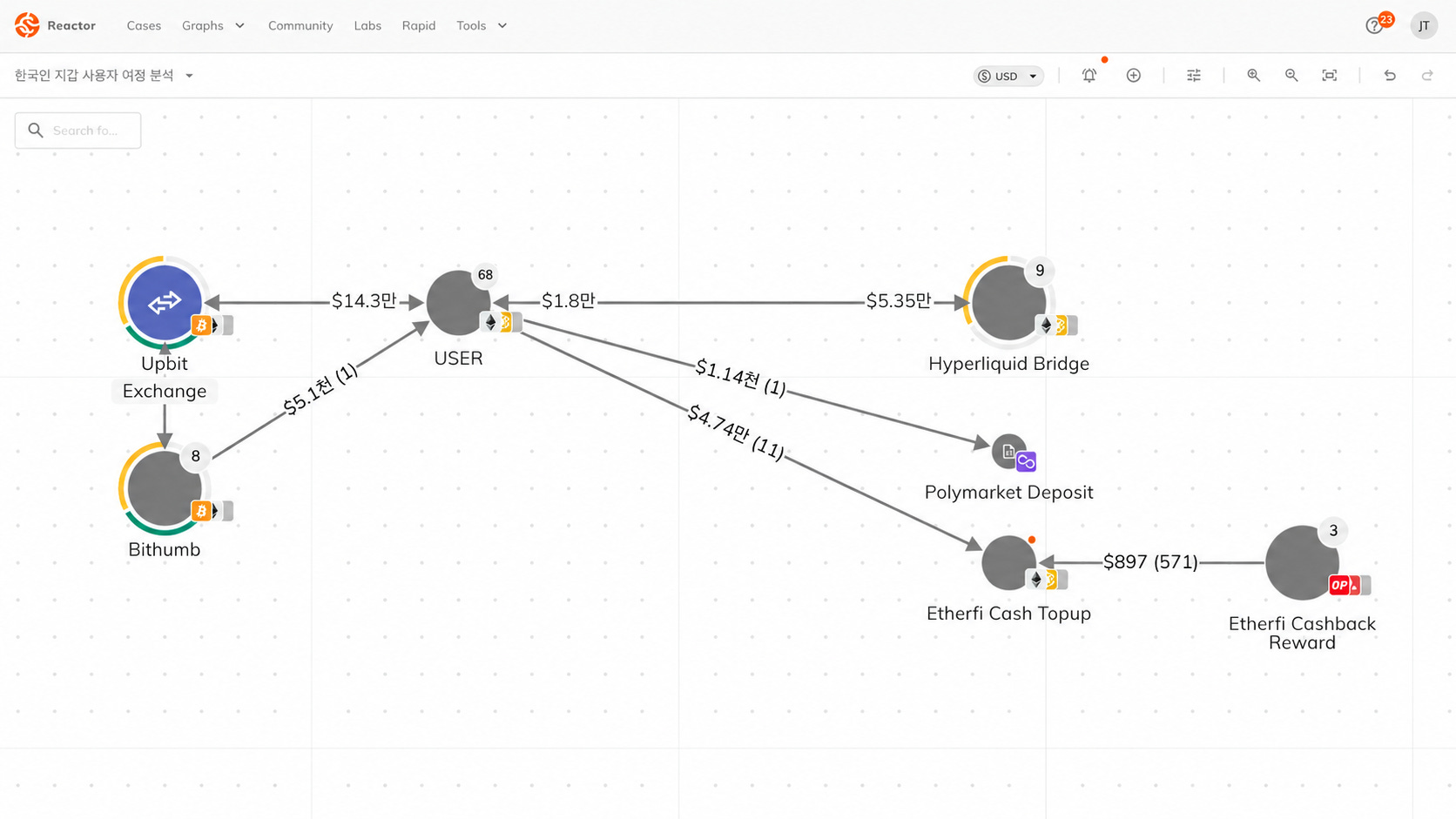
Crypto cards matter because capital that moves abroad may never return after investment and may go on to fund consumption instead. Individual wallets show this pattern. One high-value Korean-owned wallet that Tiger Research tracked moved funds from a Korean exchange to a personal wallet, traded on Hyperliquid and Polymarket, then transferred a portion to an ether.fi card for payments. Capital that left a Korean exchange kept working abroad and on-chain, and it carried through from investment into consumption.
4. The Window to Turn Capital Flows Around
The scale of capital that has moved abroad is already substantial, but room remains to change its direction. As the analysis above shows, Korean investor demand has not declined. It turns into trading and service use at foreign exchanges and on-chain services instead. Future capital flows can look different if Korea builds a market able to absorb that demand.
What matters is building both at once: an environment that keeps capital at home, and a path for capital already abroad to come back. Widening the range of demand Korea can meet will slow new outflows, and lowering the institutional friction in the repatriation process will bring capital already abroad back home. Turning the direction of capital around requires both.
4.1. Building a Reason for Capital to Stay
For capital to stay in Korea, Korean firms need to absorb changing investment demand in the Korean market. The global digital asset market has expanded beyond spot trading into derivatives and a wide range of services, and traditional assets now trade in new forms through stock perpetual futures and tokenized stocks. Korea has yet to put in place the rules and standards these products require, and exchange businesses remain concentrated in spot trading. Demand exists in Korea. The structure makes it difficult for Korean firms to connect that demand to new products and markets.

Global operators have widened their business lines as the market changed. Major global exchanges including Coinbase and Binance expanded into adjacent areas such as derivatives and institutional services, and they built or acquired the technology and infrastructure they needed. When new demand formed, they connected it to existing business and grew it into new markets. Korean operators, by contrast, found it difficult to expand into new businesses within the digital asset market and had to look to other industries for growth. This difference stems less from the ambition of the operators than from the regulatory foundation available for turning new demand into business.
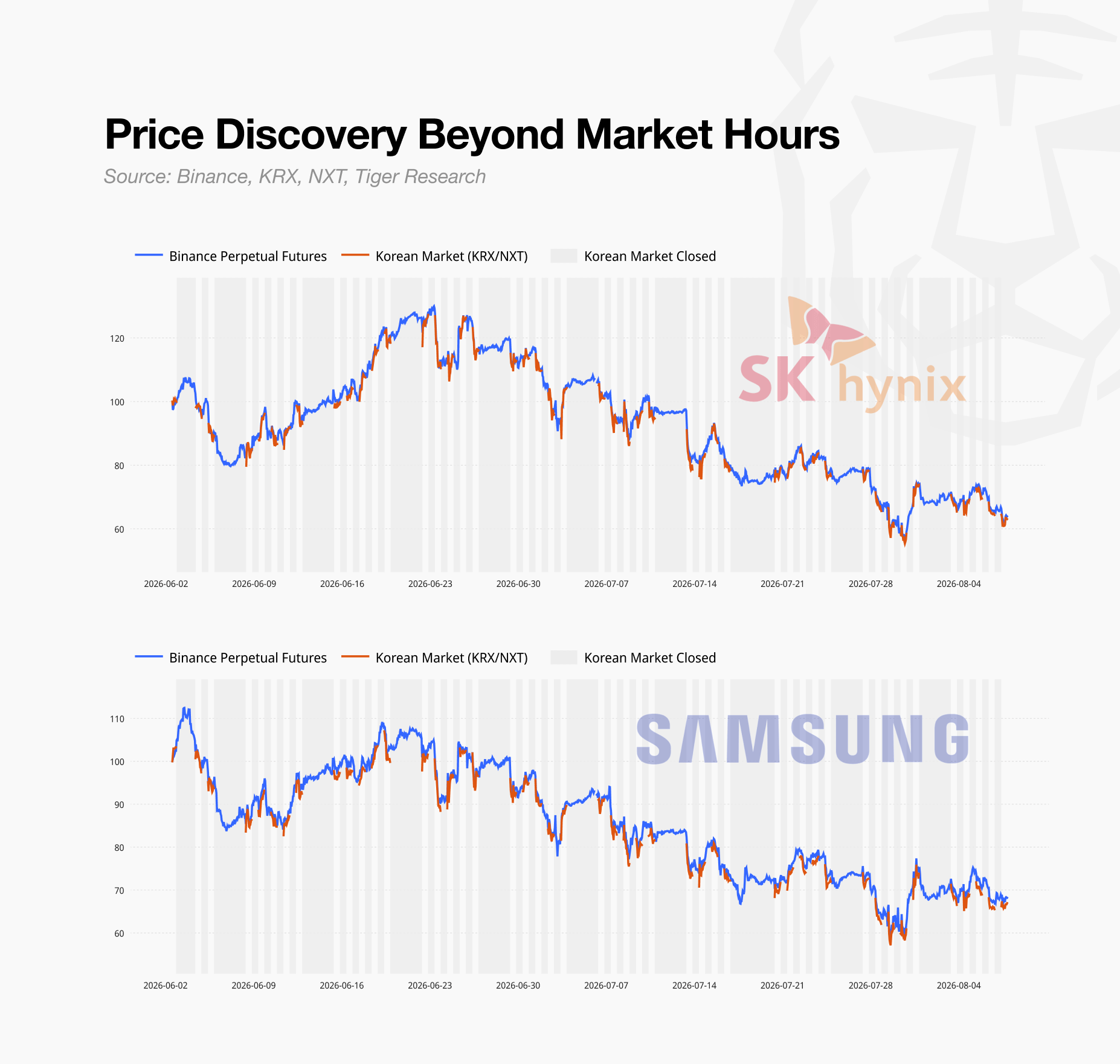
Stock perpetual futures show why Korean firms need the ability to respond to new investment demand. As the analysis above showed, Korean-owned wallets trade perpetual futures based on Korean stocks, including SK Hynix, on foreign platforms. The SK Hynix perpetual future tracks the Korean share price closely and keeps trading through evenings and weekends when the Korean stock market closes. It reflects the underlying asset with reasonable fidelity and forms a price outside regular trading hours, which suggests it could serve as a price signal that complements the Korean spot market. Unmet demand in Korea does not only turn into trading abroad. It also produces market functions that Korea could put to use.
Absorbing this demand in the Korean market requires more than case-by-case decisions on whether to permit individual products. Regulators need to set standards that let firms commercialize new products and services within the regulatory framework. Rather than permitting every product at once, they need to define clear investor protection and risk management requirements, and firms that meet those requirements should be able to expand as demand changes. That is how Korea can change a structure in which demand created at home becomes a market abroad first, and how firms can keep the business experience and competitive capabilities they build along the way inside Korea.
4.2. Widening the Path for Capital to Return
Capital that has already moved abroad will not return on its own, even as investment opportunities in Korea expand. Bringing funds back requires multiple verification steps, and unclear reporting and tax standards raise the burden further. Alongside building an environment that keeps capital at home, Korea needs to lower the burden on capital already abroad that wants to come back.
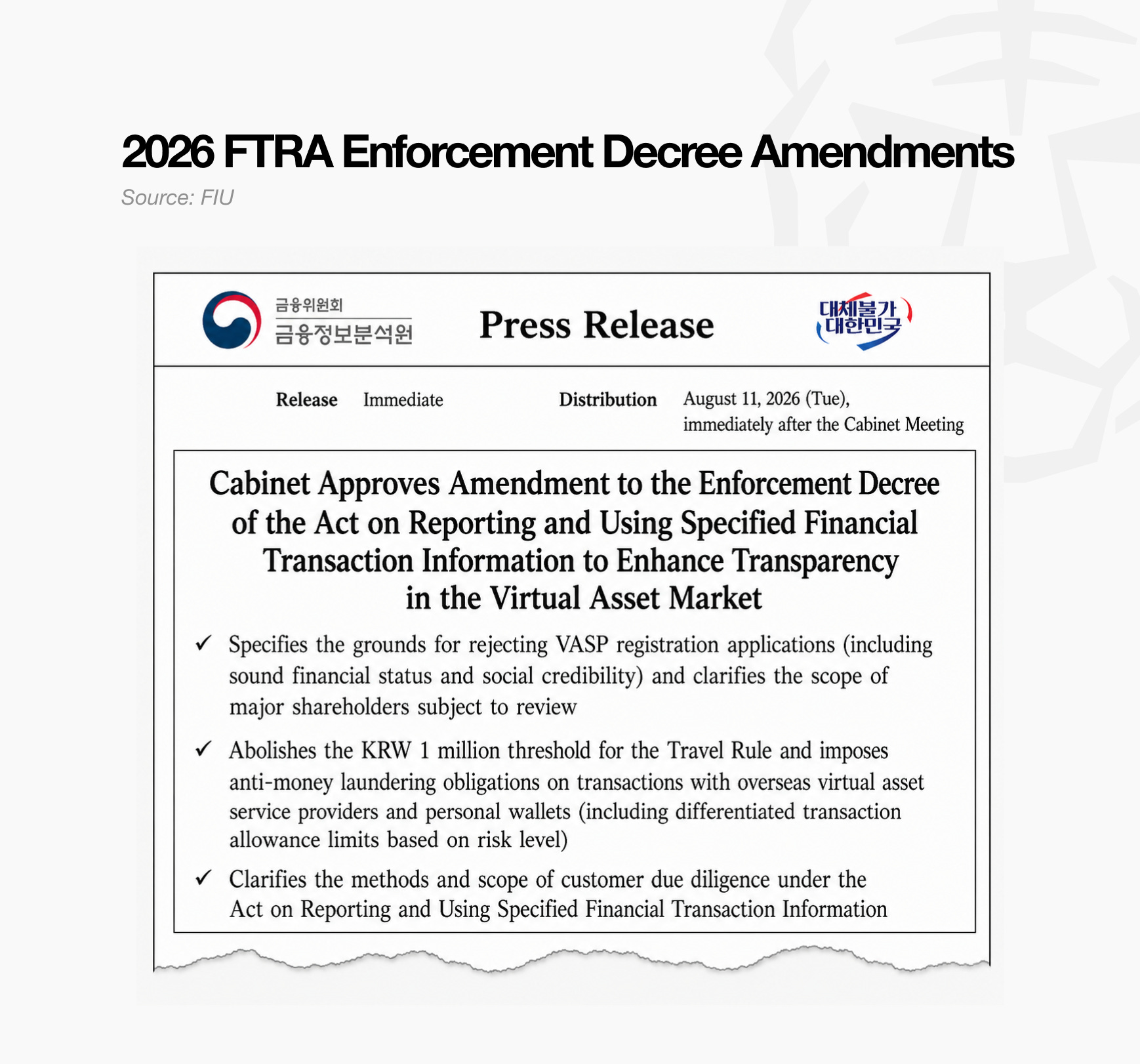
Amendments to the Enforcement Decree of the Act on Reporting and Using Specified Financial Transaction Information (FTRA) are tightening anti-money laundering controls on virtual asset transfers. The Travel Rule will apply regardless of transaction size, while transactions with foreign exchanges and personal wallets will face risk-based controls. AML controls remain necessary, but unclear verification requirements can make it harder to bring funds back to Korea. Regulators should set clear standards to reduce unnecessary friction for legitimate transfers.
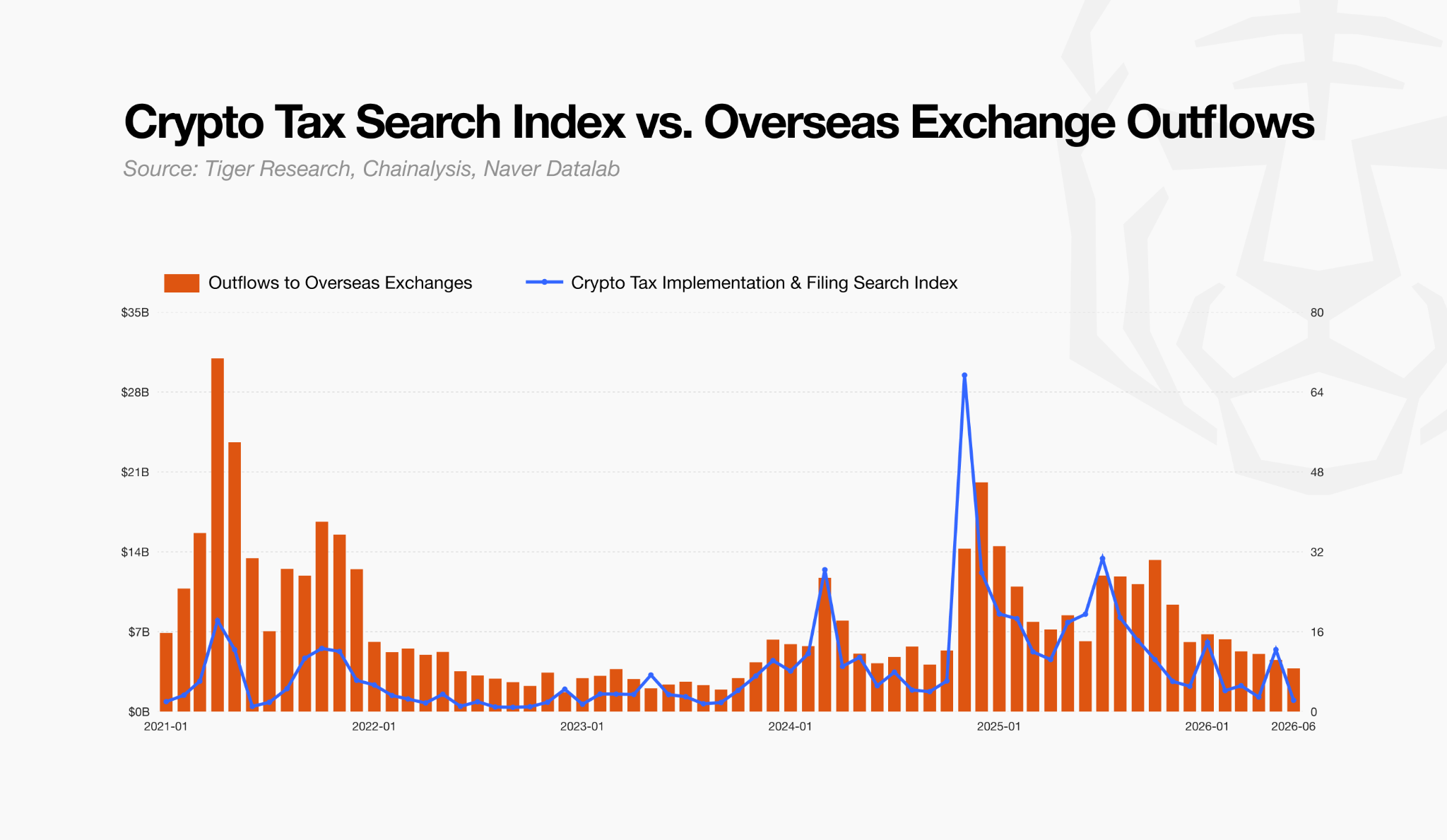
Once taxation takes effect, investors will face more to consider when they bring assets held abroad back to Korea. Assets that have moved across foreign exchanges, personal wallets, and on-chain services require confirmation of acquisition cost and past transaction history, but the standards for handling complex transactions and for accepting supporting documentation remain insufficiently specific. The problem lies less in the tax itself than in the burden and uncertainty investors face when they reconstruct and report past transactions before the rules are fully in place. Outflows from Korean exchanges tended to rise during periods when search interest in tax filing climbed, so the effect of that uncertainty on capital flows deserves attention.
Bringing capital back therefore requires two things. Korea needs to revise regulations that constrain legitimate fund movements without cause, and it needs to make the standards and procedures for necessary regulations explicit. AML controls and taxation both serve a purpose, but strengthening verification and reporting obligations before the underlying standards exist can discourage even legitimate capital from returning. Capital that moved abroad can come back only if Korea maintains the controls it needs while cutting the unnecessary burden that fund movements now carry.
5. When Capital Returns, Opportunity Follows
This analysis points to more than capital outflows. As unmet demand in Korea turns into trading and service use abroad, foreign operators capture the revenue and new business opportunities that demand generates. What matters is building a market in Korea that can absorb this demand and redirecting home some of the revenue and opportunity that now arises abroad.
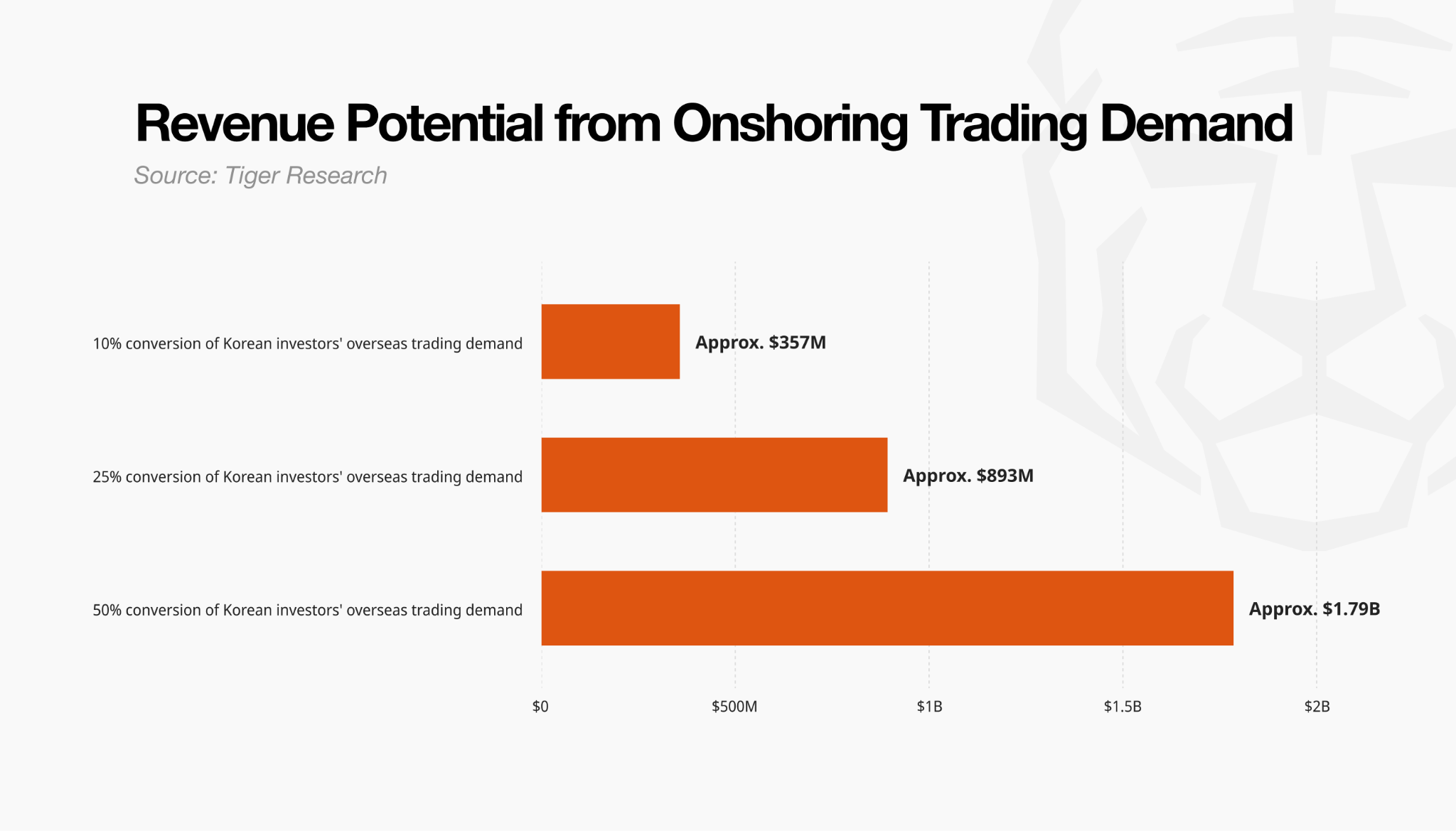
The scale is significant even on trading fees alone. Korean investors paid an estimated $3.5 billion in trading fees to foreign exchanges in 2025. Assuming the same trading activity and fee rates, routing 10% of that activity through Korean operators would generate approximately $357 million in revenue, 25% would generate approximately $893 million, and 50% would generate approximately $1.79 billion. Korea does not need to create new demand to reach these figures. Redirecting home a portion of what Korean investors already do abroad is enough.
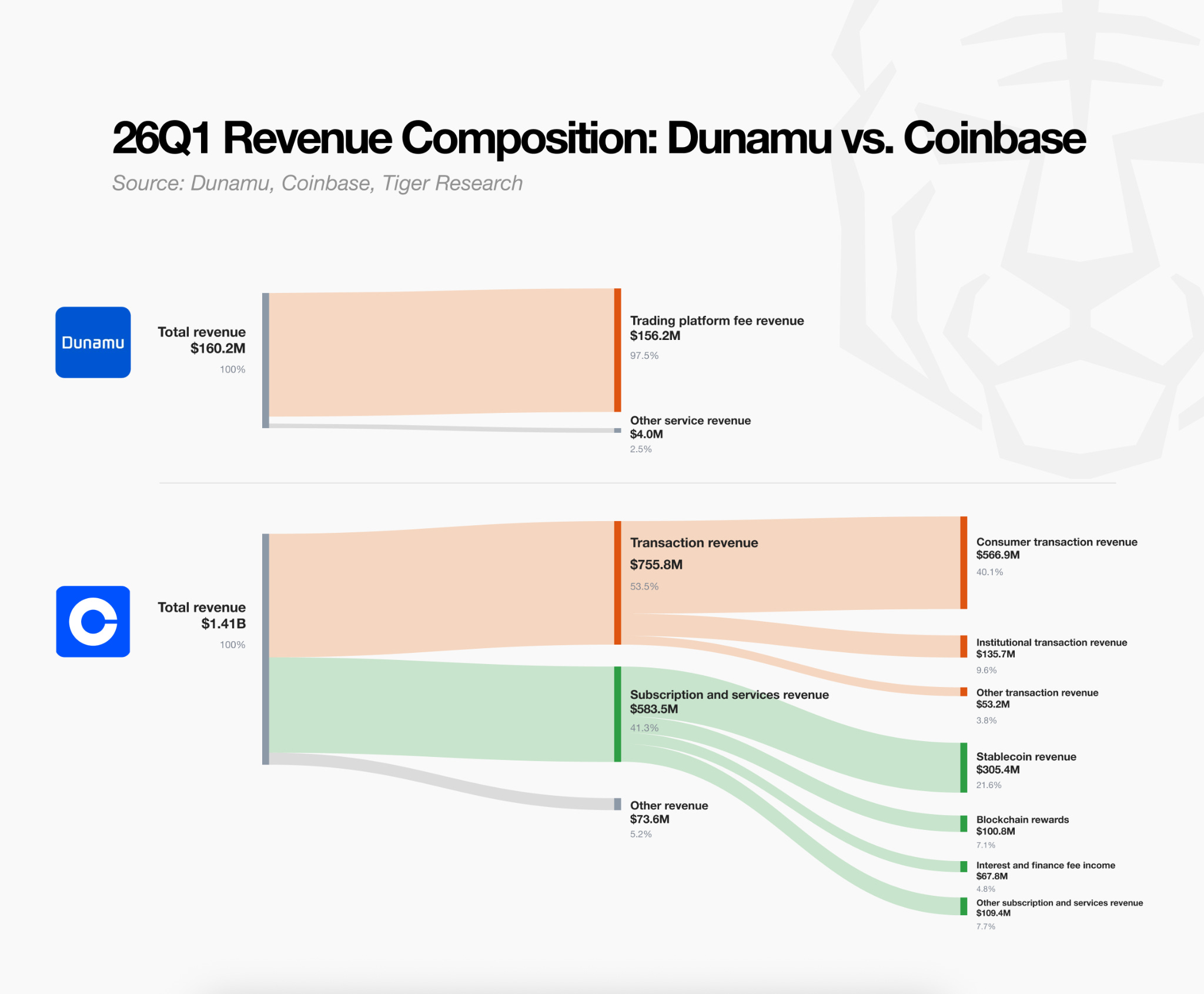
The value Korea could create runs beyond trading fees. Coinbase started in spot trading and widened into custody, institutional services, and stablecoins, and in the first quarter of 2026 it drew nearly half of its total revenue from businesses outside trading. Dunamu, by contrast, draws most of its revenue from KRW spot trading fees. The same digital asset demand can produce very different market sizes depending on whether operators can connect it to a broad range of products and services.
Korea needs to build the foundation that lets its operators turn new demand into business before this difference widens further. The global market is already expanding quickly, but Korea has yet to put in place the regulatory foundation for commercializing new products and services. Korea can still widen the scope of its market before the gap sets, which makes this a critical window for the Korean digital asset industry. Alongside building that foundation, Korea needs to give the trading and capital now heading abroad a reason to choose the Korean market.
Tax policy is one way to create that reason. Thailand exempts individual capital gains on digital asset transactions through licensed domestic operators from income tax from 2025 through 2029, which steers investors toward the regulated market. Korea can treat taxation not only as a source of revenue but as a policy instrument for drawing trading and capital into the Korean market.
Redirecting home even a portion of the demand and capital now heading abroad would produce effects beyond trading fees. It would widen the market in which Korean operators can build new products and services, which can translate into corporate growth and industrial competitiveness. Growth in the market and in the firms within it generates economic value that stays in Korea over the long term, and it broadens the tax base as well. This window calls for more than putting regulations in place. It calls for building the conditions under which a new market can grow in Korea.
Appendix. Methodology
This report identifies and analyzes wallets attributed to Korean investors using on-chain address labeling data that Tiger Research built in-house. Tiger Research has analyzed on-chain fund flows in the Korean digital asset market since 2023, accumulating the criteria and data needed to identify wallets linked to Korean investors. The current dataset holds approximately 5M address records associated with Korean and foreign exchanges, which served as the foundation for wallet identification.
Tiger Research drew on open-source intelligence (OSINT) alongside on-chain data to identify and verify these wallets. It checked wallet addresses linked to public accounts on Discord, Twitter, and GitHub, and examined activity records visible on decentralized applications including OpenSea and POAP. Korea-specific events, airdrops, and other region-limited campaigns have been relatively active, which yielded a range of signals for establishing a Korean connection to individual wallets.
Tiger Research then used Chainalysis Reactor to analyze address relationships, fund flows, and clusters, and to cross-validate existing identification results. Reactor traced associated wallets that in-house data alone could not confirm, which significantly widened identification coverage. This analysis draws on approximately 120k wallet addresses attributed to Korean investors.
Tiger Research analyzed the on-chain activity of these wallets using the blockchain data platforms Allium and Dune. It traced fund movements and smart contract interactions at the wallet level, and it aggregated activity on major services including Hyperliquid, Polymarket, and crypto cards. This showed where funds held by wallets attributed to Korean investors go once they leave exchanges, and what activity follows.
These 120k addresses do not represent the full population of Korean digital asset investors. Most Korean investors trade inside centralized exchanges, and relatively few use personal wallets or on-chain services directly. This dataset does not aim to represent all investors. It analyzes the fund flows and behavior of Korean investors who move assets outside exchanges and use on-chain services. It includes wallets that use on-chain services repeatedly or manage capital at meaningful scale, which makes it well suited to examining the activity of that investor segment.
🐯 More from Tiger Research
Read more reports related to this research.Disclaimer
This report has been prepared based on materials believed to be reliable. However, we do not expressly or impliedly warrant the accuracy, completeness, and suitability of the information. We disclaim any liability for any losses arising from the use of this report or its contents. The conclusions and recommendations in this report are based on information available at the time of preparation and are subject to change without notice. All projects, estimates, forecasts, objectives, opinions, and views expressed in this report are subject to change without notice and may differ from or be contrary to the opinions of others or other organizations.
This document is for informational purposes only and should not be considered legal, business, investment, or tax advice. Any references to securities or digital assets are for illustrative purposes only and do not constitute an investment recommendation or an offer to provide investment advisory services. This material is not directed at investors or potential investors.
Terms of Usage
Tiger Research allows the fair use of its reports. ‘Fair use’ is a principle that broadly permits the use of specific content for public interest purposes, as long as it doesn’t harm the commercial value of the material. If the use aligns with the purpose of fair use, the reports can be utilized without prior permission. However, when citing Tiger Research’s reports, it is mandatory to 1) clearly state ‘Tiger Research’ as the source, 2) include the Tiger Research logo. If the material is to be restructured and published, separate negotiations are required. Unauthorized use of the reports may result in legal action.


