

Key Takeaways
The number of M&A deals held steady, but large acquisitions gave way to smaller deals that add specific capabilities, such as licenses, payments, and institutional trading.
Established lead VCs lost influence over deal terms, while strategic investors became more active, including CEX-affiliated VCs seeking to grow their own CEX and blockchain ecosystems.
Seed and other early-stage rounds contracted, while capital concentrated in Series A to C rounds of companies that had already proven their business through revenue and licenses.
Venture equity investment declined, while financing based on cash flow, such as bond issuance, credit lines, and SPAC listings, expanded.
Capital concentrated in areas connected to traditional finance and real-world use, such as payments, stablecoins, tokenized securities, and AI-related infrastructure, rather than in standalone blockchain ecosystems.
1. Opportunities Shift Toward Institutions as the Market Rebounds
Crypto market sentiment turned from fear to greed in Q3 2026.
Bitcoin, which had declined for two consecutive quarters in the first half, rose 43% in Q3, its strongest third quarter since 2017, and US spot bitcoin ETFs recorded $6.34 billion in net inflows. The Crypto Fear & Greed Index, which had stayed in extreme fear throughout the first half, entered greed territory on August 20 and remained there for most of September.
Disclosed deal values, however, show that the rebound did not translate into more investment in crypto companies.
The capital that returned with rising prices went into crypto assets directly, while corporate investment, which ties up capital for years, did not move with short-term sentiment. The following sections examine the main changes in Q3.
2. Five Key Shifts in Q3
M&A: From Expansion Deals to Capability Acquisitions
VC Market: Lead Investors Lose Ground as Strategic Capital Grows
Funding Stages: Early-Stage Caution and a Focus on Proven Businesses
Financing: Listings and Debt Expand Beyond Equity
Sectors: Capital Concentrates in Infrastructure Linked to Traditional Finance
2.1. M&A: From Expansion Deals to Capability Acquisitions
The number of M&A deals in Q3 matched the first-half pace, but deal size fell sharply.
M&A deals totaled 39 in Q1, 36 in Q2, and 37 in Q3, while deal size appears to have declined. Data from Architect Partners, an M&A advisory firm that tracks crypto deals independently, shows that crypto M&A deal count fell 7% quarter-on-quarter in Q3 while deal value fell 83%.
Deal size fell because the targets changed. In the first half, the market was driven by deals that bought entire companies to build new business lines, such as Mastercard’s $1.8 billion acquisition of BVNK. Q3 acquisitions instead filled gaps in the buyers’ existing businesses.
Circle agreed to acquire Tazapay, a Singapore-based cross-border payments company, MoonPay agreed to acquire North Capital, which holds US securities licenses, and BitGo acquired NYDIG’s institutional trading business.
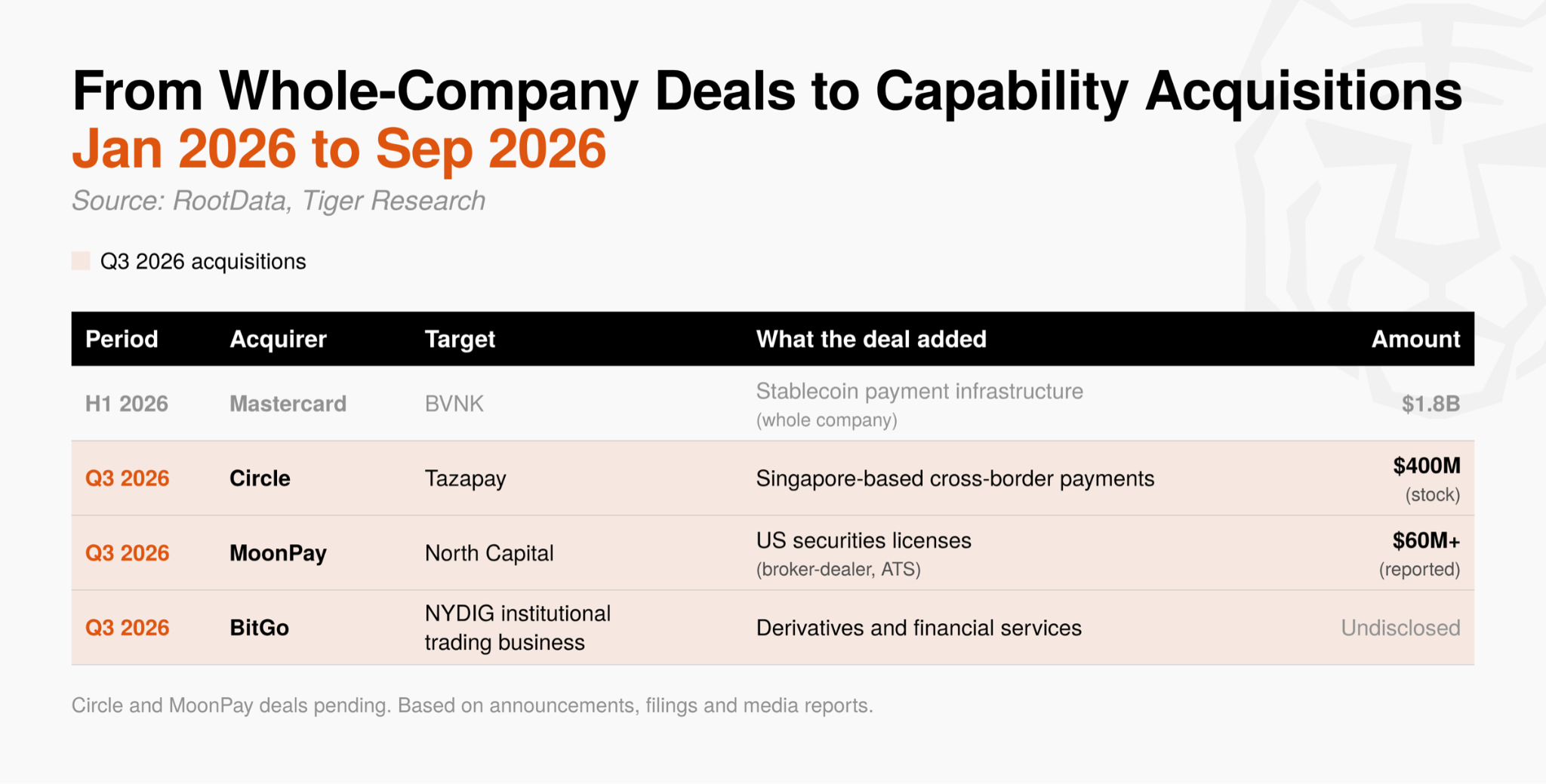
Obtaining licenses and proving a capability in-house takes a long time, while an acquisition provides both immediately. With the industry’s operating structure still taking shape, that time saving has become a competitive advantage. The focus of M&A is moving quickly from expansion into new businesses toward acquisitions that add specific capabilities.
2.2. VC Market: Lead Investors Lose Ground as Strategic Capital Grows
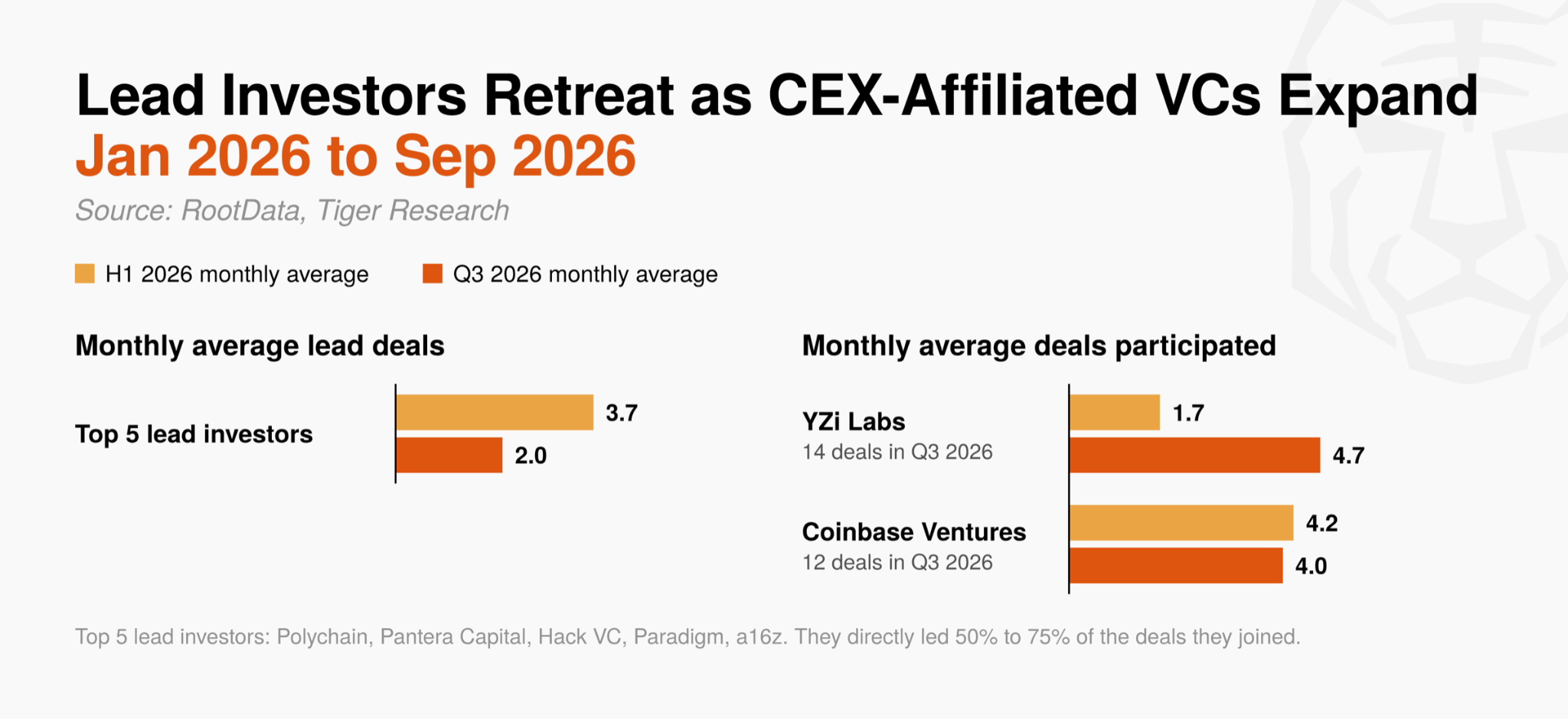
The influence of the main lead investors declined noticeably. The five most active lead investors since 2024 (Polychain, Pantera Capital, Hack VC, Paradigm, and a16z) led an average of 2.0 deals per month in Q3, down from 3.7 in the first half.
These firms had directly led 50% to 75% of the deals they joined and set valuations for the market, and their control over rounds is now weakening.
YZi Labs (formerly Binance Labs), by contrast, joined 14 deals, nearly three times its first-half monthly pace, followed by Coinbase Ventures with 12.
CEX-affiliated VCs increased their participation because their investment objectives differ structurally. Financial VCs aim for capital gains from rising equity or asset values, while CEX-affiliated VCs gain additional benefits, such as higher trading volume and new users, when their portfolio projects settle on the firm’s own CEX or blockchain, such as BNB Chain or Base.
These firms therefore have a clear reason to keep investing even when prices and valuations are uncertain. As a result, Q3 rounds reflected the influence of strategic investors seeking to grow their own platforms more than that of financial investors who set prices.
The Q3 VC market shows a shift from financial investment aimed at high returns toward strategic investment that creates business and ecosystem synergies.
2.3. Funding Stages: Early-Stage Caution and a Focus on Proven Businesses
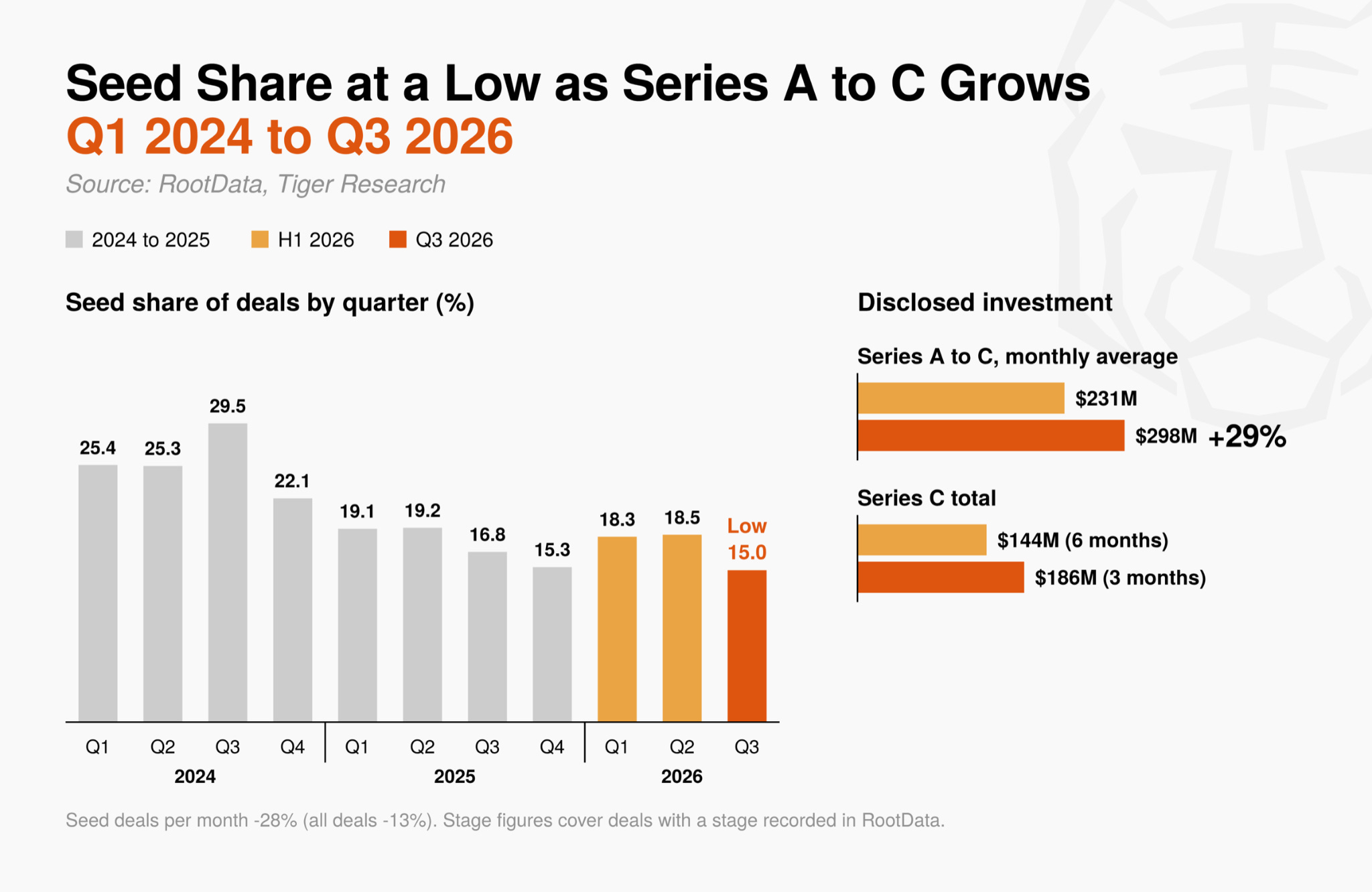
Investors were reluctant to take on unproven risk. Seed deals accounted for 15.0% of all deals, the lowest quarterly share since 2024, and the monthly number of seed deals fell 28%, more than twice the 13% decline in total deals.
Disclosed investment in Series A to C rounds rose 29% on a monthly basis, and Series C funding in Q3 alone exceeded the total for the entire first half.
Early-stage investing spreads capital across many small projects and relies on a few successes for high returns. For that model to work, later investors must keep buying equity or tokens at higher valuations.
With corporate investment more cautious across the board in Q3, expectations for such follow-on investment appear to have weakened. Investors instead concentrated capital in expansion rounds for companies whose businesses had already been proven through revenue and licenses.
Jeeves and EDX Markets, both of which raised Series C rounds in Q3, are payments and trading infrastructure companies, which reflects the same pattern. The market’s investment criteria are moving from token issuance schedules to evidence of a working business.
2.4. Financing: Listings and Debt Expand Beyond Equity
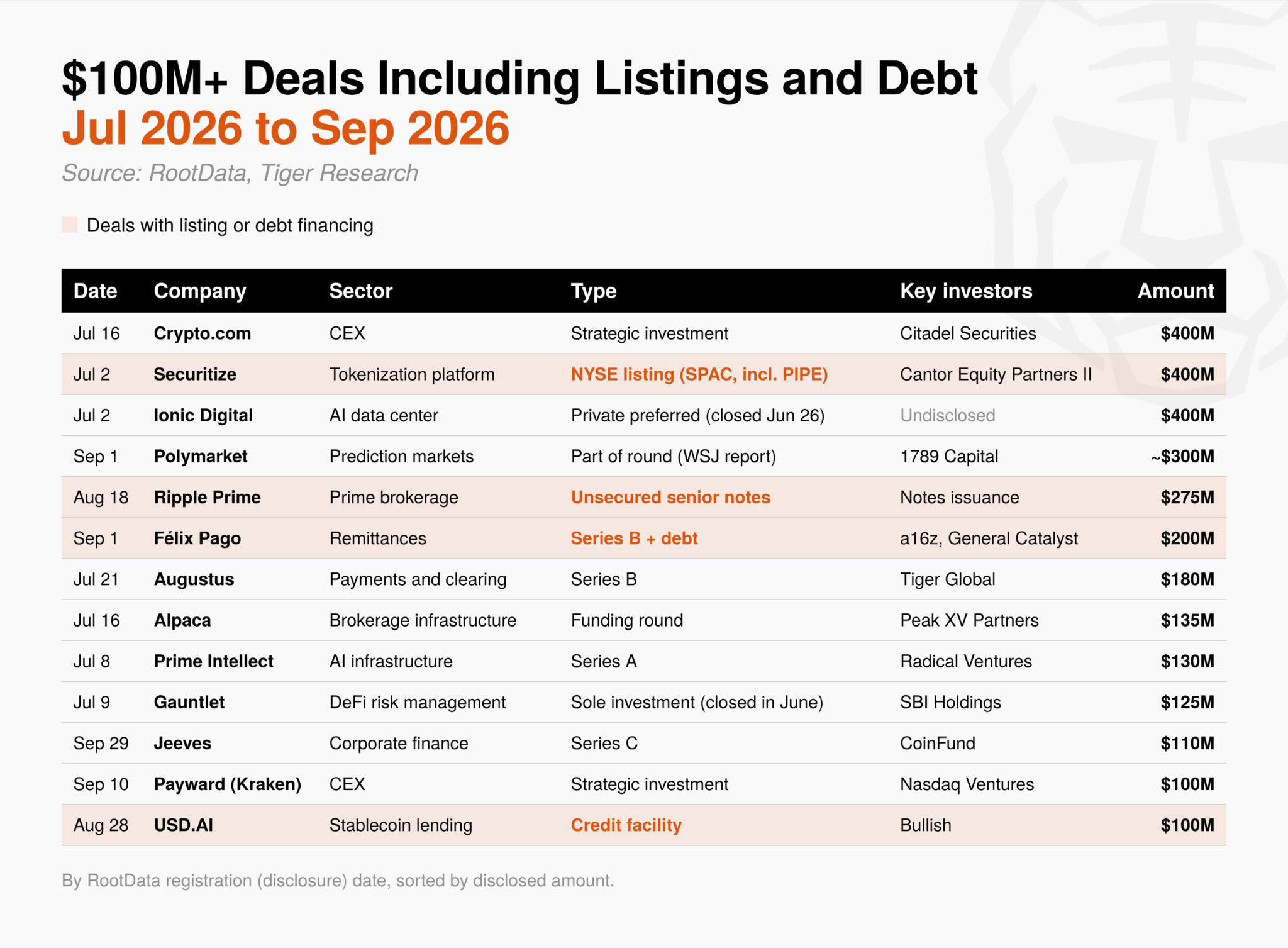
Large sums in Q3 also came from outside venture equity. Of the 13 deals worth $100 million or more, four involved a listing or debt.
Securitize listed on the New York Stock Exchange through a SPAC merger, and Ripple Prime issued $275 million in unsecured senior notes. On a monthly basis, venture and strategic equity investment fell 24%, while debt financing rose from $70 million to $190 million and listing proceeds rose from $80 million to $150 million.
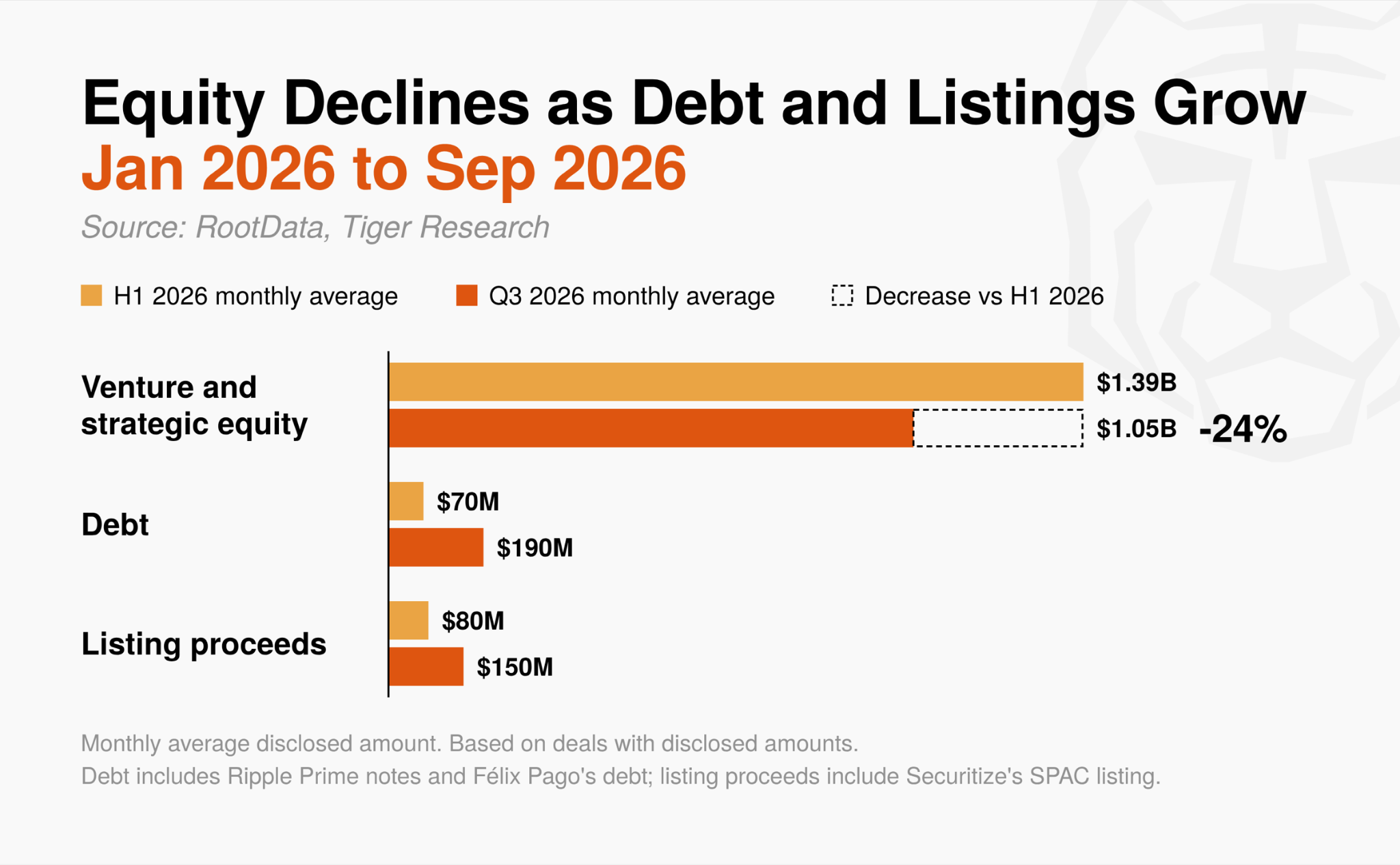
Bonds and listings require either the ability to repay or a valuation from public markets. In the first half, debt financing came mainly from bitcoin treasury companies such as Metaplanet borrowing to buy bitcoin.
In Q3, businesses with cash flow, such as prime brokerage, remittance, and stablecoin lending, borrowed to grow their operations. The basis for repayment moved from the bitcoin price to business cash flow. Some companies can now raise capital as ordinary businesses do, without venture investment, which may narrow the role of VCs to the early stage.
2.5. Sectors: Capital Concentrates in Infrastructure Linked to Traditional Finance
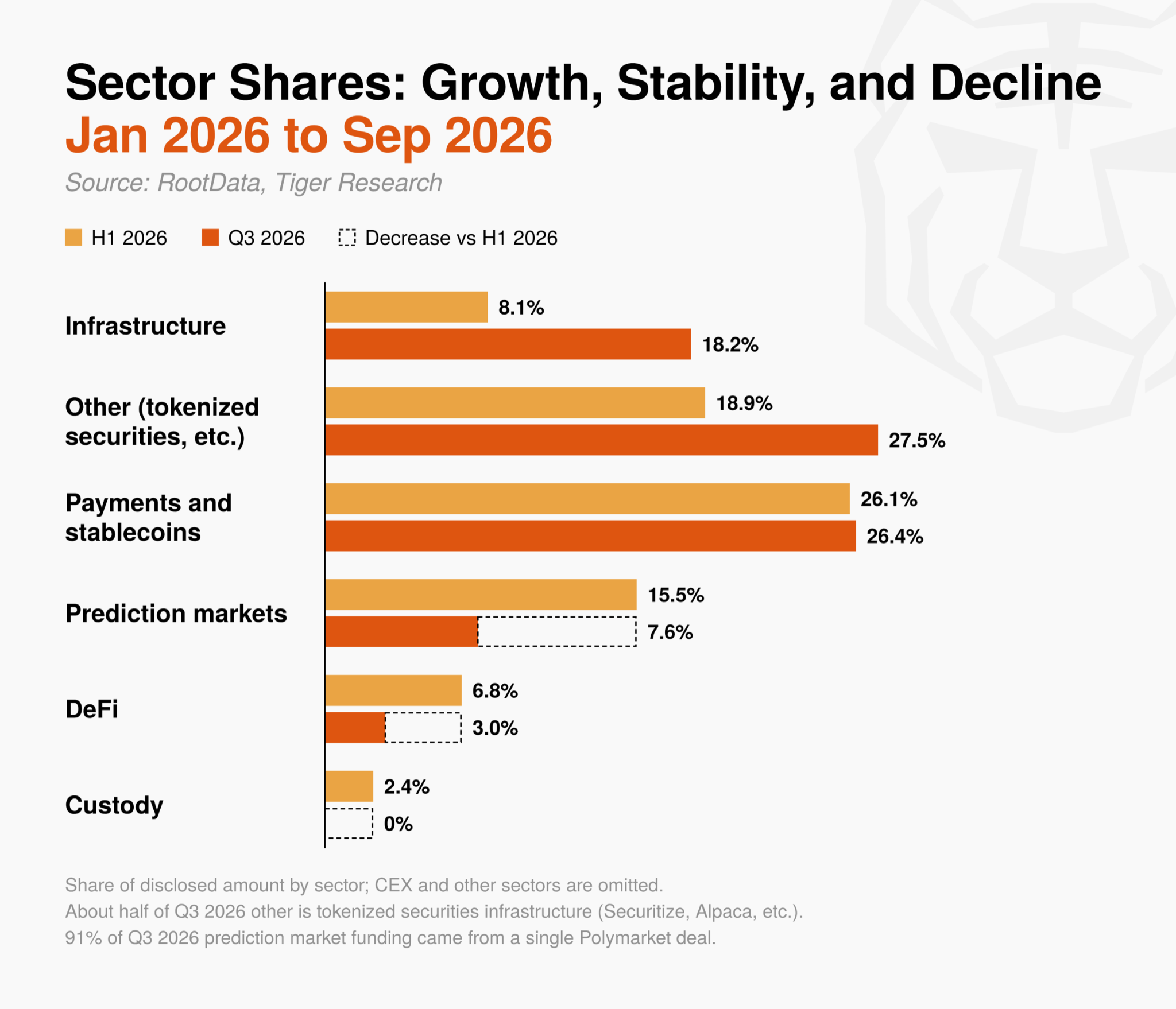
By sector, Q3 capital went to areas that connect traditional finance with the crypto ecosystem rather than to new layer 1 and layer 2 protocols.
The infrastructure sector’s share of disclosed investment more than doubled from 8.1% in the first half to 18.2%. The increase came from AI-related deals rather than new blockchain mainnets, led by Ionic Digital, which moved its business into AI data centers, and Prime Intellect, an AI training infrastructure company.
About half of the capital classified as “other” went to tokenized securities infrastructure such as Securitize and Alpaca, and payments and stablecoins was the only sector whose share held steady.
Sectors with little connection to traditional finance, by contrast, attracted much less capital. A single deal, Polymarket at about $300 million, accounted for 91% of Q3 investment in prediction markets. DeFi investment fell 71% along with a lower deal count, leaving the sector with 3.0% of the total, and the largest DeFi deal was Cari Network, a deposit token network backed by US regional banks. Custody attracted no new investment, and activity was limited to consolidation among established firms, such as BitGo’s acquisition of NYDIG’s trading business.
In Q3, capital went only to established firms that already held licenses and regulatory approvals, or to projects connected to banks and other traditional financial institutions. Investment moved clearly away from projects building new crypto ecosystems and toward the distribution channels and infrastructure through which traditional financial capital enters the crypto market.
3. Implications for Each Market Participant
Despite the price rebound, capital flowing into crypto companies remained tight in Q3. Capital instead changed its targets: small acquisitions that add specific capabilities replaced large deals, and strategic investors seeking to grow their own platforms became more prominent than financial lead investors.
Capital also concentrated in companies that had proven their business through revenue and licenses rather than in early-stage projects. As the trend toward control and fundamentals described in the previous report continues, the following sections set out the main tasks for each group of market participants.
3.1. Crypto Companies and Founders
Prepare for longer early-stage fundraising: Seed deal count fell faster than the market average in Q3. Before the next round, companies should recalculate their runway conservatively so that they can reach concrete milestones such as revenue, licenses, or major partnerships.
Review the terms of strategic investment: Capital from CEX-affiliated VCs continues to flow in, but it may come with conditions such as commitments to a specific CEX or blockchain. Companies should check in advance whether these conditions could restrict future financial investment or a sale of the company.
Build regulatory and licensing capabilities: Recent acquirers have focused on capabilities they can use immediately, such as securities licenses, payment networks, and trading infrastructure, rather than on whole companies. Companies considering a sale or partnership should define their core capabilities and how those fit a potential partner’s business.
Use a wider range of financing: Companies with stable cash flow can consider traditional financing, such as bond issuance or credit lines, to limit equity dilution.
3.2. Traditional Financial Institutions and Corporations
Enter the market through acquisitions: For new crypto businesses, acquiring a specialist company with licenses and operating experience can be more efficient than building infrastructure in-house. M&A focused on infrastructure, licenses, and trading capabilities continues to increase.
Value deals on actual terms: Disclosed deal values alone do not show how the market values these businesses. Buyers should prioritize fit with their own business and work with specialist advisers to test whether a deal can create value beyond its price.
3.3. Investors and Retail Participants
Read funding news with care: A VC funding announcement should not be read as an automatic buy signal. The large token sales and outsized trading gains of the past are harder to expect in the current market, and retail investors should recognize the limited upside of early-stage positions.
Evaluate projects on fundamentals: Projects should be assessed on revenue structure, regulatory compliance, and links to traditional finance rather than on token issuance schedules or short-term news.
The crypto market is moving beyond short-term expectations toward demonstrating real value and practical use. Some investors may regret this change, but the market’s transition into an industry can be seen as a healthy development.
Market participants that recognize this structural change and strengthen their core competitiveness and risk management will be better prepared for the next phase of the market.
🐯 More from Tiger Research
Read more reports related to this research.Data and Methodology
Data source: Data from January 2024 to September 2026 is based on the RootData API (3,515 funding rounds), dated by the RootData registration date. Ionic Digital and Gauntlet, which closed in June but were announced in July, are included in Q3. Of the 195 Q3 records in RootData, two that were not investments (a DEX launch partnership between Robinhood and dYdX Labs, and membership in an Ethereum institutional consortium) were excluded, leaving 193 deals for analysis.
Amount basis: Amounts in this report are the sum of deals with disclosed amounts (112 of 193 deals in Q3, and 286 of 441 deals in the first half). Deals without disclosed amounts are not included, so actual deal volume is larger than the figures shown. A Raven round recorded in RootData at $90 million was excluded because the original source showed that figure to be a valuation rather than an investment amount.
M&A amounts: Disclosed M&A amounts and M&A’s share of the decline (83%) are based only on deals with amounts recorded in RootData. Deals whose amounts were disclosed but not recorded in RootData, such as Circle and Tazapay ($400 million, per an SEC filing) and Mirae Asset and Korbit (about KRW 141.4 billion, or approximately $100 million), are noted separately in the text. The Q3 M&A comparison refers to quarterly data from Architect Partners.
Financing types: M&A follows the RootData round type. Listing proceeds include IPOs, post-IPO financing, and the Securitize listing. Debt includes Debt Financing, the Ripple Prime notes, and the debt portion of the Félix Pago round. Token sales include OTC and Public Sale rounds. All remaining deals are classified as venture and strategic equity investment, which also includes purchases of existing shareholders’ stakes, such as Hana Financial Group and Samsung Securities buying stakes in Dunamu in the first half.
First-half and Q3 comparison: Because the two periods differ in length (six months and three months), deal counts and amounts were converted to monthly averages for comparison. First-half figures were recalculated to reflect RootData’s subsequent data corrections (441 deals, previously 435).
Funding stages: Figures by stage, such as Seed and Series A to C, include only deals with a stage recorded in RootData (143 of 193 deals in Q3). For example, Fasset’s Series C and Augustus’s Series B are excluded from stage figures because RootData does not record their stage.
Sector classification: Each deal is assigned to a single sector based on RootData project tags, giving priority to sectors with more specific business models in the following order: prediction markets, CEX, custody, payments and stablecoins, DeFi, gaming, NFT, social and entertainment, and infrastructure. Large deals without tags were classified manually after reviewing the business, and deals that fit no sector were counted as other.
Institutional participation deals: Deals in which at least one investor classified by RootData as a corporate or institutional entity participated. This is the same basis as “deals with traditional financial institution participation” in the previous report.
Deals with direct participation by traditional financial institutions: Deals in which at least one bank, securities firm, asset manager, exchange operator, payment network, credit rating or data company, traditional market maker, or venture arm of one of these participated. Deals without investor information in RootData are not counted, so this share is a conservative figure. For example, Hana Financial Group and Samsung Securities’ acquisition of stakes in Dunamu in the first half and US regional banks’ investment in Cari Network in Q3 are excluded because investor information was not available. Investors identified by keyword were reviewed individually, and fintech companies such as PayPal, Stripe, Robinhood, and Nium were excluded from traditional financial institutions.
Verification of key deals: Key Q3 deals named in the text were cross-checked against company press releases, filings, and major media reports. Deals at the agreement stage (S&P Global and OpenZeppelin, Nasdaq and LeveL Markets, and Circle and Tazapay) have not yet closed.
Market indicators: Bitcoin prices and quarterly returns are based on Binance BTC/USDT daily closing prices (UTC). The Crypto Fear & Greed Index is from Alternative.me, and US spot bitcoin ETF net flows are from SoSoValue data as cited by Investing.com. The CLARITY Act vote and the SEC exemption are based on the US Senate vote record and reports of the SEC announcement.
About RootData
RootData is a Web3 asset data platform launched in early 2022 that provides a structured investment and fundraising database for crypto investors and founders. It currently handles more than 3.4 million search requests per month and is used by more than 2 million crypto users. RootData’s data and research are cited by major media outlets and institutions, including The Wall Street Journal, Cointelegraph, Binance Research, and The Block.
Disclaimer
This report has been prepared based on materials believed to be reliable. However, we do not expressly or impliedly warrant the accuracy, completeness, and suitability of the information. We disclaim any liability for any losses arising from the use of this report or its contents. The conclusions and recommendations in this report are based on information available at the time of preparation and are subject to change without notice. All projects, estimates, forecasts, objectives, opinions, and views expressed in this report are subject to change without notice and may differ from or be contrary to the opinions of others or other organizations.
This document is for informational purposes only and should not be considered legal, business, investment, or tax advice. Any references to securities or digital assets are for illustrative purposes only and do not constitute an investment recommendation or an offer to provide investment advisory services. This material is not directed at investors or potential investors.
Terms of Usage
Tiger Research allows the fair use of its reports. ‘Fair use’ is a principle that broadly permits the use of specific content for public interest purposes, as long as it doesn’t harm the commercial value of the material. If the use aligns with the purpose of fair use, the reports can be utilized without prior permission. However, when citing Tiger Research’s reports, it is mandatory to 1) clearly state ‘Tiger Research’ as the source, 2) include the Tiger Research logo. If the material is to be restructured and published, separate negotiations are required. Unauthorized use of the reports may result in legal action.


