

The industry shift driven by AI is already underway. Decades of advertising-supported web content are giving way to a world in which agents pay for the data they use. This report, produced with EastPoint, examines that shift.
Key Takeaways
As AI agents extract only the data they need and move on, the banner advertising model is breaking down, and platforms are shifting toward charging agents directly.
To handle the vast number of automated micropayments agents generate, fee-free stablecoins and on-chain payment standards such as x402 are emerging as essential infrastructure.
As happened with payments in the music streaming market, the per-transaction price will fall, but the sheer volume of machine-driven usage will outweigh that decline, making the overall market substantially larger.
Actual commercial adoption today remains at an early, roughly 1% to 10% adopter stage. Before the market matures, companies that build agent payment infrastructure now are the ones best positioned to remain relevant in the next paradigm.
1. An Agent World Without Web Ads
Over the past three decades, the internet content industry has grown on an advertising-based business model.
Users were exposed to advertising in exchange for free access to services, and the fees advertisers paid formed the financial basis for running these platforms.
Services could be offered for free because people visited sites and viewed the ads. As AI agents become the primary consumers of the web, however, there are fewer people left to view them.
AI agents access the web differently than people do. A person who visits a site reads its content and, in the process, is naturally exposed to banner ads. An AI agent, by contrast, extracts only the information it needs from a platform and leaves. As a result, the structure that once reliably exposed people to advertising is breaking down.
This shift undermines the revenue models that existing content and data companies rely on, seriously enough that many incumbents are now grappling with what the agent era means for their business.
2. Payment Infrastructure to Replace Web Ads
Consider a recipe platform that, anticipating the agent era, decides to charge every agent that accesses it. For an agent to retrieve a recipe from that platform, several conditions have to be met.
Payment rails: the platform needs infrastructure that allows agents to make payments.
A means of payment: the agent needs funds it can spend.
Payment delegation: controls that keep the agent from making payments outside its owner’s intent.
2.1. Payment Rails: The Emergence of the x402 Standard
Platforms need a machine-to-machine (M2M) channel that lets agents receive bills and settle them automatically, without human involvement. This requires pay-per-call billing infrastructure: a system that charges and settles each API call immediately.
One approach, taken by incumbents such as Mastercard and Ant Group, converts their existing large-scale card and simple-payment networks into agent-specific API solutions.
Existing financial networks, however, are structurally too heavy to run an approval process every time an agent requests data, which can happen dozens of times per second.
The crypto-based x402 standard has moved into that gap. Because wallet addresses communicate directly, without intermediaries such as value-added networks (VANs) or payment gateway providers, x402 allows atomic settlement similar to paying a toll, and it has emerged as a major alternative optimized for machine-to-machine transactions.
2.2. Payment Method: The Rise of Stablecoins
For an agent to purchase recipe data, it needs a way to hold and spend funds. One approach already in use links the agent to a user’s existing fiat-based fintech account or credit card infrastructure, giving it access to those payment methods. This approach, however, is better suited to conventional shopping.
Few people would pay a dollar for a banana cake recipe that used to be free. Conversely, when a transaction requires a micropayment as small as $0.0001, processing it through a conventional credit card or payment gateway network incurs fees that exceed the value of the transaction itself.
Stablecoins have drawn considerable attention as an alternative to this problem, because they function as programmable money, which makes them far better suited to an environment in which agents settle micropayments automatically and in real time, without a complex approval process.
2.3. Payment Delegation: The Delegation Framework as a Safeguard
Even with payment rails and a funding method in place, a wallet cannot simply be handed to an agent without safeguards. Strict controls are needed to prevent unintended overspending or exposure to malicious activity.
The mechanism that limits an agent to spending within a defined scope, rather than granting it unrestricted authority, is known as a delegation framework. To maintain smooth and secure control, a delegation framework verifies three main elements.
Identity: verifies who is making the payment. It identifies the owner of the requesting agent and assesses its trustworthiness, using mechanisms such as Know Your Agent (KYA) checks and decentralized identifiers (DID), to prevent identity theft and misuse.
Permissions: sets detailed rules for how the agent can spend funds, including the specific platforms it can use, the maximum amount per transaction, and the validity period.
Settlement: through smart contracts or on-chain rules, funds are finalized atomically only when the conditions set above are fully met, which removes the risk of disputes at the source.
The following section examines how, from 2025 to the present, companies have standardized these technologies and connected them to the market.
3. From Standards Competition in 2025 to Distribution Competition in 2026
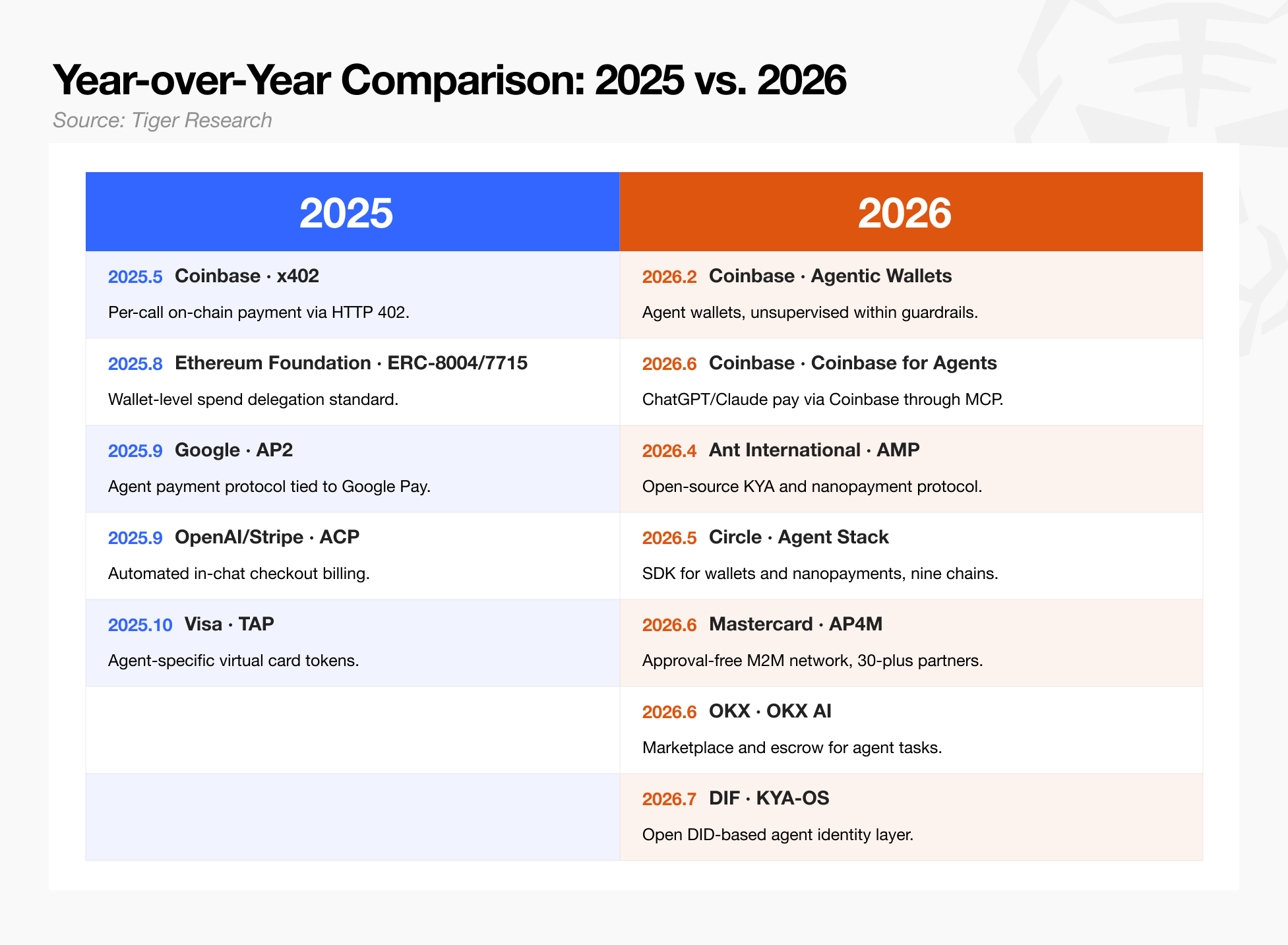
In 2025, crypto-native firms and incumbent financial and technology companies competed to establish technical specifications favorable to their own positions, each vying for leadership in agent payments.
Major standards emerged, including Coinbase’s x402 and Visa’s Trusted Agent Protocol (TAP), but most amounted to little more than published specification documents or developer SDKs.
For an agent to actually transact, identity verification, payment channels, final settlement, and counterparty matching all need to work together as an integrated system; however, each camp offered only a fragmented, self-centered layer of the protocol, and none produced the integrated ecosystem an agent would need to function.
Accordingly, 2026 is becoming the year in which the technical standards established so far move beyond nominal specification competition and into actual distribution.
Incumbent payment and financial infrastructure players are entering the field on the strength of their large merchant networks and the trust built into fiat-based systems. Ant International and Mastercard, for example, are layering agent-specific APIs on top of their existing large-scale payment networks, building a bridge between the established commerce ecosystem and AI agents.
Crypto-based infrastructure providers, meanwhile, are expanding into agent commerce and real-world usage on the strength of wallets and blockchain networks.
Coinbase has built infrastructure, through wallet and Model Context Protocol (MCP) payment integration, that lets developers and agents execute micropayments instantly within AI client environments such as Claude. Circle has extended its stablecoin payment infrastructure to nine major blockchain networks, and OKX has leveraged its existing crypto user base to secure a channel for agent transactions.
Where 2025 was a year in which each camp offered only a technical blueprint, the first half of 2026 has become a year of direct competition, as on-chain payment standards and traditional financial networks each press their respective strengths to integrate with actual AI platforms and commerce environments and claim the position of de facto standard.
4. Usage Is Real, but Adoption Is Not Yet Mass
A figure of 100 million users means something entirely different depending on whether the ecosystem that service belongs to totals one billion people or ten million.
The technology adoption lifecycle proposed by management scholar Everett Rogers, known as diffusion of innovation theory, divides adoption into five segments.
Innovators: 2.5%
Early adopters: 13.5% (16% cumulative)
Early majority: 34% (50% cumulative)
Late majority: 34% (84% cumulative)
Laggards: 16%
Reaching what is commonly called mass adoption, meaning more than seven in ten respondents actually using the technology, requires moving past the early majority and into the late majority segment.
Using this framework, the following sections examine adoption in the consumer and enterprise segments. Agent payments do not yet have a single authoritative global statistic, so what follows draws on individual company disclosures and data from specialized research firms.
4.1. Consumers
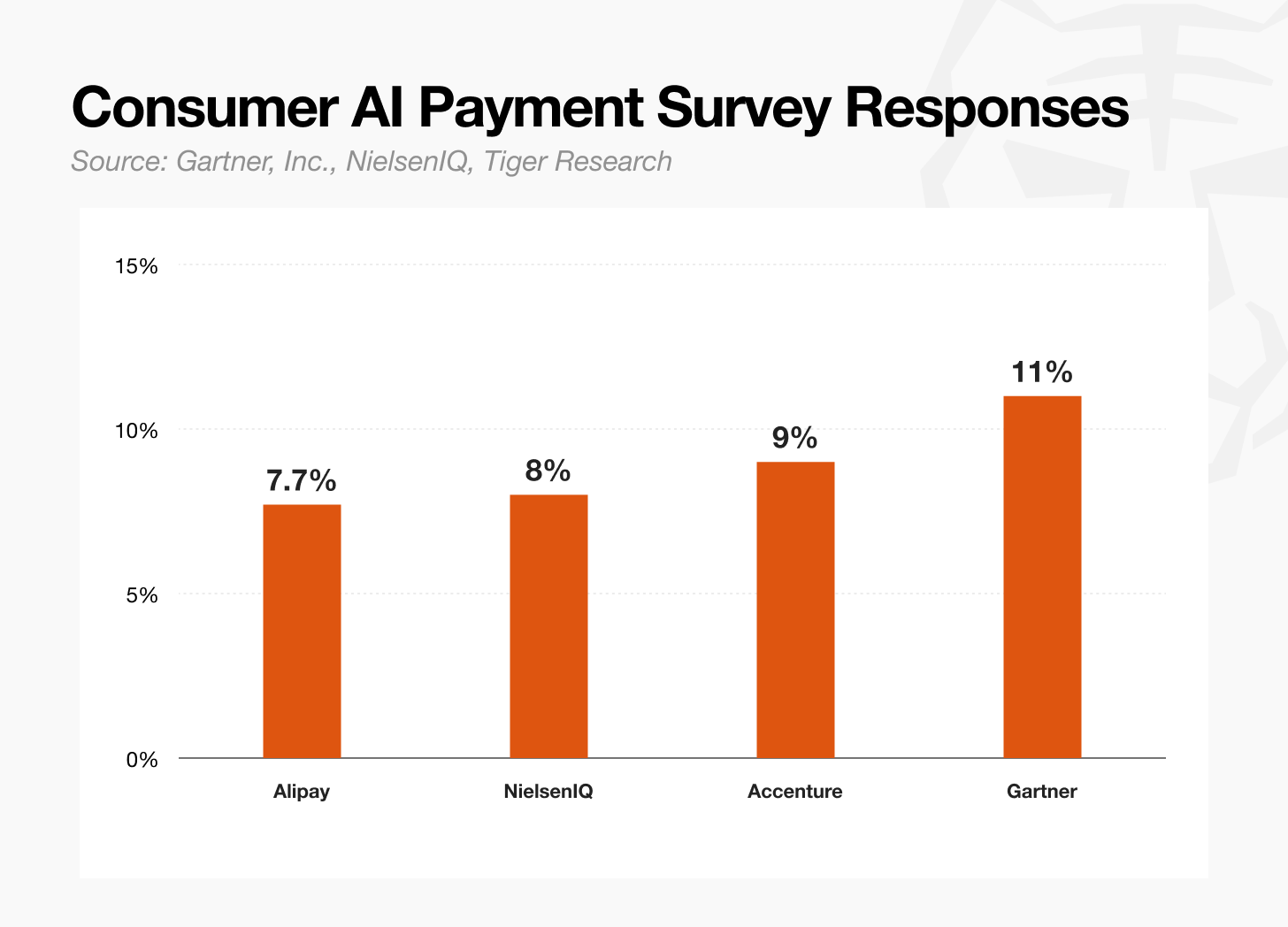
Alipay AI Pay: Ant Group has disclosed 100 million users for AI Pay. Set against Alipay’s total user base of 1.3 billion, that represents an actual usage rate of 7.7%.
NielsenIQ: according to NielsenIQ, 34% of consumers delegate product search to AI and 23% delegate review summarization. Only 8% of respondents had let AI complete a purchase entirely on its own.
Accenture: in an Accenture survey of 25,000 people across 16 countries, 9% said they would allow an agent to make purchases autonomously.
Gartner: in a survey of U.S. consumers, only 11% said they would allow AI to make purchasing decisions even in low-risk categories.
Taken together, these figures put average consumer adoption in the low teens, indicating that agent usage is still at an early stage.
4.2. Enterprises
On the enterprise and developer side, agent payment adoption remains a small sample by any measure. Individual company case studies, ecosystem metrics reviewed by independent auditors, and industry-wide adoption surveys all point to the same conclusion. As with the consumer segment, there is no single official statistic for this sector, so the following draws on individual disclosures.
When OpenAI launched Instant Checkout in September 2025, it was announced as covering more than one million Shopify merchants, but only about 12 merchants had actually activated live payment functionality.
Measured against Shopify’s total merchant base, estimated at 5.5 million to 6.8 million depending on the source, a range with nearly a twofold spread, that puts the usage rate at roughly 0.0002%.
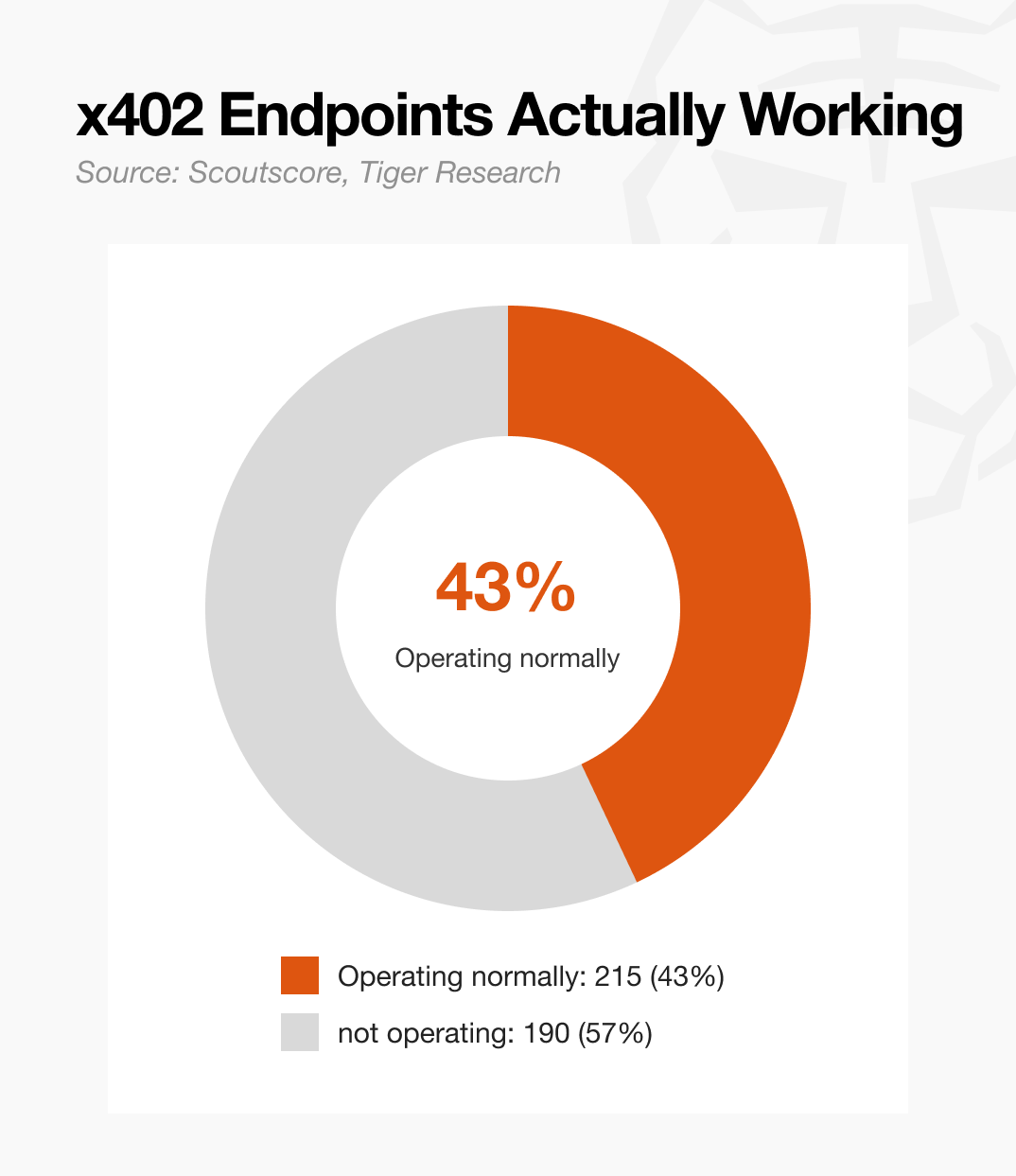
The state of the x402 ecosystem, the agent payment specification, makes clear how early this adoption remains. Only about 500 services are registered in its payment directory, and when the auditing firm ScoutScore examined all of them, just 43% operated correctly according to the specification.
As a result, only a small number of companies are running agent payment infrastructure commercially in production.
5. What Mass Adoption Would Bring
The core change that agent payments bring to the content and data markets is a mechanism combining falling per-unit prices with rising usage volume.
A single human visit to a webpage generates roughly $0.005 in ad revenue, while a machine reading and paying for the same data pays around $0.001, about a fifth of the per-visit figure. Machines, however, read far more often and in far greater volume than people do.
The music industry has already gone through this same structural shift once. As the industry moved from CDs priced at $15 apiece to streaming, which pays $0.003 to $0.005 per play, the per-unit price collapsed by a factor of thousands.
Once that micropayment model, charging roughly $0.003 per track, took hold, however, hundreds of millions of people worldwide began playing music continuously: during commutes, while exercising, and even while sleeping.
In other words, per-unit revenue from individual pieces of data will fall as agents take over, but the sheer volume of machine-driven calls and usage will outweigh that decline, and the overall size of the market and total revenue will end up larger.
6. This Is the Innovator and Early Adopter Stage
Both the consumer and enterprise segments have so far seen limited active participation in agent AI payment adoption.
On Everett Rogers’s adoption curve, both segments remain within the innovator (2.5%) and early adopter (13.5%) range, roughly 5% to 14% combined, well short of the mass adoption stage in which more than seven in ten people use the technology regularly.
These early figures need not be read as disappointing. If anything, they point to why companies should act now, while it is still possible to identify and correct problems before mass adoption arrives.
Security vulnerabilities that recently surfaced in the x402 ecosystem illustrate the transitional problems facing this early-stage infrastructure. An examination of the 15 major providers that together account for 99% of transactions found payment verification and settlement violations at every one of them, along with 31 newly identified vulnerabilities.
A handful of companies, including Coinbase, have since moved to fix some of these flaws, but most providers and the foundations governing the protocol have not made corresponding improvements at the specification level, leaving the underlying structural problems largely unresolved.
Moving straight to mass adoption without first resolving the instability in this early infrastructure would mean building on an unstable foundation.
The AI agent payment market today, then, is better understood as a period requiring patience: rather than rushing into premature mass adoption, the priority is to build technical trust and infrastructure ahead of the mainstream market to come.
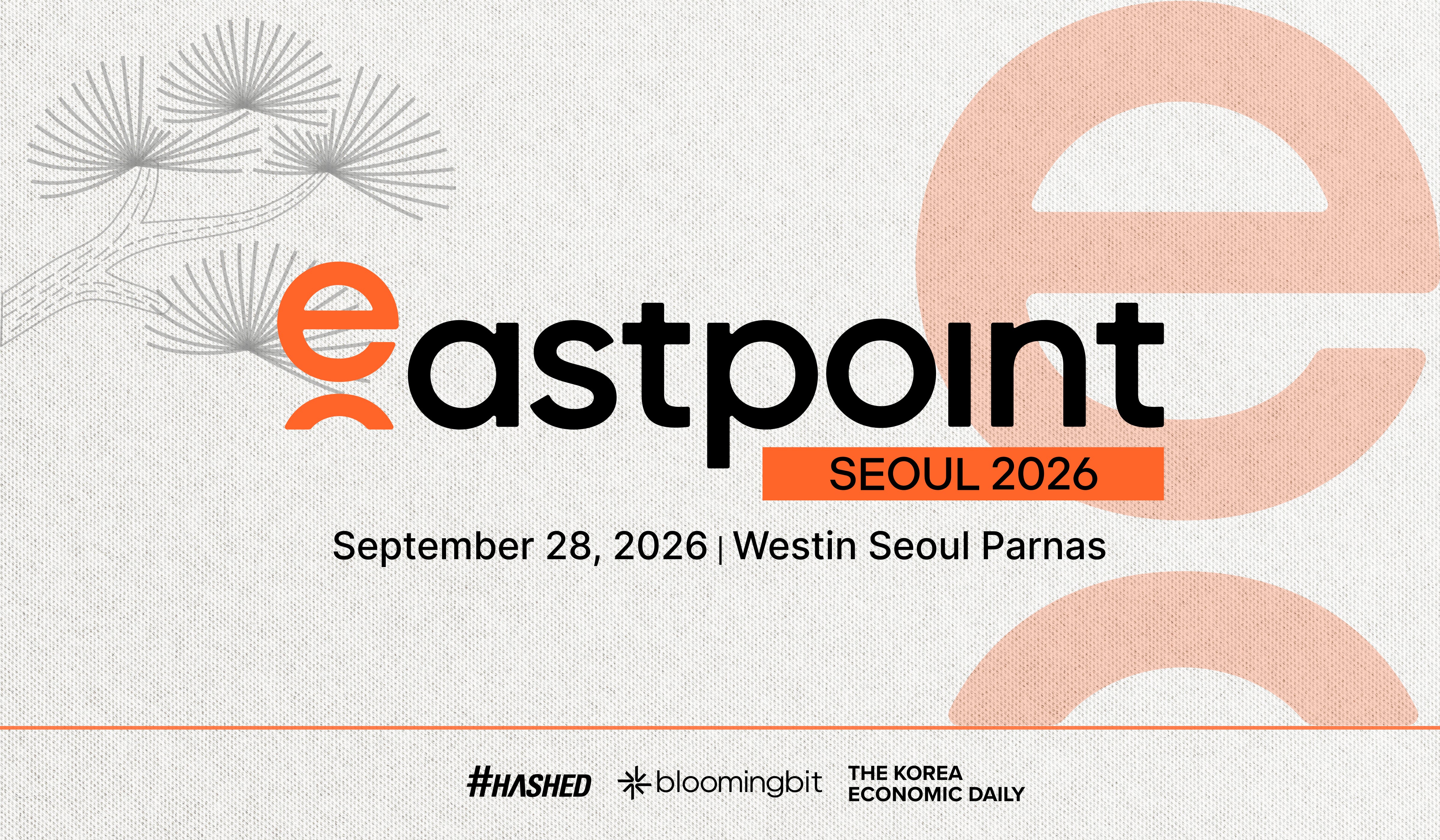
This restructuring of the industry has become a trend that cannot be reversed, and a significant industry challenge. To address this rapid paradigm shift and its implications for the industry from multiple angles, EastPoint: Seoul 2026 will be held on September 28 at the Westin Parnas Seoul.
In particular, the session “Autonomous AI in the Real World: From Decentralized Systems to Robotics“ will be moderated by Jun Park of Hashed, with participation from experts including Chi Zhang of Kite AI, Jaemin Jin of Magic Labs, Jan Liphardt of Openmind, and Junghee Ryu of RLWRLD.
The panel will examine, in depth, the conditions under which AI agents and robots can function as genuine economic actors in trustless environments, along with ways to integrate finance and digital assets into that shift.
🐯 More from Tiger Research
Read more reports related to this research.Disclaimer
This report has been prepared based on materials believed to be reliable. However, we do not expressly or impliedly warrant the accuracy, completeness, and suitability of the information. We disclaim any liability for any losses arising from the use of this report or its contents. The conclusions and recommendations in this report are based on information available at the time of preparation and are subject to change without notice. All projects, estimates, forecasts, objectives, opinions, and views expressed in this report are subject to change without notice and may differ from or be contrary to the opinions of others or other organizations.
This document is for informational purposes only and should not be considered legal, business, investment, or tax advice. Any references to securities or digital assets are for illustrative purposes only and do not constitute an investment recommendation or an offer to provide investment advisory services. This material is not directed at investors or potential investors.
Terms of Usage
Tiger Research allows the fair use of its reports. ‘Fair use’ is a principle that broadly permits the use of specific content for public interest purposes, as long as it doesn’t harm the commercial value of the material. If the use aligns with the purpose of fair use, the reports can be utilized without prior permission. However, when citing Tiger Research’s reports, it is mandatory to 1) clearly state ‘Tiger Research’ as the source, 2) include the Tiger Research logo. If the material is to be restructured and published, separate negotiations are required. Unauthorized use of the reports may result in legal action.


