

Key Takeaways
The Bank of Korea’s CBDC has entered live-transaction testing under Project Han River Phase 2, but a won-denominated stablecoin still has no legislative basis.
The revised STO bill has passed, but permitted assets and licensing details are left to presidential decree. The market’s direction will be set when those regulations appear, not when the bill passed.
With the consultative council aligned on a tokenization roadmap for stocks, bonds, and money market funds, the priority is bringing proven, standardized securities on-chain rather than sourcing new fractional-investment assets.
Hana Bank’s stake in Dunamu (6.55%, 1.0033 trillion won, about $733 million) and Mirae Asset Consulting’s stake in Korbit (97.15%, 141.4 billion won, about $103 million) point to securing infrastructure for combined STO, RWA, and stablecoin services, not fee income alone.
Overseas tokenization pilots take six months to a year, while domestic financial institutions close their budgets in early December. Implementation should start now, not wait for the detailed rules.
1. A Fragmenting Global Crypto Market and Korea’s Position
The crypto ecosystem appears borderless on the surface, but in practice national borders are becoming sharper as each country establishes its own regulatory framework.
The EU has implemented MiCA, the United States is advancing the GENIUS Act and the CLARITY Act, and in Asia, Singapore, Hong Kong, and Japan have each settled on their own regulatory approaches. Major economies are embracing the market through clear policy, but because those policies diverge, the global market is fragmenting along regional lines.
Korea is building its own environment within this trend. Investment demand and public interest in Korea are very high, but the country’s regulatory pace lags somewhat behind that of major economies.
2. Where Korea’s Crypto Market Stands Today
In the first half of 2026, Korea’s regulatory environment raised expectations of full incorporation into the formal financial system, including passage of the STO-related bill, but a series of market-restraining statements, including discussion of taxation, added to confusion within the ecosystem.
2.1. Bank of Korea’s Project Hangang Phase 1 Results (March 29, 2026)
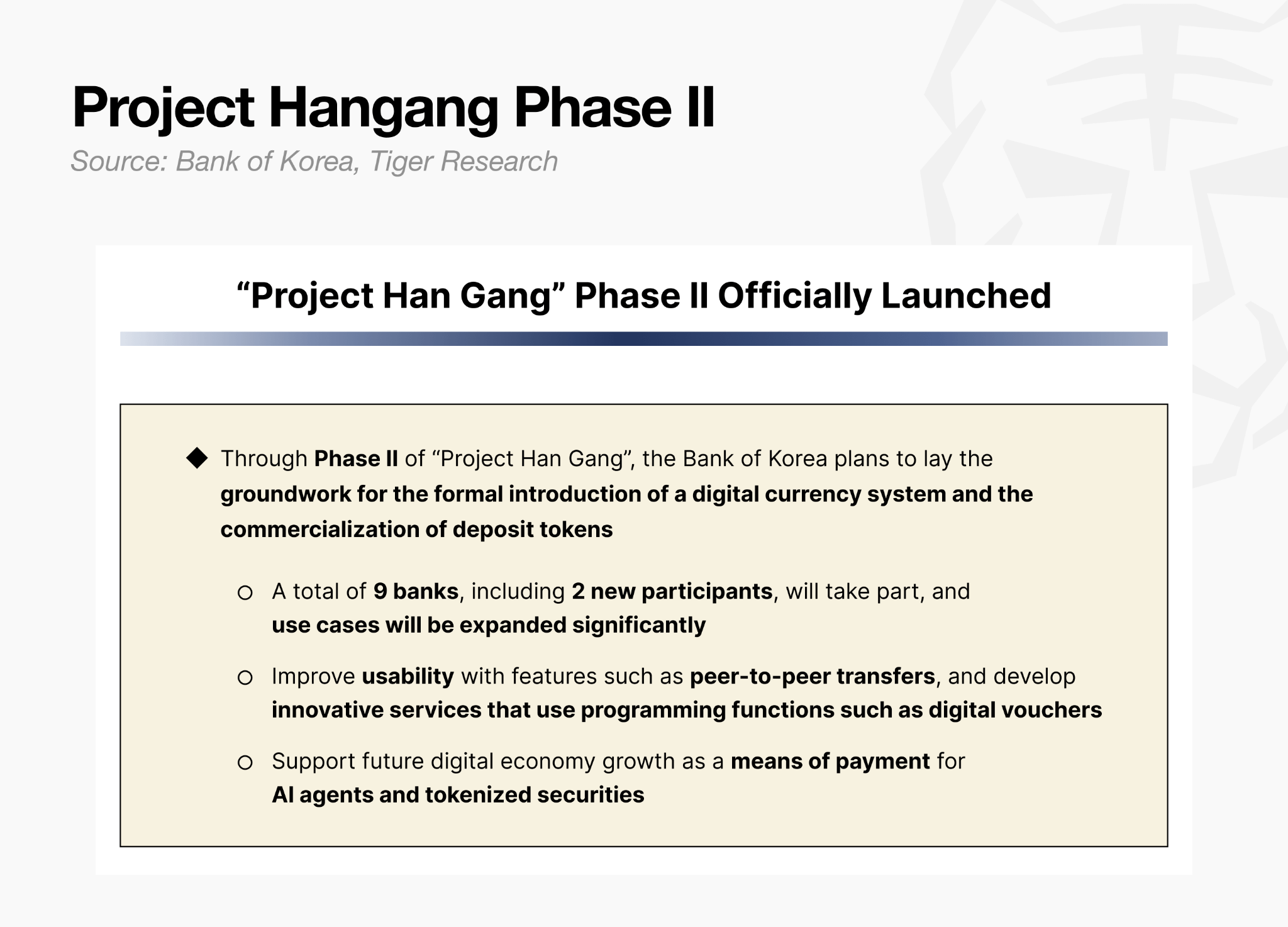
The Bank of Korea released the first-phase results report for its deposit-token-based CBDC live-transaction pilot on December 18, 2025, then formally announced the start of Phase 2 on March 29, 2026.
Phase 2 goes beyond simple technical verification to test real conditional fund disbursement, including electric vehicle subsidies and official expense accounts. The number of participating banks has expanded to nine, and the pilot has added peer-to-peer transfers, biometric authentication, and automatic deposit conversion. Live transactions are expected to begin as early as September, though no separate testing period has been set. The absence of a fixed end date reflects an effort to sustain the service on an ongoing basis rather than treat it as a one-time demonstration.
While the CBDC has advanced substantially through Project Hangang, a won-denominated stablecoin remains far from realization.
While Project Hangang has moved forward, Phase 2 of the Digital Asset Basic Act, which would institutionalize a won-denominated stablecoin, has been delayed by roughly a year. The delay stems from disagreement between the Bank of Korea and the Financial Services Commission. The Bank of Korea has argued that a bank consortium should hold a stake of at least 51 percent, while the Financial Services Commission has opposed that requirement on the grounds that it would stifle innovation.
Various policy alternatives were subsequently proposed, but legislative discussion came to a complete halt in the aftermath of the June local elections, and the process has remained stalled without clear progress since. The government and the Financial Services Commission announced plans in July to resume work in the second half of the year and pass legislation before year-end, but the process has been delayed again after Rep. Park Min-gyu of the Democratic Party, a member of the National Assembly’s Political Affairs Committee, signaled that the task force would be reorganized after the party’s August convention, with the bill to be introduced in September.
The Bank of Korea-led CBDC has already entered the live-transaction verification stage and is producing visible results, while a won-denominated stablecoin remains in an uncertain state without even a legislative basis. Premature optimism about this area should therefore be treated with caution, and it should be recognized as a long-term undertaking that will require considerable time before the market settles.
2.2. Passage of the STO-Related Bill in the National Assembly (January 15, 2026)
On January 15, 2026, revisions to the Act on Electronic Registration of Stocks, Bonds, etc. (the Electronic Securities Act) and the Financial Investment Services and Capital Markets Act (the Capital Markets Act) passed a plenary session of the National Assembly. This brought to an end the three-year regulatory sandbox regime that had been in place since the Financial Services Commission released its “Plan to Reorganize the Regulatory Framework for Issuance and Distribution of Security Tokens” in February 2023.
The revision rests on three pillars: recognizing the legal status of the distributed ledger, introducing the issuer account management institution system, and detailing a distribution roadmap for investment contract securities.
Legal recognition of the distributed ledger: extends the legally valid forms of securities registration, previously limited to physical certificates and electronic securities, to include blockchain-based distributed ledgers.
Introduction of the issuer account management institution system: gives issuers that meet the qualification requirements the authority to register and manage securities directly with the Korea Securities Depository, without going through a financial institution as intermediary.
A more concrete distribution roadmap for investment contract securities: establishes a legal basis for securities firms to broker trading, improving the secondary trading environment and market liquidity for fractional-investment assets that had previously been fragmented.
The revised law was promulgated on February 3, 2026, and will take full effect on February 4, 2027, following a one-year grace period. It is still too early to expect immediate market activation from the legislative basis alone, because key practical requirements, including the specific scope of permitted assets, have been delegated to presidential decree and supervisory regulations, and detailed guidelines have not yet been announced.
The public-private Token Securities Council, launched on March 4, 2026, to work out those guidelines, is discussing the detailed plan. The Financial Services Commission originally planned to publish the subordinate regulations and guidelines around July 2026, but the timeline slipped when the process remained at a closed-door consultation stage with the legal and financial sectors as of July 31. As of late August, working-level officials expect the announcement sometime between September and November.
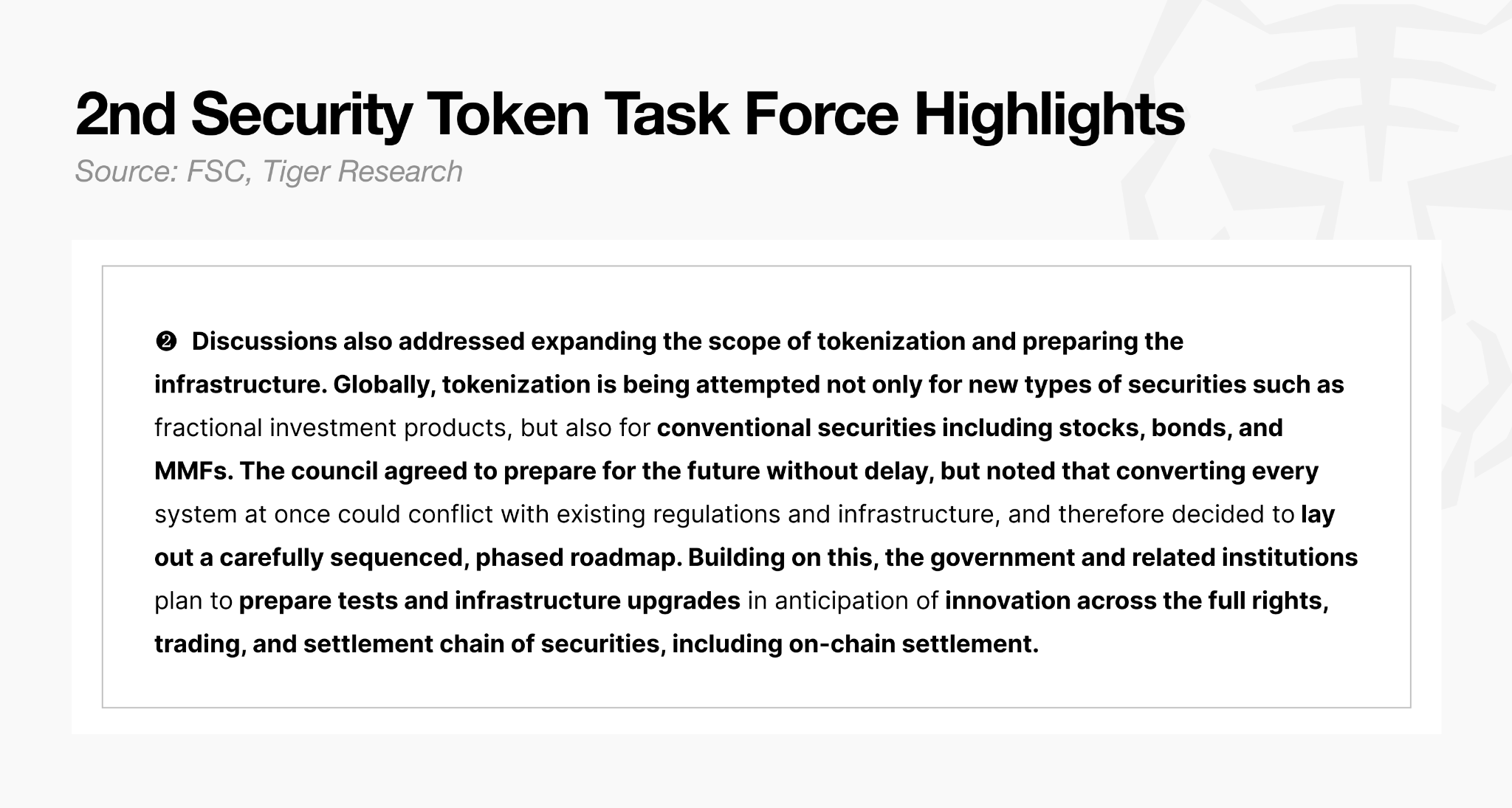
One encouraging aspect of the council’s discussions is the inclusion of standardized securities such as stocks. At the second meeting, held on May 15, the council reached consensus on a phased roadmap that includes tokenizing existing standardized securities such as stocks, bonds, and money market funds, and building on-chain settlement infrastructure. This suggests that the market, previously confined to fractional investment, could expand.
Rather than concentrating on sourcing new assets, as existing fractional-investment operators have done, building a model to distribute on-chain the standardized securities whose demand has already been proven could create a larger market opportunity. Domestic institutions should therefore study concrete precedents closely and build diverse global partnerships early, moving quickly enough to be well positioned once the market matures in earnest.
2.3. Amended Special Financial Information Act Takes Effect (August 20, 2026)
The amended Act on Reporting and Using Specified Financial Transaction Information, commonly known as the Special Financial Information Act (Act No. 21358), was promulgated on February 19, 2026, and took effect on August 20, 2026. Not all of its provisions apply as of that date. Stricter screening for virtual asset service provider (VASP) registration took effect on August 20, while strengthened Travel Rule requirements and rules governing transactions with overseas providers and personal wallets will apply around February 2027, six months after the enforcement decree is promulgated.
Stricter VASP registration screening: introduces review of major shareholders and raises financial soundness and creditworthiness requirements, raising the barrier to entry (effective August 20)
Strengthened Travel Rule: removes the 1 million won (about $730) threshold that had triggered the information-sharing requirement and extends it to all transactions (effective around February 2027)
Stricter rules for overseas providers and personal wallets: differentiates permitted transaction scope by risk level (effective around February 2027)
The core change to VASP registration screening is an expanded definition of major shareholder. The review now closely examines the financial soundness and creditworthiness of the largest shareholder, any shareholder who has appointed a majority of the CEO and directors, and, where the shareholder is itself a corporation, that corporation’s largest shareholder and representative.
The strengthened Travel Rule targets transaction splitting used to avoid reporting. For transfers between reported VASPs, the information-sharing threshold expands from 1 million won or more to all transactions, and the obligation to obtain that information now also falls on the receiving provider.
Overseas transactions are also being brought out of the regulatory blind spot. Rather than an outright ban, the rule applies three tiers of risk-based restriction. Transfers to low-risk overseas exchanges are permitted without a same-name requirement for sender and recipient. Transfers to other overseas exchanges and personal wallets are permitted only when the sender and recipient are the same person, meaning the wallet must be held in the user’s own name. Transactions with high-risk overseas exchanges are banned entirely. For overseas exchange and personal wallet transactions of 10 million won (about $7,300) or more, reported VASPs must build and operate their own suspicious transaction monitoring system.
2.4. No Additional Deferral for Virtual Asset Taxation (August 3, 2026)
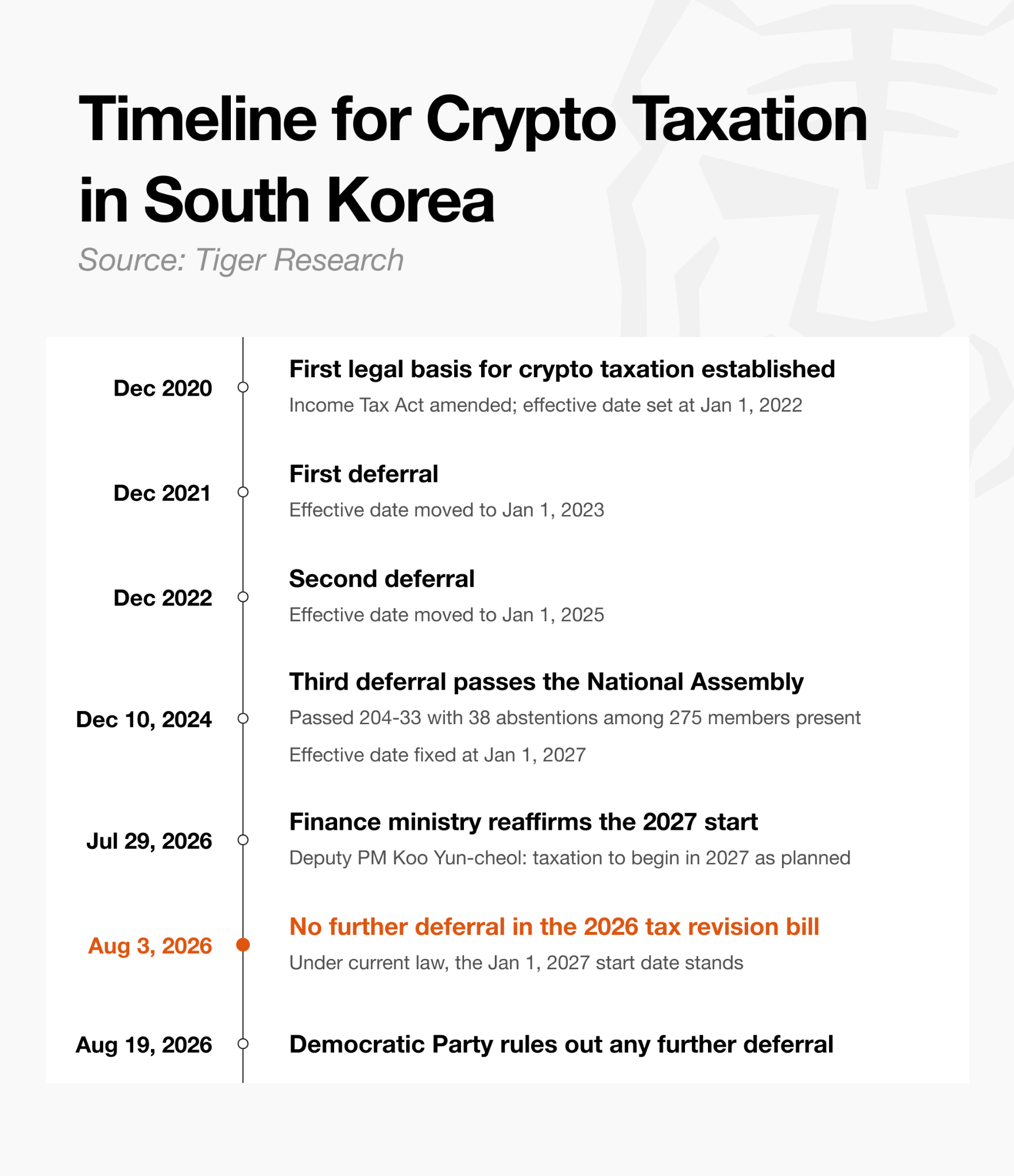
Virtual asset taxation, whose effective date was set at January 1, 2027, through a December 2024 amendment to the Income Tax Act, will proceed as scheduled under current law after the government’s August 2026 tax reform proposal excluded any additional deferral provision. Bills from the People Power Party seeking deferral or repeal remain pending, however.
In addition, a petition submitted through the National Assembly’s public petition system points to inadequate tax infrastructure, capital outflows overseas, and declining corporate tax revenue from weaker exchange earnings, but the National Assembly and the government remain divided in their response.
2.5. Exchange Stake Investment Gains Momentum
Traditional financial institutions and large capital groups are acquiring stakes in virtual asset exchanges not simply to generate returns but to secure an early position in the digital finance market. With VASP (virtual asset service provider) regulation making direct market entry difficult, equity investment offers an efficient alternative that reduces regulatory risk while providing immediate access to a large user base and liquidity.
Dunamu (Upbit’s parent company): Hana Bank acquired a 6.55% stake (1.0033 trillion won, about $733 million, resolved May 15, 2026), becoming the first commercial bank to hold a large stake in the company. On August 18, BitGo Korea’s VASP registration was accepted, completing a dual-track structure combining the Upbit stake with BitGo custody services. Hanwha Investment & Securities expanded its stake to 9.84%, becoming the third-largest shareholder, while Samsung affiliates, Samsung Securities (2%), Samsung SDS (1%), and Samsung Card (1%), together acquired a combined 4% stake (612.8 billion won, about $448 million), establishing a division of roles across security tokens, infrastructure, and payments.
Korbit (acquisition completed): Mirae Asset Consulting acquired a 97.15% stake (141.4 billion won, about $103 million), completing the acquisition. Because the acquiring entity is Mirae Asset Consulting, a non-financial affiliate, the Fair Trade Commission’s approval was likewise explained as not constituting direct investment by a financial company.
Coinone (change of largest shareholder approved July 22, 2026): Korea Investment & Securities and OKX Ventures each acquired a 20% stake (roughly 80 billion won, about $58 million, each). The ownership structure was reorganized to CEO Cha Myung-hoon at 30.36%, Com2uS Holdings at 24.54%, and Korea Investment & Securities and OKX Ventures at 20% each, marking a case of a securities firm holding a direct stake.
Bithumb (unresolved): Negotiations with Kiwoom Securities effectively broke down on August 5 over valuation and management control, and talks with Kakao have also dragged on. A multi-layered governance structure and the second-largest shareholder Vidente’s effective stake of more than 32% make a sale of existing shares difficult.
Exchange stake investment continues on this basis, and the pattern suggests that investors see exchanges over the long term as the next-generation financial infrastructure where STO, RWA, and stablecoin functions converge, positioning themselves ahead of an anticipated opening of corporate accounts and a fuller entry of institutional investors.
3. What Lies Ahead for Korea’s Crypto Market
As outlined above, Korea is in a transitional period of building its institutional framework, but regulatory barriers that hold back industry growth remain widespread at the same time. Because the market’s direction will depend heavily on the corporate governance changes among major virtual asset service providers and on legislative progress concentrated in the fourth quarter, these turning points warrant close attention.
3.1. Deal-Closing Season (September to December)
The stock swap between Dunamu and Naver Financial is likely to be the first matter to conclude.
Because the Fair Trade Commission’s business combination review has been delayed, the completion date for the comprehensive stock swap has been pushed back twice, first from June to September, then to December 31. The shareholders’ meeting has been rescheduled accordingly to November 19, and Naver Financial has set a target of listing within five years of the merger, with a clause allowing an extension if that timeline proves unworkable.
For Bithumb, a concrete three-stage roadmap has been laid out: securing new investment starting in early August, filing a preliminary listing review in 2027, and completing an IPO in 2028. However, with negotiations with Kiwoom Securities effectively broken down and discussions with Kakao continuing to stall, there is a risk that the roadmap could fall behind schedule at its very first step, the investment round.
The VASP re-registration process is also concentrated toward year end. Preliminary submissions begin in late October, formal applications close on November 20, and the Financial Intelligence Unit’s substantive review follows. In addition, registration for virtual asset transfer businesses becomes mandatory when the amended Foreign Exchange Transactions Act takes effect in early December, making this an important juncture for regulatory compliance as well.
3.2. Legislative Turning Point (September Regular Session of the National Assembly)
The government’s draft of the Digital Asset Basic Act is likely to take shape during the September regular session, introduced as member-sponsored legislation. The most sensitive issue is whether to require private stablecoin issuers to secure a bank stake of at least 51 percent and whether to cap major shareholder stakes at exchanges to improve corporate governance.
At the same time, the authorities regard amending the Capital Markets Act to regulate single-stock leveraged ETFs as an urgent priority, raising concern that legislative momentum for the Digital Asset Basic Act could weaken more than expected.
Because passage of this bill is directly tied to whether won-denominated stablecoins become institutionalized, it stands as the most decisive variable likely to reshape the market going forward.
3.3. Finalizing STO Subordinate Regulations
The enforcement decree and guidelines that will set the detailed standards for the STO market have missed their original July target and remain delayed as of late August. An announcement is expected sometime in the second half of the year, but no specific date has been set.
Once the guidelines are finalized, they will clarify the scope of underlying assets eligible for issuance as security tokens, the licensing requirements for over-the-counter exchanges, and investor trading limits. The Korea Securities Depository has begun building its system with a target of 2027 implementation, and as the subordinate regulations continue to lag, concerns are growing that a gap between actual issuance and distribution could leave the market with a period of inactivity.
4. How Companies Should Approach the Korean Market
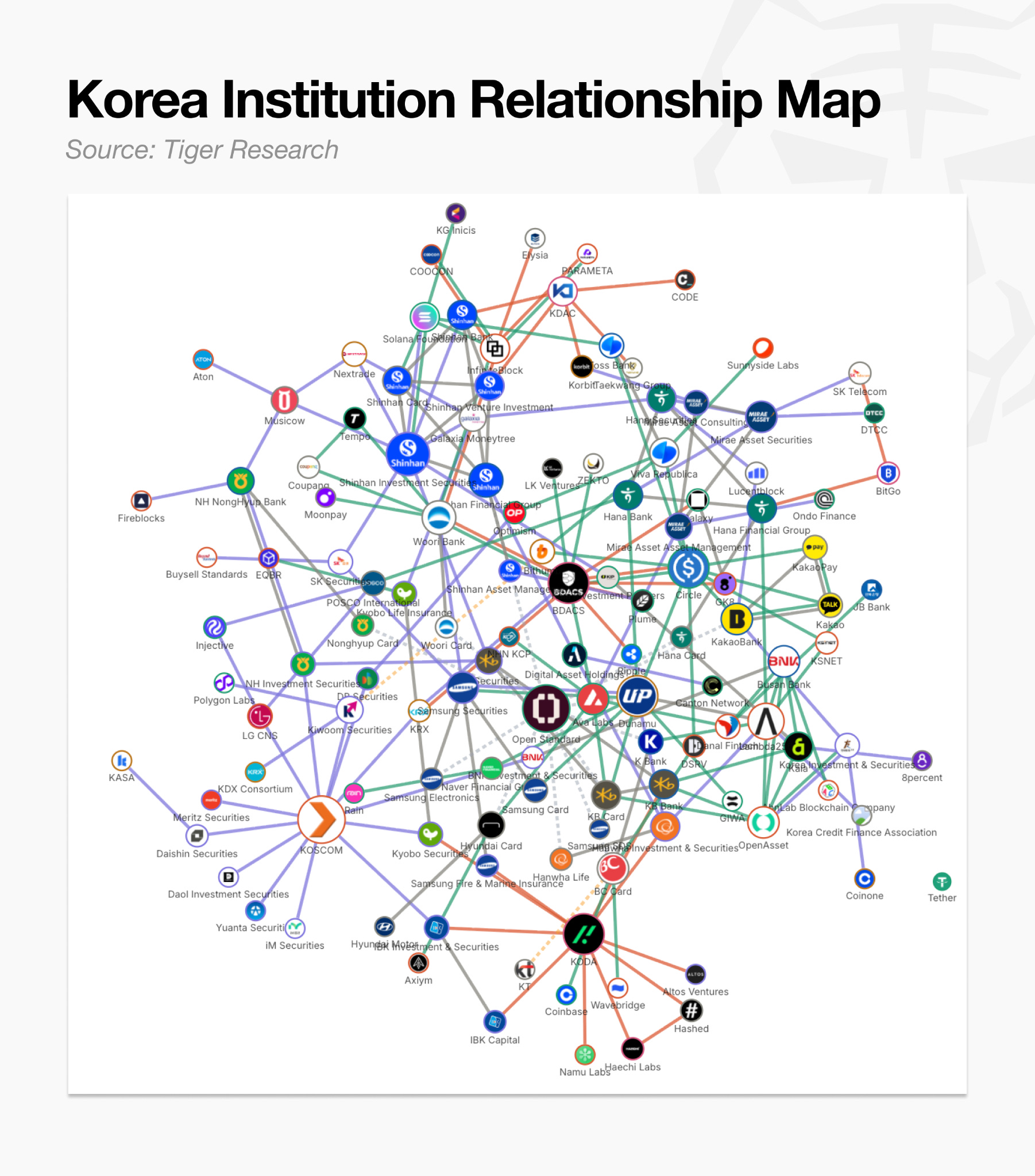
As shown in the landscape of domestic institutional relationships that Tiger Research has mapped, major institutions are continuing to expand cooperative relationships across the board to build a genuine business value chain.
Established financial institutions are leading the effort to build concrete business precedents, and Web3 projects, both domestic and international, are increasingly concentrating their resources on securing strategic partnerships with institutions rather than retail users.
This shift partly reflects the current slowdown in retail market liquidity, but it also reflects a longer-term strategic view, that real value creation within the formal financial system must come first before retail demand can be reignited.
4.1. Domestic Institutions: Making the Attempt Matters
Large-scale equity investment by traditional financial institutions continues, but the current regulatory framework limits the ability to develop a genuine business model within Korea. Institutions are left waiting for the STO subordinate regulations to be finalized or confined to limited testing through the regulatory sandbox, which makes the most effective alternative building out a business preemptively in an overseas jurisdiction where the institutional groundwork is already complete.
Waiting passively for regulatory clarity has clear limits when it comes to securing market position, and the sandbox track is confined to the narrow scope of fractional investment, making it difficult to extend to standardized securities. Domestic institutions should therefore treat building operational capability centered on an overseas base, difficult as that is right now, as their top priority.
Hong Kong manages security tokens within its existing financial regulatory framework and permits secondary distribution through licensed exchanges, offering an integrated environment for issuance and trading. Singapore offers excellent regulatory transparency but a considerably high barrier to entry, while the United States offers an issuance path through exemption provisions when using specific platforms.
Domestic financial institutions that already have overseas networks would therefore do better to focus first on the potential of their existing footholds rather than spend time exploring new jurisdictions. Rather than getting absorbed in extensive legal interpretation, a more strategic approach is to quickly test feasibility through working-level meetings with leading local platforms.
This moment in particular is a critical window.
Overseas tokenization projects typically take six months to a year or more, from initial analysis through issuance and distribution. Given Korea’s STO regulations and the February 2027 enforcement of the Electronic Securities Act, now is the right time to pursue overseas pilots that can work in tandem with the domestic market. Waiting until the domestic system is fully in place would waste more than a year, so institutions should confirm a concrete checklist and roadmap and act now.
4.2. Web3 Projects: The Same Applies, Act Now
The first gate to collaborating with Korean financial institutions is not technical capability but contracting-entity eligibility. Even for a proof of concept, information security review and vendor registration must come first, and registration is frequently denied outright when the applicant has no Korean corporate entity. Where establishing a local entity is not feasible, projects need a strategic structure that puts a credible Korean partner forward as the contracting entity.
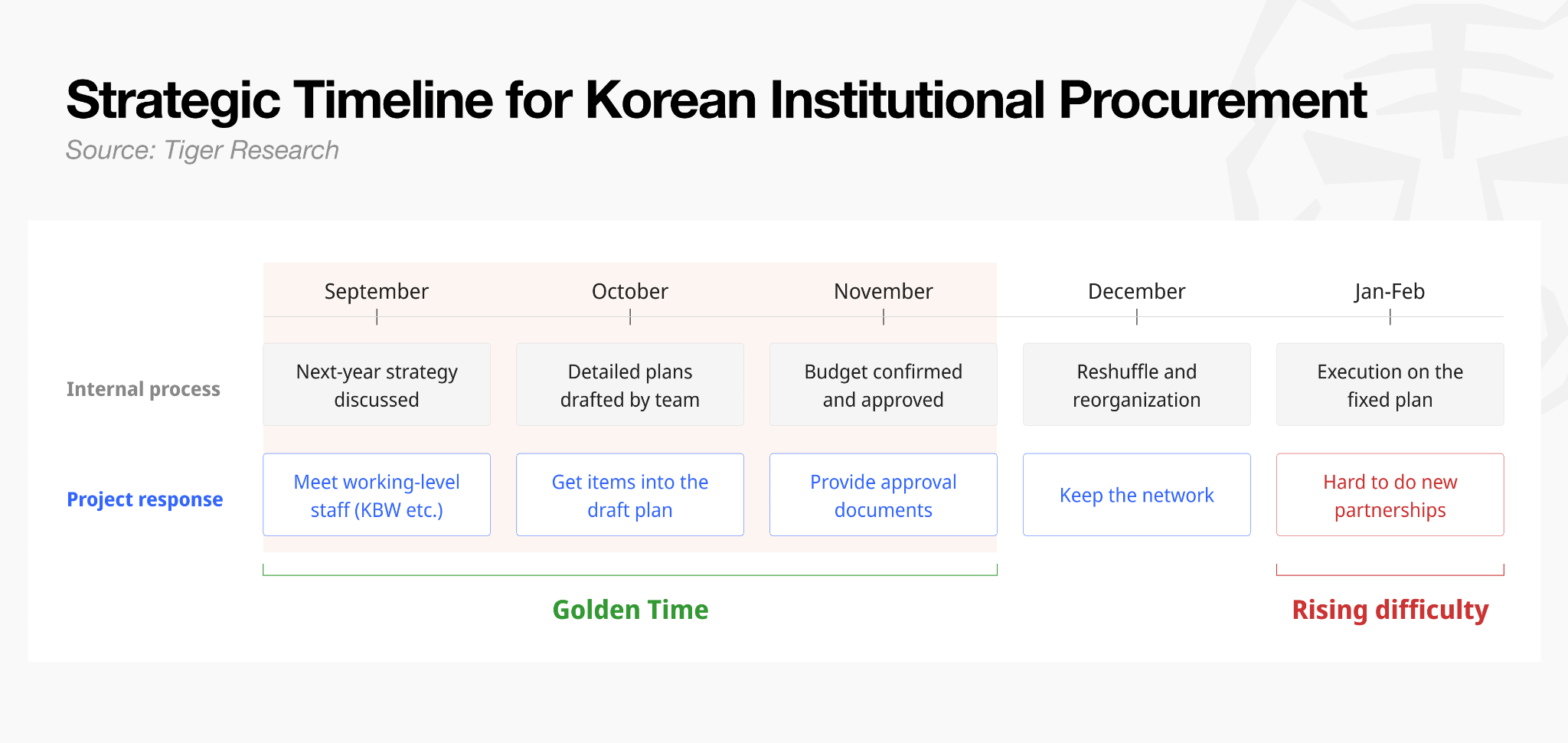
Another key variable is the budgeting cycle specific to Korean financial institutions. Most begin drafting next year’s strategy in October and finalize their budget allocations in early December. After the budget is actually executed from January onward, available resources are quickly depleted and momentum for pursuing new projects drops sharply. Projects planning to do business with these institutions should treat the current period as the window for making a proposal, because missing it substantially lowers the odds of a project moving forward.
Retail strategy also needs a full overhaul. The current market slowdown stems from a broader global downturn, so retail marketing is unlikely to deliver the results it once did. Messaging now needs to center on track record rather than promotion. Because institutional references have already accumulated to the point that a simple memorandum of understanding no longer moves the market, securing references with substantive weight has become the more important strategy.
Many foundations are also eliminating their retail budgets entirely, but AI technology is lowering costs, so unless a project is prepared to give up retail engagement altogether, the better approach is to make retail spending more efficient rather than cut it entirely.
5. An Opportunity to Observe Market Change
These rapid shifts in Korea’s virtual asset market and its move toward institutional incorporation are expected to become clearer and take more concrete shape around Korea Blockchain Week 2026 (KBW2026), to be held in September. KBW2026 is expected to serve as more than a technical or academic exchange or a networking event, functioning instead as a venue for substantive discussion of the shift underway between established finance and the Web3 ecosystem.
At this year’s event, rather than retail-focused marketing, the dominant theme is expected to be multilateral strategic discussion among financial institutions, policy authorities, and major virtual asset service providers, aimed at building business models that comply with regulatory guidelines within the formal financial system and establishing real-world use cases.
Domestic and international companies and research institutions should therefore closely analyze the policy recommendations and inter-institutional cooperation roadmaps presented during KBW2026, and use that analysis to secure an early position in the institutionalized virtual asset market expected to fully emerge going forward.
🐯 More from Tiger Research
Read more reports related to this research.Disclaimer
This report has been prepared based on materials believed to be reliable. However, we do not expressly or impliedly warrant the accuracy, completeness, and suitability of the information. We disclaim any liability for any losses arising from the use of this report or its contents. The conclusions and recommendations in this report are based on information available at the time of preparation and are subject to change without notice. All projects, estimates, forecasts, objectives, opinions, and views expressed in this report are subject to change without notice and may differ from or be contrary to the opinions of others or other organizations.
This document is for informational purposes only and should not be considered legal, business, investment, or tax advice. Any references to securities or digital assets are for illustrative purposes only and do not constitute an investment recommendation or an offer to provide investment advisory services. This material is not directed at investors or potential investors.
Terms of Usage
Tiger Research allows the fair use of its reports. ‘Fair use’ is a principle that broadly permits the use of specific content for public interest purposes, as long as it doesn’t harm the commercial value of the material. If the use aligns with the purpose of fair use, the reports can be utilized without prior permission. However, when citing Tiger Research’s reports, it is mandatory to 1) clearly state ‘Tiger Research’ as the source, 2) include the Tiger Research logo. If the material is to be restructured and published, separate negotiations are required. Unauthorized use of the reports may result in legal action.


