

Key Takeaways
The RWA market has grown rapidly. The question now is how tokenized products can be issued, sold, and repaid in practice.
In the model examined here, an offshore vehicle issues a product backed by underlying assets, while a licensed Hong Kong intermediary sells it to overseas professional investors. Investors buy the issuer’s product, not the assets themselves.
A successful sale does not ensure repayment. The issuer must have an enforceable right to the assets’ cash flows, and those funds must arrive in time to meet its obligations to investors.
The test comes after the first issuance: can the same structure support another product? A lasting market needs a steady supply of assets and investors willing to return.
1. The RWA Market Has Grown. What Comes Next?
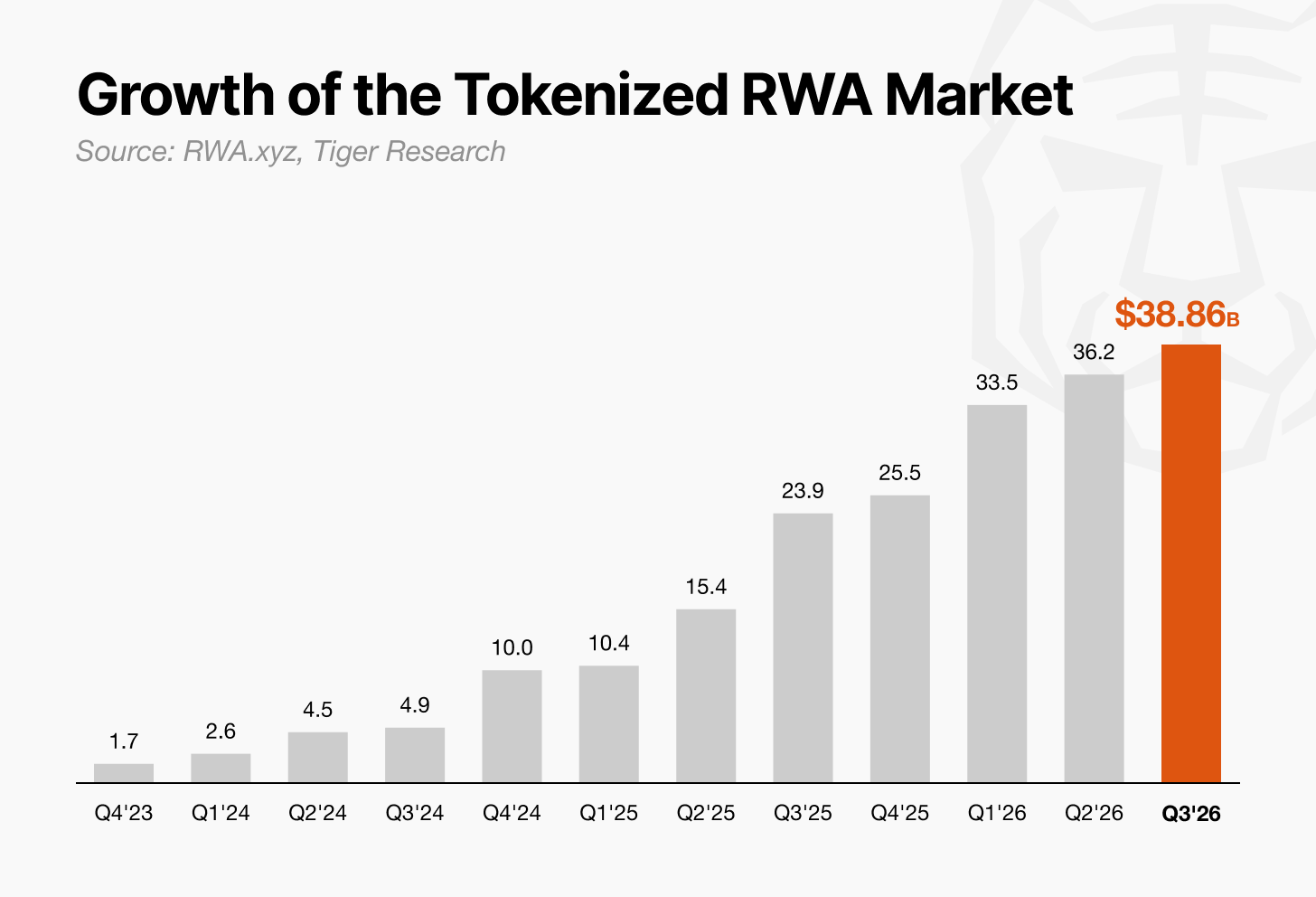
According to RWA.xyz, the RWA market grew from about $1.5 billion in August 2023 to about $38.86 billion on September 13, 2026, an increase of roughly 26 times. More types of assets are being tokenized, while governments are developing rules for their issuance and sale.
The growth is clear. The next question is how to turn an asset into a product that investors can actually buy and, ultimately, be repaid from.
2. Where Should Tokenization Take Place?
Jurisdictions are introducing rules for tokenized assets, but their requirements and pace differ. Where a product is issued can therefore affect how quickly it reaches the market.
Hong Kong offers an established security's framework, access to international investors, and experience with tokenized bond issuance, including government bonds. Its licensing and investor protection requirements give issuers and intermediaries a framework for bringing products to market.
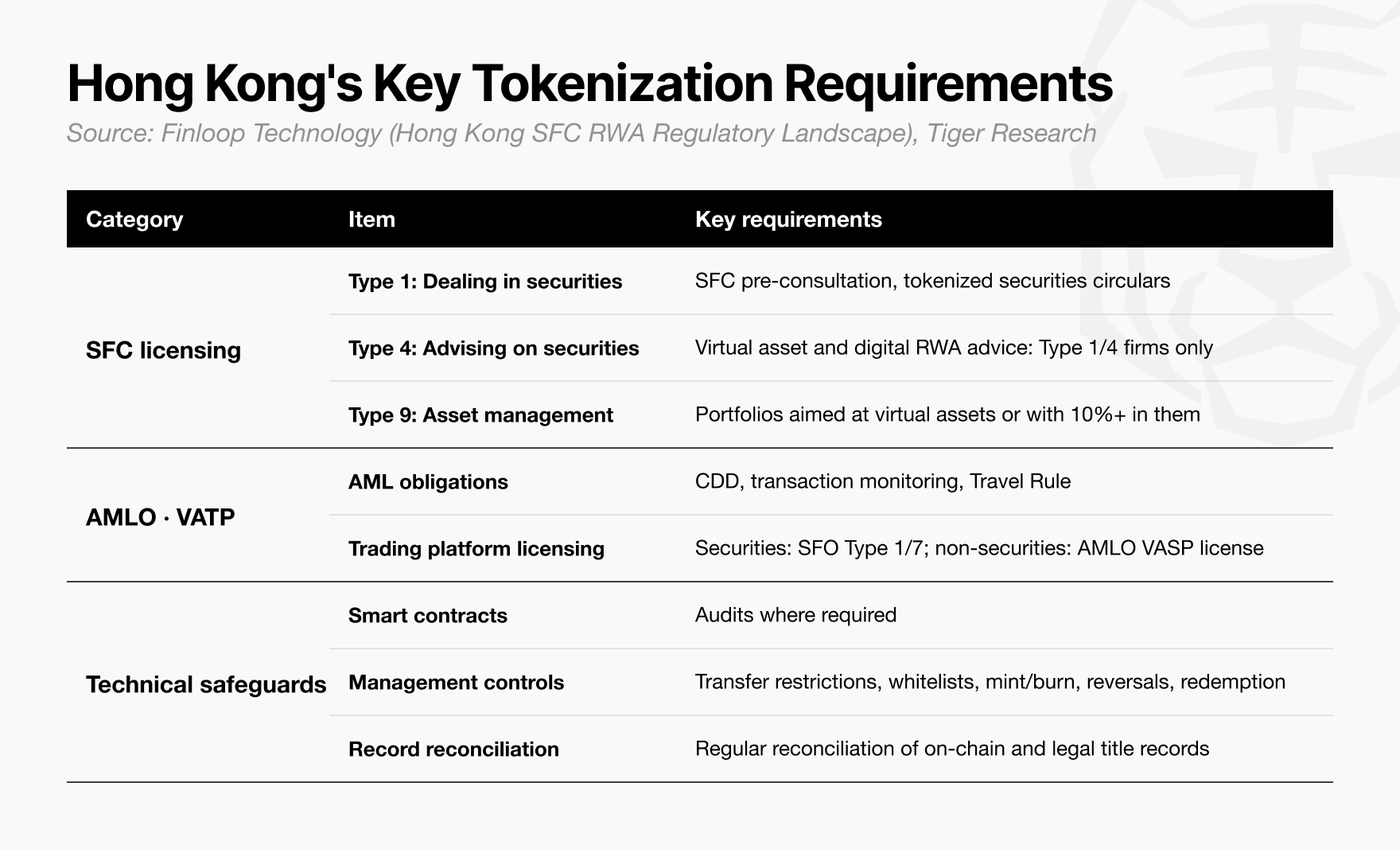
Hong Kong has set out rules for the key stages of tokenization, from SFC licensing and VASP regulation to technical safeguards. This clarity helps firms plan issuances and gives institutional investors a framework for assessing their protections. It is one reason Hong Kong is attracting attention as a hub for RWA issuance and distribution.
How, then, can assets from another country reach overseas investors through Hong Kong? We examine the process using Korean assets as an example.
3. How the Korea–Hong Kong Structure Works
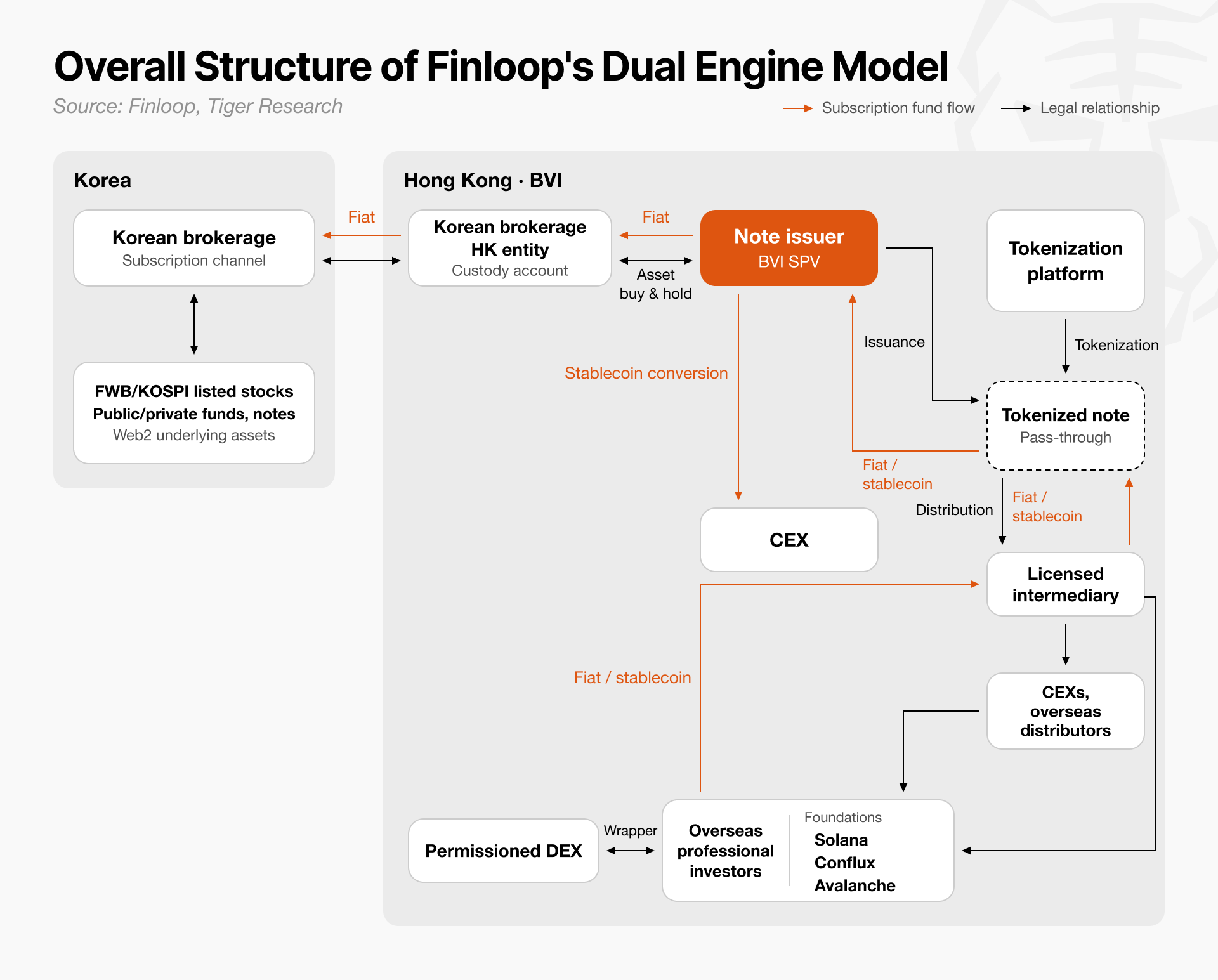
The structure diagram has two sides. Korea, where the underlying assets are sourced, is on the left. Hong Kong and the British Virgin Islands (BVI), where the product is issued and sold, are on the right.
The black arrows trace the product structure.
Korean securities firm: Provides a channel for purchasing underlying assets, such as listed stocks, fund units, and notes.
BVI special purpose vehicle (SPV): Purchases and holds those assets through a brokerage account with the Korean securities firm’s Hong Kong entity, then issues notes backed by them.
Tokenization platform: Creates tokens representing the notes issued by the SPV and records their issuance and ownership.
Distributors: Offer the product to overseas professional investors through licensed intermediaries and eligible trading venues.
The orange arrows trace the subscription funds.
Overseas professional investors subscribe using fiat currency or stablecoins. The funds reach the SPV through the intermediary. Where subscriptions are made in stablecoins, the SPV converts them into fiat currency through a CEX. The proceeds then pass through the Hong Kong entity to the Korean securities firm, which purchases the underlying assets.
Finloop, a Hong Kong financial technology company, calls this its dual-engine model. One side sources the assets; the other issues and distributes the product. Three features matter most.
The source of assets can change. A securities firm in another country and its Hong Kong entity could take the place of the Korean firms. Hong Kong could then serve as a distribution channel for products backed by assets from several markets.
The SPV sits at the center. It receives subscription funds, purchases or holds the assets, and issues the notes. Investors have a claim under the SPV’s product terms, so the SPV’s rights to the assets and its ability to pass on their returns are critical.
The SPV connects blockchain payments with conventional finance. Investors may subscribe in stablecoins and hold tokenized notes, while the assets are purchased and held through brokerage and custody arrangements.
The structure succeeds only if those links hold. That requires a suitable underlying asset, a sound issuance structure, and a lawful route to investors.
3.1. Choosing the Underlying Asset
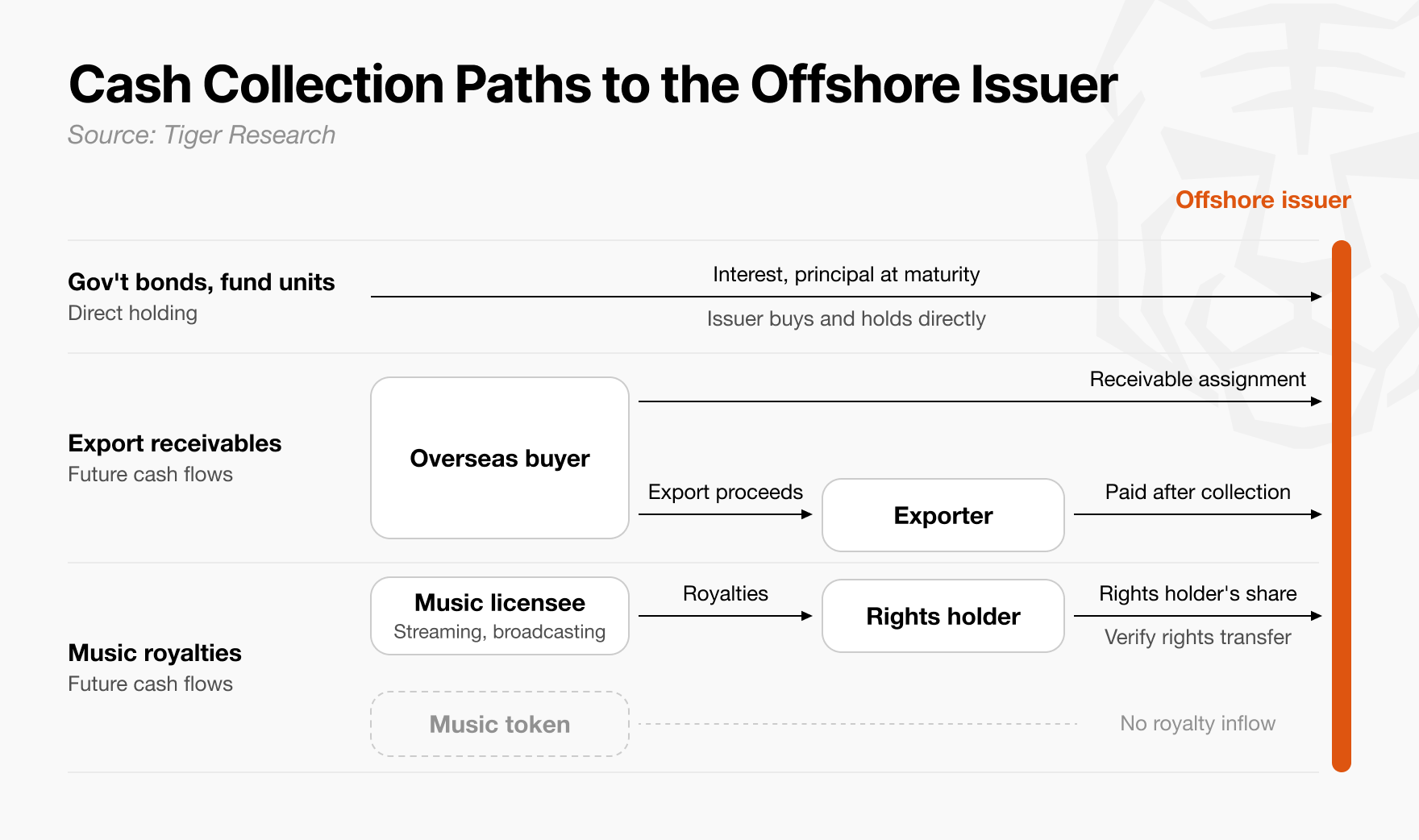
Before issuing a product, the SPV needs a clear legal right to receive the money generated by the underlying assets.
For government bonds or fund units, the question may be whether the SPV can purchase and own them directly. For export receivables or music royalties, the position is more complex. The right to collect future payments may need to be transferred to the SPV, or the asset holder may need a binding obligation to collect the money and remit it.
In either case, the contracts must establish who is entitled to the cash, who collects it, and how it reaches the SPV. Without a clear collection path, an asset cannot reliably support payments to investors.
3.2. What Does the Offshore Issuer Create?
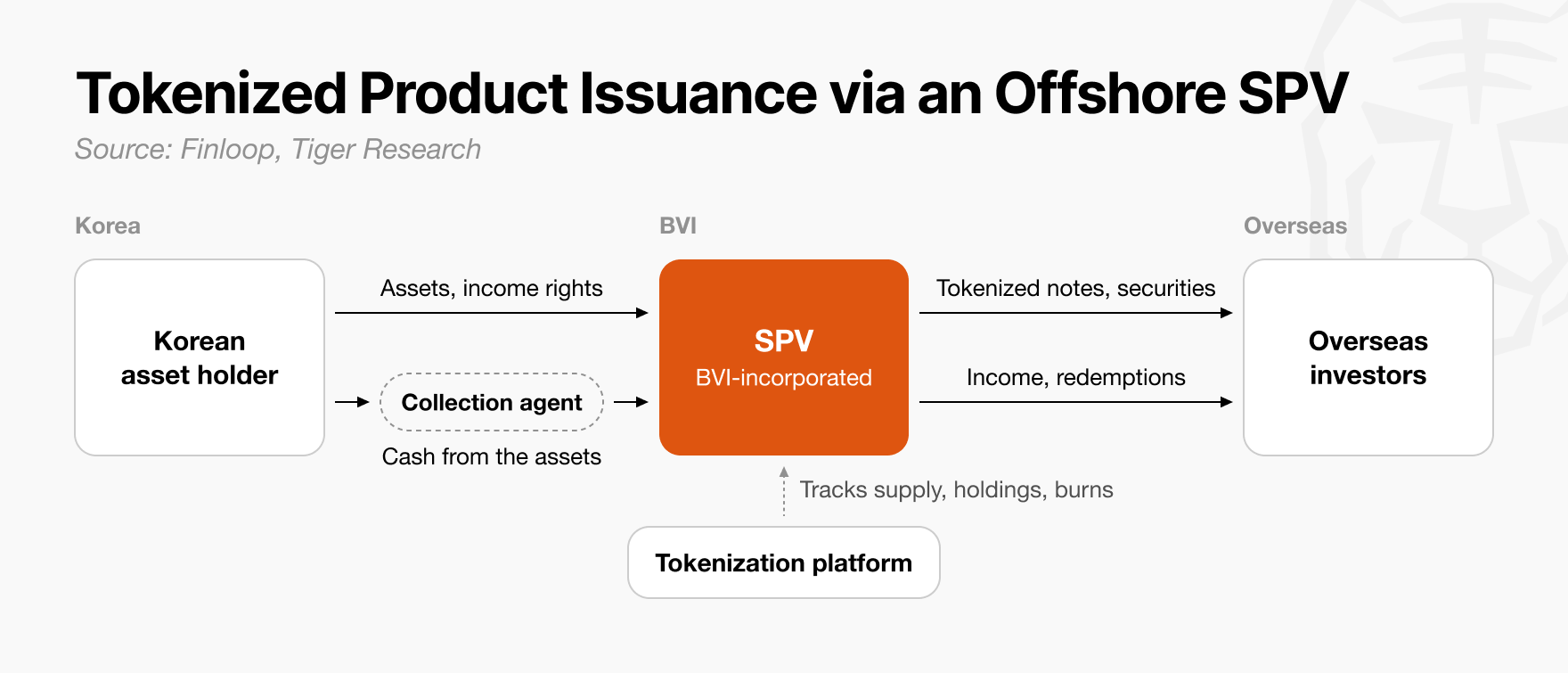
In this model, tokenization centers on the SPV. Even after the underlying Korean asset has been selected, a separate entity is needed to issue the tokens and distribute the proceeds to overseas investors.
Finloop’s dual-engine model places that role with a special purpose vehicle (SPV) incorporated in the British Virgin Islands (BVI). The SPV is the link between holders of Korean assets and overseas investors.
The SPV issues tokenized notes or securities backed by rights to income from the Korean assets. Overseas investors therefore buy a financial product issued by the SPV, rather than the Korean government bonds or export receivables themselves. Under the product terms, the SPV pays investors their income and repays principal at maturity.
For the structure to work reliably, the SPV’s incoming cash must be timed to meet its payments to investors. The issuer first needs to establish when each underlying asset will pay: interest and principal on government bonds, fund distributions and redemption proceeds, or settlement payments on export receivables and royalties.
If investors are due to be repaid before the SPV collects those funds, the product could face a liquidity shortfall or delayed repayment.
Incorporating an SPV offshore does not automatically give it access to cash generated by Korean assets. The contracts must specify the SPV’s legal rights to the underlying assets, who collects the cash, and who is responsible for remitting it to the SPV. The tokenization platform, meanwhile, keeps a transparent record of the amount issued, token holdings, and tokens burned.
The central task at the offshore issuance stage is to ensure that the cash the SPV can actually collect is sufficient and arrives in time to meet the payment terms promised to investors.
3.3. How Widely Can the Product Circulate After Its Sale in Hong Kong?
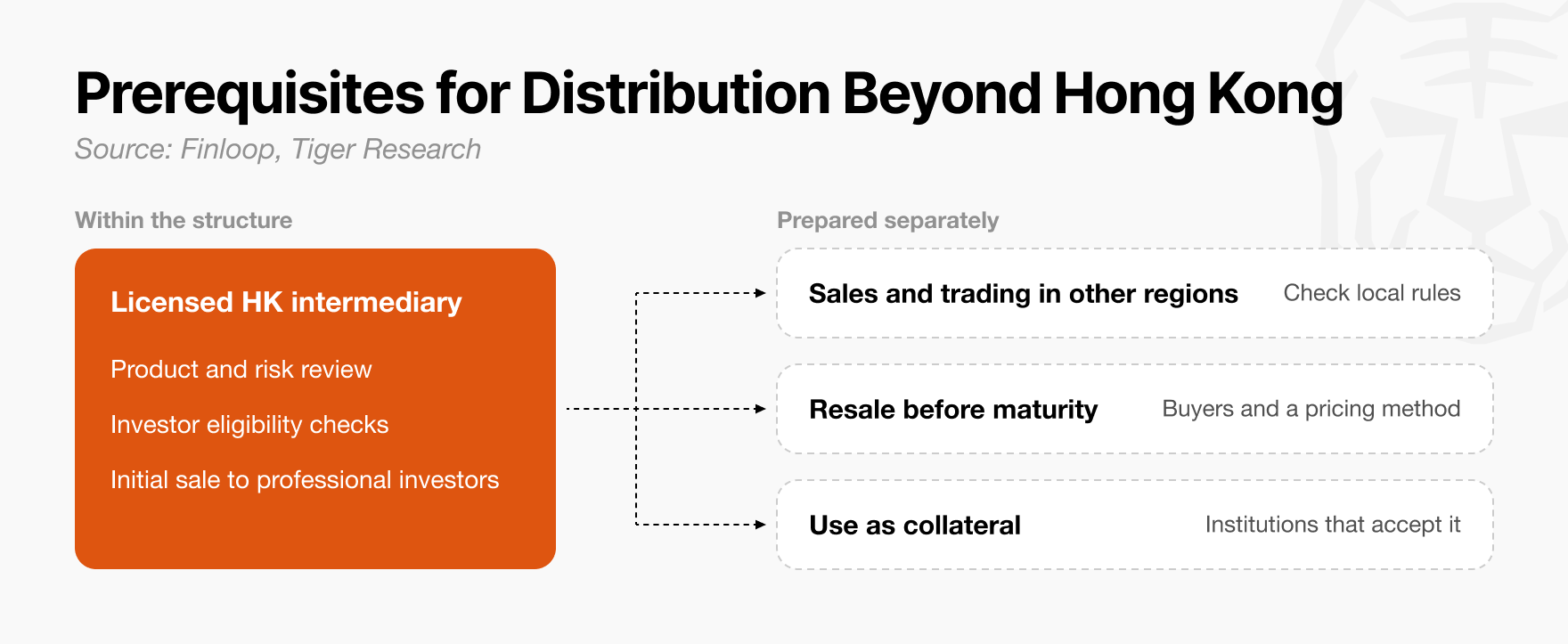
Creating a product through an offshore SPV is only one step. To sell it to overseas investors, the issuer also needs a financial institution to handle its distribution. Finloop proposes using a licensed Hong Kong intermediary, which can review the product under Hong Kong securities rules, offer it to professional investors, and reach investors outside Hong Kong.
The intermediary reviews the terms and risks of the SPV’s product and confirms that each investor is eligible to buy it. If the offering is restricted to professional investors, token transfers must remain restricted after issuance. The product terms therefore limit transfers to buyers whose eligibility has been verified. This is how Finloop proposes to structure its private placement products; the restriction does not apply to every tokenized security in Hong Kong.
Finloop also proposes making products first sold in Hong Kong available through intermediaries and trading venues in other regions. An initial sale in Hong Kong, however, does not automatically permit sales or trading elsewhere. The rules of each market must be assessed separately. Investors who want to sell before maturity also need a willing buyer and a way to determine the price. Using the product as collateral requires an institution willing to accept it.
In this structure, Hong Kong provides the route for the initial sale and investor eligibility checks. Sales and trading in other regions, as well as use as collateral, each require separate arrangements.
4. Three Risks That Could Interrupt Payments from Korean Assets to Investors
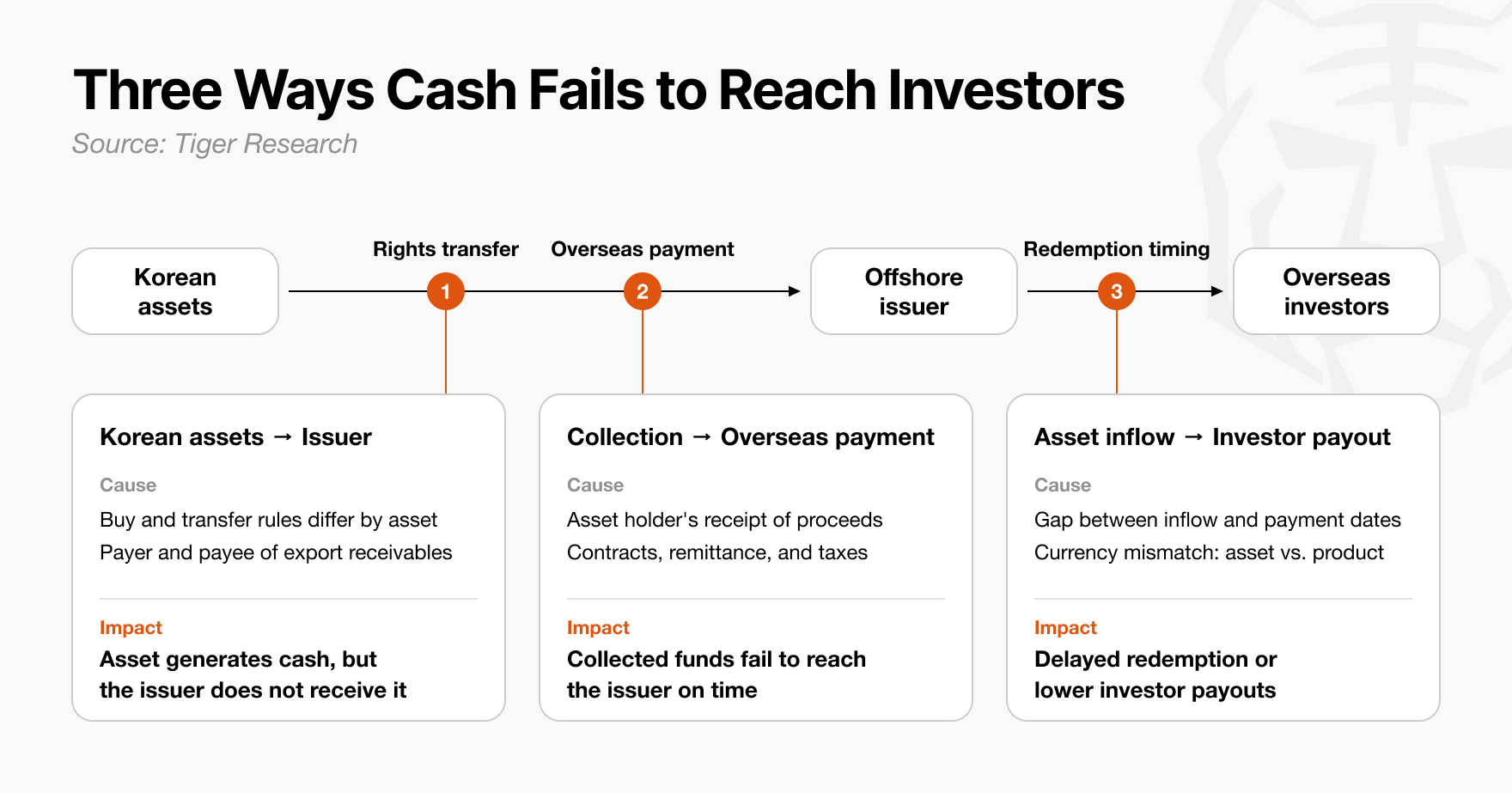
A tokenized product may sell successfully in Hong Kong and still fail to pay investors as promised. The cash generated by the underlying assets must reach them through the offshore issuing vehicle (SPV). Three risks could disrupt that flow.
Unclear rights and collection arrangements: For assets such as export receivables, the contracts must specify where the buyer pays and who is entitled to receive the money. Unless the collection obligations and settlement process are legally binding, payments from the assets may never reach the SPV.
A gap between cash collection and repayment: If investors must be repaid before the underlying assets settle, the SPV may face a liquidity shortfall and delay repayment. When won-denominated assets back a dollar-denominated product, exchange rate movements and conversion costs can also reduce returns.
Cross-border transfer and tax bottlenecks: A Hong Kong intermediary’s authorization to sell the product does not resolve how funds move from Korean asset holders to the offshore SPV or how payments are made to overseas investors. Those transfer and tax procedures must work in practice.
The model ultimately depends on whether cash from the Korean assets can pass through the SPV and reach overseas investors in full and on time, as the contracts promise.
5. The Second Issuance Matters More Than the First
Selling a product backed by Korean assets in Hong Kong once is only a starting point. The first issuance takes time: the parties must review the assets, finalize the contracts, and decide how the product will be sold.
If they have to repeat that work from scratch for every new product, the business will struggle to scale. From the second issuance onward, they need to be able to reuse the structure established for the first deal.
Dollar-settled export receivables offer a way to test whether that is possible. The issuer and intermediary could apply the debtor assessment criteria and product disclosure approach developed for the first deal to later receivables, reducing the work needed to design each product. Applying the same criteria does not, however, mean that every receivable carries the same risk.
To judge whether the model can support a lasting market, three developments matter:
Does the time needed to review assets fall with each issuance?
Do existing investors return for new products?
Do asset holders have a reason to keep supplying assets?
As experience with export receivables grows, the model could extend to other Korean assets. Its success will depend on more than one completed issuance. Asset holders must continue to supply suitable assets, investors must be willing to reinvest, and intermediaries must see value in bringing new products to market.
🐯 More from Tiger Research
Read more reports related to this research.Disclaimer
This report has been prepared based on materials believed to be reliable. However, we do not expressly or impliedly warrant the accuracy, completeness, and suitability of the information. We disclaim any liability for any losses arising from the use of this report or its contents. The conclusions and recommendations in this report are based on information available at the time of preparation and are subject to change without notice. All projects, estimates, forecasts, objectives, opinions, and views expressed in this report are subject to change without notice and may differ from or be contrary to the opinions of others or other organizations.
This document is for informational purposes only and should not be considered legal, business, investment, or tax advice. Any references to securities or digital assets are for illustrative purposes only and do not constitute an investment recommendation or an offer to provide investment advisory services. This material is not directed at investors or potential investors.
Terms of Usage
Tiger Research allows the fair use of its reports. ‘Fair use’ is a principle that broadly permits the use of specific content for public interest purposes, as long as it doesn’t harm the commercial value of the material. If the use aligns with the purpose of fair use, the reports can be utilized without prior permission. However, when citing Tiger Research’s reports, it is mandatory to 1) clearly state ‘Tiger Research’ as the source, 2) include the Tiger Research logo. If the material is to be restructured and published, separate negotiations are required. Unauthorized use of the reports may result in legal action.


