

Headlines keep breaking about AI agents trading and handling payments on their own. Quietly, though, the crypto wallet industry had already been setting the stage. Right now, more than ten companies are building wallets built specifically for agents. What are they really after, and how big could the payoff be?
Key Takeaways
When AI agents browse the internet in place of people and purchase goods or information, they end up making thousands of payments worth only a few cents each. Existing card rails cannot support payments this small, so a wallet that can automatically split and send funds according to preset conditions becomes essential.
Companies such as Coinbase and Binance are building AI wallet infrastructure despite the lack of near-term revenue because doing so secures future customers before AI agents begin transacting at scale. The current phase is about establishing that base of users ahead of actual demand.
A calculation based on Coinbase shows that rising AI agent usage could generate up to seven times its current revenue.
Payment records accumulated in a wallet can show whether an AI agent is generating income, which opens the door to lending against future earnings, similar to extending credit to a small business based on its card sales history.
This remains a stage of possibility rather than proof. AI agents still misfire and execute incorrect payments, rules vary by country and by company, and the legal standing of AI agents remains undefined. As a result, the competition underway is not about capturing revenue today. It is about establishing position years ahead of a market that is expected to take shape.
1. AI Agents Are Becoming Fully Active
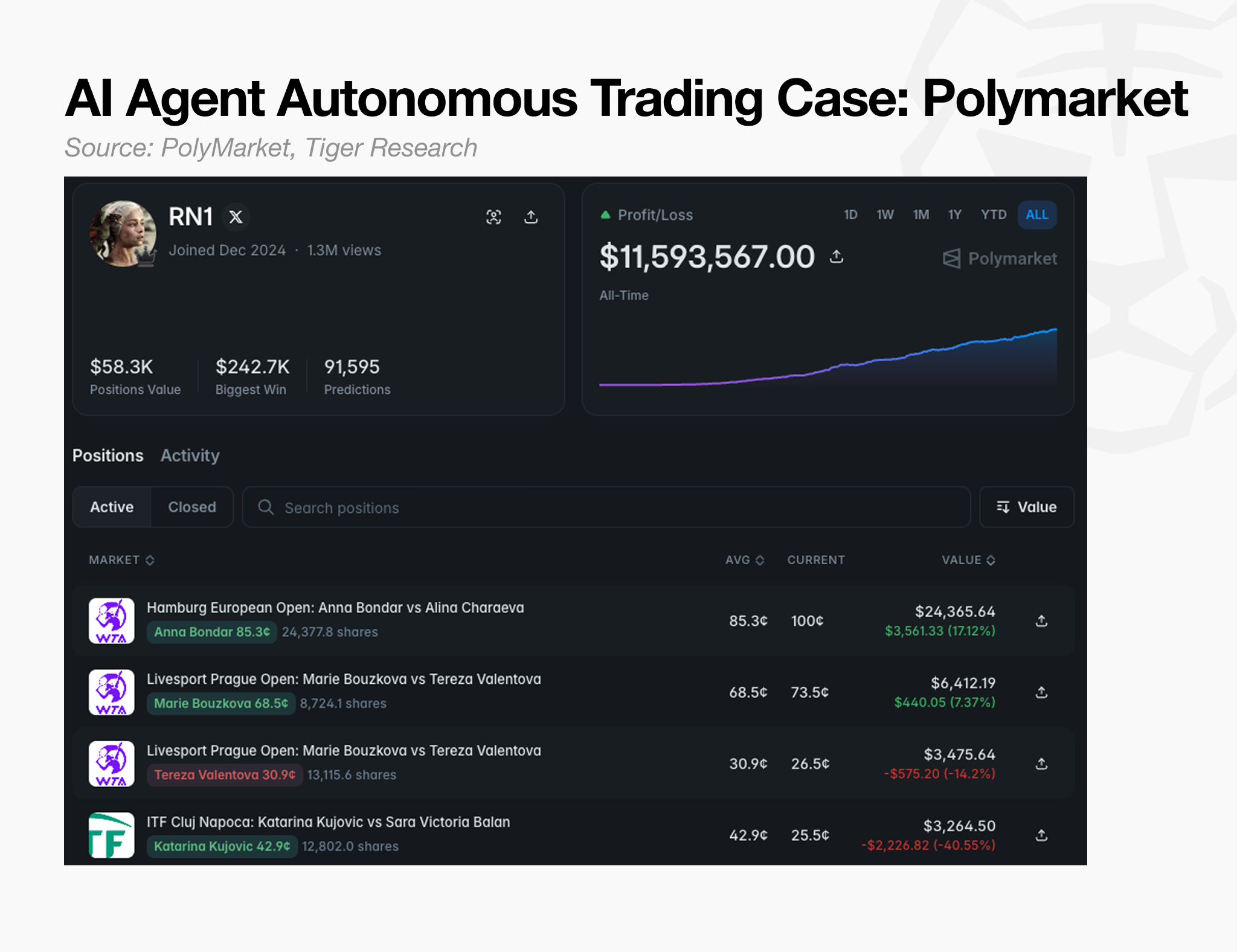
Earlier this year, a widely discussed experiment on the prediction market Polymarket gave an AI agent $50 in seed capital and set it loose to trade autonomously, under the condition that it would cease to exist if it could not earn enough on its own to cover its API and server costs. The agent went on to trade successfully, and a range of other agents have since begun trading in similar fashion.
AI agents have yet to become part of everyday life. Still, it is clear that they will see widespread use in the near future.
2. Every Agent Transaction Starts With a Wallet
AI agents have not yet entered everyday payments. Their most active use today is in crypto trading bots operating within the crypto ecosystem, independent of traditional payment rails and focused specifically on crypto trading.
In the future, however, payment will extend to things not yet imaginable today. As covered in a previous report, AI changes the nature of payment itself. Once agents, rather than people, navigate the web directly, the size of individual payments falls sharply. A single API call or a single data query may cost as little as $0.001, or in extreme cases $0.00001.
Moving beyond current wallet usage, sending payments this small automatically, split according to preset conditions and without human involvement, requires a programmable payment system. This is the background behind the emergence of the x402 payment rail, and the wallet is the foundation on which that rail runs.
Current payment rails, however, are designed around people as the transacting party.
Cards are issued to an individual cardholder, run on a chargeback structure in which a person disputes and reverses a transaction when something goes wrong, and assume a fixed fee of tens of cents per transaction. None of this is a problem when a person makes an occasional $20 purchase, but the moment an agent starts sending thousands of payments a second, at $0.001 per API call or $0.00001 per data record, that payment model no longer works economically.
The central question is whether money itself is programmable.
Cards can automate the act of entering payment information, but they cannot be programmed to split, stream, or instantly settle the flow of money based on conditions. On the rails that wallets run on, that capability is the default. Storing payment details on a card only goes as far as executing a human-scale transaction on someone’s behalf. The moment the economy shifts to machines transacting directly with one another, the wallet becomes the only possible starting point.
3. Agents Are a $50 Billion Business
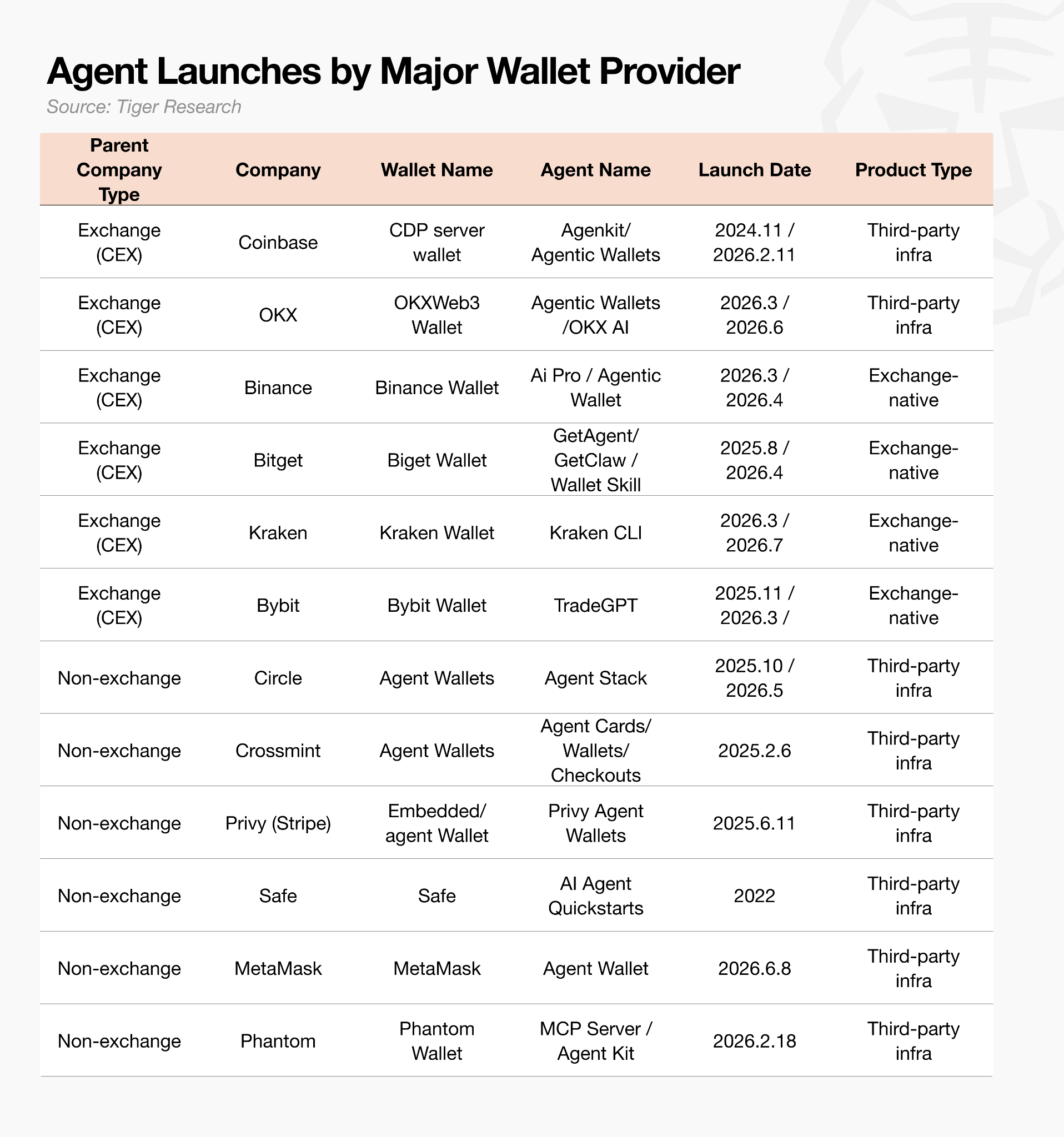
As the table shows, wallet providers span a wide range, from exchanges to stablecoin issuers. Why, then, are such a diverse set of players entering agent wallet infrastructure that carries no clear near-term profitability?
The answer is that these companies are positioning for future revenue and a future business, not today’s. Attaching agent functionality to a wallet now is not a revenue-generating move. It builds the underlying capacity to absorb transaction volume once agents begin generating large-scale activity.
The key point is that AI agents will eventually operate around the clock in a browserless environment, without human involvement. Consider a user who asks an agent to produce a piece of research. As the agent gathers information, it executes a small payment each time it pulls paid data from a different platform. A single instruction from the user can trigger 20 to 30 or more payments within moments.
A request that a person would see as a single, simple action turns into a large volume of payment transactions once it passes through an AI agent.
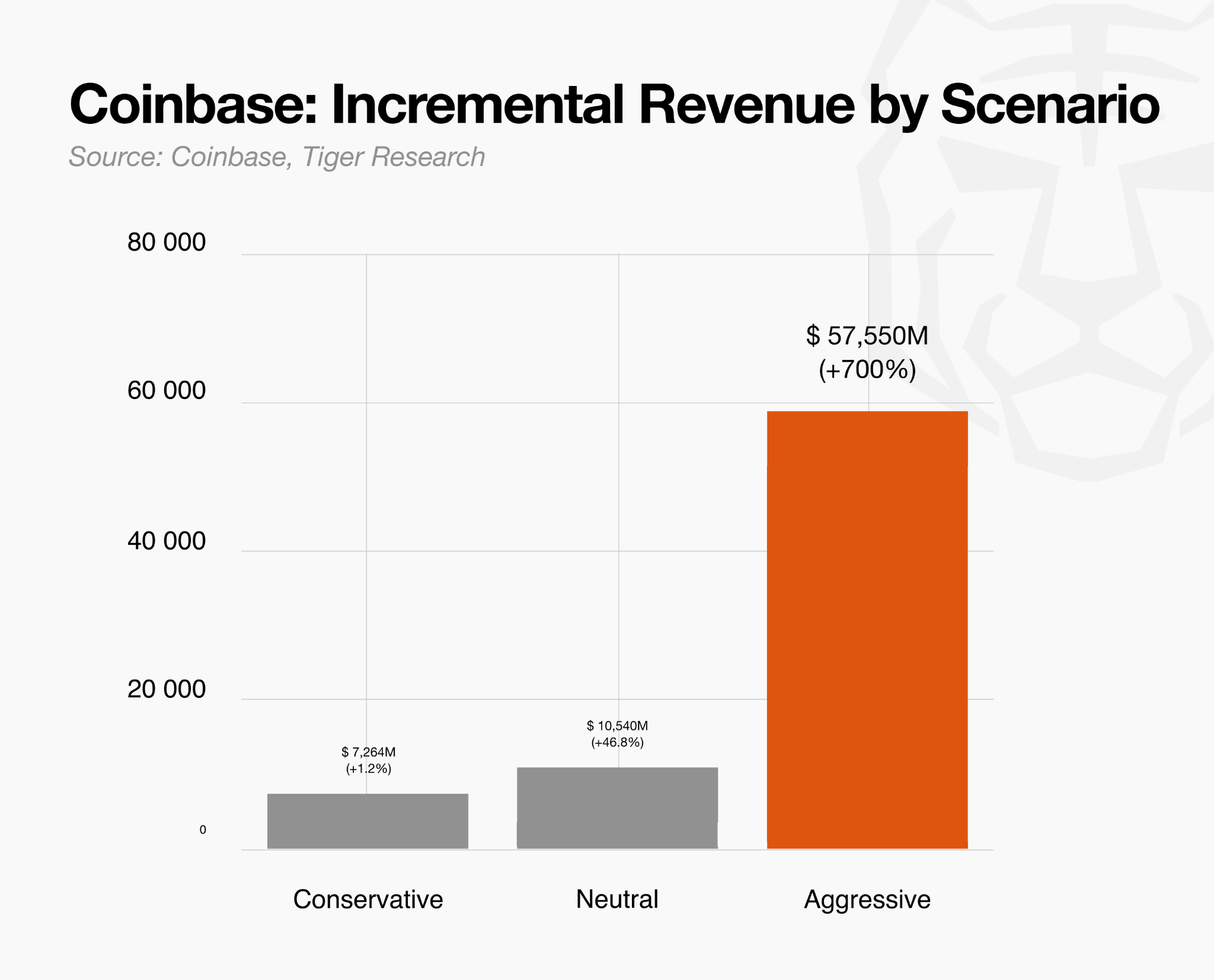
How this shift in the payment environment could affect corporate earnings can be estimated using Coinbase’s disclosed figures. The calculation uses Coinbase’s 9.2 million monthly transacting users (MTU) as the base, rather than its full base of roughly 120 million registered users.
Combining three variables, adoption rate, number of agents per user, and daily call frequency, produces the following scenario results.
Conservative scenario (10% adoption, 1 agent per user, 50 calls per day): adds roughly $84 million in annual revenue, an increase of 1.2%.
Neutral scenario (50% adoption, 2 agents per user, 200 calls per day): additional revenue rises sharply to about $3.36 billion, an increase of 46.8%.
Aggressive scenario (100% adoption, 3 agents per user, 1,000 calls per day): annual revenue reaches roughly $50.37 billion, about seven times Coinbase’s current total revenue.
What stands out in this comparison is that the gap between the three scenarios widens geometrically rather than arithmetically. Adoption alone rises tenfold, from 10% to 100%, yet the resulting revenue gap widens roughly 600-fold, from $84 million to $50.37 billion.
Because the three variables, adoption rate, agents per user, and daily call volume, multiply together, even a small increase in any one of them produces an exponential rise in the total. As a result, once agents reach mass adoption and user numbers surge, the resulting revenue stream could reach up to about seven times current total revenue.
This is why Coinbase promotes agent wallet infrastructure even without meaningful revenue today. Doing so secures its share of the revenue that an agent-driven era is expected to generate.
4. Toward Agent Neobanking
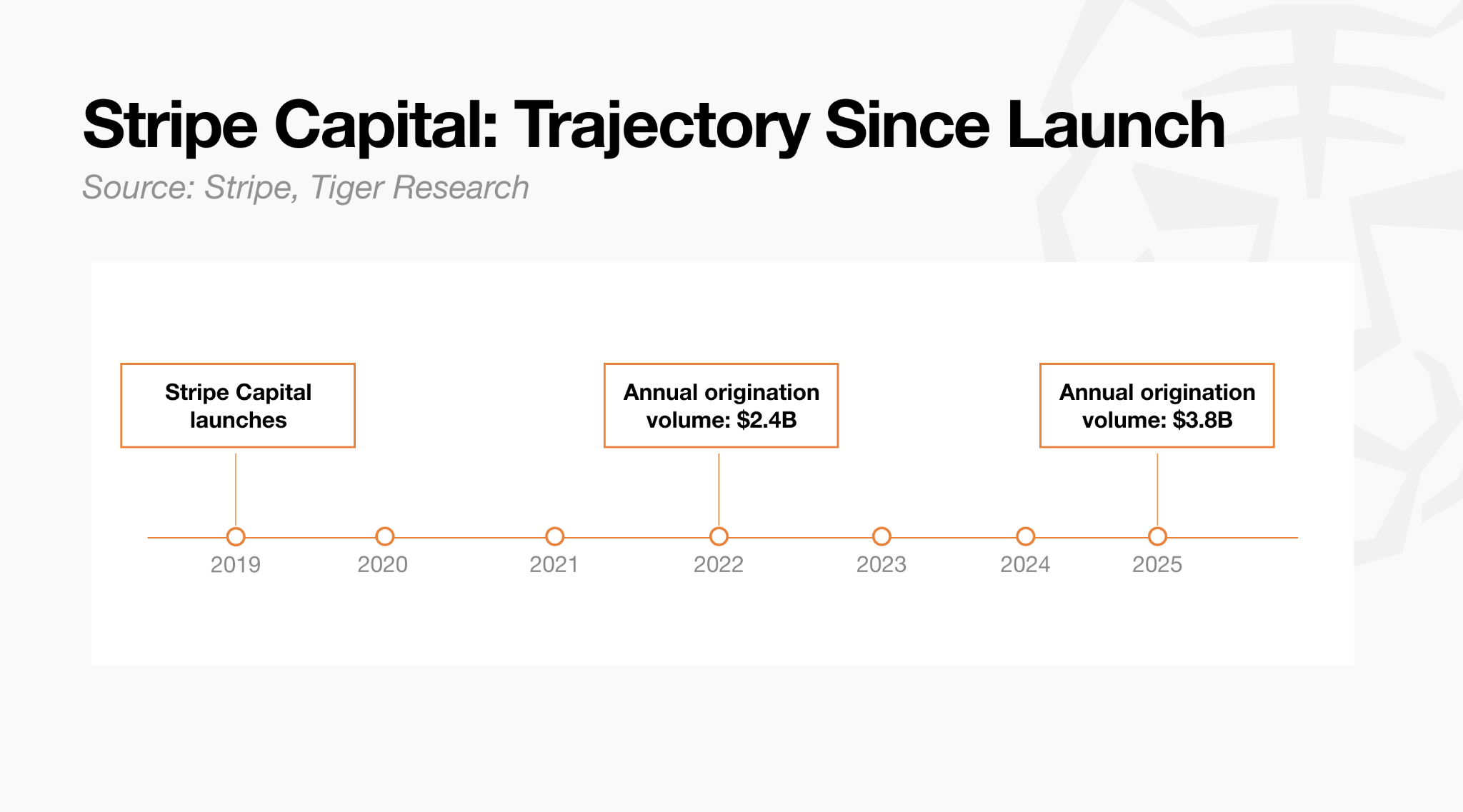
Transaction data accumulated through wallet infrastructure amounts to more than a simple record. It provides a foundation for new business models, since payment history stored in a wallet can serve as a credit assessment standard that demonstrates an AI agent’s financial standing and performance.
Once this kind of data-driven credit assessment system is in place, wallet providers can extend naturally into next-generation financial services such as revenue-based financing (RBF) built specifically for agents.
Stripe Capital is a representative case of a company that built a new financial business successfully on top of existing payment data. When Stripe launched its lending service, Stripe Capital, in September 2019, it did not rely on outside credit bureaus or extensive loan paperwork. It assessed loan eligibility and limits using only the real-time sales data already flowing through its own payment network for each merchant.
The Stripe case suggests that a company can build a high-value financial business on top of a data pipeline from its existing operations, without a separate sales network or marketing effort.
Agent wallet providers are likely to follow the same expansion path. Steadily accumulating an agent’s revenue data through its wallet creates a basis for advancing operating funds through RBF and generating income as an agent-focused financial platform.
Building this new business line, however, depends on one condition. AI agents must evolve beyond simple payment execution into asset-holding entities that generate their own income, earning enough real revenue to repay what they borrow.
5. This Growth Remains Unproven
The sevenfold revenue growth projected for Coinbase and the expansion into RBF described above are optimistic scenarios that assume agent payments become widespread. The barriers to establishing this in the real economy are substantial.
First, significant questions remain about AI agents’ actual purchase conversion rates and payment reliability. Agents still misfire during autonomous ordering, producing incorrect payments due to hallucination, and payments are sometimes blocked outright when card issuers’ fraud detection systems (FDS) reject the transaction. Actual payment completion rates remain low as a result.
In addition, payment protocols such as x402, AP2, and MPP remain fragmented rather than converging on a single standard, and the absence of clear KYC (identity verification) and financial regulation for AI agents, which are not legal persons, is a further obstacle to market expansion.
The goal for wallet providers today, then, is not short-term fee revenue. It took Apple’s App Store fifteen years to build a $10 billion annual fee market, and it took WeChat Pay seven years to establish its large mini-program ecosystem. Agent wallets are following a similarly long timeline, building out an ecosystem rather than competing for immediate returns.
The competition underway is not about today’s marginal revenue. It is about which company first gains control over data on the flow of funds within the agent economy expected to take full shape five to ten years from now.
🐯 More from Tiger Research
Read more reports related to this research.Disclaimer
This report has been prepared based on materials believed to be reliable. However, we do not expressly or impliedly warrant the accuracy, completeness, and suitability of the information. We disclaim any liability for any losses arising from the use of this report or its contents. The conclusions and recommendations in this report are based on information available at the time of preparation and are subject to change without notice. All projects, estimates, forecasts, objectives, opinions, and views expressed in this report are subject to change without notice and may differ from or be contrary to the opinions of others or other organizations.
This document is for informational purposes only and should not be considered legal, business, investment, or tax advice. Any references to securities or digital assets are for illustrative purposes only and do not constitute an investment recommendation or an offer to provide investment advisory services. This material is not directed at investors or potential investors.
Terms of Usage
Tiger Research allows the fair use of its reports. ‘Fair use’ is a principle that broadly permits the use of specific content for public interest purposes, as long as it doesn’t harm the commercial value of the material. If the use aligns with the purpose of fair use, the reports can be utilized without prior permission. However, when citing Tiger Research’s reports, it is mandatory to 1) clearly state ‘Tiger Research’ as the source, 2) include the Tiger Research logo. If the material is to be restructured and published, separate negotiations are required. Unauthorized use of the reports may result in legal action.


