

Among a crowded field of Bitcoin Layer 2s, Citrea earned the backing of Founders Fund. This report examines why.
Key Takeaways
Most Bitcoin L2s do not actually use Bitcoin’s security. Citrea does, through ZK proofs and BitVM, with Bitcoin verifying state directly.
Founders Fund has a track record of identifying unique technologies (SpaceX, Palantir). Choosing Citrea at peak Bitcoin L2 disappointment follows the same pattern of technical conviction.
The Citrea team has no marquee credentials. But they were the first to validate ZK technology on Bitcoin in production first, and shipped a mainnet when most Bitcoin L2s did not.
Technical proof is done. The remaining challenge is giving EVM ecosystem users a reason to use the same services on Bitcoin. Aggressive user acquisition is next.
1. L2 Skepticism vs. Citrea: Why Thiel Chose the Latter
Bitcoin’s market cap has surpassed $2 trillion. Yet when asked what that capital actually does, the answer is unclear. “Put this capital to work. Leverage Bitcoin’s security.” This was the recurring logic behind the Bitcoin L2 surge.
But of the dozens of projects born from that logic, few are meaningfully functioning today. The need was clear; the results were not.
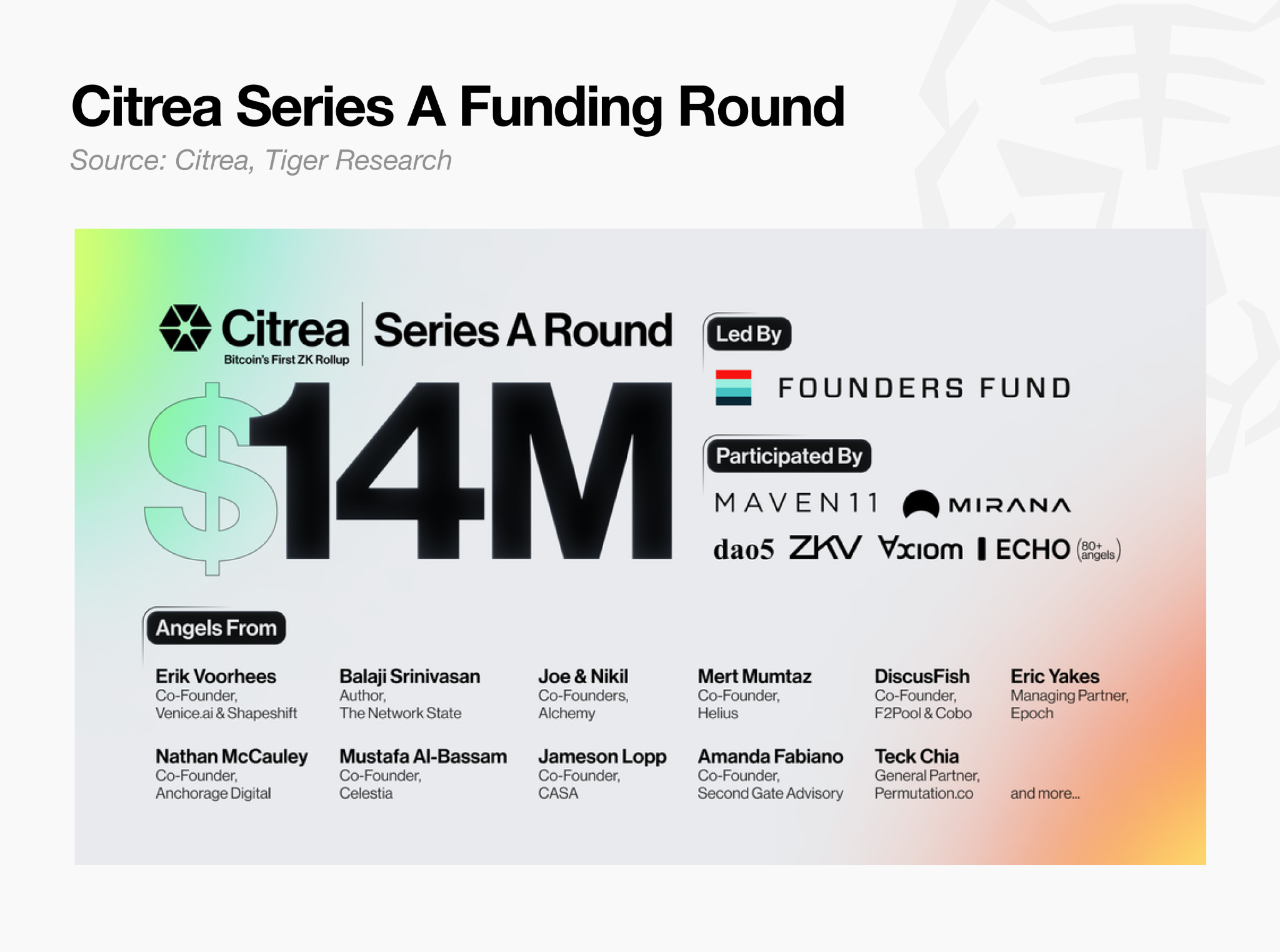
Against this backdrop, Peter Thiel’s Founders Fund invested in Citrea, choosing a team capable of building the first ZK rollup on Bitcoin, rather than just another marketing hook. It was a high-conviction bet on the technical frontier of Bitcoin L2s, made precisely when the broader market had grown most skeptical.
2. Why Thiel Chose Citrea
Founders Fund has a track record of betting on unique technologies where others won’t. LPs called the SpaceX investment “crazy.” A Kleiner Perkins partner walked out of the Palantir pitch. The Citrea investment follows this same pattern of technical conviction.
While much of the Bitcoin L2 category focused on marketing over-engineered sidechains, Citrea focused on the “Zero to One” problem, actually bringing zero-knowledge technology to Bitcoin. When sentiment toward Bitcoin L2 was at its lowest, Founders Fund made their move.
For partner Joey Krug, Citrea represented “the strongest team and technical architecture in the Bitcoin L2 space.”
As the firm’s first-ever investment in the Bitcoin ecosystem, the move wasn’t about following a trend; it was about backing the only design that allows Bitcoin’s $2 trillion in capital to finally become programmable.
2.1. A Team That Proved Its ZK Credentials
Before building on Bitcoin, the team shipped “Proof of Innocence.“ In 2022, the U.S. Treasury sanctioned Tornado Cash for money laundering. The collateral damage was immediate. Innocent users with no connection to illicit activity were treated the same.

The team used ZK proofs to let users demonstrate their wallet had no ties to sanctioned addresses without revealing their identity. RAILGUN DAO integrated the protocol. Vitalik Buterin cited it publicly.
None of the founders came from big tech or marquee protocols. But they shipped a ZK product that worked in production and earned external validation. Founders Fund’s “best team” assessment was not without basis.
2.2. Using ZK to Solve Bitcoin L2’s Core Problem
Citrea leverages ZK technology to clear Bitcoin L2’s core hurdle, using Bitcoin’s actual security while running services on top of it.
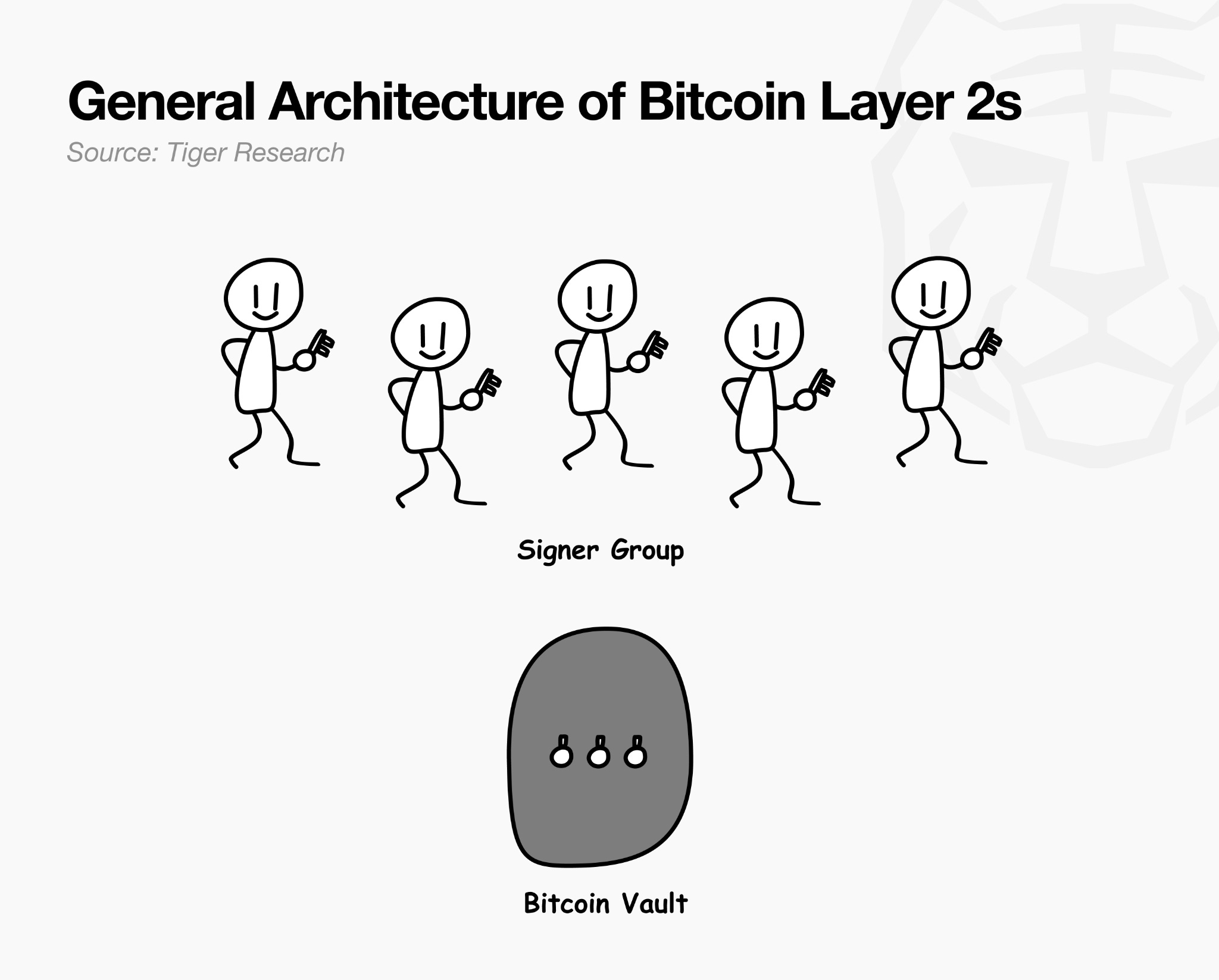
Most Bitcoin L2s assign security to a small group of signers. Think of a vault shared by five keyholders where any three can authorize a withdrawal. The model is fast and practical. But it does not fully inherit Bitcoin’s security. It relies on the honesty of a few.
Most Bitcoin L2s have not departed significantly from this structure. Design details vary, but the dependency on a small signer group remains consistent across the space.
Citrea builds a 1-of-N system, where only one honest participant is required. To illustrate: when a user attempts to withdraw Bitcoin from Citrea, four roles govern the process.
Signers: Lock the withdrawal conditions cryptographically before any request is made. Conditions are immutable once set, preventing Operators from manipulating exits.
Operators: Can only process withdrawals within Signer-defined limits. Must post collateral upfront and submit cryptographic proof of validity to reclaim it.
Watchtowers: Monitor Citrea and Bitcoin simultaneously. If an Operator attempts fraudulent withdrawal, Watchtowers capture evidence and pass it to Challengers.
Challengers: Use Watchtower evidence to invalidate the fraudulent withdrawal on Bitcoin. Operator collateral is seized upon confirmed fraud.
If any one of these four participants remains honest, the system holds. One challenge remains. Bitcoin’s base layer was not built for complex computation. How can cryptographic proof verification and dispute resolution function on top of it?
ZK technology and BitVM make this possible. They enable cryptographic proof verification and dispute resolution directly on Bitcoin. This unique technology is what Founders Fund bet on.
3. How Citrea Actually Works
Here is how the architecture described above translates into practice. Three components drive the system.
ZK Rollup: compresses transaction data and posts them on Bitcoin
BitVM: enables optimistic Bitcoin-native verification
Clementine: Citrea’s BitVM-based Bitcoin bridge
3.1. ZK Proof: Thousands of Transactions, One Proof
Consider a notary office. Getting thousands of contracts notarized one by one takes time and money. Instead, a lawyer (Citrea) reviews all of them and submits a single certification stating “all of these contracts are valid.” The notary office (Bitcoin) only needs to review that one document. Fast, cheap, and the final record stays with the notary.
That certification is the ZK proof. Citrea processes thousands of transactions off-chain, generates a ZK proof via zkEVM, and records it on the Bitcoin base layer. Anyone running a Citrea and Bitcoin node can verify that Citrea’s state is correct.
3.2. BitVM: No Rule Changes Required
One problem remains. Bitcoin was not designed to verify complex ZK proofs. Its scripting language handles only basic transaction conditions. Running complex computation directly on Bitcoin is close to impossible.
Citrea solves this with BitVM. Think of it as an appeals window inside the notary office. Under normal operation, ZK proofs are accepted as submitted. If someone challenges a proof as invalid, Bitcoin steps in to verify directly. Computation runs only when there is a dispute, not by default. Bitcoin’s consensus rules remain untouched.
3.3. Clementine: One Honest Actor Is Enough
The bridge is the weakest point in any Bitcoin L2. If funds are stolen in transit between Bitcoin and Citrea, the entire architecture becomes irrelevant. Citrea’s bridge, Clementine, approaches this differently.
The security model requires only one honest participant among N. If an operator attempts fraud, a Challenger initiates a challenge transaction directly on the Bitcoin Network using the header-chain proof published by a Watchtower, and the operator’s collateral is slashed. Funds cannot be stolen unless every participant is compromised simultaneously. Where a standard multisig bridge moves funds when 2-of-3 agree, Clementine keeps funds safe as long as even 1 honest participant is watching.
The result: attacking Citrea means attacking Bitcoin itself. That requires capturing more than half of the total hashrate to censor the challenge for the duration of the dispute window, a fundamentally different threat model from targeting a small signer group.
4. Citrea Today
Most projects run their TGE first and launch mainnet later. Testnet gives room for failure without consequence. The pattern is familiar: sell the vision, defer the technology. Mainnet is different. Real funds, real transactions, real accountability.
Citrea reversed the sequence. Mainnet launched before TGE, alongside cBTC (BTC bridged to Citrea)) and ctUSD (Citrea-native stablecoin), with live 40+ applications at launch. Among these, Satsuma, Signals, Zentra, Crest, and CellFi, are part of the Citrea Origins program, an initiative directly supported by the Citrea team.
Unlike most Bitcoin L2s, which focus on staking and yield, Citrea is directly supporting builders across DEX, prediction markets, money markets, privacy transactions, and payments.
The intent is clear: expand what a Bitcoin L2 can actually do and build real utility.
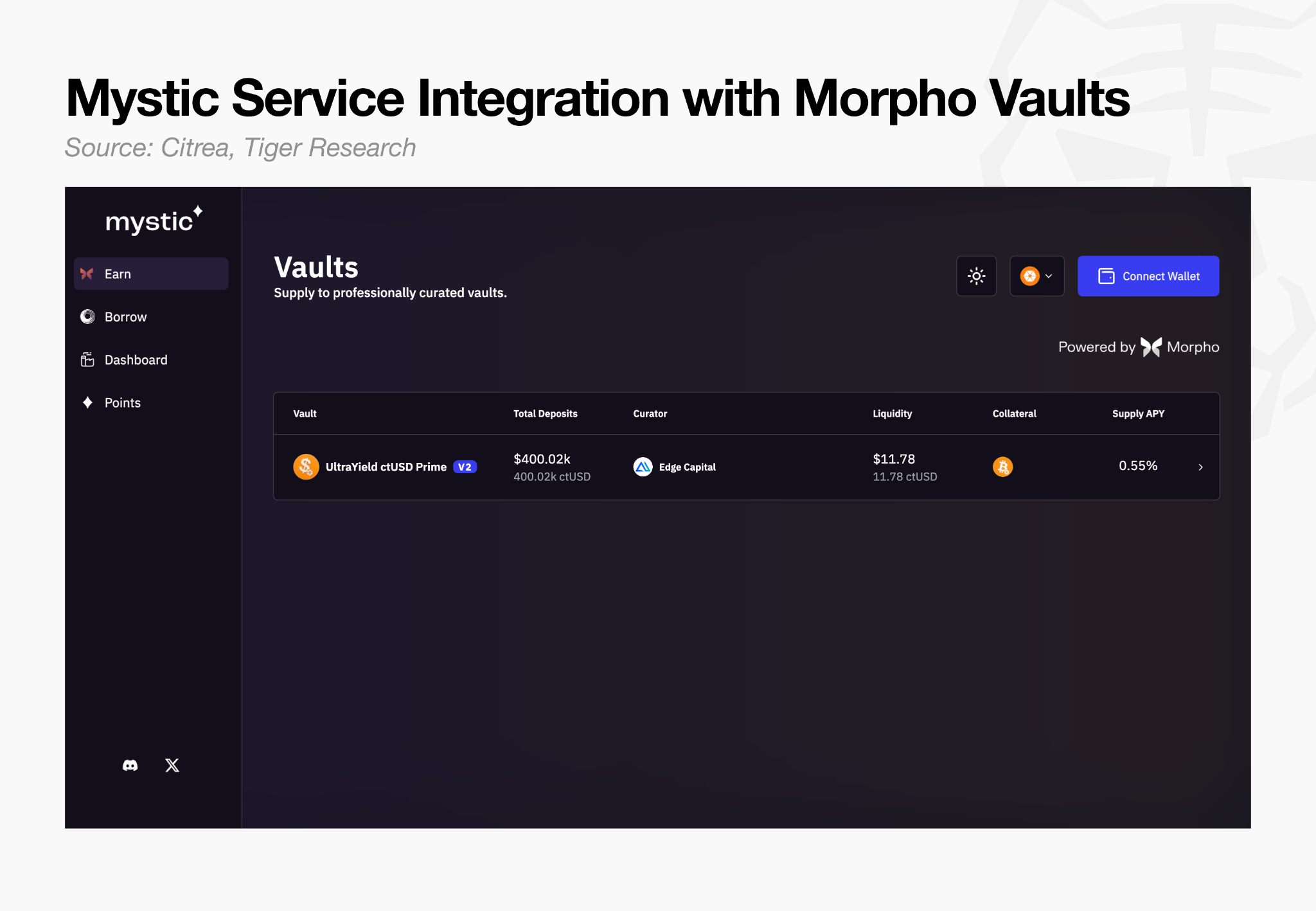
That said, Citrea remains in its early stages.
TVL stands at approximately $6M, and while the testnet campaign drew 33,000 participants, that momentum has not yet carried over to mainnet even with a new mainnet campaign. The network is less than three months old, and key services including Morpho vaults only recently launched.
Citrea’s long-term vision is to become the home of Bitcoin applications (₿apps), building an ecosystem that extends well beyond staking and yield. The ambition is clear, but user acquisition is still underway.
5. Design vs. Reality
Web3 is full of projects selling ideals. Decentralization. Censorship resistance. Financial sovereignty. Easy to nod along. Harder to open your wallet.
Citrea’s technical case is sound. A Bitcoin L2 should actually use Bitcoin’s security. $2 trillion in idle capital. ZK is the only path to get there. Founders Fund agreed, and Citrea shipped a mainnet. That separates it from projects that only talk.
The harder question comes next. Most Bitcoin holders are not uncomfortable. Holding works fine. “Built on Bitcoin” does not move the average user. Secure infrastructure is a necessary condition, not a sufficient one.
What Citrea needs now is not more technical proof. It needs to make the things users do on Arbitrum, on Base, work better on Bitcoin. That is the job of the Origins projects. DEX, money markets, privacy transactions, prediction markets. If those applications do not attract users, the infrastructure remains infrastructure.
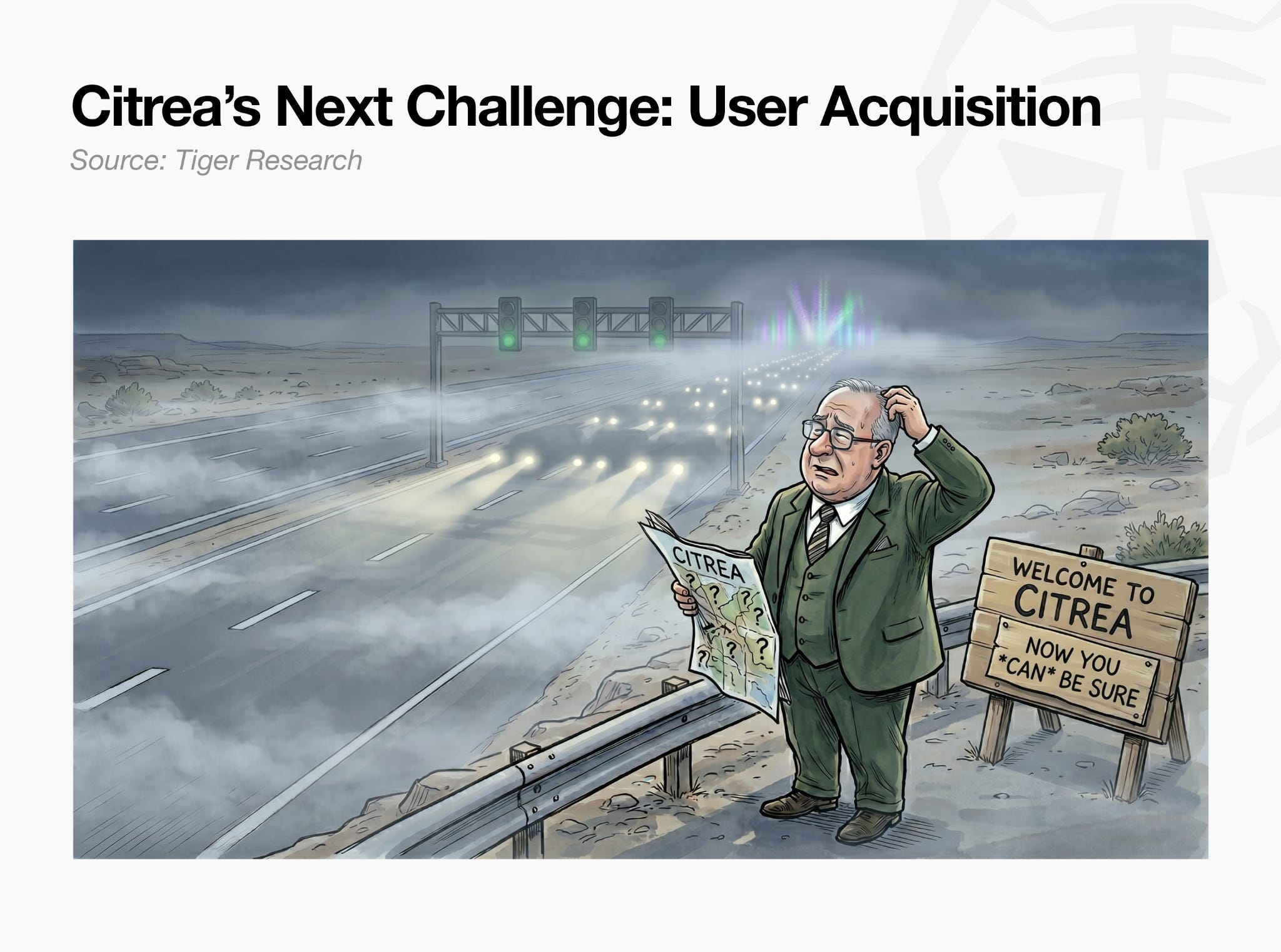
The foundation is laid. The highway is built, the signals are up. Now the cars need to come. No matter how well the road is paved, without traffic it is just empty asphalt.
Citrea’s next challenge is not building a better road. It is finding the drivers.
🐯 More from Tiger Research
Read more reports related to this research.Disclaimer
This report was partially funded by Citrea. It was independently produced by our researchers using credible sources. The findings, recommendations, and opinions are based on information available at publication time and may change without notice. We disclaim liability for any losses from using this report or its contents and do not warrant its accuracy or completeness. The information may differ from others’ views. This report is for informational purposes only and is not legal, business, investment, or tax advice. References to securities or digital assets are for illustration only, not investment advice or offers. This material is not intended for investors.
Terms of Usage
Tiger Research allows the fair use of its reports. ‘Fair use’ is a principle that broadly permits the use of specific content for public interest purposes, as long as it doesn’t harm the commercial value of the material. If the use aligns with the purpose of fair use, the reports can be utilized without prior permission. However, when citing Tiger Research’s reports, it is mandatory to 1) clearly state ‘Tiger Research’ as the source, 2) include the Tiger Research logo following brand guideline. If the material is to be restructured and published, separate negotiations are required. Unauthorized use of the reports may result in legal action.


