

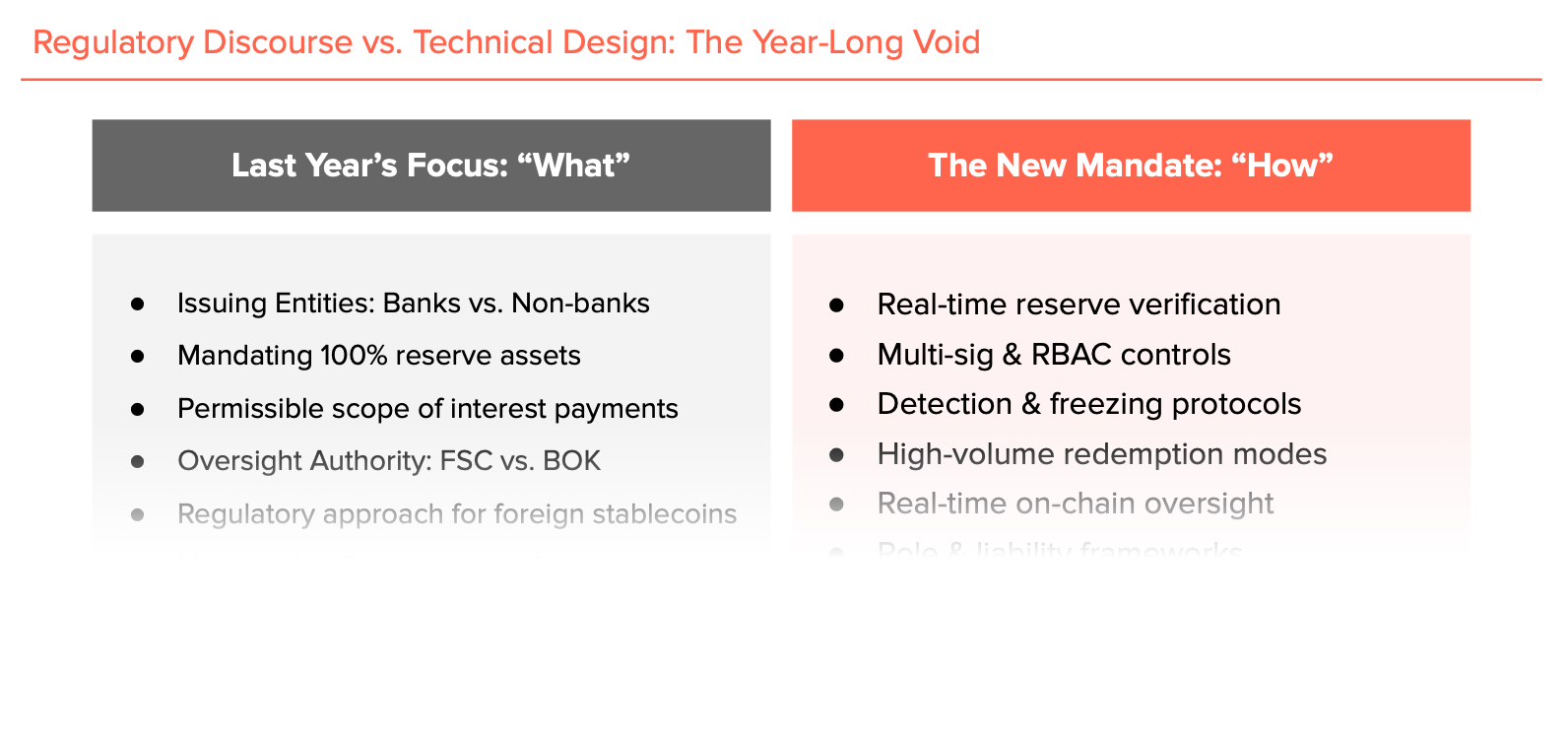
For the past year, KRW stablecoin discourse focused on regulatory “What” (issuers, reserves). The priority must now shift to technical “How”: moving beyond who initiates the market to how to sustain it operationally.
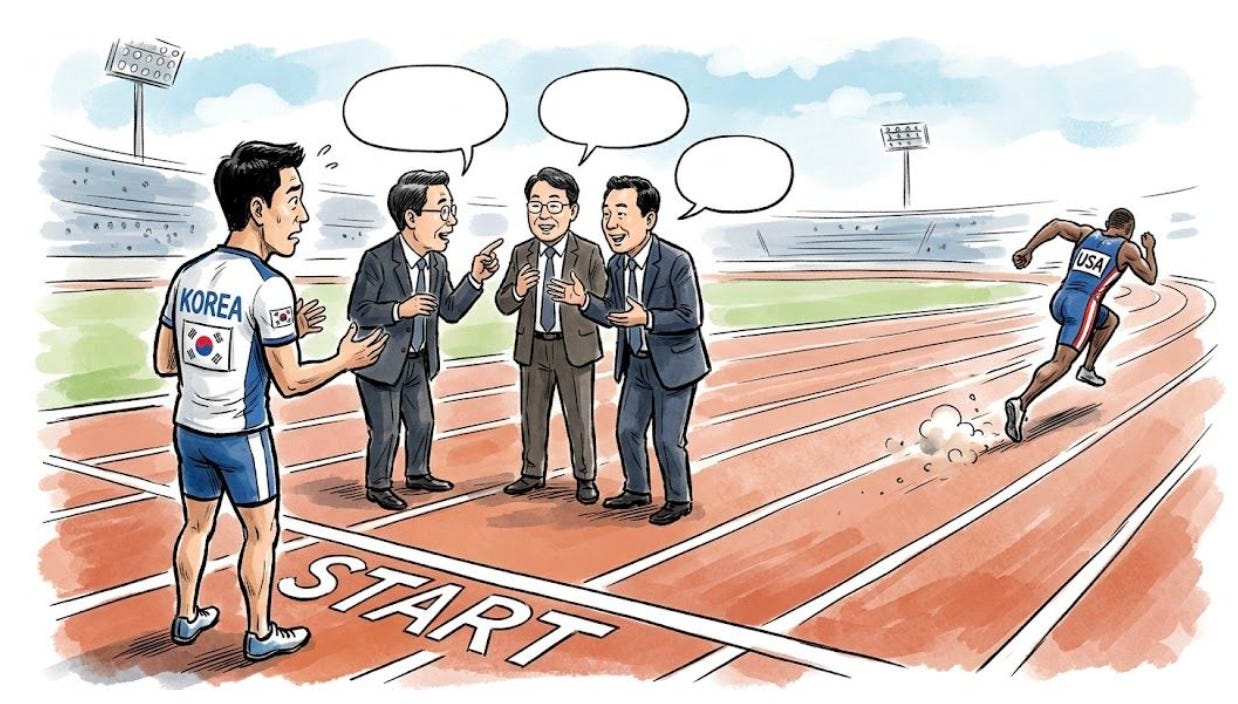
From Initiation to Execution: Shifting the Focus from “Who” to “How”
Since the KRW stablecoin was formalized as a presidential pledge in June 2025, over eight related bills have been introduced to the National Assembly, making its issuance a fait accompli.
The critical challenge is speed. While domestic discussions stalled, USD stablecoins captured over 99% of the global market. Moving beyond repetitive discourse, it is time to pivot the conversation: the priority is no longer who will initiate the market, but how to ensure its operational success.
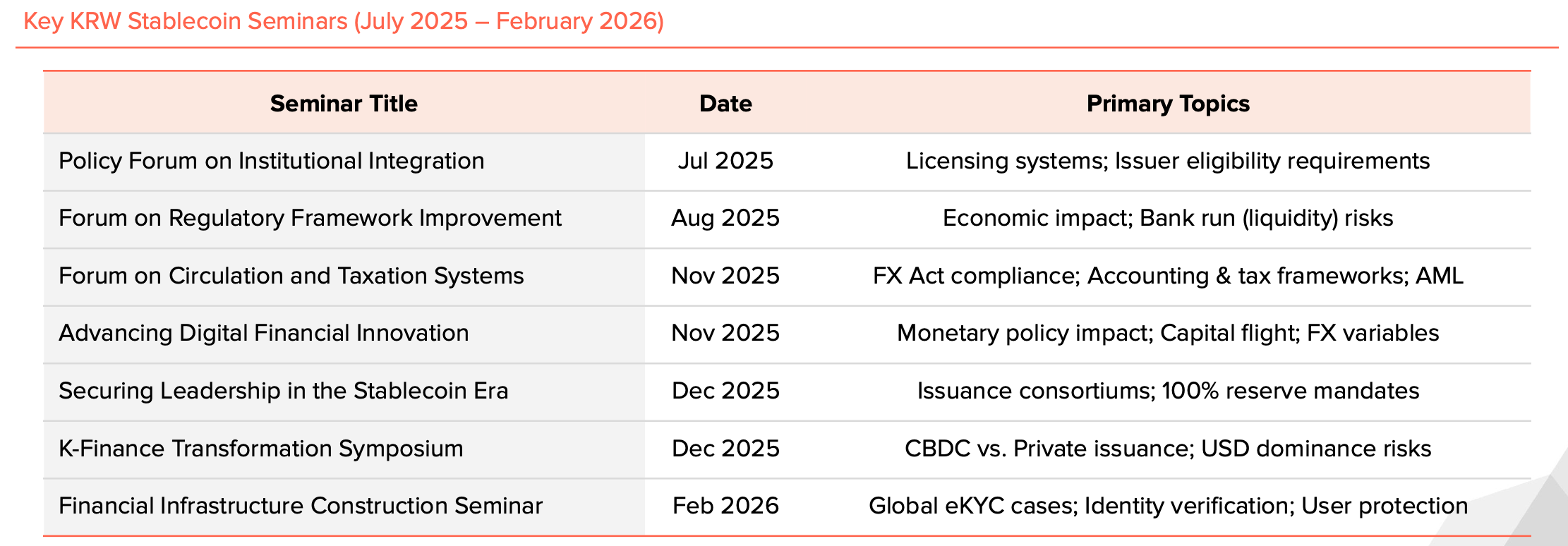
A Year of Discourse: Defining the Regulatory “What”
Between July 2025 and February 2026, the National Assembly and academia convened over seven major forums. Discussions focused predominantly on issuing entities, reserve asset requirements, and oversight authority.
While specific conclusions varied by event, the underlying trajectory remained consistent: “What”
Beyond the Framework: What Regulations Leave Unspoken
Discussions over the past year have remained confined to three primary pillars: issuing entities, oversight authority, and risk warnings. Crucially, the actual operational mechanics were never on the official agenda.
The decision to authorize issuance is merely the starting point. Without a framework for practical execution, even the most robust regulations remain nothing more than static documentation.
Disclaimer
This report was partially funded by Kaia. It was independently produced by our researchers using credible sources. The findings, recommendations, and opinions are based on information available at publication time and may change without notice. We disclaim liability for any losses from using this report or its contents and do not warrant its accuracy or completeness. The information may differ from others’ views. This report is for informational purposes only and is not legal, business, investment, or tax advice. References to securities or digital assets are for illustration only, not investment advice or offers. This material is not intended for investors.
Terms of Usage
Tiger Research allows the fair use of its reports. ‘Fair use’ is a principle that broadly permits the use of specific content for public interest purposes, as long as it doesn’t harm the commercial value of the material. If the use aligns with the purpose of fair use, the reports can be utilized without prior permission. However, when citing Tiger Research’s reports, it is mandatory to 1) clearly state ‘Tiger Research’ as the source, 2) include the Tiger Research logo following brand guideline. If the material is to be restructured and published, separate negotiations are required. Unauthorized use of the reports may result in legal action.


