

What if FTX’s reserves had been directly verifiable? Unverifiable finance can fail at any time. With AI agents executing trades on behalf of humans, that risk spreads faster.
Key Takeaways
The 2008 crisis and FTX collapse shared the same root, unverifiable structures. Trust was the only option. Hidden insolvency surfaced all at once.
Nexus replaces institutional assurances with mathematical proof via zero-knowledge proofs. Reserves, liquidation logic, and trade matching all become verifiable.
The Trifecta, L1 + Nexus Exchange + USDX, is the core mechanism. Volume drives USDX demand, and that revenue funds developers and grows the ecosystem. The flywheel depends on initial volume.
Verifiability proves its worth in a crisis. With established exchanges already entrenched, how fast Nexus secures initial liquidity is Trifecta’s first real test.
That value compounds in an AI agent era. One error can propagate across a market in a chain reaction. Nexus’s structural case grows stronger over time.
1. Finance Is Not Transparent
The problem with traditional finance is not performance. We already have convenient financial services. The problem lies behind that convenience: users cannot see what is actually happening inside the financial system.
This opacity has repeatedly triggered crises.
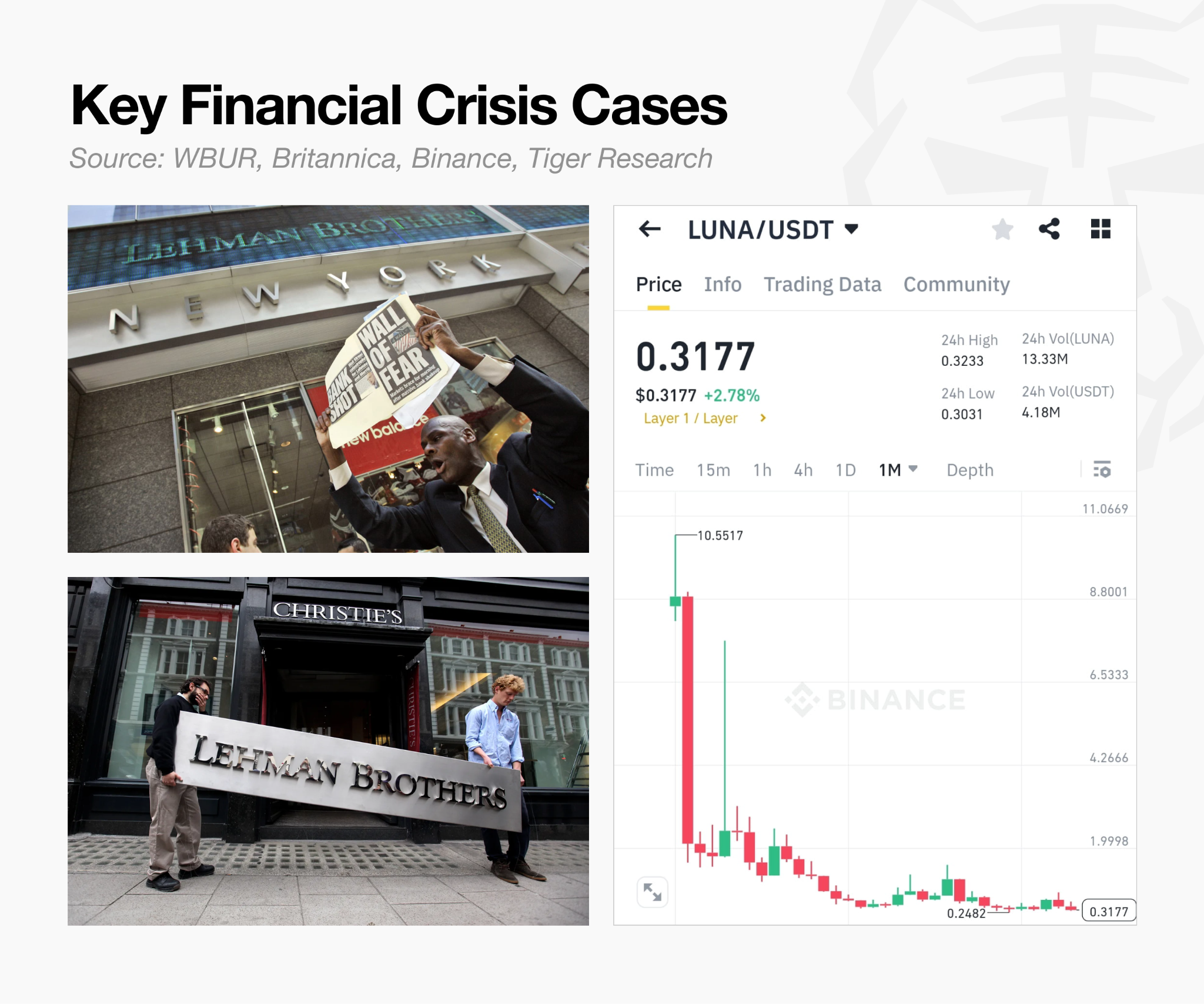
The 2008 financial crisis is the clearest example. U.S. commercial banks knew loan defaults were mounting, yet chose not to reflect those losses on their books. Financial statements looked healthy, and neither depositors nor regulators could identify the real risk. Hidden insolvency surfaced all at once, shaking the global financial system.
The problem will only grow. As AI agents emerge as primary actors in financial transactions, algorithms replace the judgments that humans once made. Without a verifiable system in place, there is no way to catch errors when they occur.
2. Verifiable Finance
Nexus focuses on the absence of verification hidden behind convenience. Its goal is to transform finance that has never been verifiable into what it calls Verifiable Finance.
Zero-Knowledge Proof (ZKP) makes this possible. It is a technology that mathematically proves a statement is true without revealing the underlying details. Consider an exchange claiming to hold $10B in customer assets.
[As-Is] Current approach: The exchange announces that assets are “safely held.” Users have no way to verify the actual balance.
[To-Be] ZKP approach: The exchange feeds asset data into an algorithm, which generates a proof that holdings meet or exceed customer deposits. Specific asset details remain private, and only the fact that the condition is satisfied is mathematically proven.
In other words, trust in the institution is replaced by mathematical proof.
Nexus aims to extend this across the full financial stack: trade matching, routing verification, and validation of profit/loss calculations and liquidation logic. The intent is to convert areas that once required institutional trust in faith into subjects of proof. Financial infrastructure, in turn, gets rebuilt on a verifiable foundation.
ZKP has often functioned as a marketing term rather than a production technology, even as costs have fallen and throughput has grown. Nexus responds by targeting finance as a specific use case rather than building a general-purpose proving environment. The goal is to demonstrate ZKP in practice, in a domain where accuracy and transparency are directly tied to the safety of user funds.
3. ZKP in Practice: The Trifecta
Last cycle disproved the assumption that good technology attracts good applications on its own. Nexus builds the financial services directly. L1, Nexus Exchange, and stablecoin USDX form a single integrated stack.
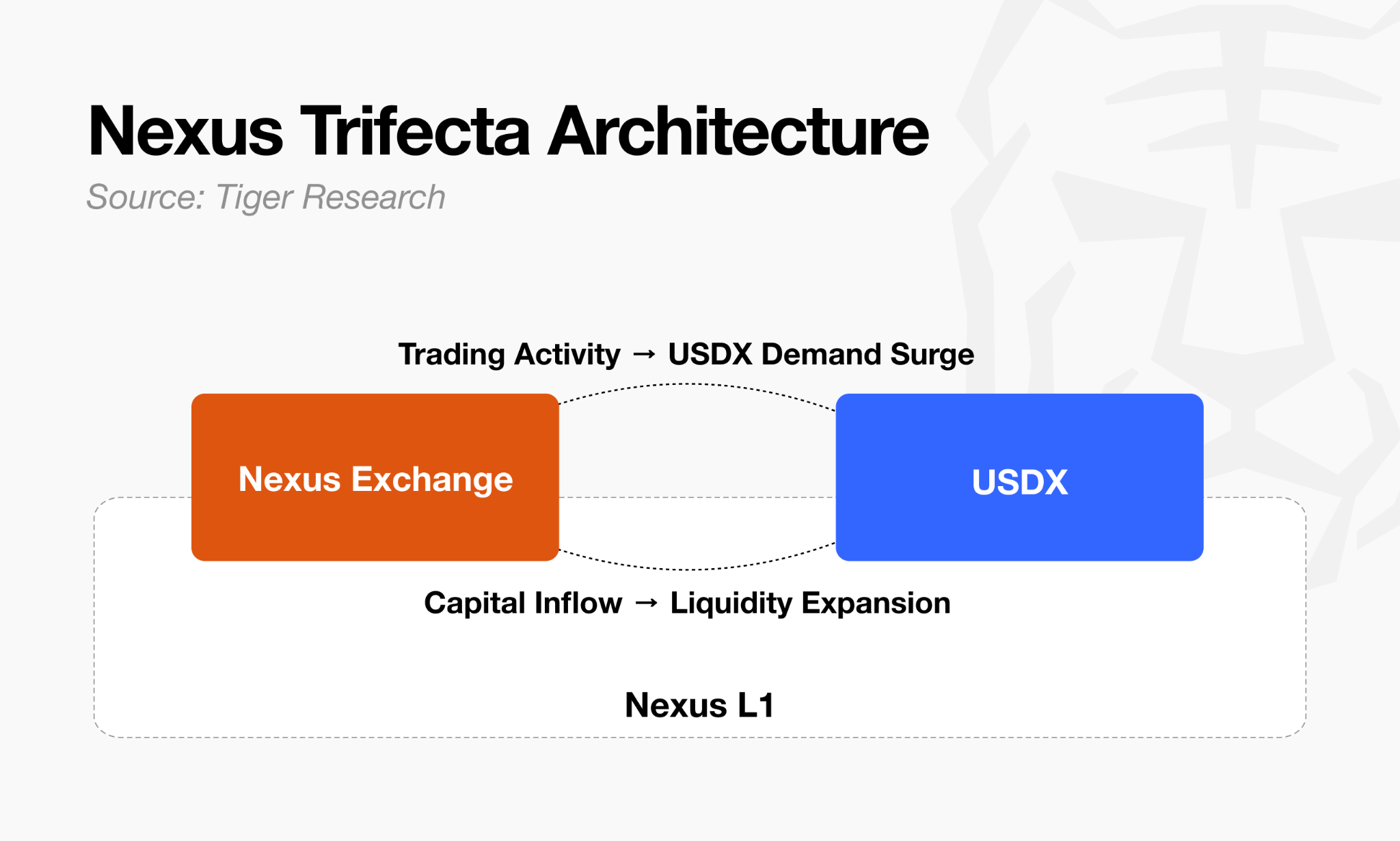
Existing chains keep L1, exchange, and stablecoin separate, bridged by external integrations. Speed, liquidity, and verification run in different environments as a result. Nexus designed the L1 and exchange together, with USDX embedded directly in the chain. All three share one environment. Nexus calls this the Trifecta.
The flow is simple. Exchange activity drives USDX demand, pulling more capital into the ecosystem. That capital deepens liquidity, which grows trading volume. The L1 is the infrastructure underlying the entire cycle.
3.1. Nexus Exchange: An Exchange Built Into the Protocol
Nexus Exchange is structurally different from a typical DEX. Most DEXs deploy as smart contracts on top of a chain. Nexus Exchange runs within the chain itself, not on top of it. Think of it less as a downloaded app and more as a function native to the operating system.
With the exchange embedded in the chain, every application shares one order book and one liquidity pool. Liquidity stops fragmenting across protocols and consolidates in one place. Trade execution runs in the chain’s high-speed environment, delivering CEX-level speed in a non-custodial structure.
An alpha version is currently in development on testnet. Features are expanding through community feedback. Long-term, Nexus Exchange is positioned to serve three roles at once.
Proof network activation: Ongoing trading creates the workload that keeps the proof network live.
Reference app: The first live demonstration of Nexus architecture’s performance and verification capabilities.
Liquidity gateway: The primary channel for pulling capital into the ecosystem.
One exchange drives infrastructure, proves the technology, and attracts capital. But it is still an exchange, and volume is what matters. Crypto trading volume is down from its peak, and crypto assets alone cannot fill an exchange. How quickly real-world assets like equities and bonds come onchain will be the deciding factor.
3.2. USDX: Native Stablecoin
USDX is the base currency of the Nexus ecosystem, serving as the default settlement currency for Nexus Exchange. All trades are denominated and settled in USDX.
Issued natively within the chain, USDX removes the need for external stablecoin bridges. Trading, settlement, and collateralization run within a single chain without interruption.
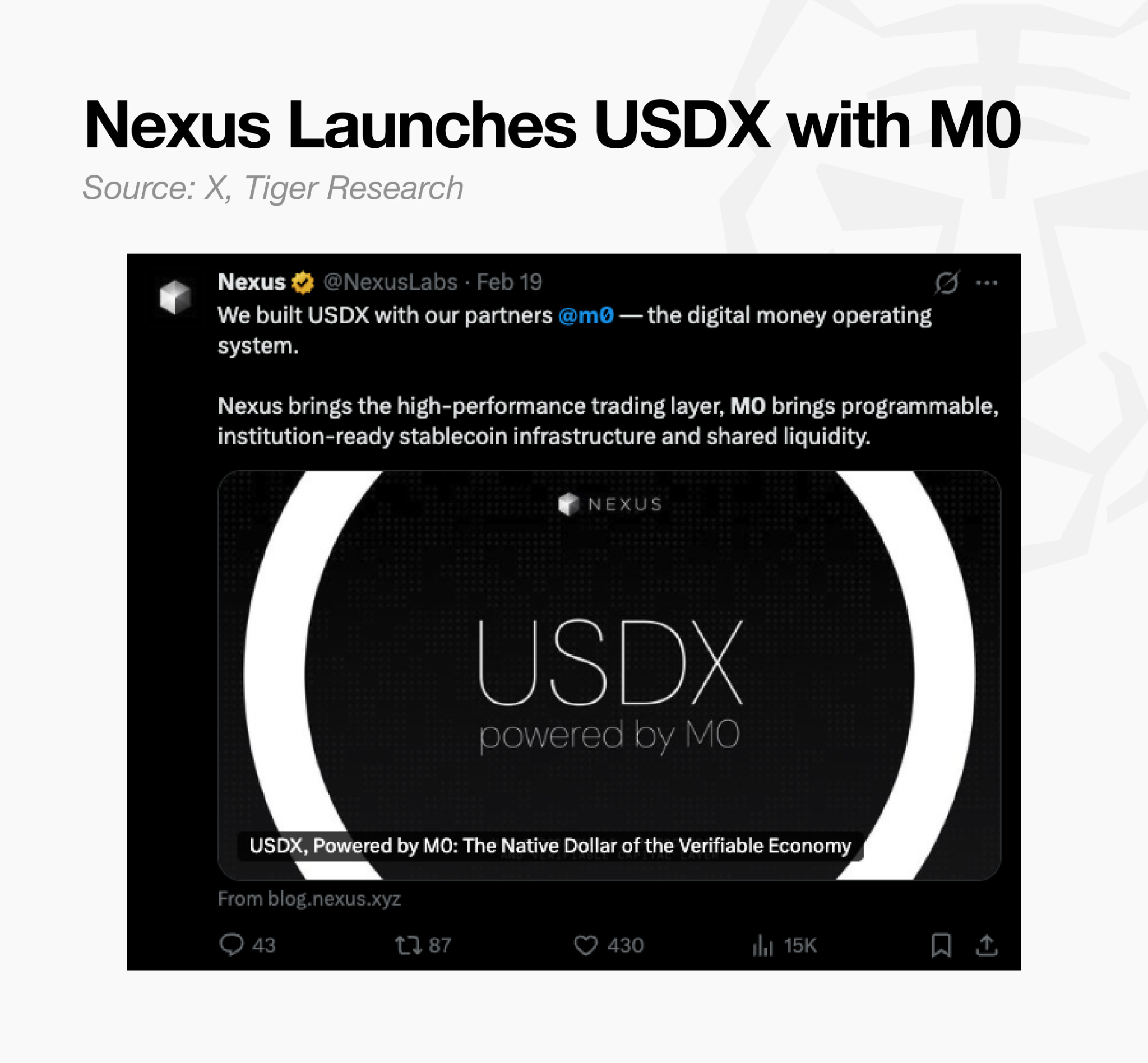
Issuance is planned on M0 infrastructure, backed 1:1 by U.S. Treasuries. Nexus aims to apply cryptographic proof to collateral verification. Whether zkVM-based proof of reserves will be fully realized remains to be confirmed after mainnet.
Nexus Exchange generates the volume and liquidity. USDX is the fuel that runs the engine. Exchange activity creates USDX demand, and USDX circulation deepens exchange liquidity. But the cycle cannot start without a reason to use USDX. In a market where USDC and USDT are already deeply entrenched, being native is not a sufficient advantage. How quickly liquidity builds on the exchange will decide USDX’s fate.
4. Revenue Structure for Ecosystem Growth: Yield Streaming
An exchange and stablecoin working together are not enough if the ecosystem is empty. The flywheel needs developers and protocols. Nexus solves this through incentive design.
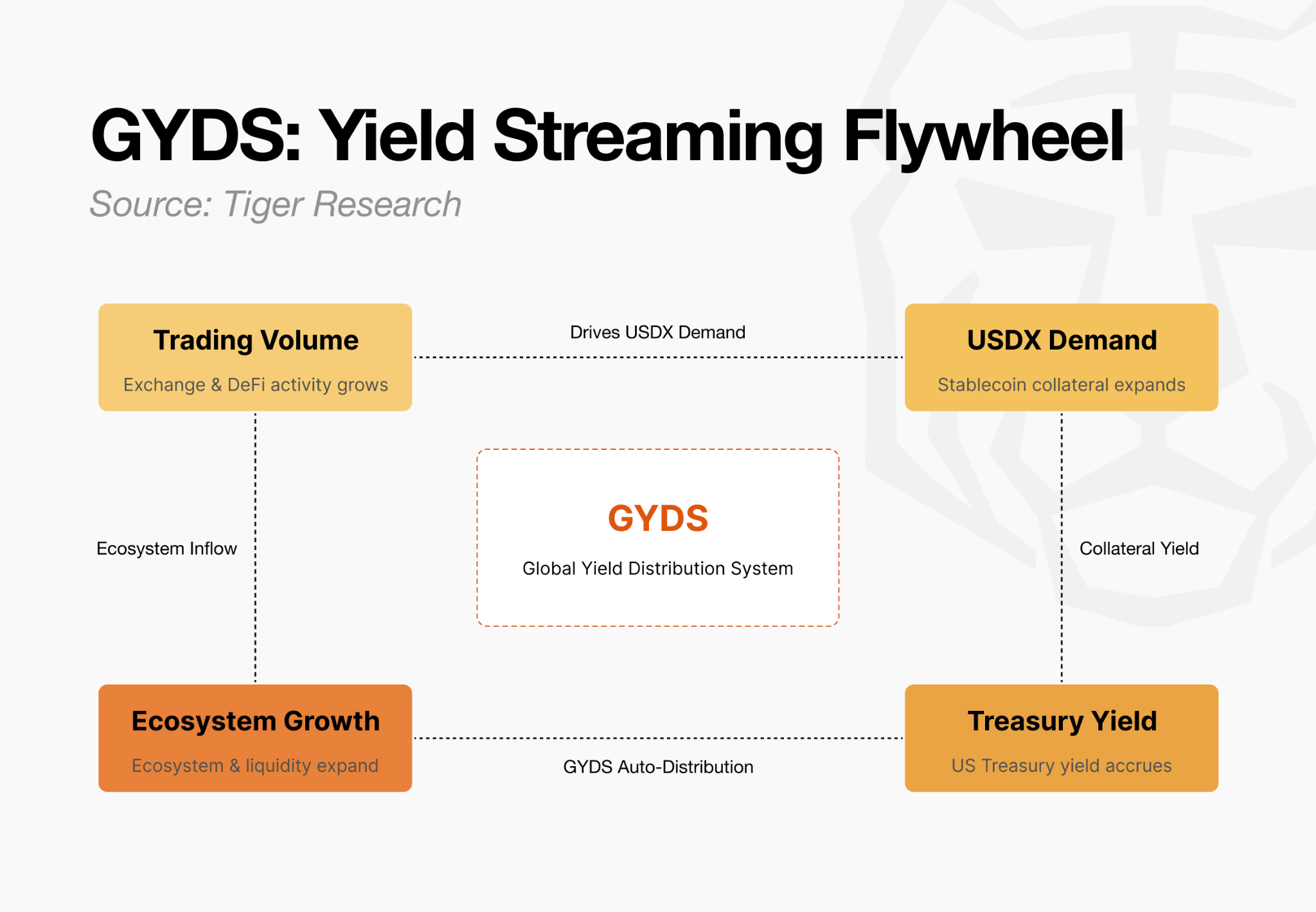
The core mechanism is GYDS (Global Yield Distribution System). It automatically distributes interest income from U.S. Treasuries, the collateral backing USDX, to app developers. Traditional DeFi required governance votes or foundation negotiations to receive grants. GYDS removes that process. Revenue is distributed automatically, proportional to the TVL and trading volume of apps integrating USDX.
This is not a one-time grant. Protocol revenue flows across the ecosystem in real time. Nexus calls this Yield Streaming. As user bases grow, developer earnings grow with them, without external support.
More trading volume means more USDX demand. More USDX demand means more Treasury yield. That yield flows to developers, pulling more apps into the ecosystem. More apps drive more volume. The Trifecta closes its loop.
5. Dual Core: A Chain With Two Runways
Verifiable Finance requires infrastructure built for it. Nexus solves this with a Dual Core architecture, two execution environments within one chain.
An airport analogy helps. A main runway for general flights and a dedicated high-frequency runway within the same airport, each running independently, coordinated by one control tower.
NexusEVM (main runway): A general-purpose, Ethereum-compatible execution environment. Token issuance, governance, and standard DeFi protocols run here.
NexusCore (dedicated runway): A high-performance environment built directly into the L1 for financial computation. Futures, derivatives, and liquidation processing complete in under 200 milliseconds.
Traditional DeFi could not deliver both. General-purpose chains offered composability but not speed. Dedicated chains offered speed but fragmented liquidity. Dual Core lets general and high-speed financial applications run at their own pace, sharing one chain and one liquidity pool.
Some features are still in development. Specifications may change before mainnet.
6. From Today’s Finance to Tomorrow’s AI Agent Finance
The real test begins now. Mainnet, originally targeted for Q1, has shifted to Q2 2026. Mainnet launch, USDX issuance, and Nexus DEX activation must all land at once.
Near-term, product usability is what to watch. Verifiability is invisible to users in normal conditions. Traders on Hyperliquid feel speed and liquidity depth, not how assets are verified. Users did not check proof of reserves before FTX collapsed. Whether the Trifecta can sustain itself on usability alone, before verifiability earns its recognition, is the question.
Longer term, verifiability is the point. When AI agents become the primary actors in financial transactions, the game changes. Agents feed each other’s outputs directly into the next trade. One error propagates across the chain. Humans stop when something feels wrong. Agents do not. Without cryptographic proof of execution, there is no way to break the chain.
Existing blockchains were not built for this. Speed and verifiability came at each other’s expense. ZKP processes computation off-chain and records only the proof on-chain. In a market where verifiability is a prerequisite rather than a feature, Nexus’s structural value grows.
Agent finance is still early. But time may be on Nexus’s side. More autonomous trading means more demand for verifiable infrastructure. The structure Nexus is building now, L1, exchange, and stablecoin interlocked in one verifiable environment, becomes more relevant with every passing cycle.
The architecture is compelling. What remains is execution and time.
🐯 More from Tiger Research
Read more reports related to this research.Disclaimer
This report was partially funded by Nexus. It was independently produced by our researchers using credible sources. The findings, recommendations, and opinions are based on information available at publication time and may change without notice. We disclaim liability for any losses from using this report or its contents and do not warrant its accuracy or completeness. The information may differ from others’ views. This report is for informational purposes only and is not legal, business, investment, or tax advice. References to securities or digital assets are for illustration only, not investment advice or offers. This material is not intended for investors.
Terms of Usage
Tiger Research allows the fair use of its reports. ‘Fair use’ is a principle that broadly permits the use of specific content for public interest purposes, as long as it doesn’t harm the commercial value of the material. If the use aligns with the purpose of fair use, the reports can be utilized without prior permission. However, when citing Tiger Research’s reports, it is mandatory to 1) clearly state ‘Tiger Research’ as the source, 2) include the Tiger Research logo following brand guideline. If the material is to be restructured and published, separate negotiations are required. Unauthorized use of the reports may result in legal action.


