

What if DeFi could run every RWA yield strategy on a single platform just like traditional finance? Solstice Finance was built to answer that question.
Key Takeaways
Solstice Finance goes beyond single-strategy DeFi yield by operating multiple strategies with varying risk-return profiles on one platform.
The protocol currently runs eUSX and plans to roll out strcUSX and oUSX.
The team includes members with traditional finance backgrounds, but it still needs to prove sustainable yield generation in crypto.
In crypto, trust is built on on-chain transparency, not regulation or audits. The fact that eUSX’s yield structure and AUM are not fully disclosed is the first hurdle Solstice must clear.
1. A Management Platform Born in Crypto
In traditional finance, investors access a range of products through financial institutions. Products are segmented by asset class and leverage level, and investors choose based on their risk appetite. The institution designs, manages, and shares returns with investors.
DeFi has a similar structure: the vault. Investors deposit capital, and protocols manage it to generate yield.
However, most protocols offer only a single strategy. In TradFi terms, it is like a firm selling just one product. Investors have no way to adjust risk, and when market conditions shift, returns depend entirely on that one strategy.
Solstice Finance addresses this limitation by deploying multiple products within its vault platform (YieldVault), with its own trading desk executing each strategy directly.
Rather than a curator model that assembles external yield sources, a single team handles everything from strategy design to execution.
2. Investment Starts with USX
Understanding Solstice’s yield structure begins with USX.
USX is an overcollateralized settlement layer, designed to be 1:1 with the US dollar and serves as the access point for all yield strategies within the Solstice ecosystem. Just as investors must fund a brokerage account before buying financial products, USX plays the same role in Solstice.
USX is more than a simple deposit instrument. It is designed as base infrastructure that can connect not only to Solstice’s internal strategies but also to external DeFi applications. The structure allows various strategies to be layered on top.
When USX is deposited into the YieldVault, the yield mechanism activates. Depositors receive eUSX, a token representing their share of the yield generated by the underlying strategy. Returns are not paid out separately like interest. Instead, the value of eUSX itself appreciates over time.
This is a real-world yield strategy, being brought onchain through an LST - a liquid staking token.
Currently the vault operates a single delta-neutral strategy, but YieldVault is designed as a management platform capable of connecting multiple RWA yield strategies sequentially.
3. Solstice as an Evolving Management Platform
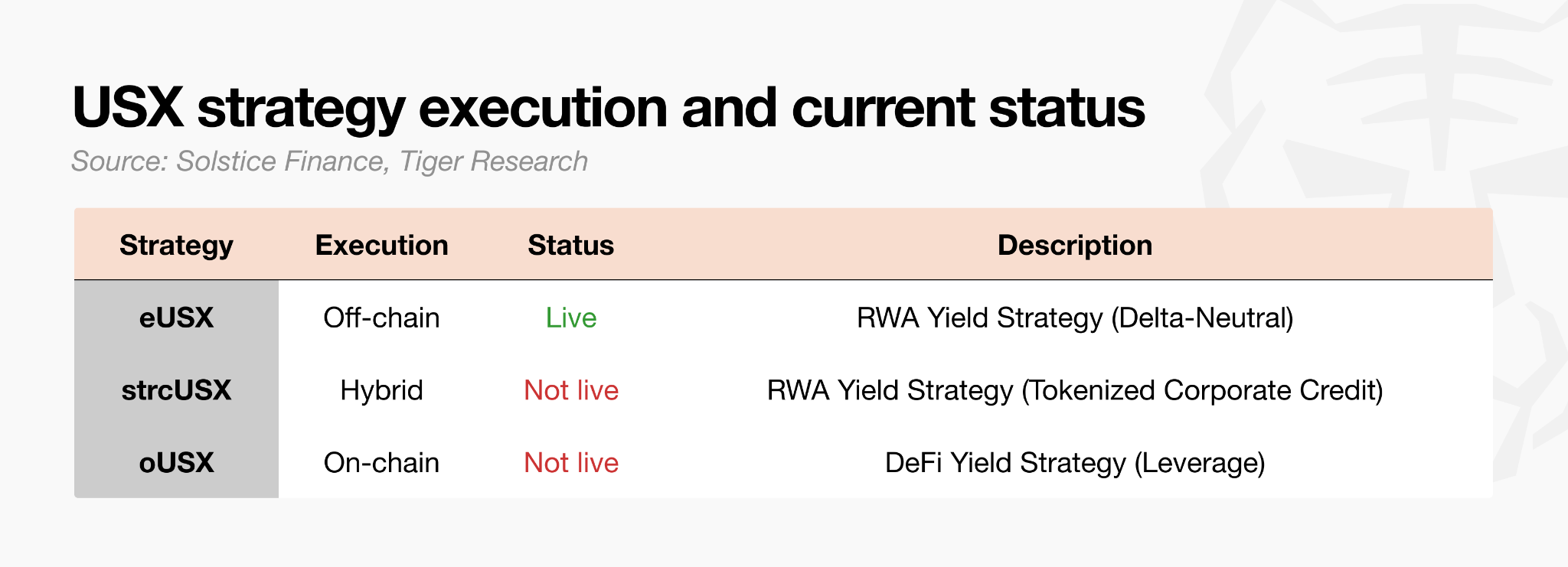
All Three strategies share one commonality: they run on USX. The difference lies in how yield is generated and the level of risk involved. eUSX is currently live; the remaining two strategies are in pre-launch.
3.1. eUSX: RWA Yield Strategy (Delta-Neutral)
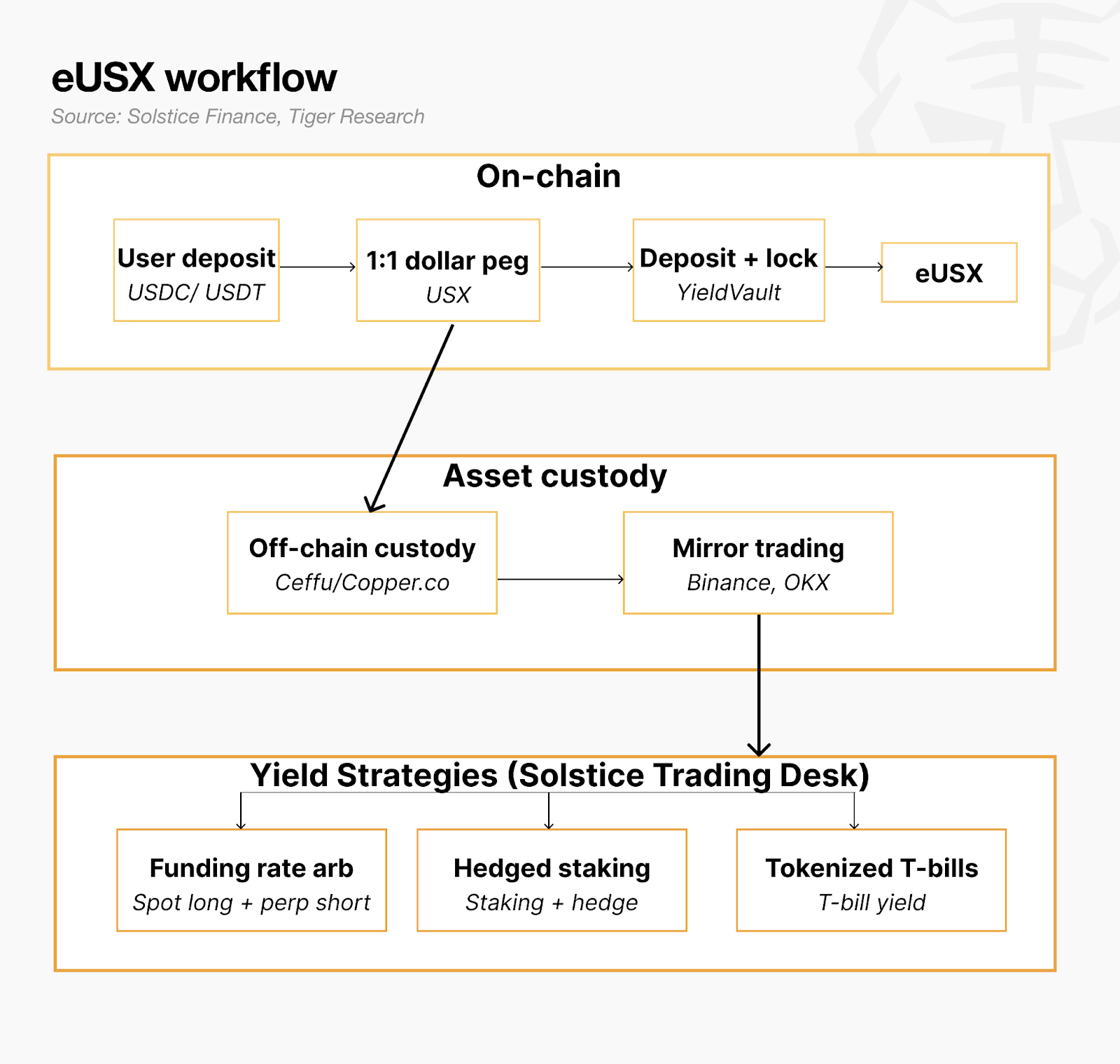
eUSX is Solstice’s core yield product. The mechanism works as follows:
Deposit USX into YieldVault to receive eUSX.
Holding eUSX accrues yield. No additional eUSX enters the wallet; instead, the amount of USX redeemable per eUSX increases over time.
If 1 eUSX = 1 USX at the start, yield accumulation pushes it to 1 eUSX = 1.05 USX, then 1.10 USX. USX itself maintains its dollar peg.
eUSX functions as a Liquid Staking Token (LST), usable in lending, liquidity provision, and other DeFi activities.
This is what the user sees. However, eUSX’s yield structure is not fully verifiable on-chain in real time. To address this, Solstice partners with Accountable to provide external verification of collateralization ratios and solvency. Even so, the custodial framework and exchange risk management remain critical variables.
Solstice stores stablecoins (USDT/USDC) received through USX swaps with external custodians. Some custodians support mirroring: assets remain with the custodian while the corresponding balance is used as margin on exchanges.
Since the original assets stay with the custodian, funds are preserved even if an exchange becomes insolvent.
Through these accounts, Solstice executes its core delta-neutral strategy: holding spot longs and futures shorts simultaneously to offset price exposure, capturing funding rate payments in the process.
A structural limitation exists when negative funding rates persist, reducing returns. Solstice supplements this with tokenized treasury yields and staking as auxiliary strategies.
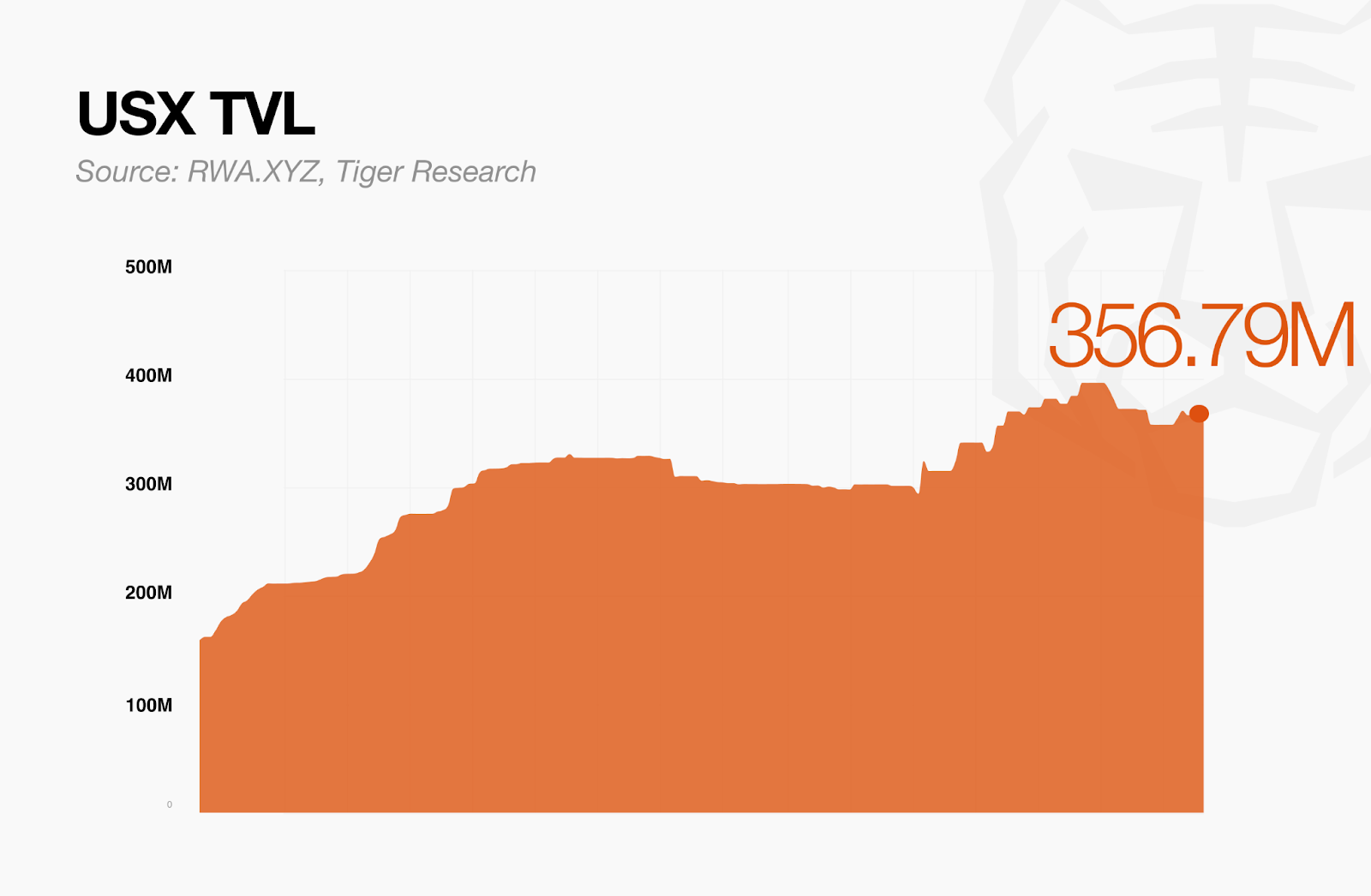
The product has accumulated $356.79M in TVL. However, the strategy itself is not unique and has been employed by other DeFi protocols. For Solstice to establish a distinct competitive edge, the differentiated strategies yet to be released must deliver meaningful differentiation in the market.
3.2. strcUSX: RWA Yield Strategy (Tokenized Corporate Credit)
struUSX is fundamentally different from the other three strategies. Rather than sourcing yield from crypto markets, it tokenizes exposure to a publicly listed company in traditional finance. specifically, it wraps preferred share exposure to strategy Inc. (formerly MicroStrategy), making it accessible within Solana DeFi.
The Rational: diversifying yield sources by blending RWA TradFi assets into a crypto native portfolio.
3.3. oUSX: DeFi Yield Strategy (Leverage)
oUSX carries the highest risk and the highest target yield among the Three strategies. It automates advanced DeFi strategies including looping (repeated borrow-deposit cycles to amplify yield), recursive lending, concentrated liquidity provision, yield stacking, and peg arbitrage.
If eUSX is a market neutral fixed deposit, oUSX is closer to a leveraged high-risk investment product.
4. Execution Capability as Competitive Edge
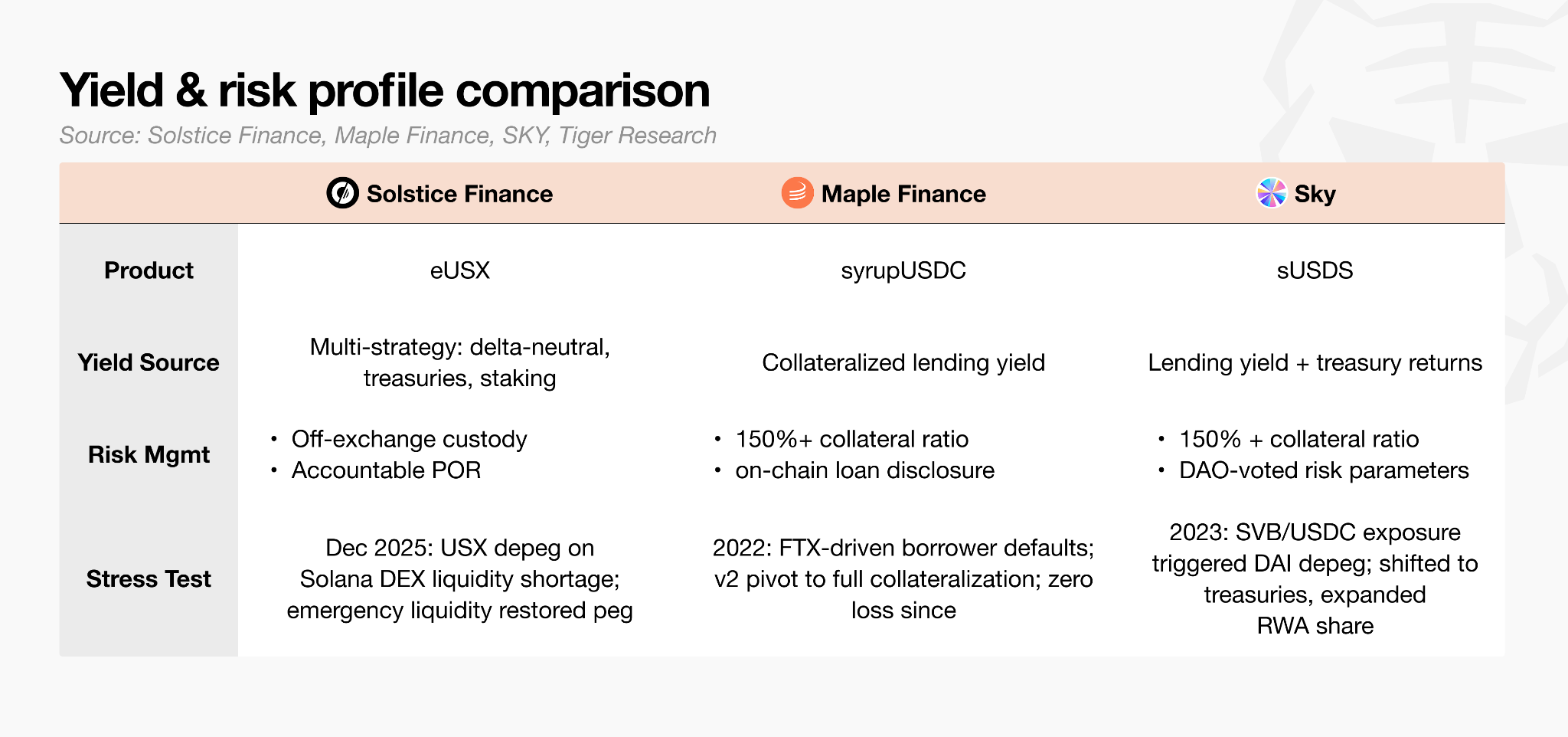
strcUSX, and oUSX are all in pre-launch, and their specific execution structures are subject to change.
Solstice’s long-term vision is to layer multiple yield strategies on top of a single protocol. But no matter how diverse the strategies, they are meaningless without proven returns. Since much of the strategy execution occurs off-chain, the capability of the team designing and executing these strategies is effectively the protocol’s competitive edge.
Investment management is handled directly by Solstice’s in-house trading desk. A single team handles everything from strategy design to execution with no external outsourcing. In practice, vault curators like RockawayX are incorporating Solstice’s yield strategies into their own curated vaults. While many vaults source yield externally, Solstice is the source being sourced.
The desk is led by CIO Stuart Connolly, who managed treasury operations and portfolio management at large hedge funds including BlueCrest Capital and Oceanwood Capital. His experience spans swaps, repos, and margin management, areas directly relevant to the delta-neutral strategies Solstice employs.
The rest of the team is composed of professionals from global investment banks, hedge funds, and institutional-grade digital asset exchanges.
Solstice’s trading desk is not a crypto-native team that learned traditional finance. It is closer to a traditional finance hedge fund desk that migrated into digital assets.
Experience alone does not guarantee returns. However, the team’s 36-month track record (annualized IRR of 13.96% and Sharpe ratio of 7.05 as of September 2025) offers tangible evidence of performance.
Over a longer operating period, IRR adjusted to 13.8% and Sharpe ratio to 6.6, demonstrating that returns shift alongside changes in funding rate conditions.
Whether these figures hold across varying market environments requires ongoing validation.
5. The Bull Case for Solstice
The bull case for Solstice is a scenario in which USX becomes core infrastructure for Solana DeFi, with diverse strategies and external apps connecting on top, expanding across the broader ecosystem.
Solana DeFi is growing rapidly, but there is no clear precedent for a platform that manages multiple yield strategies under one roof. If USX fills this gap, partner DeFi apps will naturally adopt USX and USX-based products, driving ecosystem expansion. Infrastructure comes first, services build on top, and as services accumulate, USX’s utility widens.
Three conditions must be met for this scenario to materialize:
The partner ecosystem must translate into real liquidity inflows. Liquidity integrations are already in place with major Solana DeFi protocols including Raydium, Orca, and Marinade, and total partners now exceed 50. Whether this drives actual SLX demand remains to be confirmed.
Additional strategies must launch on schedule. The management platform thesis is only complete when strcUSX, and oUSX generate real market demand.
The track record must hold. As the number of partners grows, maintaining stable liquidity on secondary markets becomes an increasing challenge.
If all three conditions are met, USX becomes the default financial layer for liquidity entering Solana. As the Solana ecosystem grows, capital flowing through USX scales with it, and the yield strategies built on top expand accordingly. Solstice’s value will ultimately be determined not by individual strategy returns, but by how much liquidity passes through the platform.
Whether these three conditions are fulfilled one by one will be the benchmark for evaluating the bull case.
🐯 More from Tiger Research
Read more reports related to this research.Disclaimer
This report was partially funded by Solstice Finance. It was independently produced by our researchers using credible sources. The findings, recommendations, and opinions are based on information available at publication time and may change without notice. We disclaim liability for any losses from using this report or its contents and do not warrant its accuracy or completeness. The information may differ from others’ views. This report is for informational purposes only and is not legal, business, investment, or tax advice. References to securities or digital assets are for illustration only, not investment advice or offers. This material is not intended for investors.
Terms of Usage
Tiger Research allows the fair use of its reports. ‘Fair use’ is a principle that broadly permits the use of specific content for public interest purposes, as long as it doesn’t harm the commercial value of the material. If the use aligns with the purpose of fair use, the reports can be utilized without prior permission. However, when citing Tiger Research’s reports, it is mandatory to 1) clearly state ‘Tiger Research’ as the source, 2) include the Tiger Research logo following brand guideline. If the material is to be restructured and published, separate negotiations are required. Unauthorized use of the reports may result in legal action.


