

Key takeaways
Distrust of market makers stems from price manipulation firms that presented themselves as market makers. Because there were no clear qualification requirements, the name was used freely.
Legitimate market makers lower investors’ trading costs by narrowing spreads and standing ready as a counterparty at all times. Projects hand this work to independent market makers to avoid suspicion that they are intervening in their own token’s price.
Crypto market makers do the same work as their counterparts in traditional finance, but they operate in a fragmented market where there is no framework for formal contracts with CEXs and where contracts with token issuers are not disclosed. Trading with one’s own capital is already legal; the regulatory gap lies in the contracts.
The Digital Asset Basic Act is the first opportunity to put this solution into law. The bill as proposed allows market making commissioned by a CEX, but recognizes contracts commissioned by token issuers only for the first six months after listing. Issuer contracts, where most of the problems arise, also need to be brought within the framework.
1. Why Market Makers Came to Be Seen as Manipulators
Anyone who has traded in the crypto market will recognize a familiar pattern: a token’s price surges right after listing, then collapses, and the heavy trading volume disappears almost overnight. Crypto investors often point to market makers (MMs) as the force behind these swings.
This negative perception originated with price manipulation firms operating under the market maker label. Because of these firms, the term “market maker” in the crypto market came to mean a manipulation group, and investor losses from their activity have continued in markets worldwide.
In the US, the FBI charged firms that offered “manipulation as a service,” and in Korea, a group that inflated trading volume under the pretext of providing liquidity received prison sentences. These were illegal operators that offloaded token supply for a fee, however, not market makers performing the function the term describes.
Because there were no clear qualification requirements, the “market maker” name was used indiscriminately, and the credibility of the entire industry suffered as a result.
Manipulation of this kind damages trust in the market and has nothing to do with the actual role of a market maker, which is to supply liquidity.
2. Why Markets Need Market Makers
A market maker is a key market participant that supplies liquidity and keeps trading going by quoting buy and sell prices at the same time. To understand why market makers are needed, it helps to first set out what they do. In Korea, the term “liquidity provider (LP)” is also widely used alongside “market maker.”
In a broad sense, supplying liquidity is not limited to firms with a particular qualification. Any order that does not execute immediately and instead rests on the order book waiting for a counterparty, known as a maker order, gives other investors someone to trade with.
Anyone who places maker orders is therefore providing liquidity in the broad sense. High-frequency trading (HFT) firms such as Jump Trading, which fill order books by trading with their own capital, fall into this category.
Just as an airport currency exchange counter guarantees that travelers can exchange money at any time, a market with market makers allows buyers and sellers to trade without waiting for each other. Both investors and token issuers benefit.
2.1. What Investors Gain: Lower Trading Costs
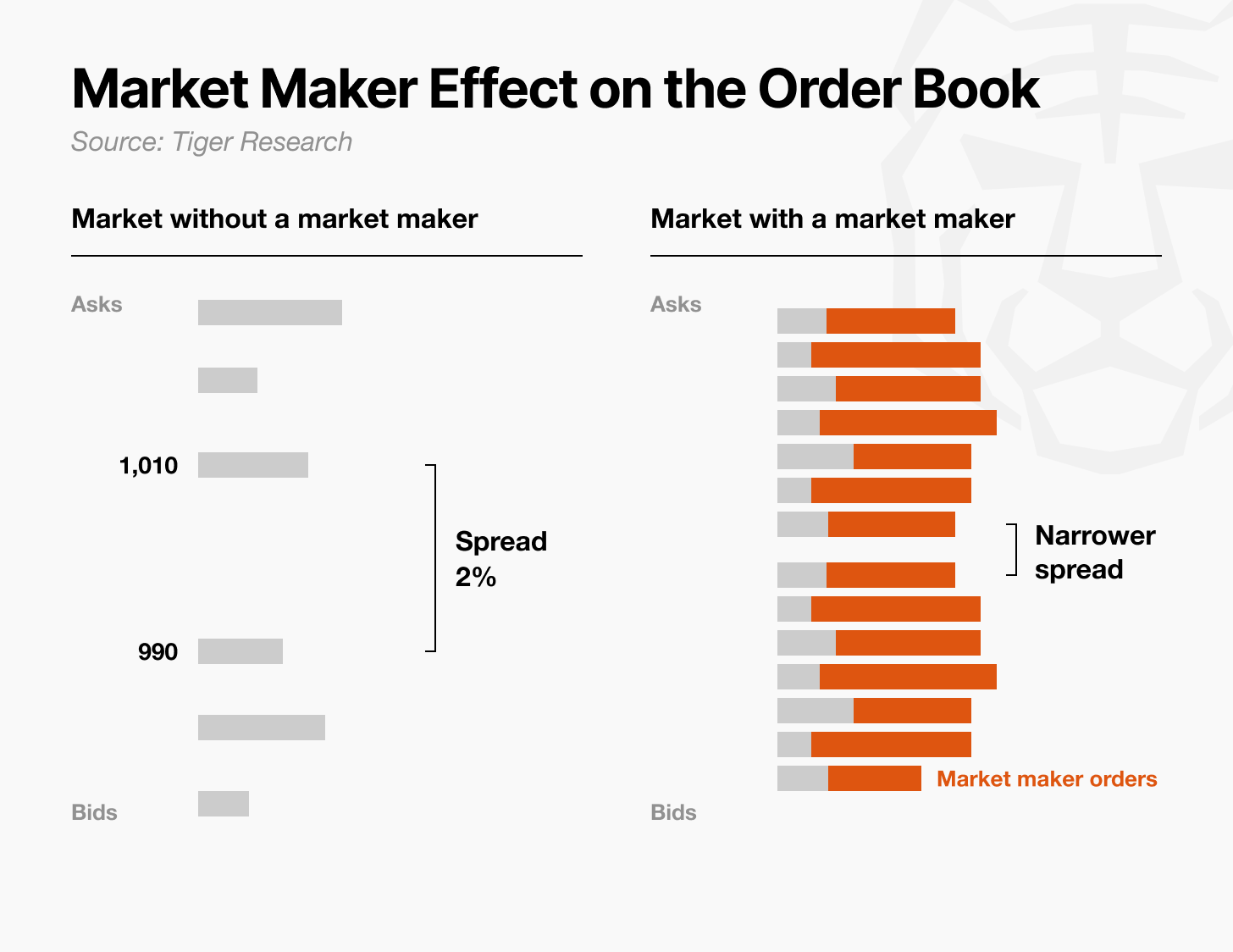
Fees are not the only factor that determines an investor’s actual profit or loss. “Hidden costs” matter more: whether an order executes immediately at the desired price, whether large trades move the price, and whether prices differ across CEXs.
The work of a market maker comes down to meeting these three conditions. It places dense quotes on both the buy and sell sides, takes the other side of a trade when no other counterparty is present, and closes price gaps between CEXs. Investors can then trade at lower cost, when they want, and at similar prices across venues.
Lower trading costs: narrower gap between buy and sell prices (the spread) and lower additional cost for large orders
Trading on demand: a counterparty available at all times
Smaller price gaps across CEXs: simultaneous quotes on multiple CEXs, with arbitrage bringing prices together
First, trading costs fall.
The gap between the buying price and the selling price, the spread, is itself a cost. If the price at which an investor can buy right now is KRW 1,010 and the price at which they can sell right now is KRW 990, buying and immediately selling loses 2%.
The loss grows with order size, because once the volume available at the best price is used up, the order moves to the next price level and then the one after, buying at progressively higher prices. When a market maker places dense quotes, the spread narrows and more volume sits at each price level, which reduces the loss an investor takes on each trade.
Second, investors can buy and sell when they want.
In investing, being able to enter and exit a position at the moment of one’s choosing matters. With a thinly traded token, a seller has to wait until a buyer appears, and the price keeps moving in the meantime.
A market maker keeps quotes on the book during normal conditions and acts as a counterparty. As a result, even when few people are trading, a seller can find someone to take the order immediately, and a buyer can buy without waiting.
2.2. What Token Issuers Gain
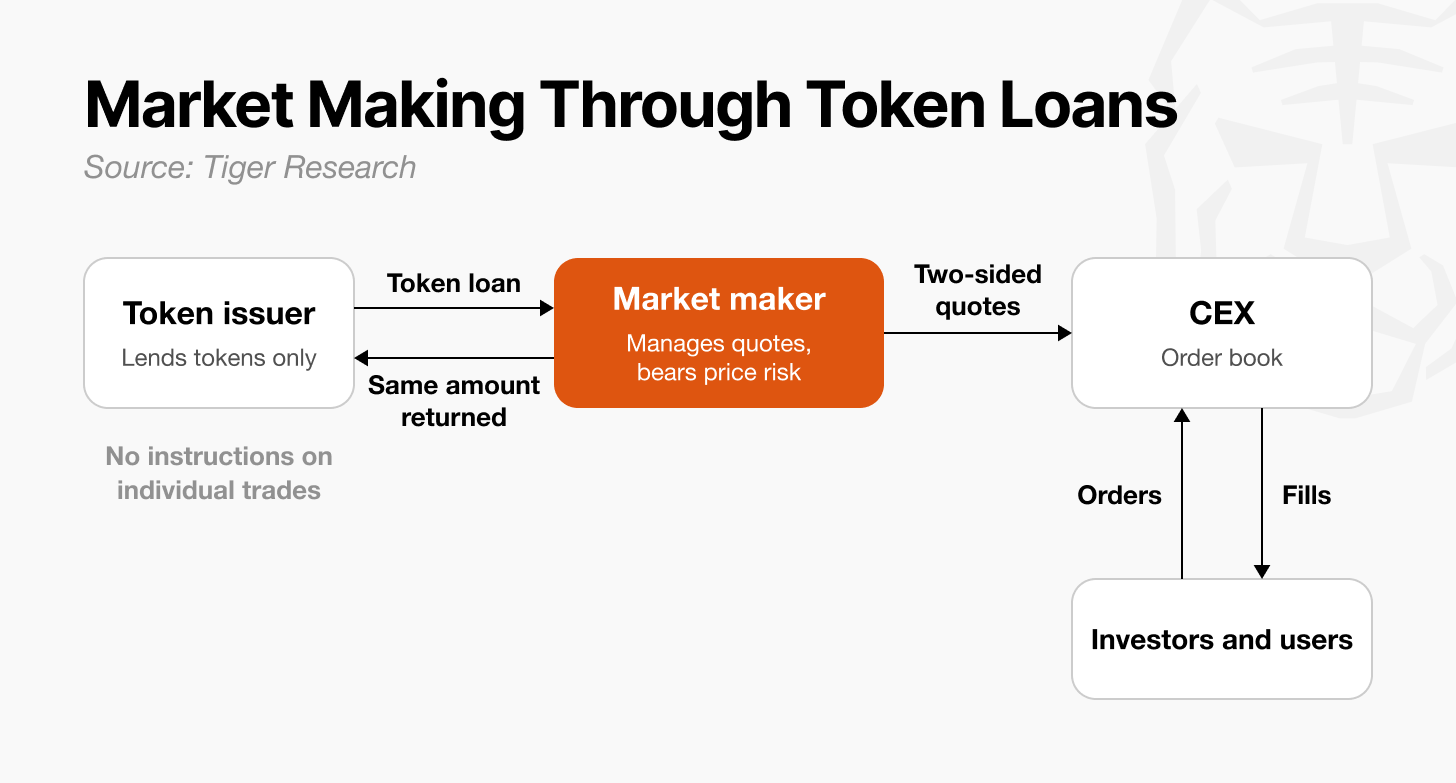
For a token issuer, listing is the beginning rather than the end. A token needs to keep trading after listing so that users and investors can come and go and the token can be valued fairly. A market maker maintains this market on the issuer’s behalf, and the issuer gains two things through it.
Consistent trading: less sharp price movement in response to small orders
No suspicion of price intervention: an independent market maker manages quotes, and the token issuer only lends tokens
First, the issuer gets a market in which its token trades consistently. A listed token is valued by the market every day. Users buy the token to use the service, and investors buy and sell it based on its prospects.
The token can be valued fairly only if these participants can enter and exit without difficulty. In a thinly traded token, even small orders move the price sharply, and this volatility increases uncertainty and damages the issuer’s reputation regardless of its actual performance.
Second, the issuer avoids suspicion of intervening in the price. When a token issuer buys and sells its own token directly, it easily draws suspicion that it is moving the price. Trading is therefore left to an independent market maker, and the issuer only lends out tokens. A legitimate contract also includes provisions that prohibit price manipulation.
In short, investors can execute trades when they need to while paying much less in trading costs, and token issuers can establish a trading environment in which their asset circulates steadily. The difference between the buy and sell prices that a market maker earns is effectively a fee for service paid by market participants who want to trade immediately.
As competition in the market gradually brings these costs down, the benefits extend to all participants.
3. How Crypto Market Makers Differ
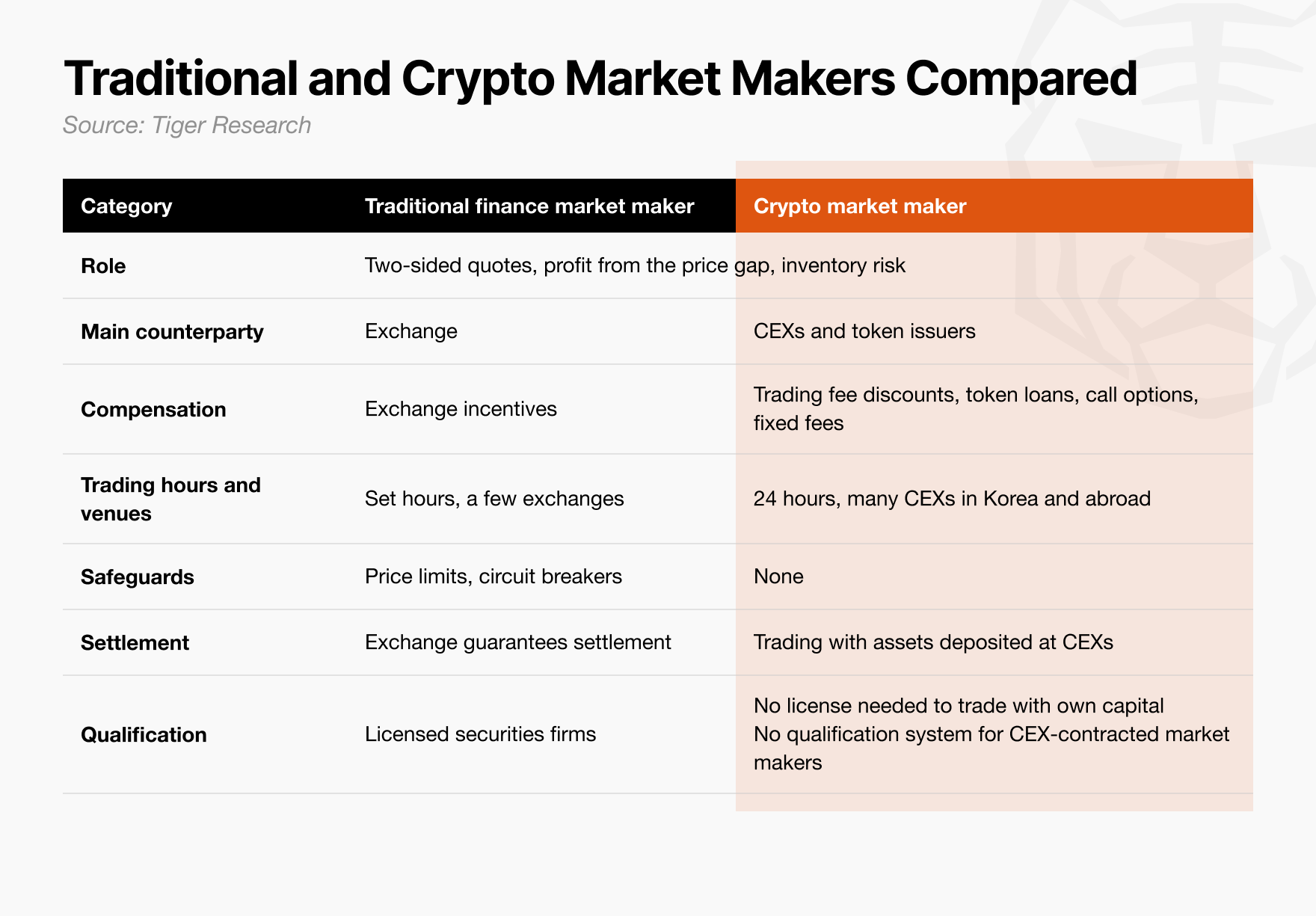
What a crypto market maker does is no different from what a market maker in traditional finance does. The difference lies in the market where it operates and in the rules of the country that governs it. A stock market maker signs a formal contract with the exchange and works under an established regulatory framework.
In the crypto market, by contrast, there is not yet a framework governing contracts between market makers and CEXs or token issuers.
3.1. Who Can Act: Licensed Institutions vs. No Contract Requirements
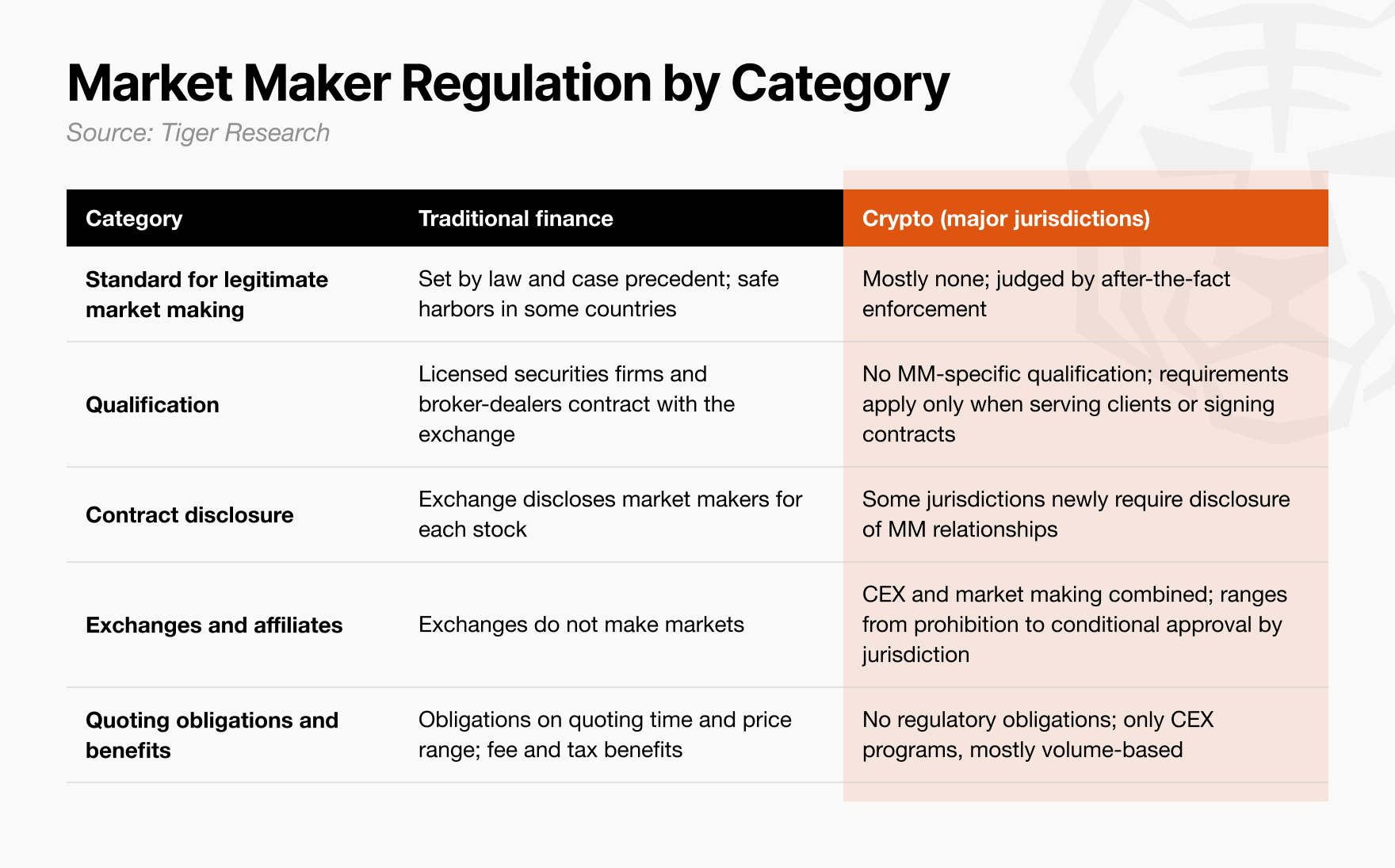
In traditional finance, market making is a formal role clearly defined by law. Financial institutions that pass a review sign a formal contract with the exchange and, in return for submitting quotes as agreed, receive fee discounts.
The exchange publicly discloses which firm makes markets in which stocks, and long-standing law and case precedent have set clear standards for what counts as “legitimate market making.”
The crypto market is in a very different position. Market makers do the same work, but there is effectively no framework under which a market maker signs a formal contract with a CEX and exchanges obligations for compensation.
The two markets differ in two decisive ways.
The first is the absence of rules on contracts. There is no set framework for what counts as legitimate market making, who can become a market maker under contract with a CEX, or what obligations it bears and what compensation it receives.
The second is structural risk specific to the crypto market. Distorted arrangements are common, such as CEXs taking on the market maker role themselves or market makers signing undisclosed contracts directly with token issuers. Given these conditions, major financial regulators have focused on immediate problems rather than building an entirely new framework, for example by barring CEXs from also operating market makers and requiring that undisclosed contracts be made public.
The Korean market faces the same problem. CEXs are strictly prohibited from acting as market makers themselves, yet there are still no standards or formal procedures for judging what counts as legitimate market making.
One point should not be misunderstood. The gap in the rules concerns the formal contracts that market makers sign with CEXs or securities firms, and these contracts are also where a license is required. Placing quotes and trading with one’s own capital is already a legal activity, regardless of licensing. The EU’s MiCA likewise does not require a license for market making on a CEX with one’s own capital and applies requirements only when services are provided to clients.
3.2. Who Signs the Contract: Exchanges vs. CEXs and Token Issuers
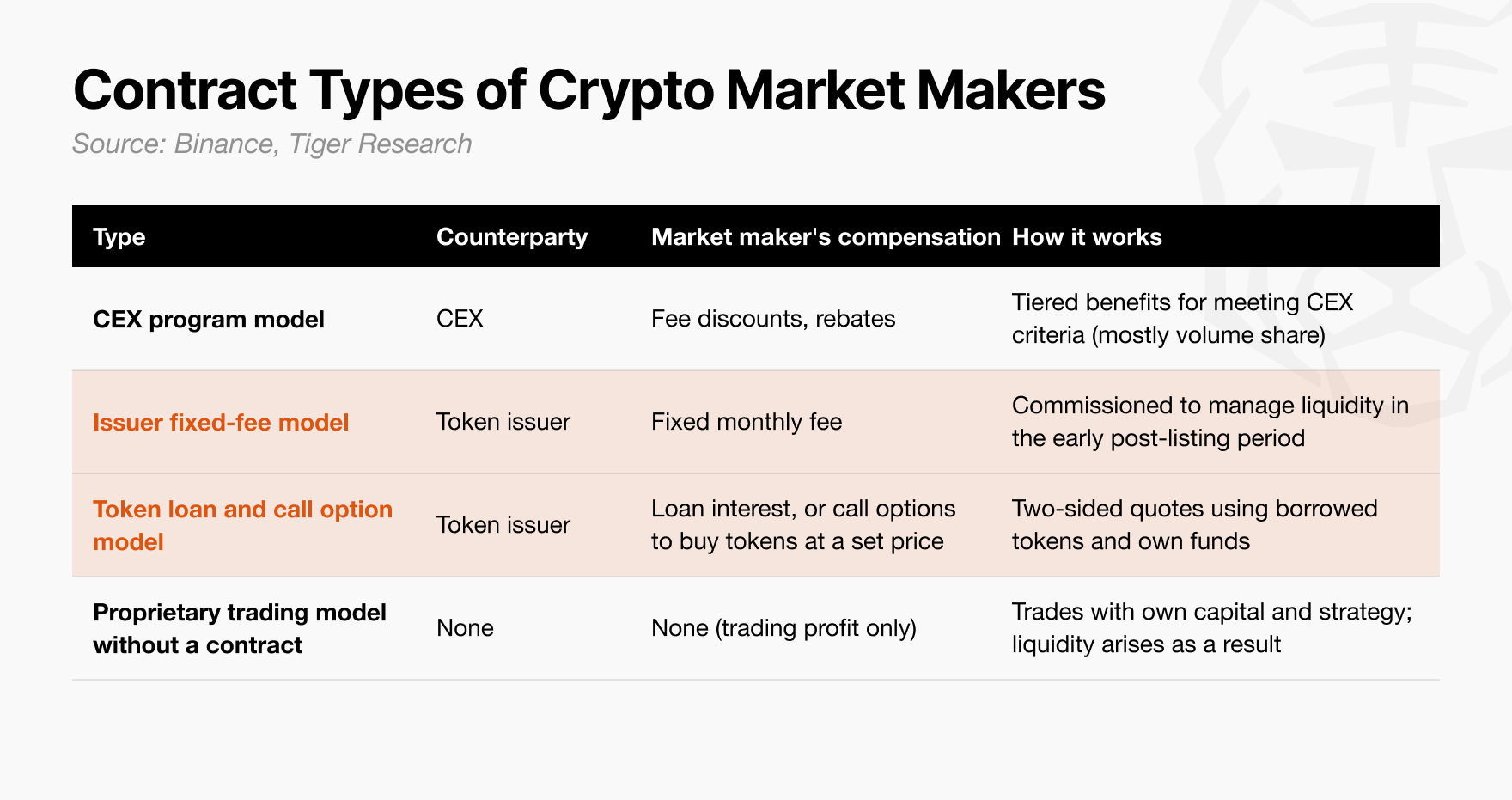
The most visible difference between crypto market making and traditional finance is that commissioned contracts with token issuers are widespread.
Among these, the “proprietary trading model without a contract” is different in nature. The market maker signs no contract with anyone and receives no compensation. It trades with its own capital according to its own strategy, and liquidity arises as a result.
This corresponds to the broad sense of liquidity provision described earlier and is an already legal activity with no point of contact with licensing. The token loan model is also essentially the same as proprietary trading if the market maker makes its own trading decisions and bears the price risk, and the issuer does not direct individual trades.
Problems arise among issuer contracts that measure performance by trading volume. According to industry participants, these contracts differ from CEX-led contracts in matters such as the source of funds and who bears the risk, and they cover a wide range of terms, from spread settings to strategies around listing and token unlock dates.
Contract structures that use volume generation as the main performance metric, however, carry a high risk of inducing wash trading and other fictitious trades, and the fact that their terms are never disclosed is seen as a major limitation.
3.3. Where Trading Happens: A Single Market vs. Fragmented Markets
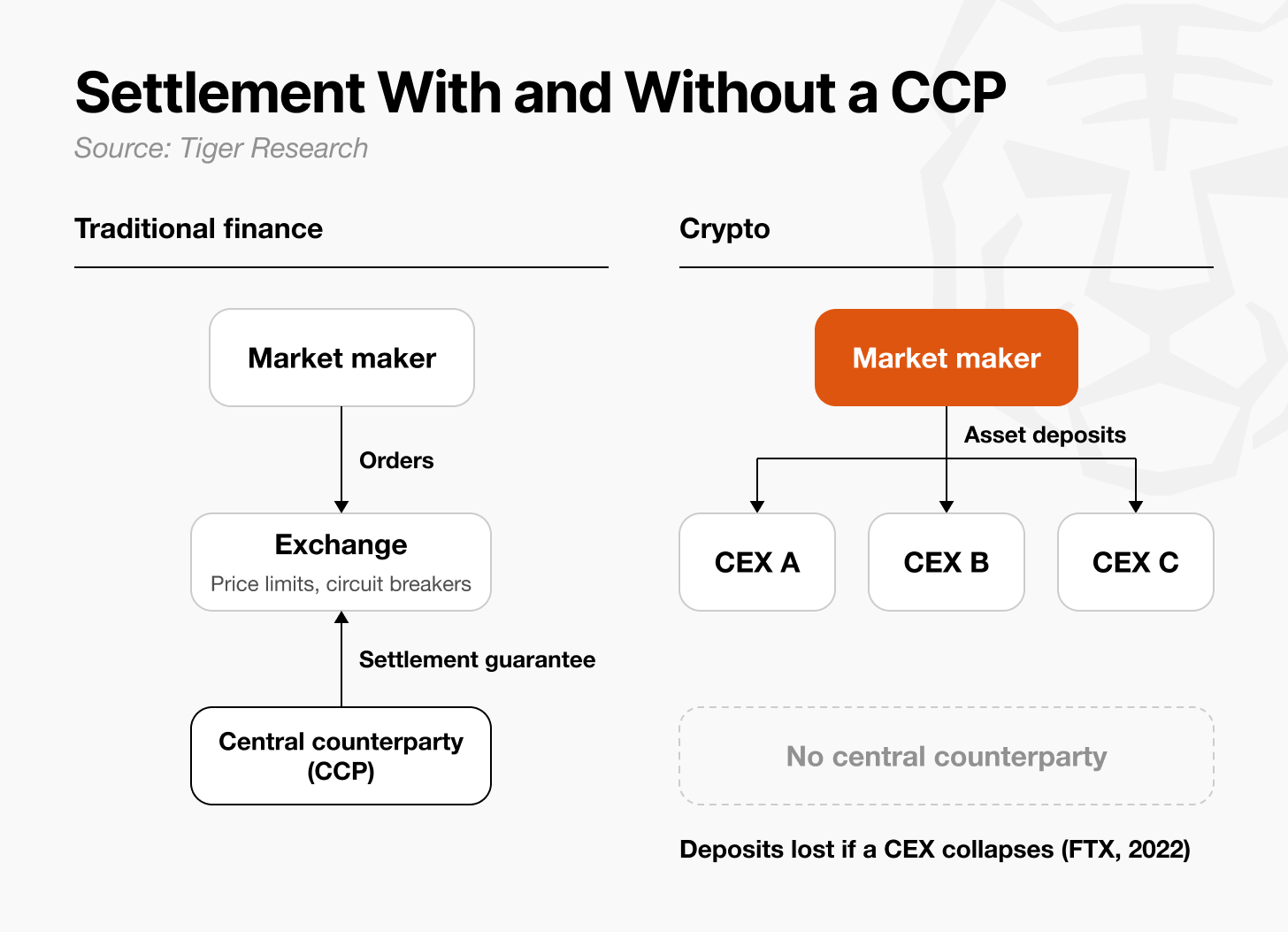
Stocks trade on one exchange during set hours, and the exchange and clearing house protect against sudden price moves and settlement risk. Crypto trades around the clock on CEXs around the world, and there are no mechanisms to provide that protection. Supplying liquidity across these fragmented markets is a source of risk for market makers.
First, the crypto market runs 24 hours a day, seven days a week, and is split across many CEXs worldwide, which frequently produces price imbalances. Market makers spread their assets across multiple CEXs to correct these imbalances, but when a network disruption such as a deposit or withdrawal suspension occurs, this function stops almost immediately.
Second, the tools available to hedge risk are very limited. Because there are no safeguards such as circuit breakers and high-leverage futures trading is widespread, market makers protect against price moves by taking futures positions that offset their spot holdings.
As the liquidation cascade of roughly $19 billion in a single day in October 2025 showed, when a CEX’s auto-deleveraging (ADL) system is triggered, even a market maker’s legitimate hedge positions can be forcibly closed. Having lost even this minimal protection, market makers pulled their quotes in haste, and the shock and disorder in the market grew sharply.
The most fundamental problem is a settlement structure without a central counterparty (CCP). Unlike the traditional financial system, in which trades and settlement are guaranteed, crypto market makers must deposit assets directly with each CEX in order to trade. As a result, when a CEX holding those deposits collapses, as FTX did in 2022, a market maker can lose its entire deposit with no recovery.
4. Five Limitations of the Market Maker Industry Today
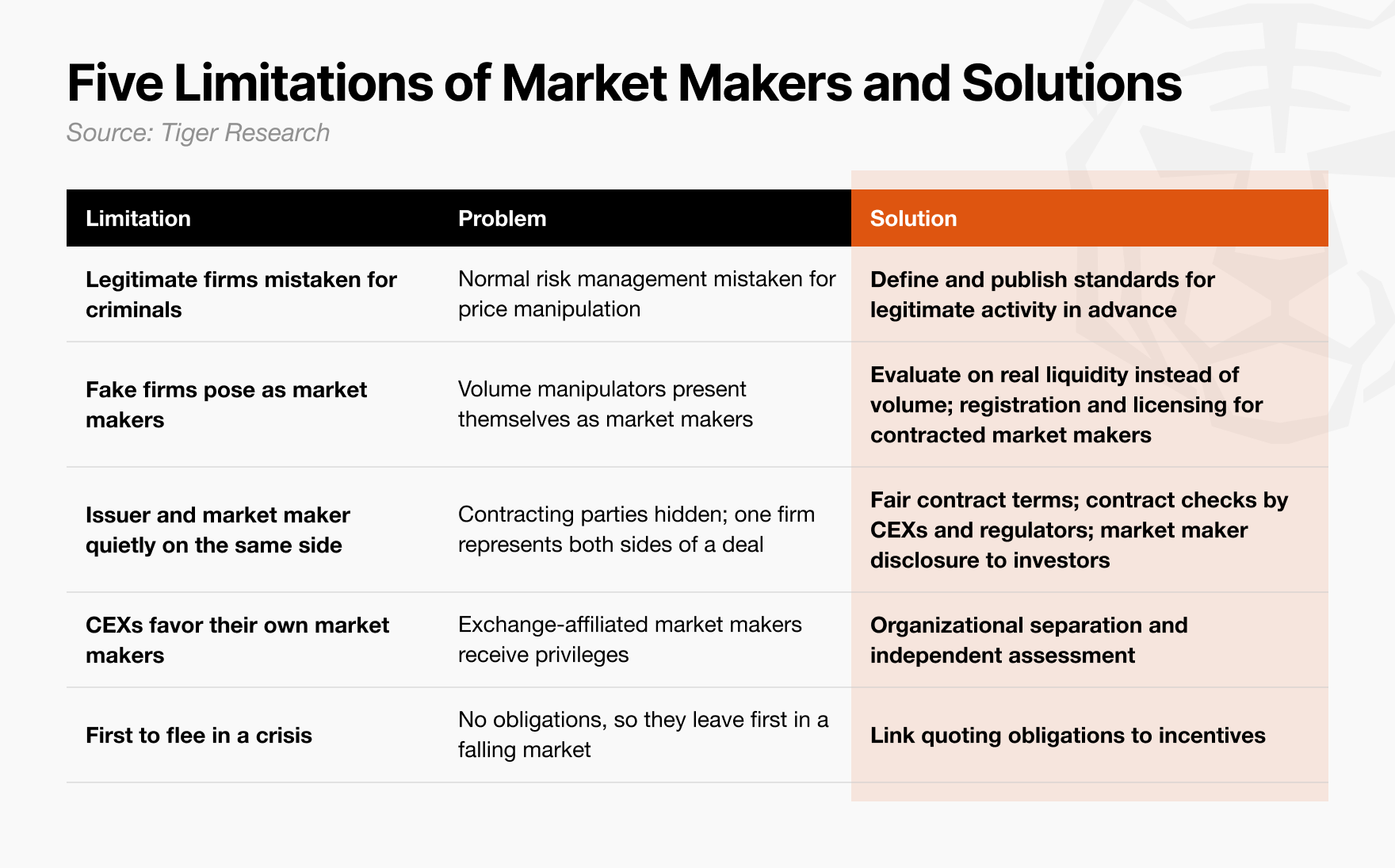
The market maker role is essential for smooth trading. Left unchecked, however, indiscriminate market making activity can seriously damage market stability. It is time to diagnose the structural problems of the crypto market accurately and find practical solutions.
The five limitations examined in the following sections are not flaws in the market making function itself. They arise because there are no clear standards or surveillance systems to distinguish legitimate liquidity provision from illegal price manipulation. Crypto market making today needs proper standards to be established in the market.
4.1. Normal Risk Management Is Mistaken for Manipulation
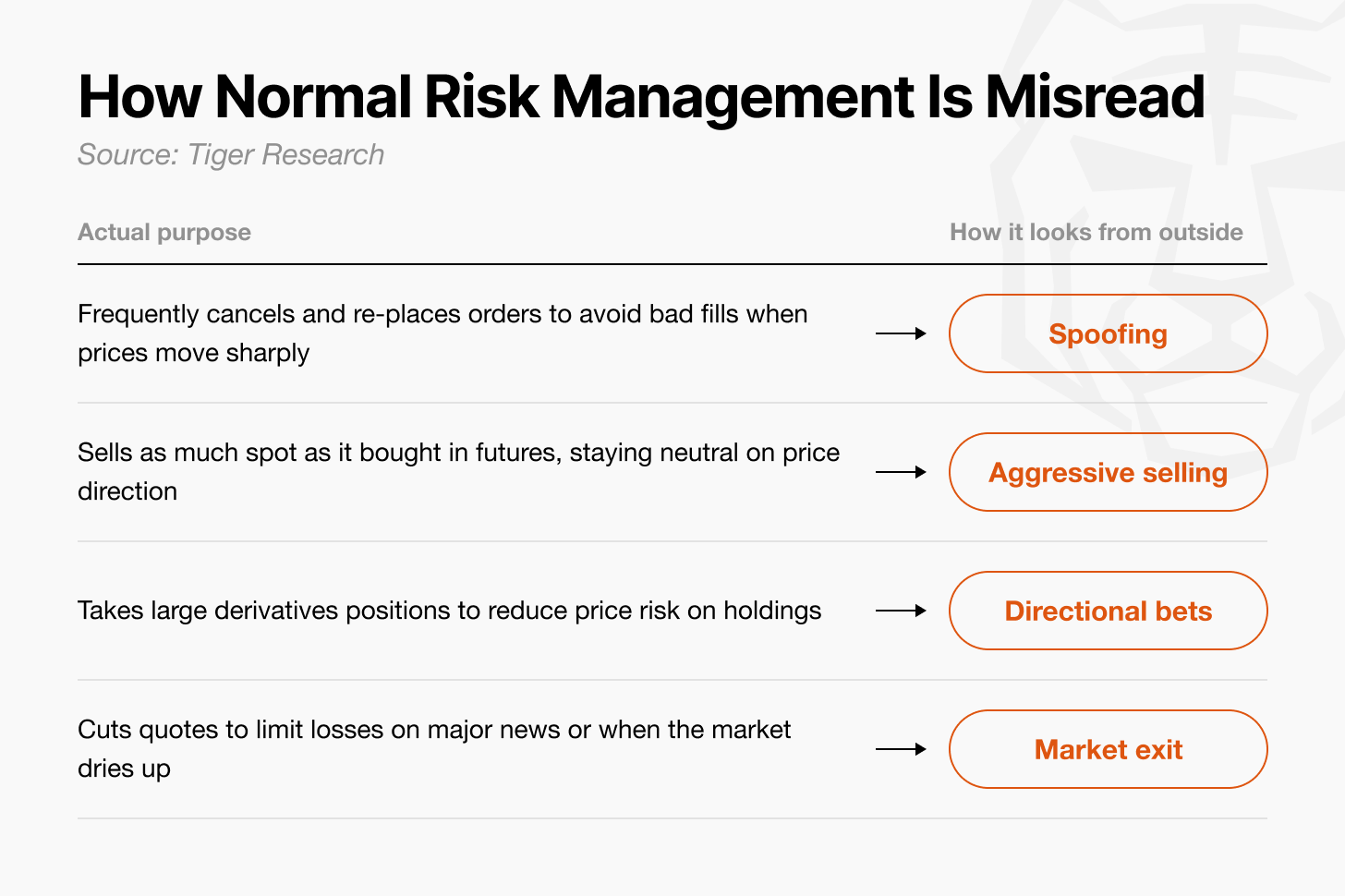
To outside observers, a market maker’s normal risk management can easily look like market disruption or price manipulation. Industry practitioners identified four risk management practices that are most often misunderstood.
Without a definition of what is normal, these misunderstandings occur even in markets with established regulation.
The Korean stock market is a representative case. In 2021, the Financial Supervisory Service judged frequent quote modifications and cancellations by market makers at nine securities firms to be market disruption and notified them of KRW 48.7 billion (about $35 million) in fines, and market making stopped immediately.
About a year later, in July 2022, Korea’s Securities and Futures Commission cleared the firms, finding that modifications and cancellations were unavoidable for meeting obligations and managing risk, that their modification and cancellation rates (95.68% to 99.55%) were similar to those on the New York Stock Exchange (about 94.6%), and that no standards had been set in advance. The activity was not illegal, but the market operated without market makers for a year until that conclusion was reached.
In the crypto market, the lack of clear standards means that the same trades are argued in court to be liquidity provision by one side and price manipulation by the other. Even legitimate market makers cannot predict whether their trades will be found unlawful, and some leave the market as a result.
The solution is to establish standards for legitimate activity in advance. The test should be whether there was an intention to trade, not simply how often orders were cancelled. This matches the approach the US took after the 2010 Flash Crash, when it banned only quotes at extreme prices. Practitioners also treat the following as the key criteria: compliance with contracts and risk management rules, an actual reduction in price risk, and whether the activity was based on two-sided quotes without a directional aim.
Was the activity carried out within a pre-agreed contract and internal risk management rules?
Did the activity actually reduce the market maker’s price risk?
Was it based on two-sided quotes, without the aim of pushing the price in one direction?
For example, if a market maker sells spot and buys the same quantity of futures during a sudden market move, it may look like aggressive selling from the outside, but it is a normal hedge that offsets the risk of the overall position.
Selling large amounts of spot without a hedge while spreading negative rumors, on the other hand, is difficult to describe as risk management. If regulators and CEXs publish these standards in advance, legitimate liquidity providers can operate without legal uncertainty, and illegal activity can be identified more clearly.
The problem created by the absence of standards does not end with legitimate firms falling under suspicion. It also makes it easier for firms that are not market makers to pose as market makers.
4.2. Volume Manipulators Operate Under the Market Maker Label
The previous section dealt with legitimate market makers falling under suspicion. The opposite problem also exists: firms that are not market makers presenting themselves as such. Many of the incidents the market remembers as “market maker misconduct” involved firms that borrowed the name to run an entirely different business.
Gotbit is a representative example. According to US prosecutors, from 2018 to 2024 Gotbit sold a service that inflated trading volume using software that repeatedly bought and sold between multiple accounts. The aim was to raise client tokens in crypto market cap rankings and get them listed on major CEXs. The founder pleaded guilty and was sentenced to eight months in prison, and the company forfeited about $23 million in crypto assets.
Practicing market makers noted that the business model of such firms was to create fake volume without taking on any price risk. In a market that looks only at volume, these firms can even appear to be performing well.
The standard for evaluating market makers therefore needs to shift from trading volume to whether trading is actually possible, because volume can be inflated at will through wash trading. Practicing market makers treat volume only as an outcome and instead look at the following:
How deep is the order book within 1% to 2% of the current price?
How far does the price move when a given amount is traded?
How much of the time are buy and sell quotes posted at the same time?
However large volume appears, if the order book is thin and small orders move the price sharply, there is no real liquidity. The deciding question is whether outside participants can execute the size they want at a fair price. When CEXs and token issuers select market makers on the basis of these measures, firms whose only purpose is illegal price manipulation will gradually be pushed out of the market.
Registration or licensing can be required of firms that sign contracts with CEXs or token issuers and sell services under the market maker name. Firms like Gotbit, which took money from issuers to sell a service, can be screened out from the start if requirements are placed at the contract stage. There is no need to bring participants trading with their own capital under licensing.
As noted in Section 3, the EU’s MiCA takes the same approach and requires a license only for services provided to clients, not for market making on a CEX with one’s own capital.
4.3. Hidden Contracting Parties and Conflicted Arrangements
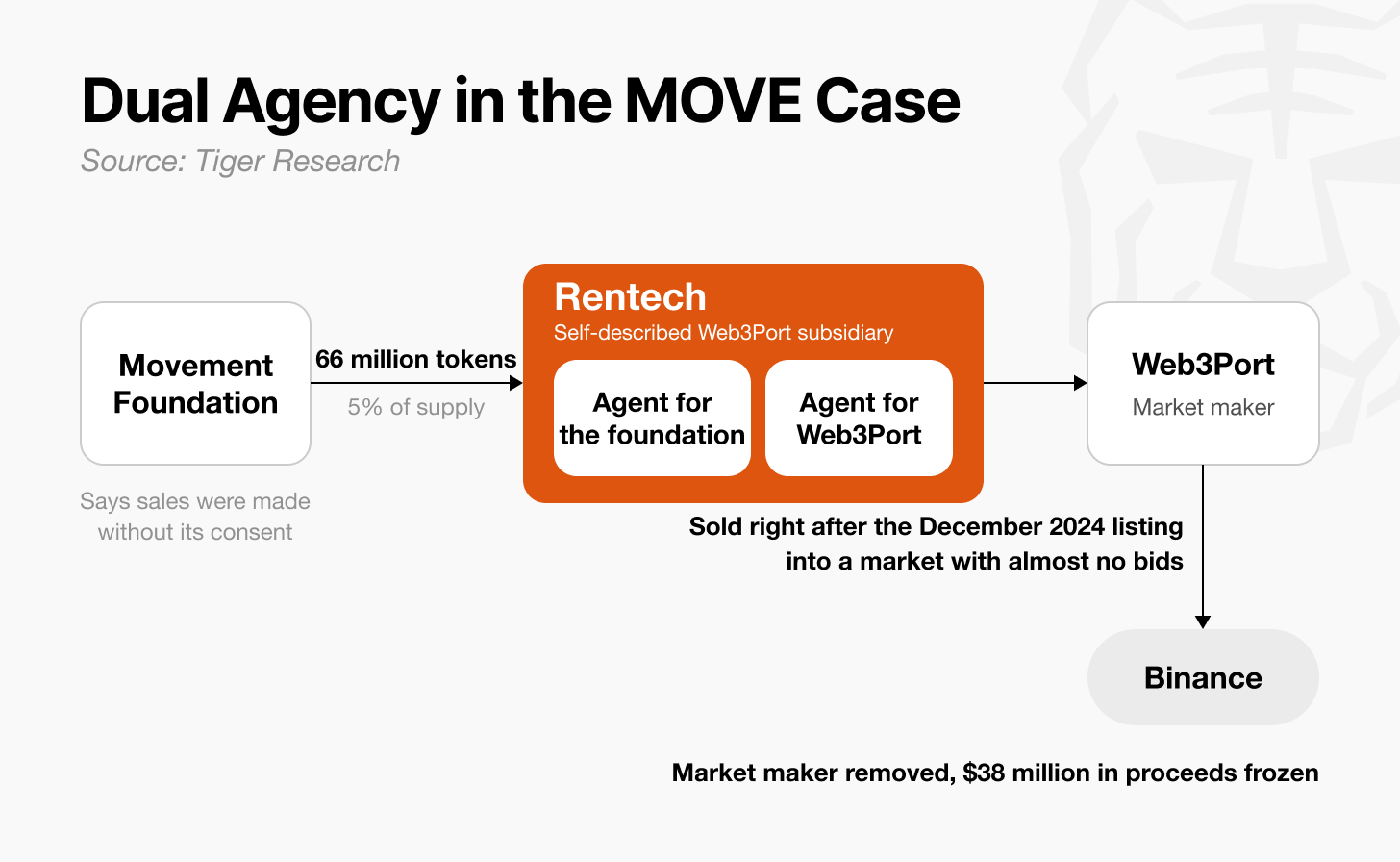
Even when a capable firm is selected, serious problems can arise if the structure of who contracted with whom is opaque. In the crypto market, the parties to contracts between token issuers and market makers are often not clearly disclosed. With the counterparties hidden, distorted arrangements can emerge, such as a single firm acting as agent for both sides of the same deal.
The MOVE case illustrates this. The Movement Foundation transferred 66 million tokens, 5% of supply, to Rentech, an intermediary that described itself as a subsidiary of Web3Port, and entrusted it with providing liquidity. It later emerged that Rentech appeared in the contract once as the foundation’s agent and once as Web3Port’s agent, meaning the same firm stood on both sides of the deal.
These tokens were sold into the market right after the December 2024 listing, when there were almost no buy orders. Binance removed the market maker and froze $38 million in proceeds, and Coinbase later suspended MOVE trading.
The foundation stated that the sales were made without its consent. The arrangement was called a liquidity provision contract, but what actually happened was not two-sided quoting but a one-sided disposal of the token issuer’s supply.
Legitimate market making therefore depends on fair contract terms and transparent contracting relationships.
On the substance of the terms, contracts of legitimate market makers rest on two firm principles: the market maker bears real price risk, and the token issuer does not intervene in the price.
Under a token loan arrangement, the market maker provides two-sided quotes using the borrowed tokens and its own funds. When the contract ends, it simply returns the same number of tokens and receives no instruction at any point to move the price in a particular direction. To ensure this, the contract must include the following:
A ban on wash trading
A ban on pushing the price in a particular direction
A cap on the spread between buy and sell prices
A minimum quote size
The same principles hold under a call option contract if the market maker sets its day-to-day quotes on its own and the token issuer only sets the option terms without directing individual trades.
The second requirement is making contracts visible. At a minimum, CEXs and regulators should be able to confirm which market makers are active, with what token amounts and on what terms, and whether any intermediary represents both sides at once.
This is the information Binance has required from issuers of listed tokens since March 2026. Going further, just as stock exchanges disclose the market maker for each stock, investors should also be able to see which market makers are active in a token.
4.4. Exchange and Market Maker Under One Roof
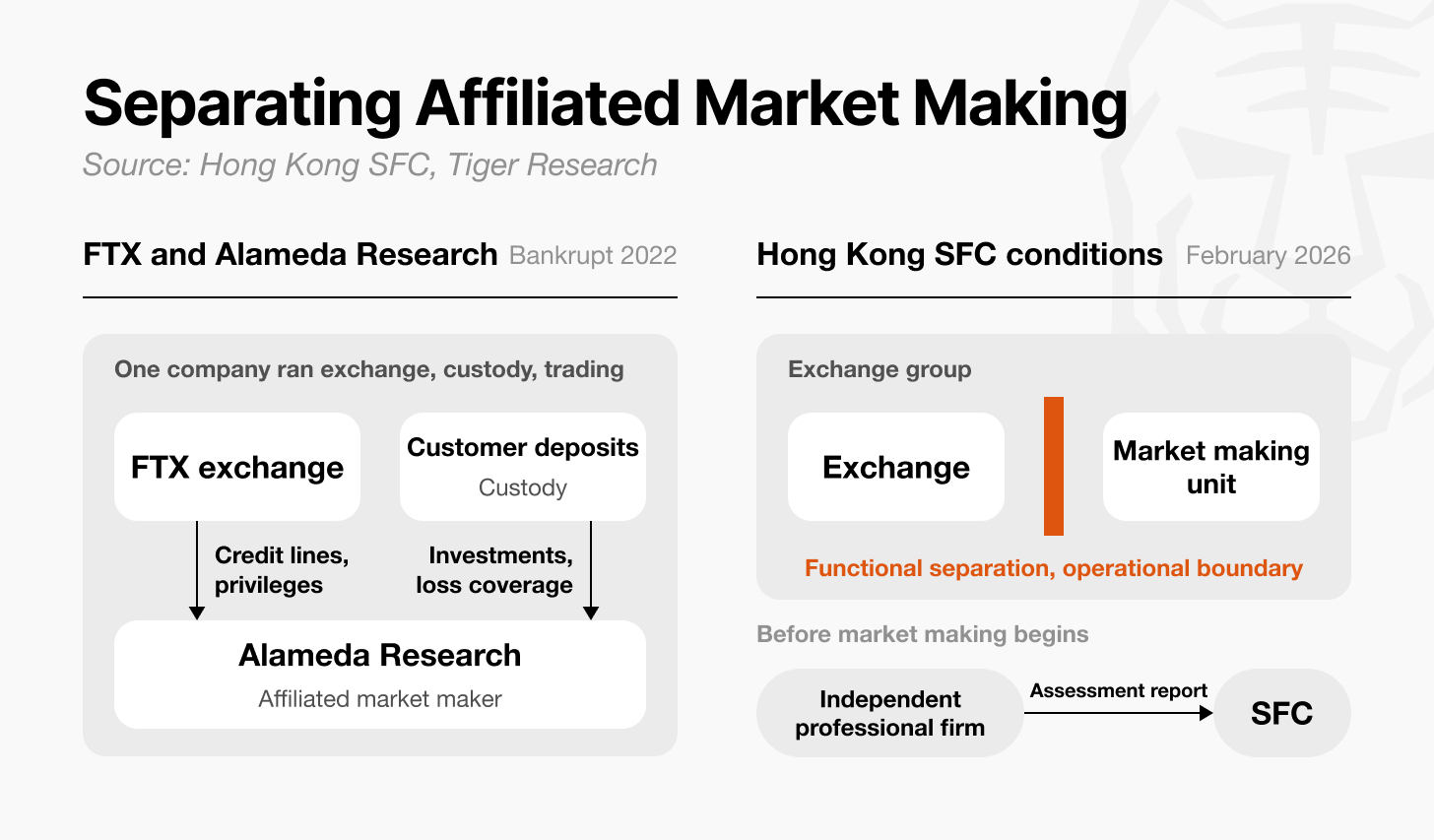
When a market maker is an affiliate of a CEX, the conflict of interest grows. When one company runs a CEX, custody, and proprietary trading together, the affiliated market maker can easily receive privileges that other users do not have.
FTX and Alameda Research are a representative case. Alameda acted as a major market maker on FTX and received credit lines and privileges unavailable to other users. US authorities found that FTX customer deposits flowed to Alameda and were used for investments and to cover losses. Both companies went bankrupt in 2022.
The problem was not the market maker status itself but the fact that the credit and discretion attached to that status were used without any oversight to misappropriate customer assets.
The solution, then, is not to ban affiliated market makers outright but to separate and monitor them. After the International Organization of Securities Commissions (IOSCO) named this conflict of interest a key issue in its 2023 recommendations, Hong Kong turned it into regulation. In February 2026, Hong Kong’s Securities and Futures Commission (SFC) allowed market making by CEX affiliates on three conditions:
The market making unit must be functionally separated from the CEX.
There must be clear operational boundaries between the two.
Before market making begins, an assessment report from an independent professional firm must be submitted to the regulator.
This approach draws a clear line and monitors it so that preferential treatment and information sharing do not occur. If Korean CEXs come to conduct market making through affiliates or related companies, the same principles should apply from the outset.
4.5. Market Makers Without Obligations Leave First in a Crisis
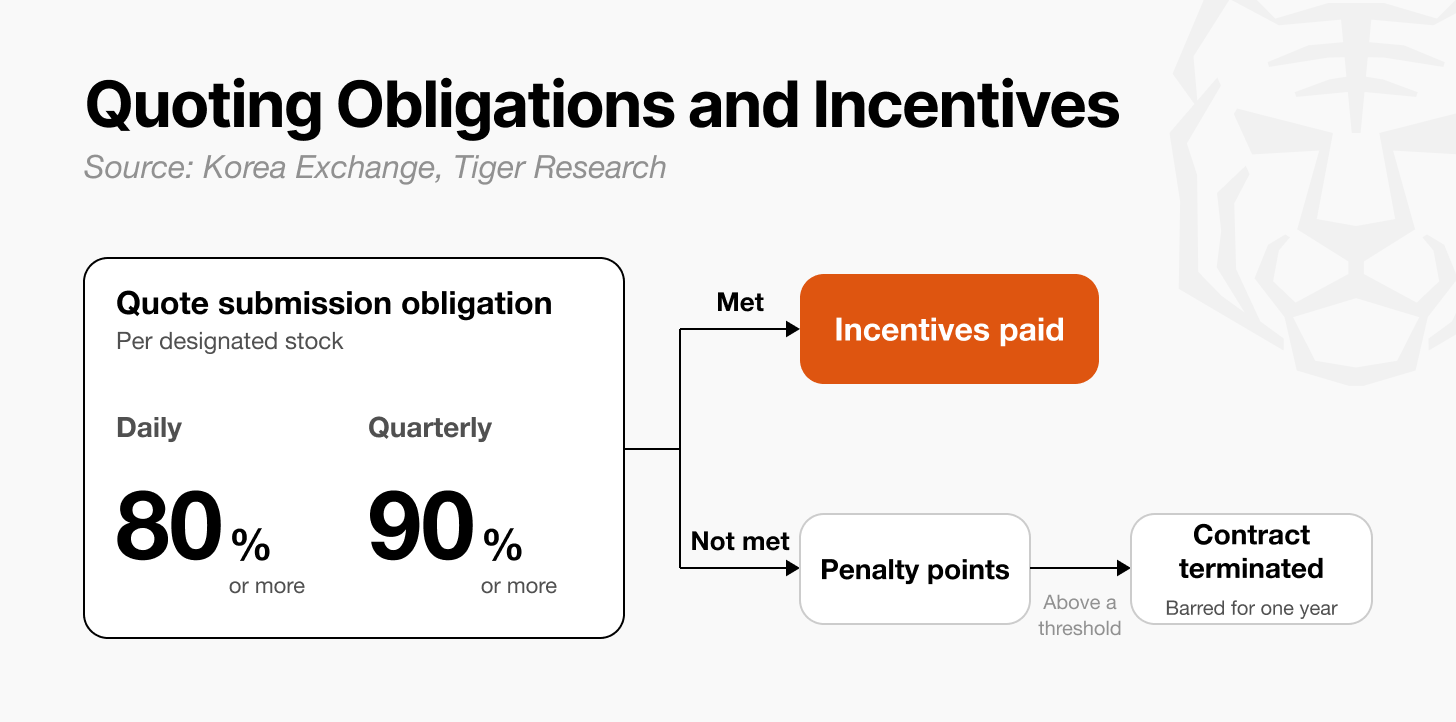
Where the first four cases are limitations seen under normal conditions, the last is a problem that appears when the market falls sharply.
Most crypto market makers have no binding obligations they must meet in a falling market. When losses mount, withdrawing quotes is the rational response, and the resulting gaps in the order book cause the market to collapse rapidly.
The October 10, 2025 event discussed earlier is a representative case. As many crypto assets fell 40% to 70%, industry practitioners assessed the withdrawal of market maker quotes as a decisive factor.
Preventing withdrawal in a crisis requires clear performance obligations together with an appropriate incentive structure. Participants bound by enforceable rules did in fact behave very differently in a crisis.
According to interviews with practitioners, when one crypto asset fell sharply on negative macroeconomic news, its market maker temporarily widened the spread but kept its quotes on the book, preventing trading from breaking down. This difference came from contractual obligations and risk management guidelines.
The traditional stock market has put these mechanisms into regulation. The Korea Exchange (KRX) requires market makers to submit quotes for at least 80% of each day and 90% of each quarter for each designated stock, and pays incentives only to firms that meet these obligations. Firms that fall short receive penalty points, and above a certain level their commissioned contract is terminated and they are disqualified for one year.
A measure of whether obligations were met is also needed. Practicing market makers judge recovery after a market shock not by a price rebound but by whether trading has resumed functioning normally:
Does the widened spread between buy and sell prices narrow again?
Is the quote volume that was withdrawn being replenished?
Are price differences between CEXs converging?
How long does it take to return to normal?
If these measures are used as the standard for obligations and compensated accordingly, market makers will have more reason to stay in a crisis than to leave.
5. From Enforcement to Oversight
Distrust of market makers in Korea is not without basis. As Section 4 showed, however, tracing that basis reveals that the problem was not the market making function itself. It was a structure in which anyone could claim to be a market maker and no one had defined what normal activity looks like.
Korean law still leaves this structure in place, though it is important to identify precisely where the gap lies. Placing quotes while trading with one’s own capital is legal today, and the same applies to operating with borrowed tokens. Like any other trading, this activity is punishable if it amounts to price manipulation, but it is not a problem simply because it is proprietary trading. The gray zone lies outside it, in the contracts.
There is no channel for formal contracts with CEXs. The current Virtual Asset User Protection Act prohibits price manipulation without providing an exception for market making. If a CEX signs a contract with a market maker that includes quoting obligations, trades made under that contract risk being treated as price manipulation.
There is no license or registration system for contracted market makers.
It is difficult for corporations to open accounts and trade on Korean KRW CEXs.
What sits outside the regulatory framework in Korea, then, is not liquidity provision itself but a channel for commissioning and overseeing it through formal contracts. Contracted market makers have no route to supervision within the framework, and only after-the-fact enforcement remains.
Major jurisdictions are already moving in this direction, raising rules on unfair trading to the level of traditional finance and creating a framework within which market participants can operate.
EU: Price manipulation of crypto assets has been prohibited since December 30, 2024, when MiCA took full effect. Market making on a CEX with one’s own capital is not subject to licensing; licenses attach to the point where services are provided to clients. Large market makers such as Keyrock and Flowdesk obtained licenses in June 2026 in order to serve clients.
Hong Kong: Judging that liquidity on CEXs was insufficient, the SFC allowed market making by CEX affiliates in February 2026, on the condition that the market making unit be separated from the CEX.
Japan: In July 2026, Japan passed amendments bringing crypto assets under the Financial Instruments and Exchange Act and added a new ban on insider trading.
Although these jurisdictions started from different points, they are clearly heading toward the same goal: regulating unfair price manipulation as strictly as in traditional finance while formally recognizing legitimate liquidity providers within the regulatory framework.
The task for the Korean market is to find the same balance. Neither blanket distrust of market makers nor uncritical defense of them is a sound answer. The regulatory changes needed to address the structural limitations described above can be summarized as follows.
Put the standard for distinguishing normal activity from misconduct into law. The starting point can be the standards the industry already uses: whether the market maker bears price risk itself, whether there is no aim of pushing the price in one direction, and whether outside investors were actually able to buy and sell. Standards set in advance prevent normal risk management from being mistaken for price manipulation.
Define qualifications for market makers that sign contracts. Registration and licensing requirements should apply where a market maker signs a contract with a CEX or issuer and takes on obligations. Volume manipulators operating under the market maker label would then be screened out at the contract stage, while broad liquidity provision with one’s own capital would remain open as it is today.
Make contracts visible. At a minimum, CEXs and regulators should be able to see which market makers are active, with what token amounts and on what terms. Investors should also be able to see which market makers are active.
Prevent conflicts of interest. If market making is carried out within the same group as a CEX, the organizations should be separated and subject to external assessment, as in Hong Kong.
Pair obligations with compensation. Imposing quote maintenance obligations with matching compensation, as in the KRX market maker program, gives market makers a reason to stay in the market during a crisis.
Now is the right time to put this legal and regulatory framework in place.
The Digital Asset Basic Act bill introduced in June 2025 includes a provision excluding market making commissioned by a CEX from the definition of price manipulation.
In September 2026, the director-general in charge at the Financial Services Commission (FSC) said publicly that the FSC would review the need to introduce a market making framework.
At the parliamentary audit in October, the FSC chairman said the bill’s content had already been prepared and was in final consultations. The government aims to enact it within the year.
The remaining question is no longer whether to allow market makers but on what standards to allow them. One point should not be missed here. The bill made public so far follows the stock market model, centered on market making commissioned by a CEX. Many of the problems discussed above, however, came from contracts with token issuers rather than with CEXs. If the bill does not address how token issuer contracts are treated, the largest blind spot outside the framework will remain.
Opening the market to corporations is also tied to this legislation. In February 2025, the FSC announced that it would allow about 3,500 listed companies and professional investors to trade crypto assets on a pilot basis. It has not yet finalized the guidelines, however, and is considering timing the announcement in connection with the Digital Asset Basic Act.
If market makers are not brought within the rules now, while the rules for a market that corporate funds will enter are being set, liquidity provision will remain outside the framework even after the market opens.
For the Korean crypto market to take in institutional capital properly, the view of market makers needs to change first. Enforcement alone cannot keep legitimate market makers in the market, nor can it screen out firms that merely borrow the name. The Digital Asset Basic Act is the first opportunity to move market makers from being a target of enforcement to being a subject of oversight.
🐯 More from Tiger Research
Read more reports related to this research.Disclaimer
This report has been prepared based on materials believed to be reliable. However, we do not expressly or impliedly warrant the accuracy, completeness, and suitability of the information. We disclaim any liability for any losses arising from the use of this report or its contents. The conclusions and recommendations in this report are based on information available at the time of preparation and are subject to change without notice. All projects, estimates, forecasts, objectives, opinions, and views expressed in this report are subject to change without notice and may differ from or be contrary to the opinions of others or other organizations.
This document is for informational purposes only and should not be considered legal, business, investment, or tax advice. Any references to securities or digital assets are for illustrative purposes only and do not constitute an investment recommendation or an offer to provide investment advisory services. This material is not directed at investors or potential investors.
Terms of Usage
Tiger Research allows the fair use of its reports. ‘Fair use’ is a principle that broadly permits the use of specific content for public interest purposes, as long as it doesn’t harm the commercial value of the material. If the use aligns with the purpose of fair use, the reports can be utilized without prior permission. However, when citing Tiger Research’s reports, it is mandatory to 1) clearly state ‘Tiger Research’ as the source, 2) include the Tiger Research logo. If the material is to be restructured and published, separate negotiations are required. Unauthorized use of the reports may result in legal action.


