

Key Takeaways
The bill would define four types of digital asset businesses and set rules for KRW stablecoins, domestic initial coin offerings (ICOs), and centralized exchanges (CEXs), with details left to enforcement decree.
CEXs: Listing reports would become a legal obligation with liability for material misstatements, so CEXs are likely to scrutinize overseas projects more closely. A 20% ownership cap (34% with approval) would apply, with a three-year grace period (up to six years for small and mid-sized CEXs).
Domestic financial institutions: Only bank-majority consortiums could issue KRW stablecoins at first, while a fintech could still be the largest individual shareholder. If the Banking Act's 15% cap applies, at least four banks would need to join, so fintechs should keep structures open and compete on distribution and use cases. Custody, brokerage, and asset management also open up.
Overseas stablecoin issuers: Issuers licensed in their home jurisdiction would register a Korean branch with the Financial Services Commission (FSC), or file foreign tokens with the FSC. Filing requirements are still to be set, so issuers should check which route applies.
Web3 foundations: Domestic ICOs would be allowed, but offshore hubs' tax benefits make a move back to Korea unlikely. Foundations seeking a Korean listing will need to give CEXs information faster and may need disclosure staff or a local representative in Korea.
Putting Korea's Digital Asset Market Rules into Law
About two years after the Virtual Asset User Protection Act (Phase 1) took effect in July 2024, the government has released its draft of the Digital Asset Basic Act (Phase 2), which is likely to mark an important turning point for Korea's crypto ecosystem. Many have expressed disappointment with the draft.
Even so, the bill would put previously unwritten market rules into law and set out which activities firms may conduct and what they must do to obtain licenses, disclose information, and distribute digital assets.
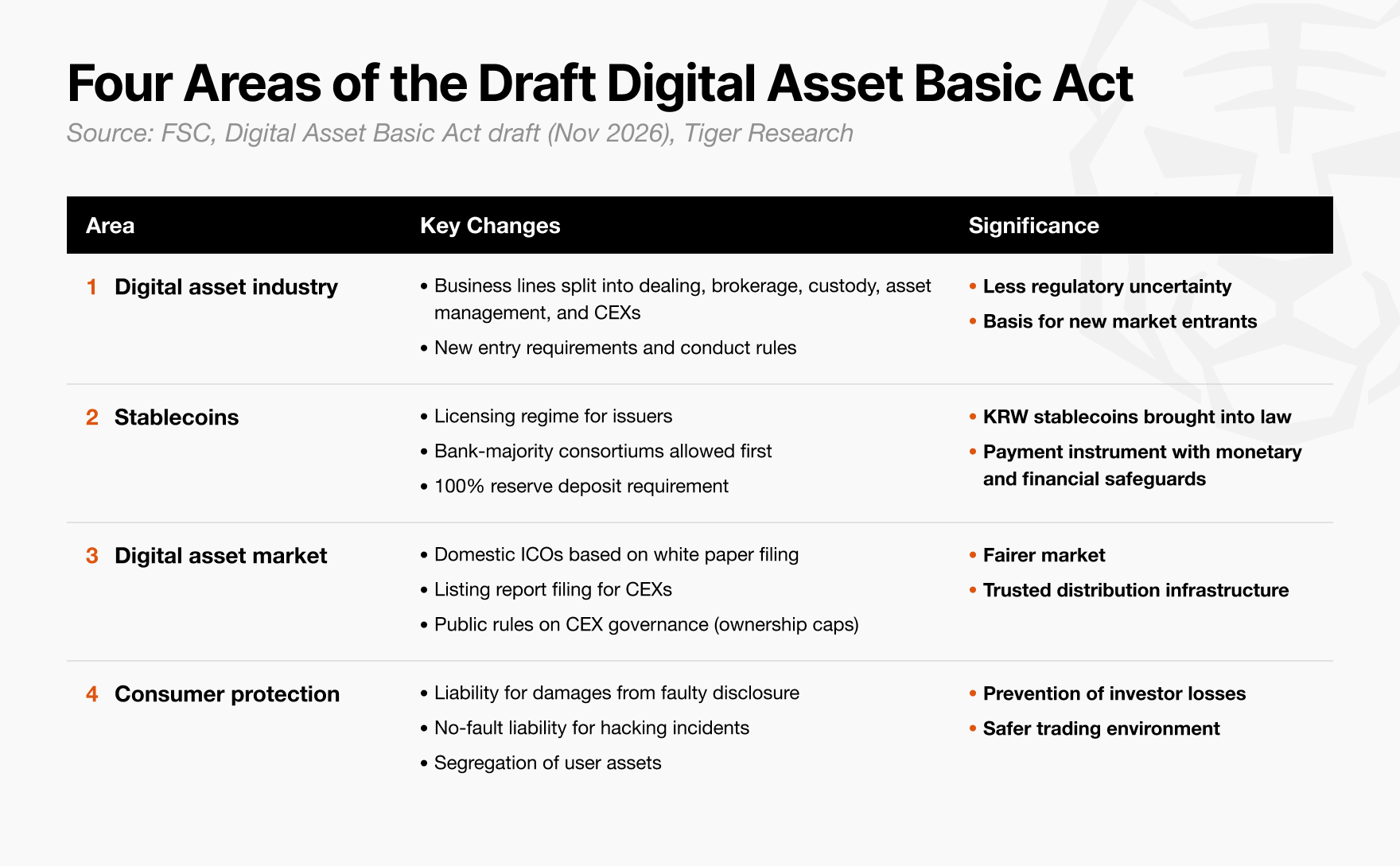
All four key market groups will therefore need to substantially revise their strategies: 1) CEXs, 2) domestic financial institutions and fintech companies, 3) overseas stablecoin issuers, and 4) Web3 foundations.
Rather than interpreting each provision, this report looks at what exchanges, Korean financial institutions and fintechs, overseas stablecoin issuers, and Web3 foundations need to prepare for.
1. CEXs: Listing Rules Become Law and Ownership Is Capped
Because CEXs would have to submit listing reports to the FSC, publish them, and bear liability for their content, they are likely to become more cautious about listing overseas projects. Shareholdings would be capped at 20% (34% with FSC approval), with a three-year grace period after designation (up to six years for small and mid-sized CEXs).
The bill would change how CEXs list assets and who can own them. Of the two, the listing rules would have the more direct impact on day-to-day operations and on how projects reach the market.
Changes to ownership and governance, by contrast, come with a grace period of three years from designation (up to six years for small and mid-sized CEXs), which allows CEXs to adjust in stages.
1.1. Mandatory Disclosure of Listing Reports
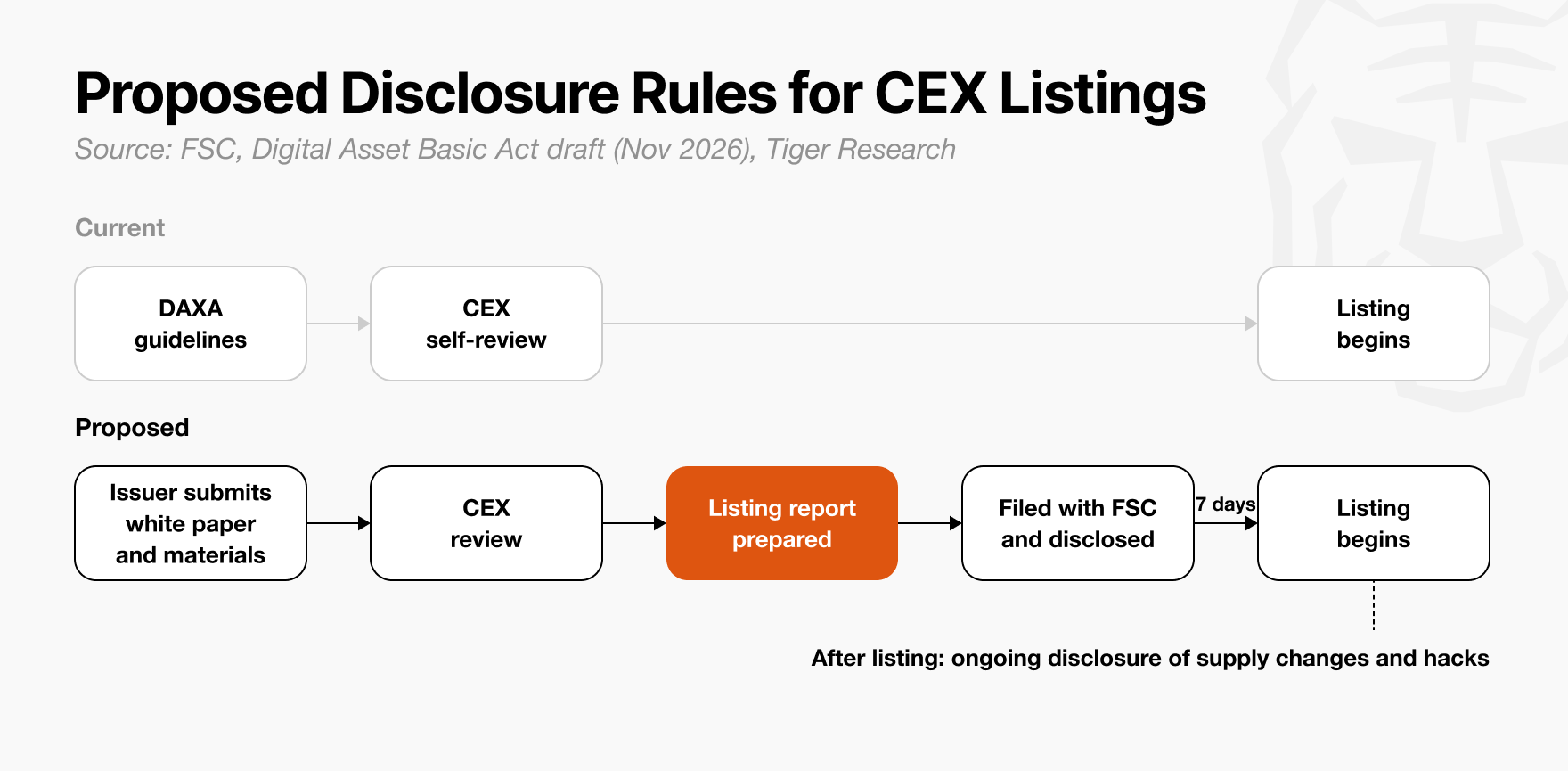
Until now, project listings on Korean CEXs have followed the guidelines of DAXA (Digital Asset eXchange Alliance) and each CEX's own review. Under the bill, CEXs would have to prepare a listing report, which the draft calls a "trading support report," based on their review of the project and the underlying materials submitted to them.
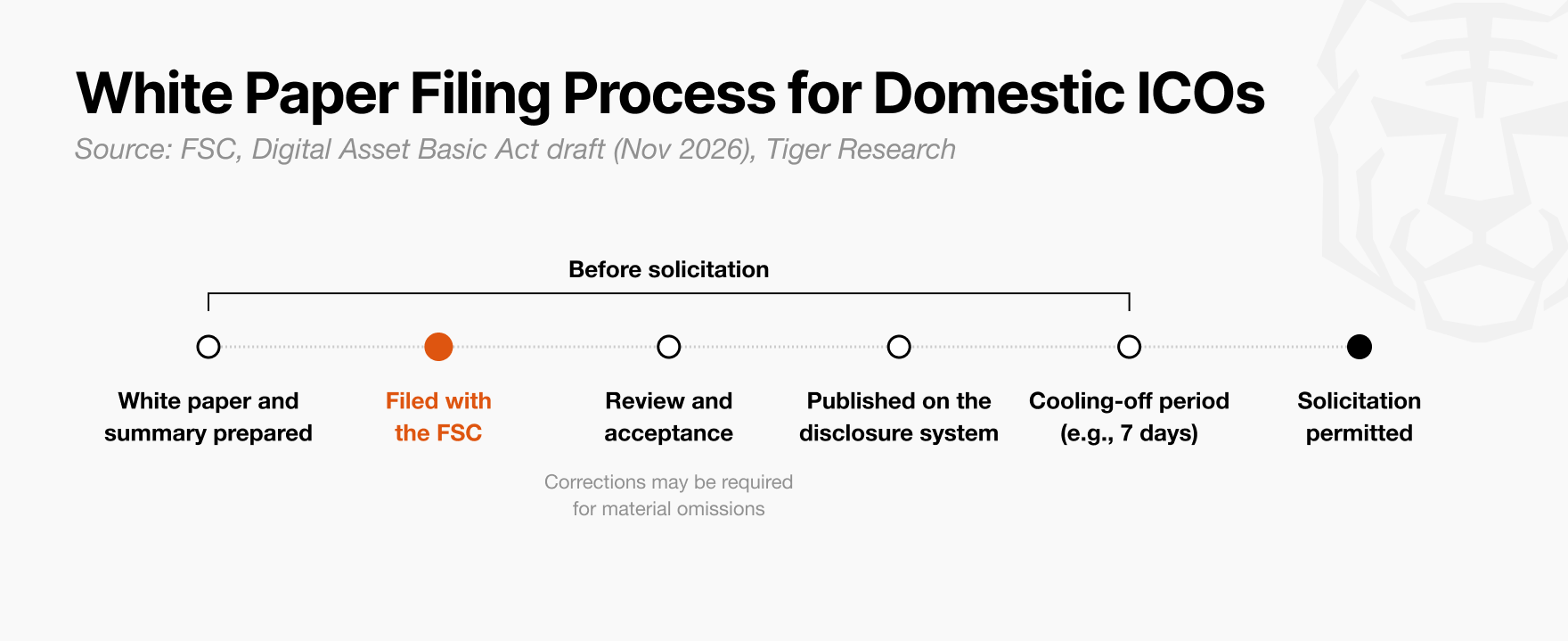
The listing report would have to be submitted to the FSC and published on the (tentatively named) Integrated Digital Asset Disclosure System before listing, for example, seven days in advance. The obligation would apply not only to new listings but also to assets already trading.
The report would state the issuer, issuance volume, project, and risks. If it contained a false statement or omitted a material fact, the parties subject to the disclosure obligation, including executives, could be held liable for damages. In effect, CEXs write these reports to compensate for the difficulty of project due diligence, and the reports would now carry legal liability.
However, most major blockchain projects are based overseas, so Korean CEXs face practical limits in fully verifying the information and due diligence materials that overseas foundations provide.
If CEXs face stricter verification and disclosure requirements, they are likely to be more selective about listing overseas projects, apart from a few large projects with established credibility.
This liability structure may also lead CEXs to add external verification to listing reviews. Listings in traditional finance go through external audits and reviews, and since CEXs would now write reports that carry legal liability, they may add external audits or reviews of their own.
A false statement or omission of a material fact in a white paper would also carry liability, so both CEXs and projects are likely to treat white papers with greater rigor.
CEXs should therefore prioritize preparing listing reports not only for new listings but also for assets already trading. They should also build a due diligence process that includes external audits or reviews in advance.
1.2. CEX Designation and the 20% Ownership Cap
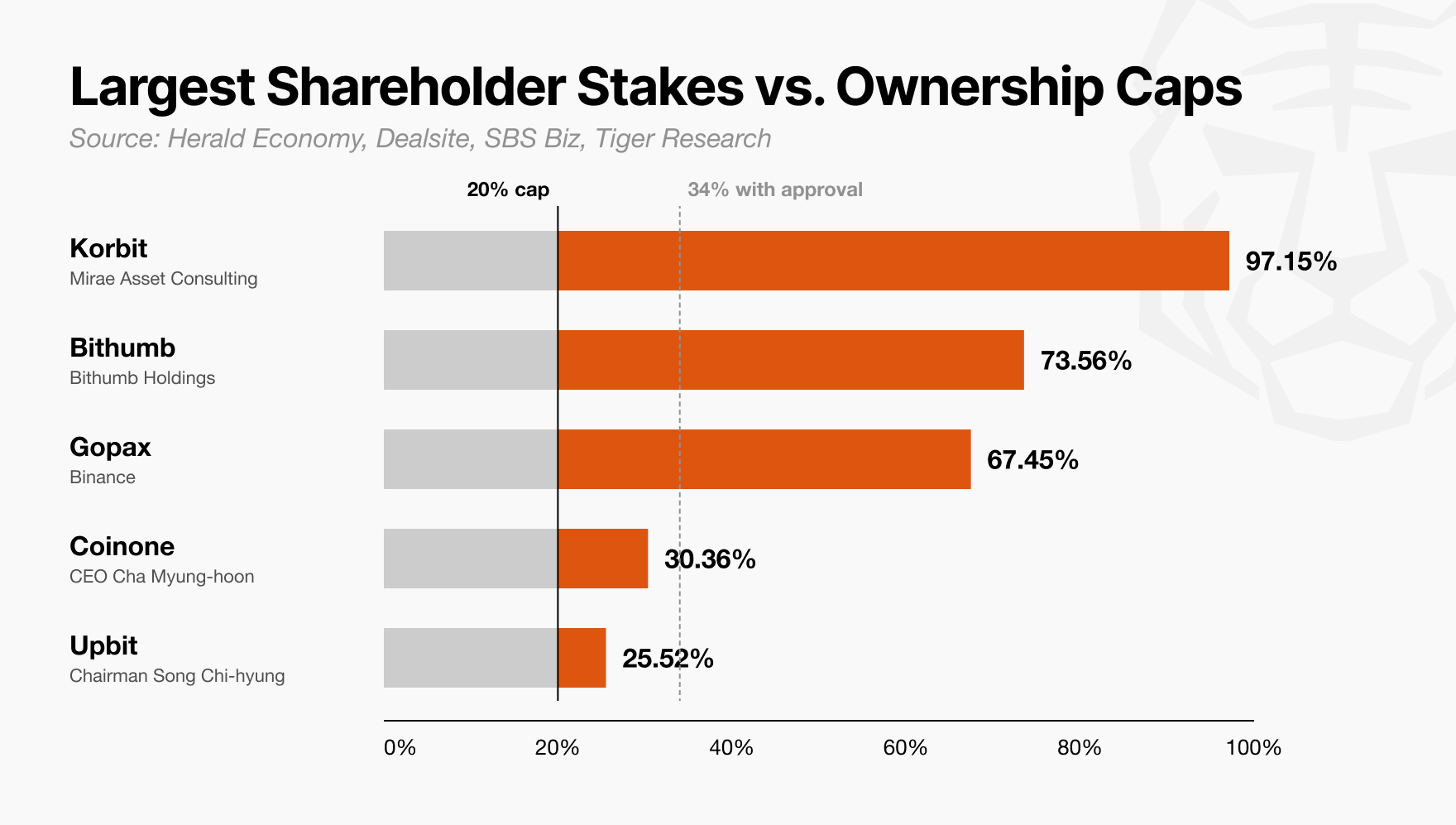
CEXs began as private businesses but have grown to the point where the government regards them as public infrastructure. To secure their public character and neutrality, the government proposed a shareholding cap modeled on the rules for alternative trading systems (ATS) in traditional finance. CEXs have so far faced no shareholding limits.
To become a CEX, a business would need licenses for all three of dealing, brokerage, and custody. It would then need to obtain FSC designation by demonstrating sufficient equity capital and the ability to operate a trading venue.
Shareholdings in a designated CEX would be capped at 20%. The enforcement decree is expected to allow financial companies and certain other entities to hold up to 34% with FSC approval. Shares above the cap would carry no voting rights.
Both existing and new CEXs would receive a three-year grace period after designation, and CEXs classified as small or mid-sized by market share could receive an additional three years. The burden of restructuring ownership all at once is therefore limited. However, until the method for calculating the cap and the scope of eligible financial companies are set, CEXs will find it hard to calculate how much adjustment they need.
CEXs whose largest shareholder holds more than 20% should therefore plan how to sell excess stakes and attract new investors within the grace period of three years from designation (up to six years for small and mid-sized CEXs). The calculation method and the financial companies eligible for approval will be set by enforcement decree, so CEXs will need to adjust these plans once the decree is finalized.
2. Domestic Financial Institutions: New Business Lines Beyond Stablecoins
The bill's impact on domestic financial institutions extends beyond stablecoin issuance. It would divide the digital asset business into four lines (dealing, brokerage, custody, and asset management), each requiring a license or registration. Separately from joining a stablecoin consortium, financial institutions will need to decide which business lines to enter and how.
The press release does not say whether financial companies may operate these businesses directly or alongside their existing businesses. This needs to be confirmed in the bill text and the enforcement decree.
2.1. Stablecoins: Bank-Led Consortiums and the Opening for Fintech
Debate over KRW stablecoin issuance has long centered on whether commercial banks or non-bank IT companies such as fintechs should take the lead. Major financial firms and related companies formed voluntary consortiums even before the bill was released. The draft gives banks a majority stake to address stability concerns while allowing a fintech or technology firm to become the largest individual shareholder.
Issuers would need equity capital of at least KRW 5 billion (about $3.4 million) and an FSC license. Initially, only consortiums in which banks collectively hold a majority stake would be allowed to issue, and a fintech or technology company could become the largest individual shareholder within such a consortium. The draft does not specify a separate ownership cap for technology companies.
The FSC's example has four banks at 15% each for a combined 60%, a fintech company at 30%, and others at 10%. As that example shows, a fintech company can be the largest individual shareholder, but only within a consortium in which banks collectively hold a majority.
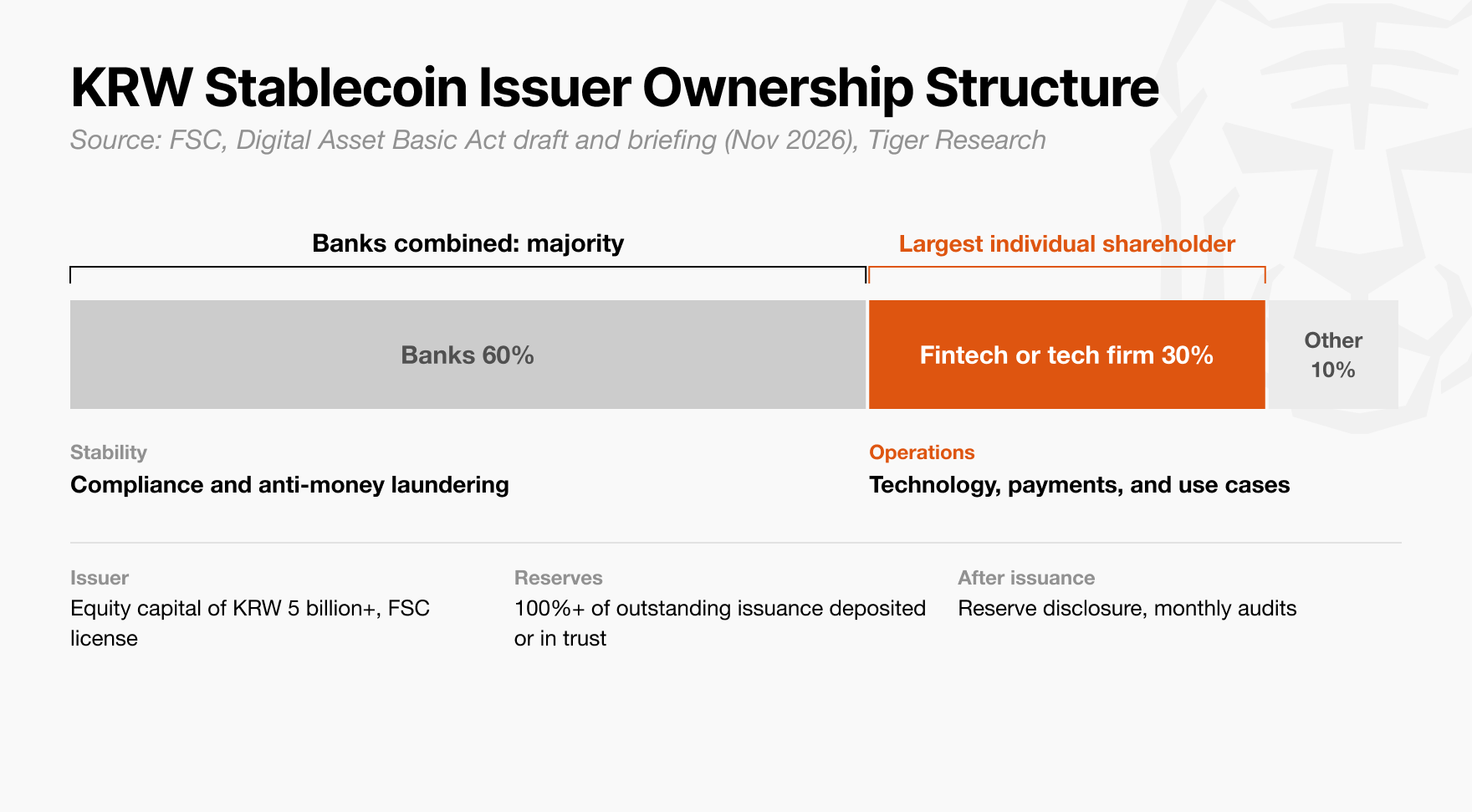
The Banking Act's 15% shareholding cap is a key variable here. Under the current Banking Act, a bank may not own more than 15% of a non-financial company. If this rule applies as is, at least four banks would need to join a consortium for banks to hold a combined majority.
The draft, however, does not specify how this cap would apply to consortium structures. Financial authorities are reportedly considering amending supervisory regulations to add stablecoin issuance to the businesses that bank subsidiaries may conduct. If the existing 15% cap is applied strictly without change, multiple banks would have to participate at once, which would significantly constrain how consortiums can be formed.
Building a workable consortium with banks will therefore be central to any KRW stablecoin business. Shareholder requirements and the application of the Banking Act's 15% cap will be set in the enforcement decree.
Fintech and technology companies should therefore discuss several possible ownership structures with banks, including one in which banks collectively hold a majority and a technology company is the largest individual shareholder, so they can respond quickly once the decree is finalized.
Competition between fintech companies and banks for influence over these consortiums is likely to intensify. Fintechs can gain influence by securing distribution partners and building real-world use cases early. Those relationships are likely to matter more to the business than the volume of stablecoins issued.
Fintech companies should therefore focus on expanding everyday payment and distribution networks rather than only providing technology. One effective way to differentiate is to build infrastructure and distribution in new areas where banks remain cautious over regulatory and stability concerns, such as agent-based payments.
2.2. New Business Lines Opened by the Separation of Digital Asset Businesses
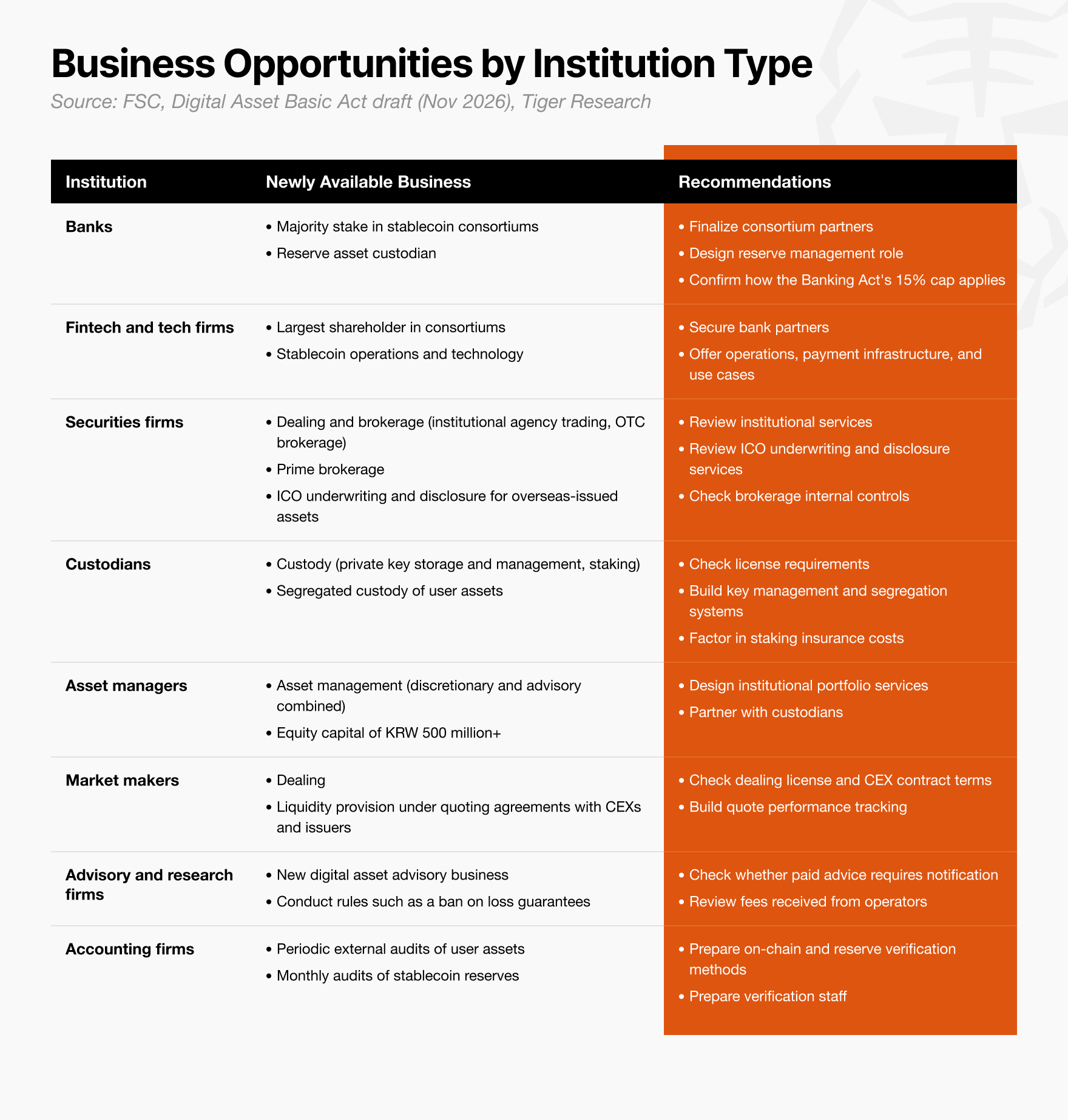
The bill would divide the digital asset business into dealing, brokerage, custody, and asset management. The first three would be subject to licensing and asset management to registration. Businesses already operating would also have to apply for a license within a set period, depending on the business lines they intend to pursue.
No institution is required to enter these lines, but those targeting a related business should watch the newly created categories closely.
How far financial institutions can participate in the market will not be settled by the bill alone and will depend on follow-up rules. Financial institutions should therefore check the following:
Partners and business lines: Plan collaboration partners and target business lines in advance.
Enforcement decree: Monitor developments until consortium shareholder requirements and licensing requirements for each business line are finalized.
Costs: From the business feasibility stage, factor in three costs: no-fault liability for losses from hacks, punitive administrative penalties of up to 10% of revenue for breaches of IT security requirements, and monthly audits of reserve assets.
Partnership design: Before applying for a license, design partnerships across business lines, such as bank and fintech consortiums for stablecoins and custodian partnerships for asset management.
The bill must pass National Assembly review and is expected to take effect one year after promulgation, so there is time to prepare. Until the enforcement decree is finalized, however, it is safer to keep partners and business structures open and under review than to commit to them.
2.3. Issues the Draft Leaves Open
The draft does not directly address two questions: whether financial companies should be kept separate from crypto businesses, and whether corporations may trade crypto assets.
On the separation principle, the FSC said it will continue to review its policy direction while following the National Assembly debate. On allowing crypto trading through corporate accounts, it said detailed criteria are more likely to be set through administrative guidelines than in the bill itself, and that it would review the issue alongside the legislative debate.
Bank partnerships for KRW real-name deposit and withdrawal accounts remain governed by the existing Act on Reporting and Using Specified Financial Transaction Information rather than the new bill. Amendments to the Foreign Exchange Transactions Act would be needed to support cross-border transactions and overseas distribution of KRW stablecoins.
These are classified as matters for review in consultation with the Ministry of Economy and Finance and other relevant ministries.
Rules on decentralized finance (DeFi) and prediction markets are also absent from the bill text. Whether and how they are regulated will be decided when the enforcement decree and FSC supervisory regulations are drafted.
How far traditional financial institutions can participate in the crypto market will therefore not be settled by this bill alone. It will take shape through subsequent amendments and guidelines.
3. Overseas Stablecoin Issuers: Korean Procedures Now Apply
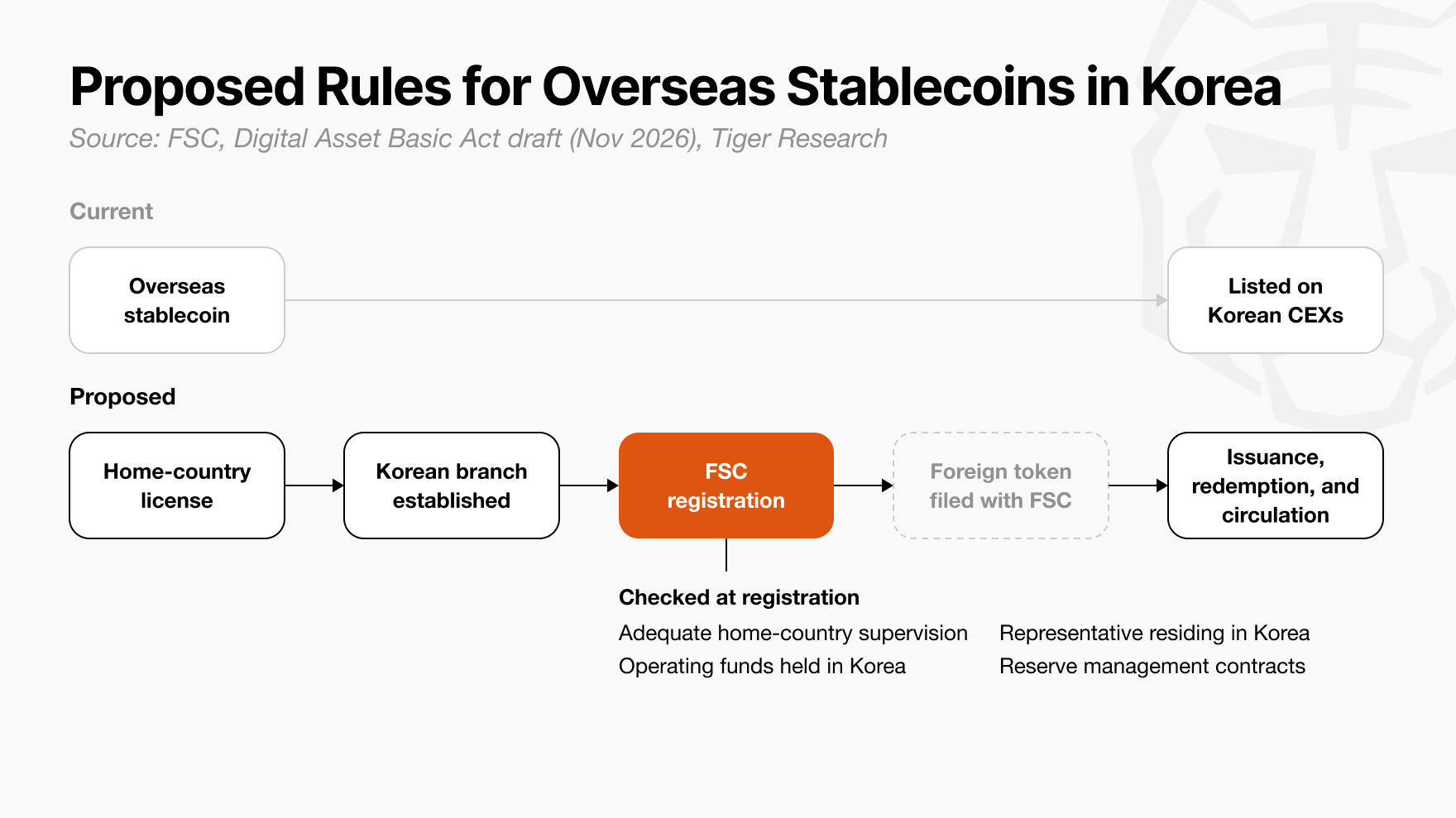
Overseas stablecoins must go through one of two routes to be distributed in Korea. An issuer licensed in its home jurisdiction can issue and redeem in Korea once it sets up a Korean branch and registers with the FSC, while a foreign token can be distributed in Korea if it meets certain requirements and is filed with the FSC. CEXs may list only tokens whose issuance plans have been approved.
However, the "certain requirements" for the filing and the detailed approval procedures will be set by enforcement decree, so some administrative uncertainty remains.
Overseas digital asset companies and projects that see Korea as an attractive market will therefore need to prepare their entry strategies and compliance frameworks more thoroughly than before.
4. Web3 Foundations: Domestic ICOs Would Be Allowed, but Uptake May Be Limited and Disclosure Liability Remains
Raising funds by issuing crypto assets has until now been entirely prohibited in Korea.
On September 29, 2017, the government announced a full ban on all forms of ICOs, including securities-type and coin-type offerings. Major Korean projects then moved their issuing entities overseas to avoid the restriction.
A 2019 FSC survey likewise found that many Korean companies had set up paper companies in Singapore and other jurisdictions and carried out ICOs that were offshore in form only.
To end the practice of issuing tokens offshore before listing them on Korean exchanges, the bill would allow domestic ICOs.
Issuers are unlikely to move their operations back to Korea on that basis alone. Hubs such as Singapore offer an established base for issuers along with tax benefits and other issuance-friendly conditions, and allowing domestic ICOs cannot easily replace them.
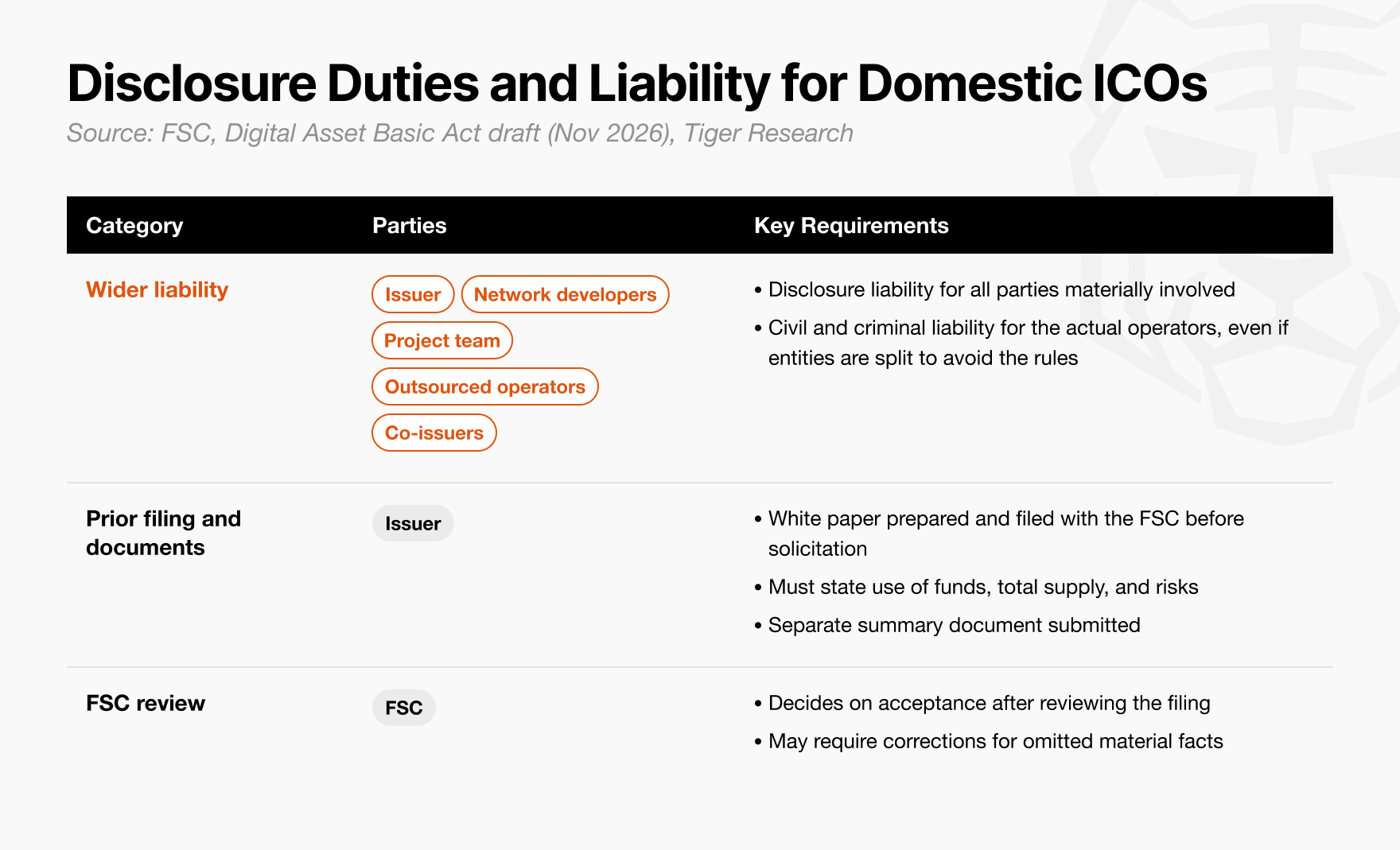
The bill would extend disclosure liability beyond the issuer to network developers, project teams, outsourced operators, and other parties actively involved in issuance. Under the bill, issuers would have to file a white paper with the FSC before soliciting purchases.
Parties subject to disclosure obligations, including executives, could be held liable for damages arising from false statements or omissions in a white paper or report. For assets issued overseas, a Korean digital asset business operator would handle disclosure on the issuer's behalf.
As the range of liable parties widens, review by CEXs and financial authorities is also likely to become stricter. Web3 foundations in Korea and abroad will therefore need to provide the information CEXs request in more detail and more promptly than before.
To prepare, foundations may need dedicated disclosure staff in Korea or a local firm or representative to handle disclosures on their behalf.
Digital Assets: A First Step into the Regulated Financial System
The draft goes beyond investor protection to build a legal foundation that also covers promoting the digital asset industry and developing its market.
Many issues remain before the framework is complete. Key details have been delegated to the enforcement decree, including shareholder requirements for stablecoin consortiums, eligibility for the 34% exception to the CEX ownership cap, and filing requirements for foreign tokens. The bill itself must also still pass National Assembly review. The bill text contains no provisions on DeFi or other forms of future on-chain finance.
The final rules will determine how much compliance work firms face and which digital asset businesses they can pursue in Korea. Despite these limitations, the draft marks the start of Korea's effort to bring digital assets into the regulated financial system while balancing market oversight with industry development.
🐯 More from Tiger Research
Read more reports related to this research.Disclaimer
This report has been prepared based on materials believed to be reliable. However, we do not expressly or impliedly warrant the accuracy, completeness, and suitability of the information. We disclaim any liability for any losses arising from the use of this report or its contents. The conclusions and recommendations in this report are based on information available at the time of preparation and are subject to change without notice. All projects, estimates, forecasts, objectives, opinions, and views expressed in this report are subject to change without notice and may differ from or be contrary to the opinions of others or other organizations.
This document is for informational purposes only and should not be considered legal, business, investment, or tax advice. Any references to securities or digital assets are for illustrative purposes only and do not constitute an investment recommendation or an offer to provide investment advisory services. This material is not directed at investors or potential investors.
Terms of Usage
Tiger Research allows the fair use of its reports. ‘Fair use’ is a principle that broadly permits the use of specific content for public interest purposes, as long as it doesn’t harm the commercial value of the material. If the use aligns with the purpose of fair use, the reports can be utilized without prior permission. However, when citing Tiger Research’s reports, it is mandatory to 1) clearly state ‘Tiger Research’ as the source, 2) include the Tiger Research logo. If the material is to be restructured and published, separate negotiations are required. Unauthorized use of the reports may result in legal action.


