

Key Takeaways
DTCC is expanding its securities tokenization business through four core services. Rather than pursuing decentralization as an ideal, DTCC aims to preserve its role as the central intermediary and set the standards for tokenized securities through regulatory compliance and on-chain efficiency.
DTS: DTS lets DTC participants tokenize their security entitlements to stocks, ETFs, and U.S. Treasuries held at DTC. The resulting tokens can be transferred 24 hours a day between the registered wallets of financial institutions.
ComposerX: ComposerX is an integrated management service that addresses the back-office fragmentation financial institutions face when adopting tokenization. Institutions can use it to handle token issuance, investor registration, dividends, and transfer registration in one place.
Collateral AppChain: Collateral AppChain is a blockchain-based collateral management service operated by DTCC. It aggregates collateral records across multiple chains through LedgerScan and uses live market prices to value collateral.
Digital Launchpad: Digital Launchpad is a sandbox where financial institutions can test asset tokenization logic and its practical application without the upfront cost of building infrastructure. Institutions can use the platform to test token issuance and margin calculation and see how the operating framework works.
1. Why DTCC Entered the Blockchain Business
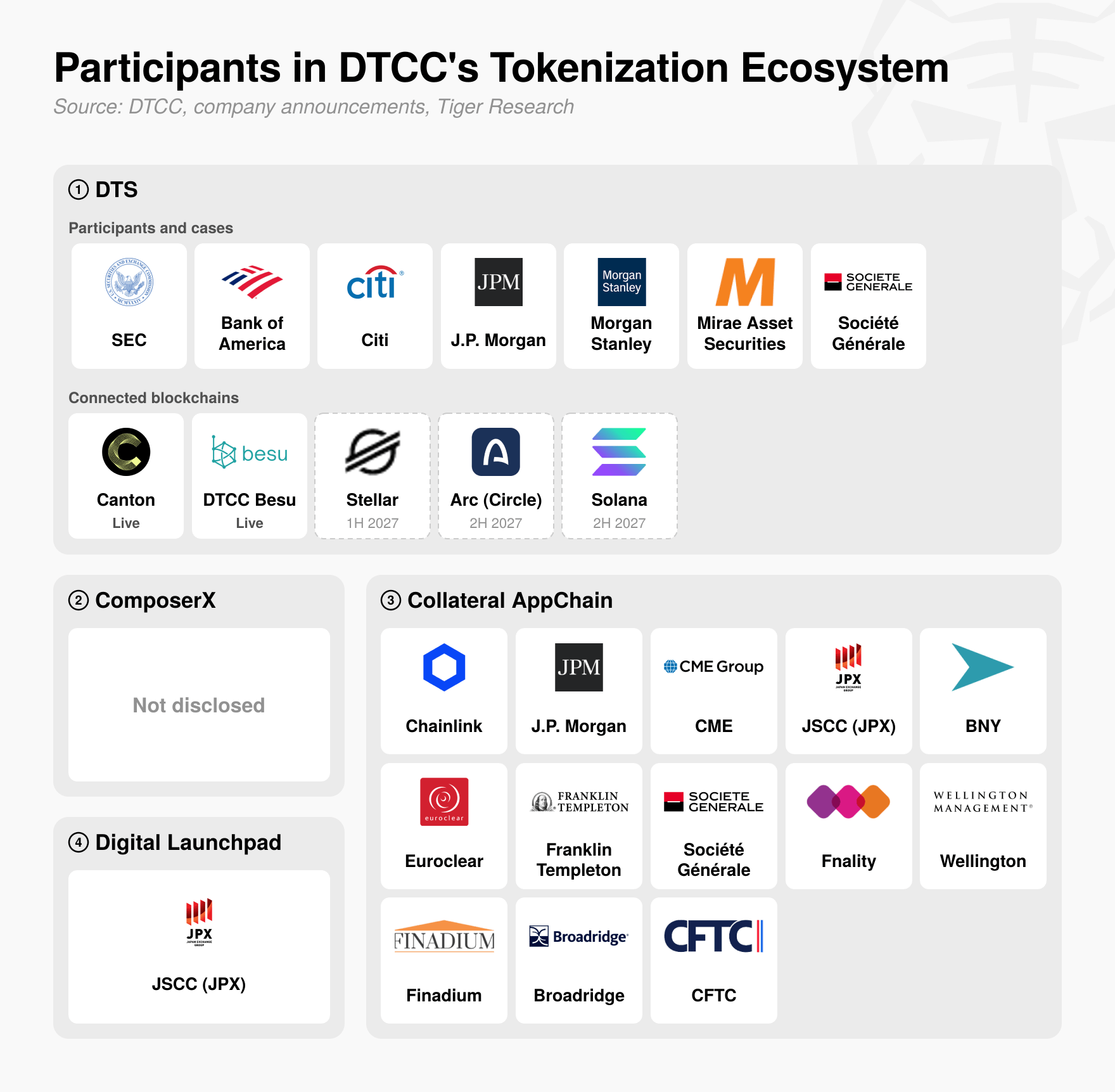
The Depository Trust & Clearing Corporation (DTCC), parent company of the U.S. central securities depository The Depository Trust Company (DTC), has steadily expanded its partnerships with major blockchain networks and financial institutions over the past year, and its tokenization business has grown quickly as a result.
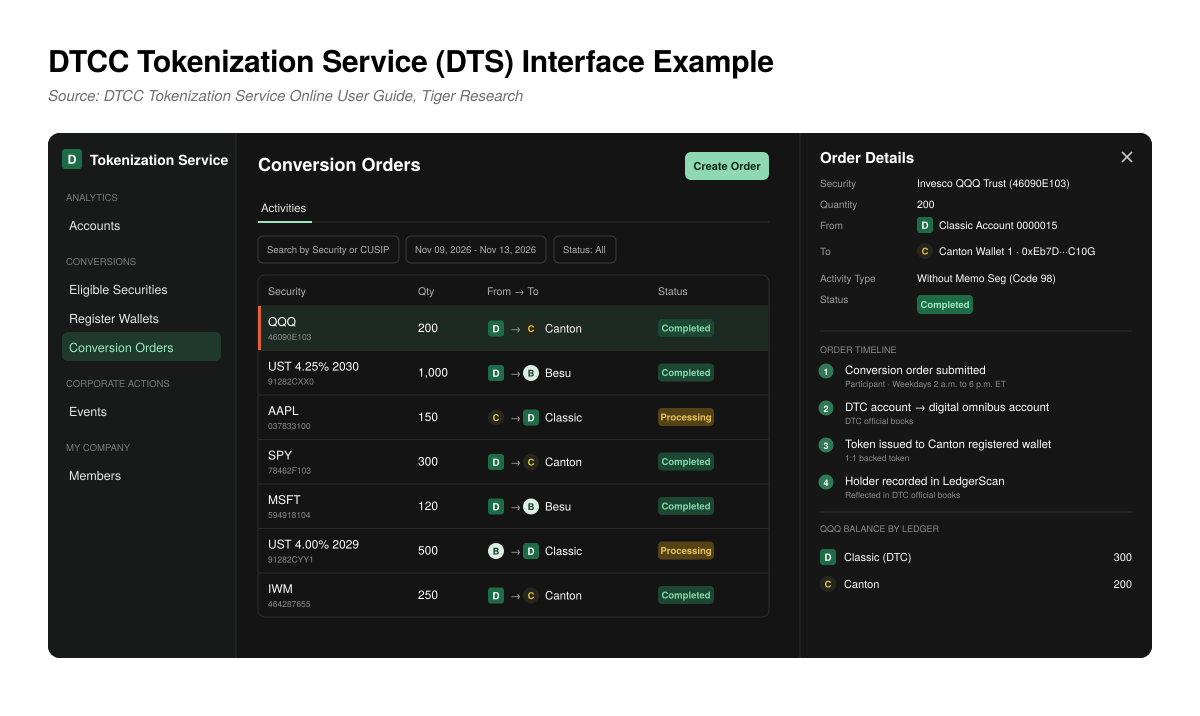
DTCC began with Canton Network in December 2025 and later announced multi-chain support. In October 2026, DTC officially launched the tokenization service after 20 of its participants signed usage agreements.
In November 2026, DTCC also announced plans to connect with Solana, allowing eligible securities held at DTC to be converted into Solana-based tokens from the second half of 2027, marking a full-scale entry into the market.
These moves are significant because they begin shifting existing settlement infrastructure onto blockchain in earnest. Because the initiative is led by a depository and clearing institution at the center of the global financial system, it is expected to go well beyond a proof of concept (PoC) and bring a fundamental change to how traditional financial infrastructure operates.
2. DTS (DTCC Tokenization Service): 24-Hour Transfers of Tokenized Securities
DTS (DTCC Tokenization Service) lets DTC participants tokenize their security entitlements to eligible stocks, ETFs, and Treasuries held at DTC, with the tokens carrying the same legal rights as the underlying entitlements. The securities themselves remain at DTC, and only the tokens, which can be transferred securely at any time of day, change hands.
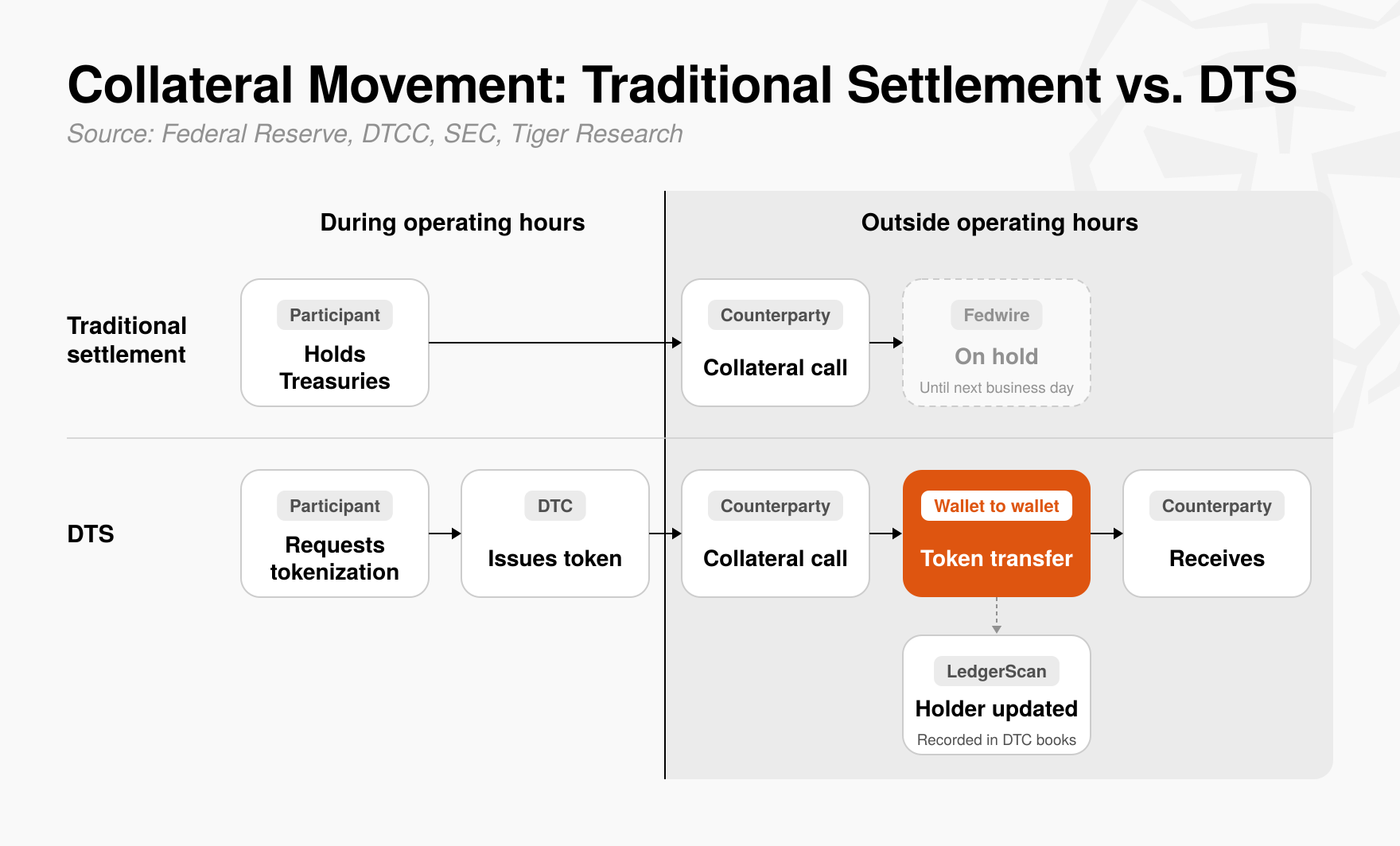
In the traditional financial system, collateral shortfalls or settlement requests that arose outside bank business hours and the operating hours of Fedwire Securities could not be addressed immediately. DTS, by contrast, supports 24-hour transfers between pre-approved Registered Wallets on the same chain, so firms can move tokenized collateral outside traditional operating hours.
As a result, financial institutions can reduce both the time it takes to move collateral and the cost of pre-funding it.
Time savings: Previously, if a collateral call came in after Fedwire closed, securities could not be delivered until the next operating day. With DTS, institutions can respond by sending tokens directly between registered wallets on the same chain.
Cost savings: Previously, institutions had to hold ample cash and Treasuries in advance to cover collateral calls that might arrive after the close. If collateral can be delivered after the close, the amount of pre-funded assets can be reduced.
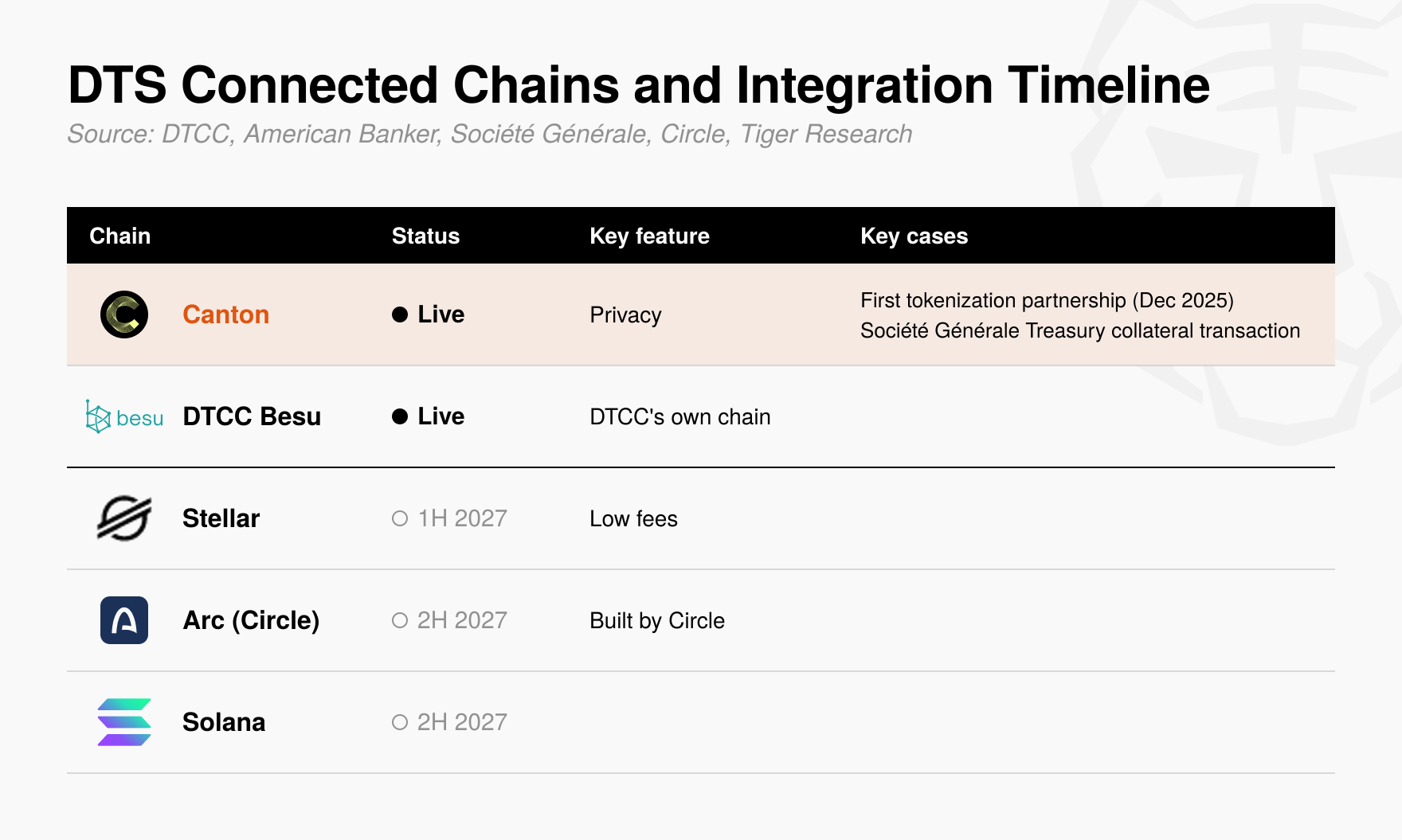
DTCC is pursuing a multi-chain strategy rather than relying on a single blockchain. Nadine Chakar, DTCC’s head of digital assets, has stressed that no single chain can handle the volume DTCC needs to process. Institutional clients also have different infrastructure requirements, which is another reason for the multi-chain approach.
For example, clients who prefer Canton prioritize strong privacy protection, while those drawn to Stellar care most about low fees. Accordingly, DTCC plans to keep adding connected blockchains in line with market demand.
Two networks are currently integrated with DTS: Canton and DTCC Besu. Stellar is scheduled to be added in the first half of 2027, followed by Circle’s Arc and Solana in the second half. Because these integrations are still at the planning stage, Canton is expected to serve as the core of the DTS ecosystem in the near term.
Canton was the first network DTCC partnered with on tokenization, in December 2025, and the Treasury collateral transaction that Société Générale announced after the service launched also took place on Canton.
3. ComposerX: One Platform from Token Issuance to Recordkeeping
ComposerX is a digital asset software suite that DTCC announced in February 2025, covering token issuance, servicing, and recordkeeping.
DTCC built ComposerX to address back-office fragmentation: even after financial institutions issue tokens on a blockchain, their existing accounting and custody systems remain separate from the on-chain records.
Institutions still have a range of work to do after tokenizing an asset, including investor verification, transfer registration, dividend payments, ledger reconciliation, and regulatory reporting. Because their existing systems were not designed for tokenized assets, this work has to be managed separately.
ComposerX helps firms issue and service tokenized assets and reconcile blockchain records with their existing systems.
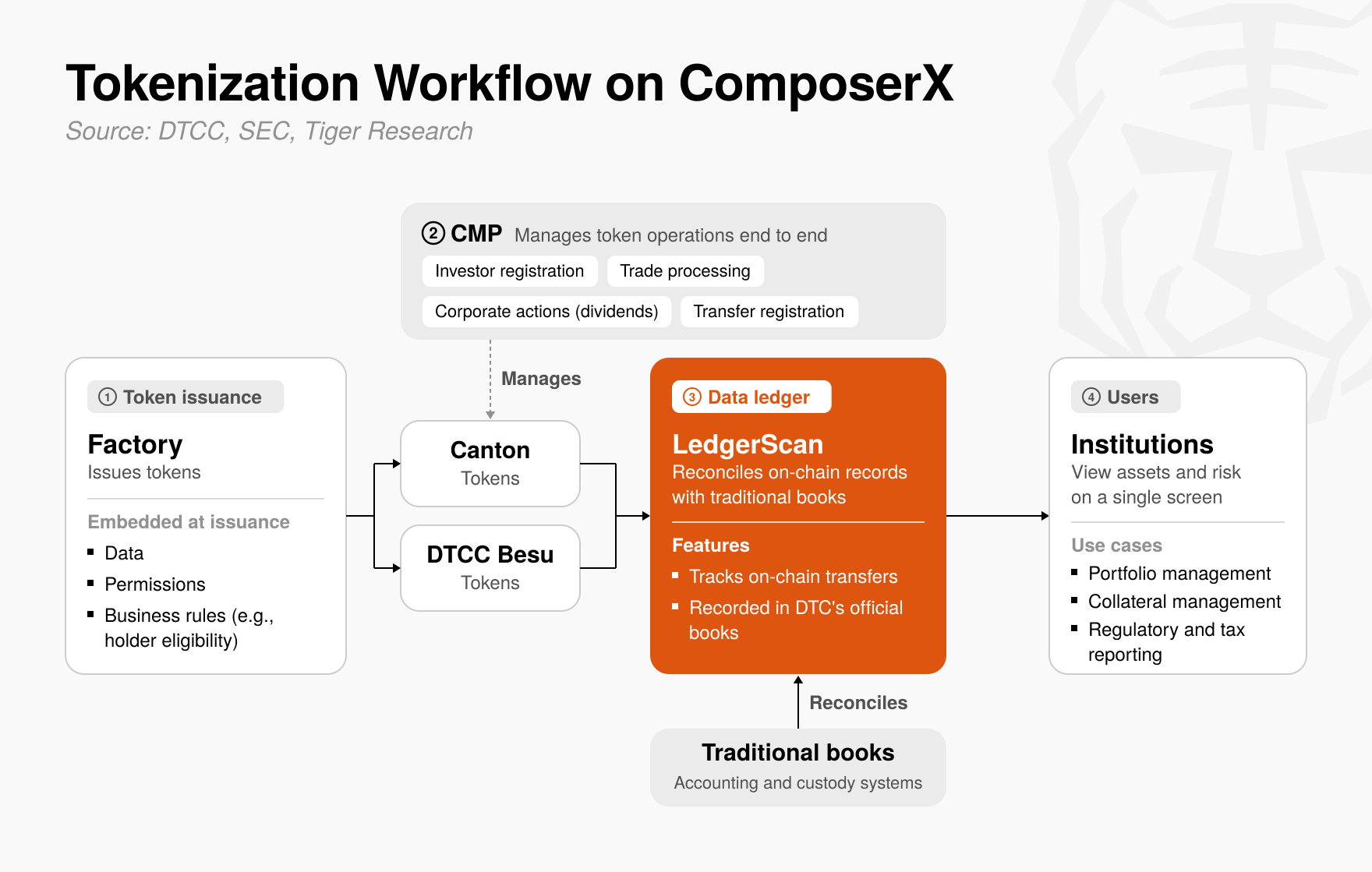
ComposerX consists of three main components.
Factory: Investor eligibility, which institutions previously checked trade by trade, can be set as rules when a token is issued, and CATF (Compliance Aware Token Framework) then checks it automatically each time a trade is executed.
Capital Markets Platform (CMP): Tasks such as investor registration, transfers, and dividend payments, which were previously split between transfer agents and broker-dealers, are handled in one place through CMP.
LedgerScan: Matching blockchain records against accounting and custody records, which used to be done separately after the fact, is handled by LedgerScan, which reads the blockchain in near real time and reconciles the two.
As a result, institutions can manage tokenized assets spread across multiple networks from a single console, substantially reducing back-office operational risk and inefficiency.
DTS is the clearest example of ComposerX in use. When DTC launched DTS in October 2026, it adopted ComposerX as the core system. DTS runs on the Canton and DTCC Besu chains under agreements with 20 participants, and the holdings recorded in LedgerScan serve as DTC’s official books and records for tokenized entitlements.
Ahead of the October launch, more than 30 firms used this structure on July 15, 2026 to process collateral pledges, Treasury repo, and stock DVP transactions. After the launch, on November 2, Société Générale announced that it had accepted $10 million in U.S. Treasuries tokenized through DTS as collateral on Canton. ComposerX is also used in Collateral AppChain, discussed in the next section.
With ComposerX, DTCC has laid the groundwork for resolving in advance the reconciliation and recordkeeping problems that tokenization can create. Specific external usage has not yet been disclosed, but demand from financial institutions for integrated management tools is expected to grow as tokenized assets and connected chains expand.
4. Collateral AppChain: An Automated Ledger for Tokenized Collateral
Collateral AppChain is DTCC’s blockchain collateral ledger, built on ComposerX technology.
Two similarly named products need to be distinguished first. DTCC AppChain is DTCC’s own blockchain built on Besu, while Collateral AppChain is a collateral management program that runs on that blockchain. In this section, “AppChain” refers to the collateral management program.
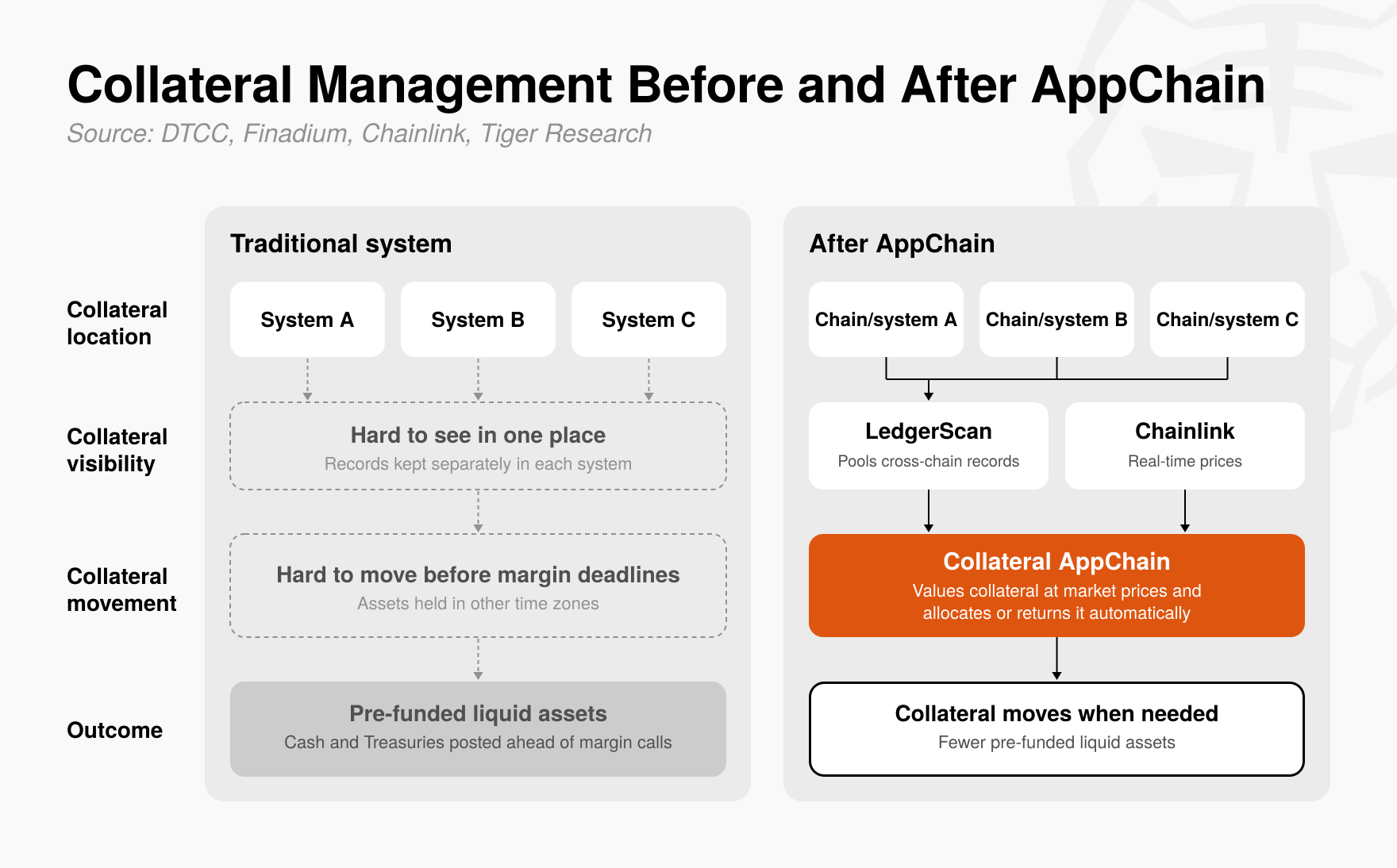
A financial institution’s collateral is spread across multiple systems, which makes it difficult to see in one place. Assets held in other time zones are particularly hard to move before margin deadlines. Institutions therefore pre-fund highly liquid assets such as cash and Treasuries to prepare for sudden margin calls.
DTCC is building AppChain to solve both problems: collateral scattered across systems and the difficulty of moving it before deadlines. AppChain uses LedgerScan, described in the previous section, to aggregate collateral records across multiple chains and uses live market prices to calculate collateral value.
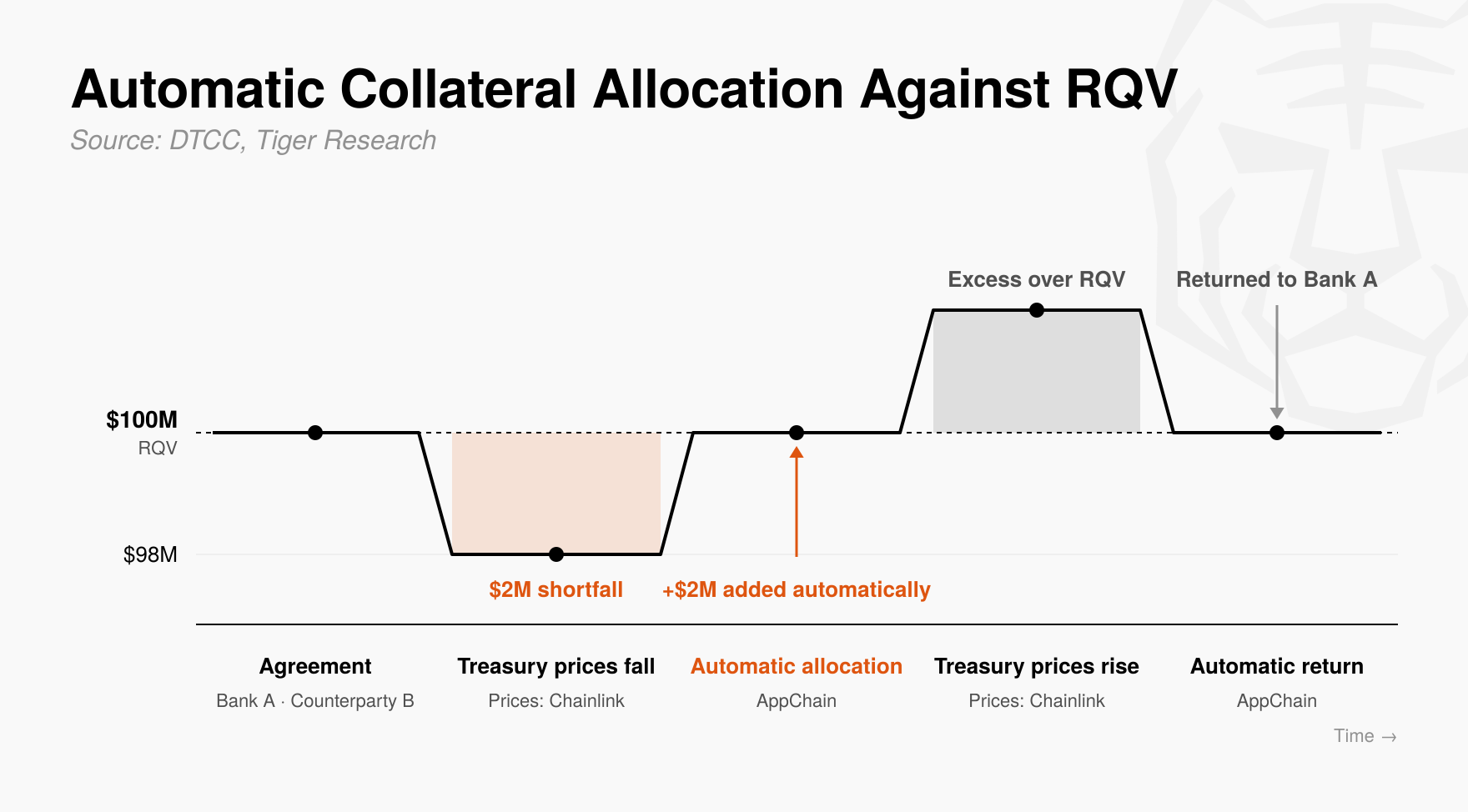
A hypothetical example shows how collateral moves in practice.
Bank A borrows from counterparty B and posts tokenized Treasuries as collateral. The two firms agree that the collateral must always be worth at least $100 million, an amount referred to as the Required Value (RQV). If Treasury prices fall and the collateral is worth $98 million, Bank A must post an additional $2 million in collateral; if prices rise, Bank A receives the excess back.
AppChain values the assets against the RQV and processes the settlement in real time, automatically adding collateral where there is a shortfall and returning any excess. DTCC automated this valuation and allocation process by integrating Chainlink’s oracle technology, which feeds external price data into the system in real time.
This automation makes collateral management far more efficient. In DTCC’s April 2025 demonstration, collateral processing time fell from one day to about one hour, and during its July 2026 limited-production trades, DTCC processed clearinghouse margin through AppChain. A joint white paper with Finadium also estimates that applying AppChain to 15% of bank wholesale funding could reduce the amount of high-quality liquid assets (HQLA) banks need to hold by about 17%.
DTCC had initially targeted a Q4 2026 launch for AppChain, but the rollout was moved to follow the launch of the tokenization platform. Chainlink has separately referred to a Q1 2027 launch, which suggests the official release may take longer.
5. Digital Launchpad: A Test Environment for Blockchain Adoption
Digital Launchpad is a sandbox in which DTCC provides prebuilt core infrastructure so that financial institutions can easily test and validate new blockchain-based workflows.
Previously, institutions that wanted to validate blockchain adoption had to build the initial infrastructure themselves, including installing nodes, setting up networks, and preparing token issuance tools, which carried significant technical and financial costs.
In Digital Launchpad, DTCC provides the blockchain network and ComposerX tools in advance, so institutions can concentrate on developing and testing their own digital asset business logic and how it applies to their operations without upfront investment.
By easing the infrastructure burden, Launchpad helps institutions cut the time and cost of testing. Japan Securities Clearing Corporation (JSCC), which took part in a pilot, reported that using Launchpad to streamline node installation and token issuance significantly reduced the time and cost of validation. It also successfully issued cash, stock, and bond tokens and ran margin call and collateral substitution processes.
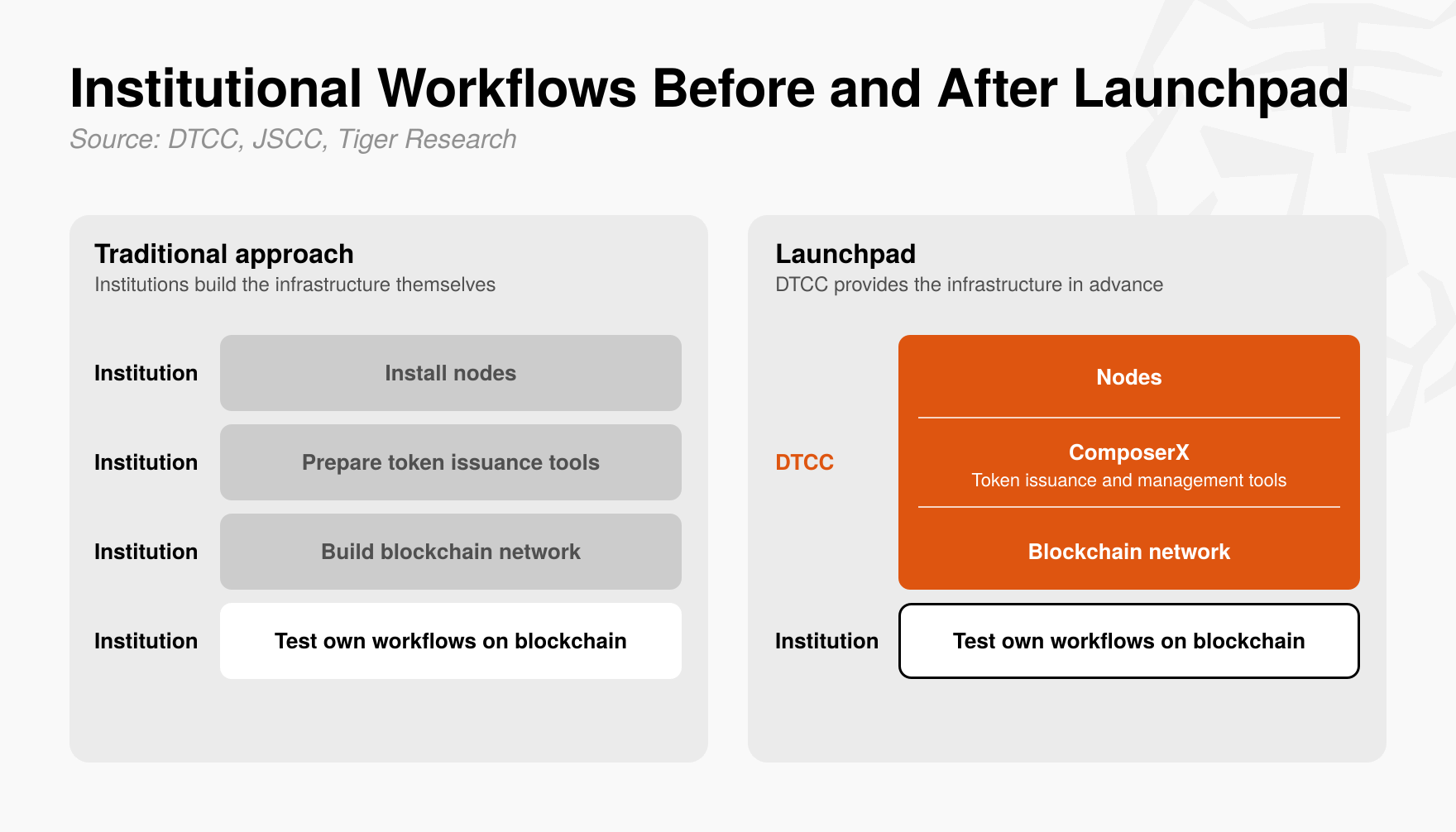
The key needs identified in these Launchpad trials later led to the development of Collateral AppChain.
Most early validation work, including JSCC’s, centered on collateral management. In April 2025, DTCC used the Launchpad testbed to complete a demonstration of collateral movement across multiple chains with major financial institutions. The proof-of-concept infrastructure shown at that time was later developed into Collateral AppChain, which DTCC is now moving from experiment to production infrastructure.
Digital Launchpad has not received new feature updates since AppChain was developed, but it continues to serve as a stable test environment for global financial institutions looking to enter the tokenization market.
6. Where Is DTCC Heading?
DTCC’s blockchain strategy is not aimed at replacing existing financial infrastructure outright or at achieving decentralization in the pure sense. It is better understood as a deliberate effort by DTCC, long the central intermediary of traditional financial markets, to extend that role to tokenized markets.
DTCC is building barriers to entry that private-sector innovators and crypto startups would find difficult to overcome. Its advantage rests on decades of experience meeting strict regulatory requirements, its network of Wall Street financial institutions, and its track record in clearing and settlement, a business that depends on trust.
DTCC adopts blockchain as a distributed technology but layers its own control and compliance frameworks, such as ComposerX and CATF, on top of it, which keeps emerging blockchain firms from taking over its role.
To early blockchain participants who advocated “finance without intermediaries,” these moves may look like an extension of centralization that undermines what blockchain was meant to be. Paradoxically, however, this is also what is moving the market fastest. Because DTCC, which already runs core post-trade infrastructure, offers a controlled environment that it manages and is accountable for, large and conservative traditional financial institutions can use tokenized assets within the operational and compliance frameworks they already know.
In other words, active involvement by an incumbent central institution is making it easier, and faster, for regulated financial institutions to adopt tokenized assets.
Rather than pursuing decentralization itself, DTCC aims to lead a trust-based digital asset ecosystem that combines regulatory compliance with on-chain efficiency. If AppChain is successfully rolled out and trading of the tokens on external venues picks up, DTCC’s model of “controlled blockchain innovation” is likely to become a new standard for global capital markets.
🐯 More from Tiger Research
Read more reports related to this research.Disclaimer
This report has been prepared based on materials believed to be reliable. However, we do not expressly or impliedly warrant the accuracy, completeness, and suitability of the information. We disclaim any liability for any losses arising from the use of this report or its contents. The conclusions and recommendations in this report are based on information available at the time of preparation and are subject to change without notice. All projects, estimates, forecasts, objectives, opinions, and views expressed in this report are subject to change without notice and may differ from or be contrary to the opinions of others or other organizations.
This document is for informational purposes only and should not be considered legal, business, investment, or tax advice. Any references to securities or digital assets are for illustrative purposes only and do not constitute an investment recommendation or an offer to provide investment advisory services. This material is not directed at investors or potential investors.
Terms of Usage
Tiger Research allows the fair use of its reports. ‘Fair use’ is a principle that broadly permits the use of specific content for public interest purposes, as long as it doesn’t harm the commercial value of the material. If the use aligns with the purpose of fair use, the reports can be utilized without prior permission. However, when citing Tiger Research’s reports, it is mandatory to 1) clearly state ‘Tiger Research’ as the source, 2) include the Tiger Research logo. If the material is to be restructured and published, separate negotiations are required. Unauthorized use of the reports may result in legal action.


