

Key Takeaways
Democrats have secured majorities in both chambers, with 54 Senate seats and 228 House seats. Control of the digital asset legislative agenda will shift from Republicans to Democrats after two years of Republican leadership.
Industry critics such as Elizabeth Warren, Sherrod Brown, and Maxine Waters are likely to lead key committees. Their influence will make existing digital asset bills harder to pass, while congressional attention is expected to turn to investigations into World Liberty Financial (WLF), the Trump family’s digital asset business.
Even moderate and pro-crypto Democrats want conflict-of-interest rules for public officials. Negotiations over these provisions could delay the CLARITY Act longer than expected.
Republicans will focus on defending the GENIUS Act rather than passing new legislation. They can still use the Senate’s 60-vote threshold for overcoming filibusters and the threat of a presidential veto to block Democratic proposals.
President Trump will face greater constraints on his crypto-friendly agenda. The direction and pace of regulation will depend on how Democrats pursue the Trump family’s business interests and how the White House responds.
1. Where the U.S. Midterm Results Stand
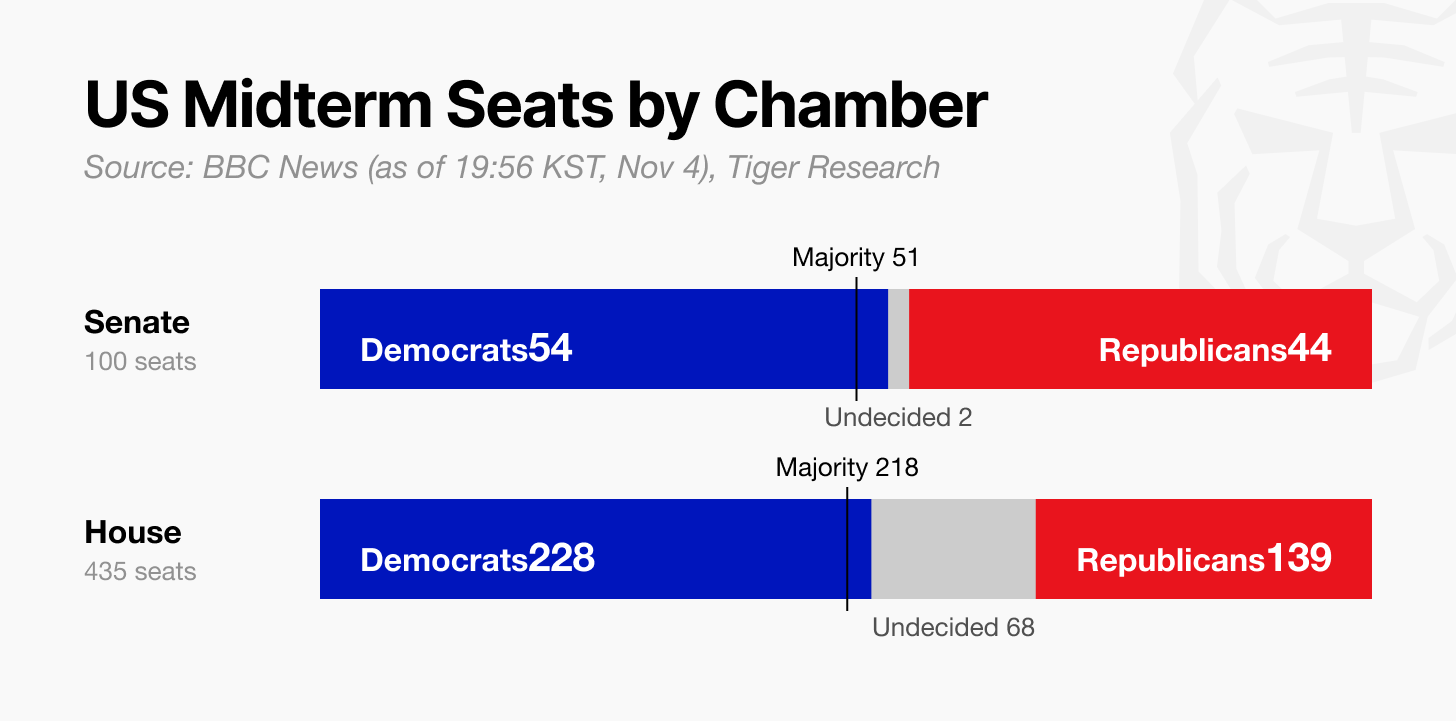
Democrats have secured 54 of the Senate’s 100 seats and 228 of the House’s 435 seats, exceeding the majority thresholds of 51 and 218, respectively. These results represent gains of seven Senate seats and 25 House seats. Two Senate races and 68 House races remain uncalled, but Democratic control of both chambers is already assured.
When the new Congress convenes in January 2027, Democrats will control the legislative agenda and committee chairmanships.
The result matters for digital assets because Republicans led the two major legislative efforts that have shaped the market over the past two years: the GENIUS Act and the CLARITY Act. Democrats will now be able to block further legislation and revisit the framework Republicans have built, with broad implications for the market.
2. Where Elected Democrats Stand on Digital Assets
The Democrats elected to Congress fall broadly into three groups, based on their past statements and records:
Traditional critics who view digital assets as an industry designed to evade regulation.
Moderates who support clear rules but insist on conflict-of-interest restrictions for public officials and stronger consumer protections.
A smaller pro-crypto group that wants to bring the industry into the regulated financial system through a clear legal framework.
The challenge for the industry is that critics are likely to secure the committee chairmanships that determine which bills advance.
Moderates and pro-crypto Democrats are not unconditional allies, either. They also want Congress to address the Trump family’s digital asset businesses, making it unlikely that the current bills will advance unchanged.
2.1. Critics Are Likely to Lead Key Committees
The election has strengthened the position of the industry’s critics within the Democratic Party.
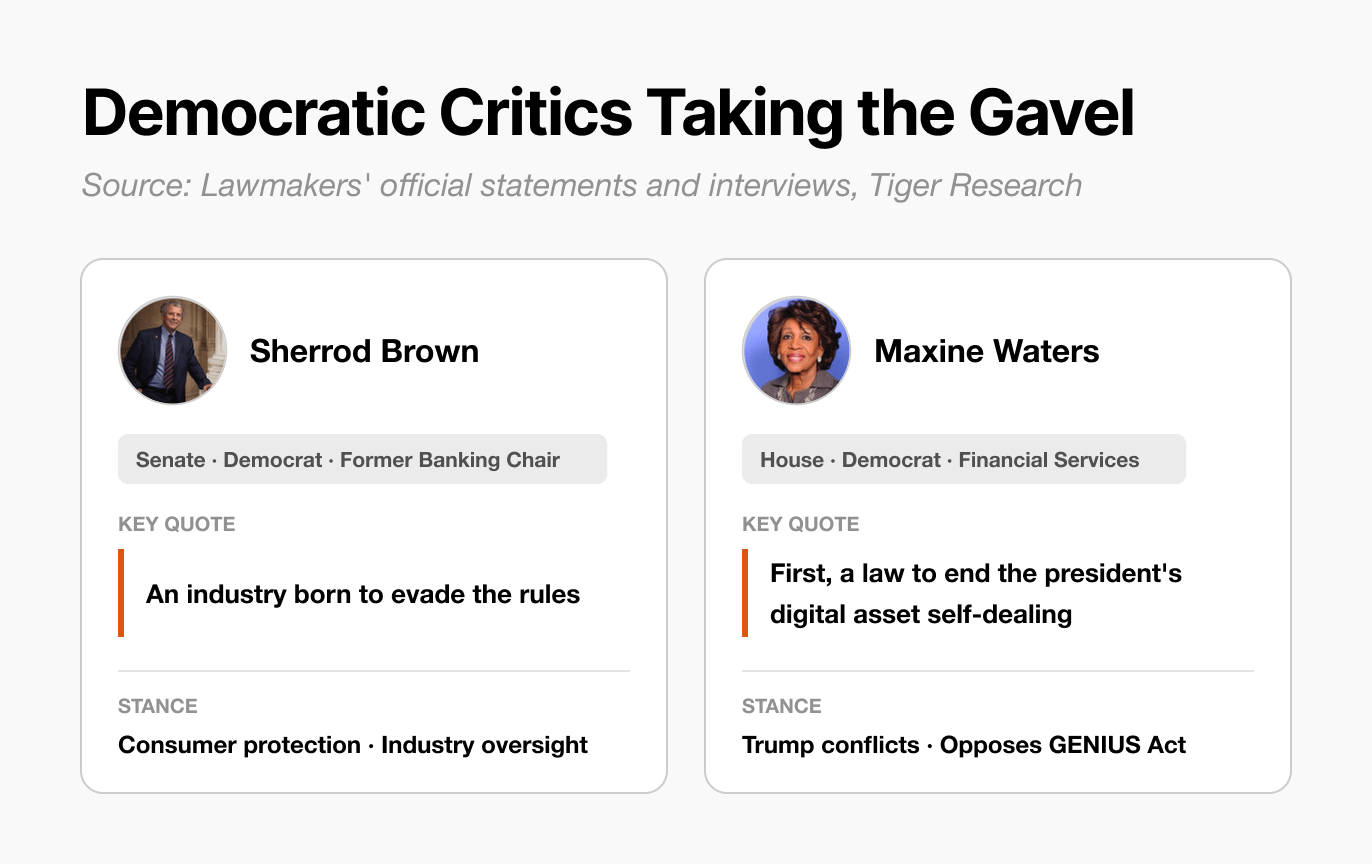
Figures such as Senator Elizabeth Warren, who ran in the 2020 Democratic presidential primary, see digital assets as an industry built to avoid regulation. They have consistently opposed industry-friendly legislation. With Democrats taking the majority, these lawmakers are more likely to lead the committees responsible for digital asset bills.
Senator-elect Sherrod Brown, a former three-term senator from Ohio and former chair of the Senate Banking Committee, is among the industry’s most prominent critics. As committee chair, he prevented crypto legislation from advancing.
At a 2021 stablecoin hearing, Brown argued that stablecoins were neither decentralized nor transparent. He has now won despite crypto-backed political groups spending approximately $63 million to prevent his return to the Senate. That history gives the industry little reason to expect a warmer reception.
Representative Maxine Waters, who has served in the House since 1991, is widely considered the leading candidate to chair the House Financial Services Committee.
Waters is currently the committee’s ranking Democrat. She previously chaired it from 2019 to 2023, becoming the first woman and the first Black person to hold the position. With Democrats regaining the House, she is expected to return to the role.
When the GENIUS Act passed the Senate, Waters criticized it as riddled with loopholes, arguing that there was nothing smart about it despite its name. She also described the recent Binance hack as a warning that the crypto industry cannot operate without strong accountability.
With these lawmakers leading key committees, the digital asset agenda that Republicans advanced over the past two years will face much greater resistance.
Their first target is likely to be World Liberty Financial, the Trump family’s digital asset business. Democrats have already called for Senate hearings following reports that an investor linked to Abu Dhabi’s royal family acquired a 49% stake in WLF for approximately $500 million, four days before Trump’s inauguration.
Congress is also likely to examine why the SEC dropped more than ten digital asset enforcement cases, an issue Waters has already called for an investigation into. Senate Democrats could put further pressure on regulators by delaying confirmations for key SEC and CFTC positions.
In the first half of 2027, digital asset headlines may therefore center on investigations into WLF associates and subpoenas for the SEC chair, with legislative progress receiving less attention.
2.2. Moderates Support Clear Rules, With Conditions
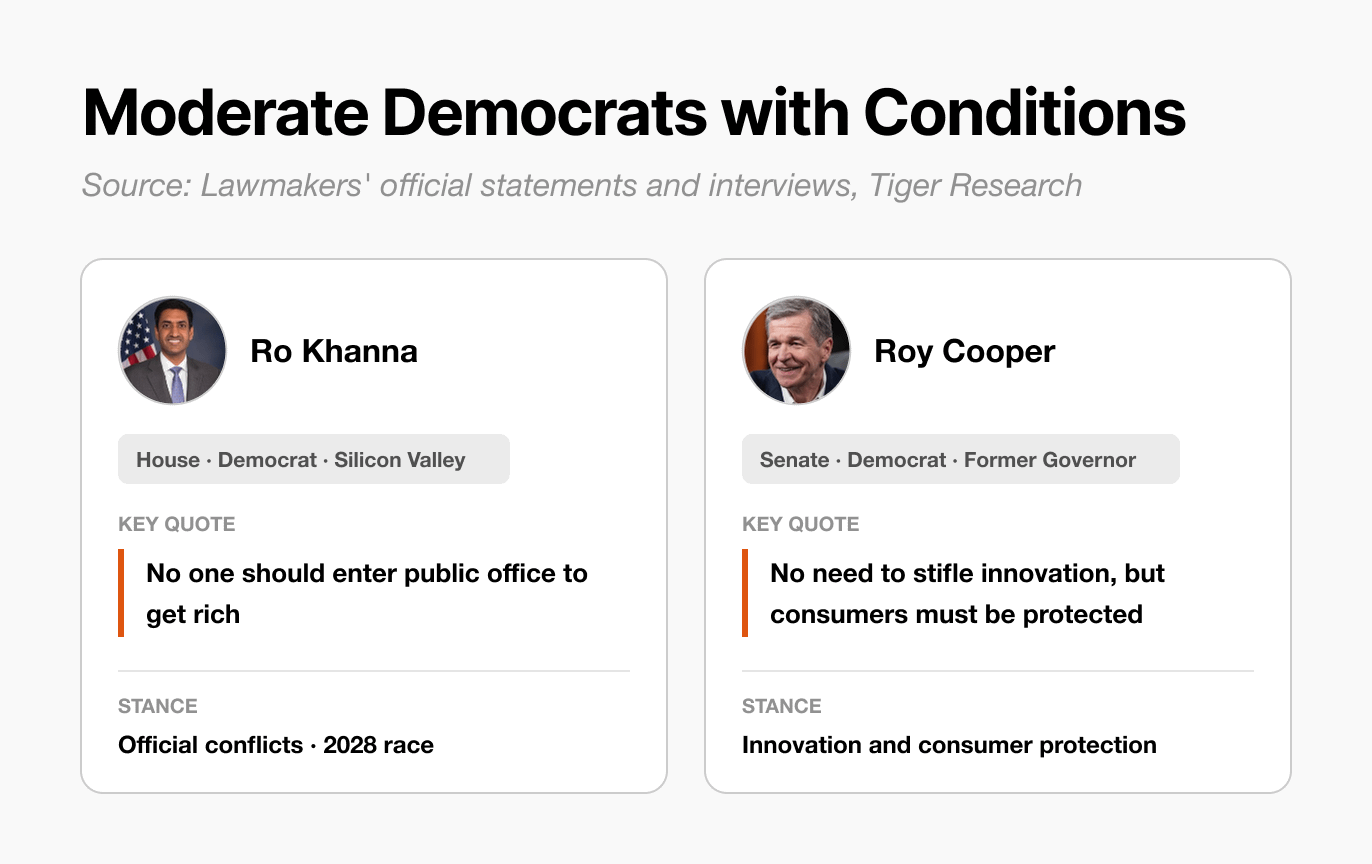
Moderate Democrats generally support digital asset legislation but also want stronger consumer protections and conflict-of-interest restrictions for public officials. If the CLARITY Act returns to a Democratic-led Congress, their demands could determine its final form.
Representative Ro Khanna has long supported clear rules for digital assets. In 2022, he co-sponsored the Digital Commodity Exchange Act, which emphasized consumer protection and transparency. In 2025, he said Congress could pass both stablecoin legislation and the CLARITY Act that year. At the same event, however, he argued that elected officials should not hold memecoins.
Khanna has also been discussed as a potential 2028 presidential candidate, giving him further reason to emphasize conflicts of interest involving public officials.
Senator-elect Roy Cooper, a former North Carolina governor, has no federal voting record. During the campaign, however, he met with industry representatives and said the industry wanted to comply with the law. Businesses, he argued, simply wanted to know the rules and be confident that those rules would not constantly change. His position combines support for regulatory stability with an emphasis on consumer protection.
As these lawmakers enter negotiations, they are likely to seek changes to the existing bills.
Moderates may make their support conditional on provisions preventing public officials from using digital assets for personal gain. Khanna’s Ban Crypto Corruption legislation is one example. He has also launched an inquiry seeking records on WLF’s dealings with the United Arab Emirates.
Lawmakers such as Cooper are likely to press for additional safeguards against illicit finance and stronger protections for consumers. But provisions aimed at the president’s family could prompt Trump to veto the legislation.
The CLARITY Act could consequently remain stalled as lawmakers negotiate between the current text and the changes Democratic moderates want.
2.3. Pro-Crypto Democrats
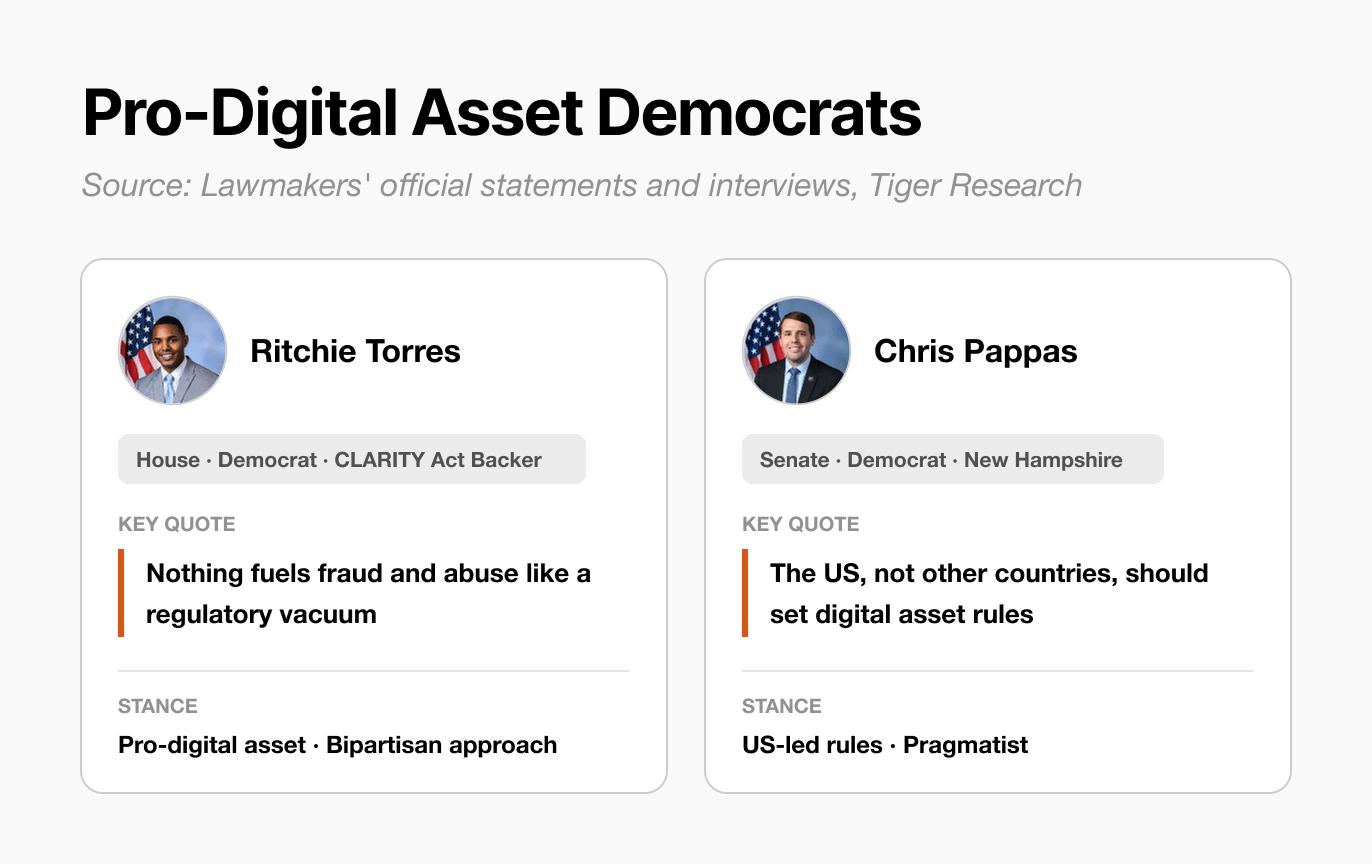
This group includes lawmakers who voted for the CLARITY Act and the GENIUS Act in the House, as well as those who campaigned on establishing clear rules for digital assets. They offer the industry potential allies in a Democratic-led Congress, although they are not yet positioned to lead the relevant committees.
Representative Ritchie Torres has been one of the Democratic Party’s most active advocates for digital asset legislation. He co-sponsored the CLARITY Act and the Blockchain Regulatory Certainty Act, led a letter urging fellow Democrats to support the CLARITY Act ahead of the 2025 House vote, and voted for the GENIUS Act.
At an SEC oversight hearing in February 2026, Torres said he had long believed in emerging technologies such as digital assets and blockchain. His support nevertheless has limits. After suspicious Polymarket trades betting on President Maduro’s removal came to light in January, he introduced legislation with 30 other lawmakers to prohibit public officials from using nonpublic information to trade on prediction markets.
Senator-elect Chris Pappas voted for both the CLARITY Act and the GENIUS Act while serving in the House. After the votes, he argued that U.S. leadership in innovation required embracing new technologies and establishing clear rules and safeguards for digital assets. He described the bills as a starting point for protecting consumers and supporting small business growth.
At the same time, Pappas expressed deep concern about President Trump’s disregard for established ethical standards and legal requirements, calling for stronger anti-corruption rules for public officials. In May 2026, he also called for a House investigation into corruption and insider trading on prediction markets.
These lawmakers are likely to seek conflict-of-interest provisions in the CLARITY Act to attract support from other Democrats.
Both Torres and Pappas have supported the bill while arguing that public officials must be prevented from exploiting their positions for personal gain. Concerns about the Trump family’s digital asset businesses were a major obstacle in September’s Senate vote, when no Democrat voted in favor. Addressing those concerns would remove one of the party’s main reasons for opposing the legislation.
Their ability to lead the process remains limited, however. Industry critics are likely to control the key committees, while provisions targeting the president’s family could meet resistance from the White House. For the industry, much will depend over the next two years on whether pro-crypto Democrats can use ethics provisions to build a compromise acceptable to both sides.
3. Elected Republicans: The Same Agenda, Less Control
Republicans elected to Congress continue to support private stablecoins as a means of preserving the dollar’s global dominance. They also oppose a government-issued central bank digital currency, or CBDC.
Their influence has weakened, however, following the defeat of several industry-friendly Republicans, including Senator Jon Husted and Representative Bryan Steil, who chairs the House digital assets subcommittee.
3.1. The Lawmakers Behind the GENIUS Act and the CLARITY Act
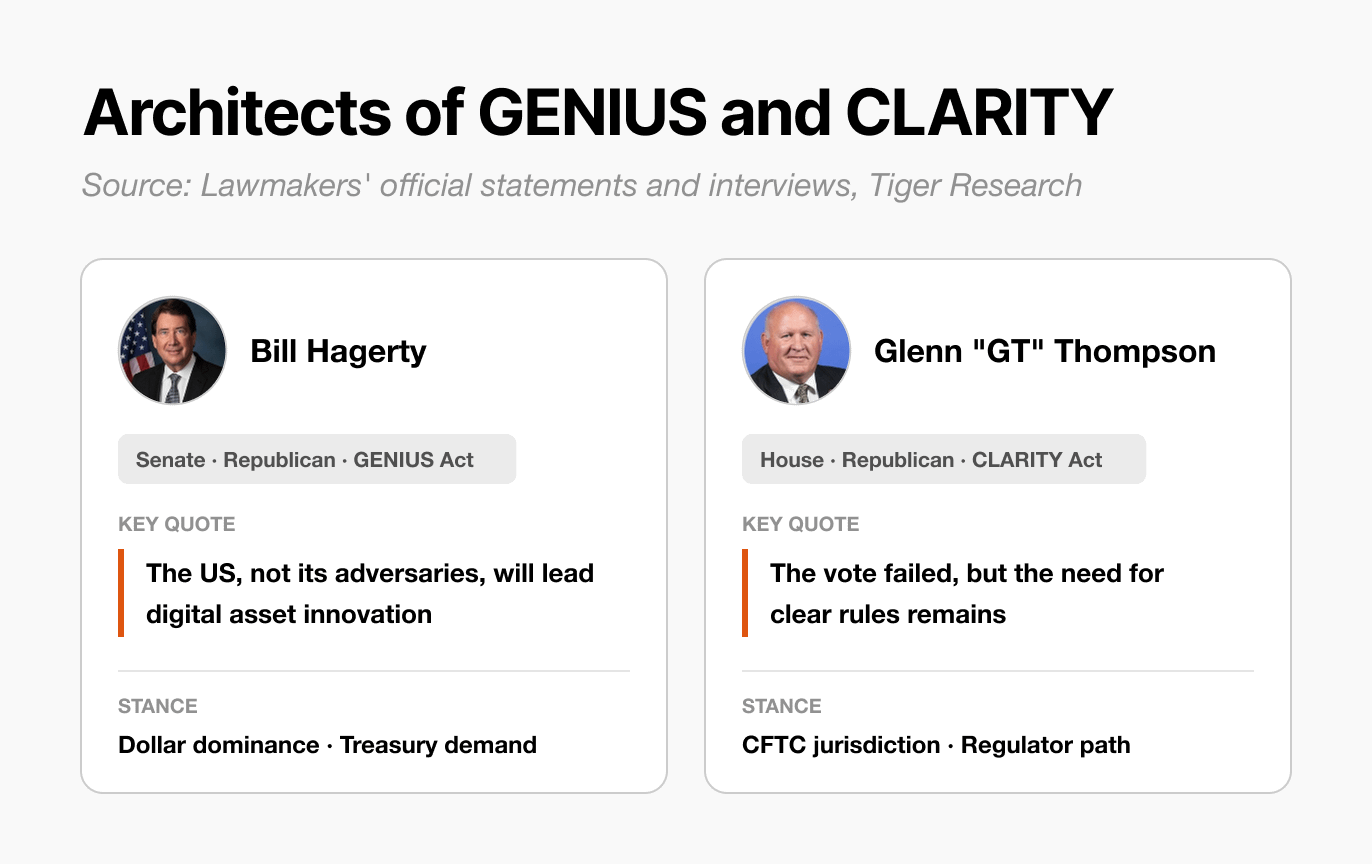
Senator Bill Hagerty and Representative Glenn Thompson, both reelected, helped write the frameworks behind stablecoin legislation and the CLARITY Act. With Republicans losing their majorities in both chambers, their priority will shift to preserving the legislative gains they have already made.
Republican lawmakers will now spend more of their time defending existing policy.
They are likely to focus on protecting the GENIUS Act, using the Senate’s 60-vote threshold for overcoming filibusters and the threat of a Trump veto to block Democratic efforts to tighten regulation. They may also support the SEC and CFTC in developing rules under their existing authority, allowing policy work to continue without new legislation.
3.2. Firm Opponents of a CBDC
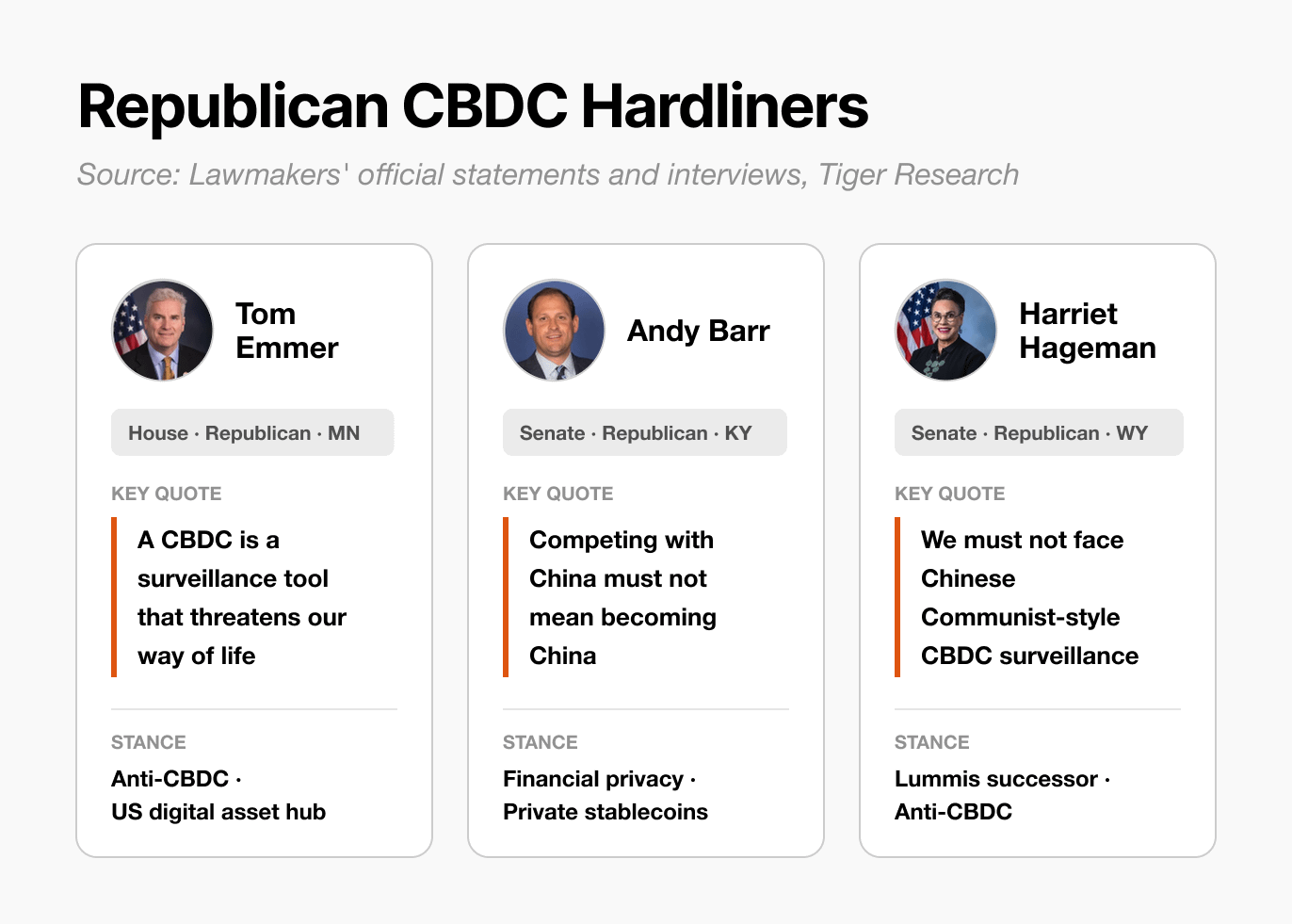
Opposition to a CBDC is one of the clearest points of agreement among elected Republicans. They see digital asset policy as a way to develop the industry while limiting government surveillance of financial activity.
These lawmakers support private sector digital assets but firmly oppose a digital dollar issued directly by the government. They view a CBDC as a potential tool for monitoring individual transactions and favor private stablecoins as an alternative.
Their goal is to prohibit a CBDC by statute. With Democrats controlling Congress, that route is effectively closed for the next two years.
President Trump’s January 2025 executive order remains the principal explicit federal prohibition on a U.S. CBDC. Because a future president could reverse the order, Republican lawmakers have sought to put the ban into law. Representative Tom Emmer’s Anti-CBDC Surveillance State Act passed the House in July 2025 but did not clear the Senate. Its prospects have weakened further under Democratic control of both chambers.
These lawmakers are therefore likely to focus on overseeing implementation of the GENIUS Act. For example, they may scrutinize whether Treasury’s implementing rules introduce mechanisms that would allow the government to monitor stablecoin transactions.
A CBDC is unlikely to be introduced during the remainder of Trump’s term, which runs through January 2029, as long as the executive order remains in place. Their attention is consequently likely to shift toward privacy protections for stablecoin users.
4. Democrats Now Set the Congressional Agenda
Democrats have secured majorities in both chambers. The remaining election results will determine the size of those majorities, but congressional control has already shifted.
Their current positions suggest that investigating the Trump family’s digital asset businesses will take priority over passing new legislation. Leading Democrats on the relevant committees identified these businesses as a top investigative priority before the election. As the majority party, they will have the authority to issue subpoenas.
Even if Democrats take up the CLARITY Act again, they are likely to demand stronger consumer protections and conflict-of-interest restrictions for public officials. Concerns about the Trump family’s digital asset businesses were a major obstacle in September’s Senate vote, when the bill received no Democratic support.
Republicans will focus on defending the GENIUS Act and blocking Democratic proposals to tighten regulation. Their minority status makes passing new laws difficult, but they retain substantial power to obstruct legislation. Most contested bills need 60 votes to overcome a Senate filibuster, and Trump can veto legislation that reaches his desk.
The CLARITY Act now faces a harder path to passage. Trump, who has been the main political force behind the administration’s crypto-friendly agenda, will also have less room to act. Republicans’ policy goals remain largely unchanged, but progress is likely to slow.
To assess the direction and pace of regulation, the industry will need to watch how leading Democrats pursue the Trump family’s digital asset interests and how the White House responds.
🐯 More from Tiger Research
Read more reports related to this research.One Year Under the Trump Administration: Changes in the U.S. Crypto Industry
U.S. Bitcoin Strategic Reserve: What It Will Actually Mean for the Market
Disclaimer
This report has been prepared based on materials believed to be reliable. However, we do not expressly or impliedly warrant the accuracy, completeness, and suitability of the information. We disclaim any liability for any losses arising from the use of this report or its contents. The conclusions and recommendations in this report are based on information available at the time of preparation and are subject to change without notice. All projects, estimates, forecasts, objectives, opinions, and views expressed in this report are subject to change without notice and may differ from or be contrary to the opinions of others or other organizations.
This document is for informational purposes only and should not be considered legal, business, investment, or tax advice. Any references to securities or digital assets are for illustrative purposes only and do not constitute an investment recommendation or an offer to provide investment advisory services. This material is not directed at investors or potential investors.
Terms of Usage
Tiger Research allows the fair use of its reports. ‘Fair use’ is a principle that broadly permits the use of specific content for public interest purposes, as long as it doesn’t harm the commercial value of the material. If the use aligns with the purpose of fair use, the reports can be utilized without prior permission. However, when citing Tiger Research’s reports, it is mandatory to 1) clearly state ‘Tiger Research’ as the source, 2) include the Tiger Research logo. If the material is to be restructured and published, separate negotiations are required. Unauthorized use of the reports may result in legal action.


