

Key Takeaways
The digital asset custody market has grown quickly over the past year, with the number of custodians licensed under MiCA in Europe rising more than fourfold, from 50 to 230.
Custody earns fees in proportion to the value of the assets held, which limits its growth, and trust services, which allow a firm to manage and invest those assets, are emerging as the next stage.
Historically, safe deposit companies expanded from safekeeping into estate administration and collateral management, and State Street later moved from custody into investment management. A similar pattern is now emerging in digital assets.
Anchorage and BitGo are expanding into stablecoin issuance and settlement, while Agora and Catena are pursuing investment advisory and asset management, and all four are using, or seeking to use, national trust bank charters to expand their services.
A custodian’s competitiveness is expected to depend less on the volume of assets it holds than on the additional services it can offer clients.
1. The Custody Industry’s Rapid Growth Over the Past Year
A year ago, Tiger Research’s report “The Custody Industry Growth You May Have Overlooked” argued that custody is a core foundation of the digital asset industry. At the time, however, custody services that hold and manage assets drew little attention.
Over the past year, the number of companies entering the crypto custody market has risen sharply. In Europe, custodians licensed under MiCA (Markets in Crypto-Assets Regulation), the EU’s comprehensive crypto framework, increased more than fourfold, from 50 to 230. Large global financial institutions are also joining, with Standard Chartered acquiring a specialist custody firm and Citigroup announcing plans to enter the market within the year.
This shift reflects the steady growth of on-chain assets. According to RWA.xyz, tokenized real-world assets (RWA) have grown 85% this year alone to about $39.8 billion. Stablecoins grew more than 50% in 2025 alone to pass $300 billion and have held around that level since. Because both tokenized assets and stablecoins require the underlying assets to be held in custody, custody demand has grown alongside them.
Companies are not entering the market for custody alone, however. Custody revenue comes mainly from fees proportional to the assets held, which limits growth. Companies are therefore using their existing custody relationships as a starting point to expand into trust services and improve profitability.
Companies are focusing on custody to capture rising custody demand in the near term and, over the longer term, to use it as a base for expanding into higher-value businesses such as trust services.
2. Custody and Trust Services: From Safekeeping to Asset Management
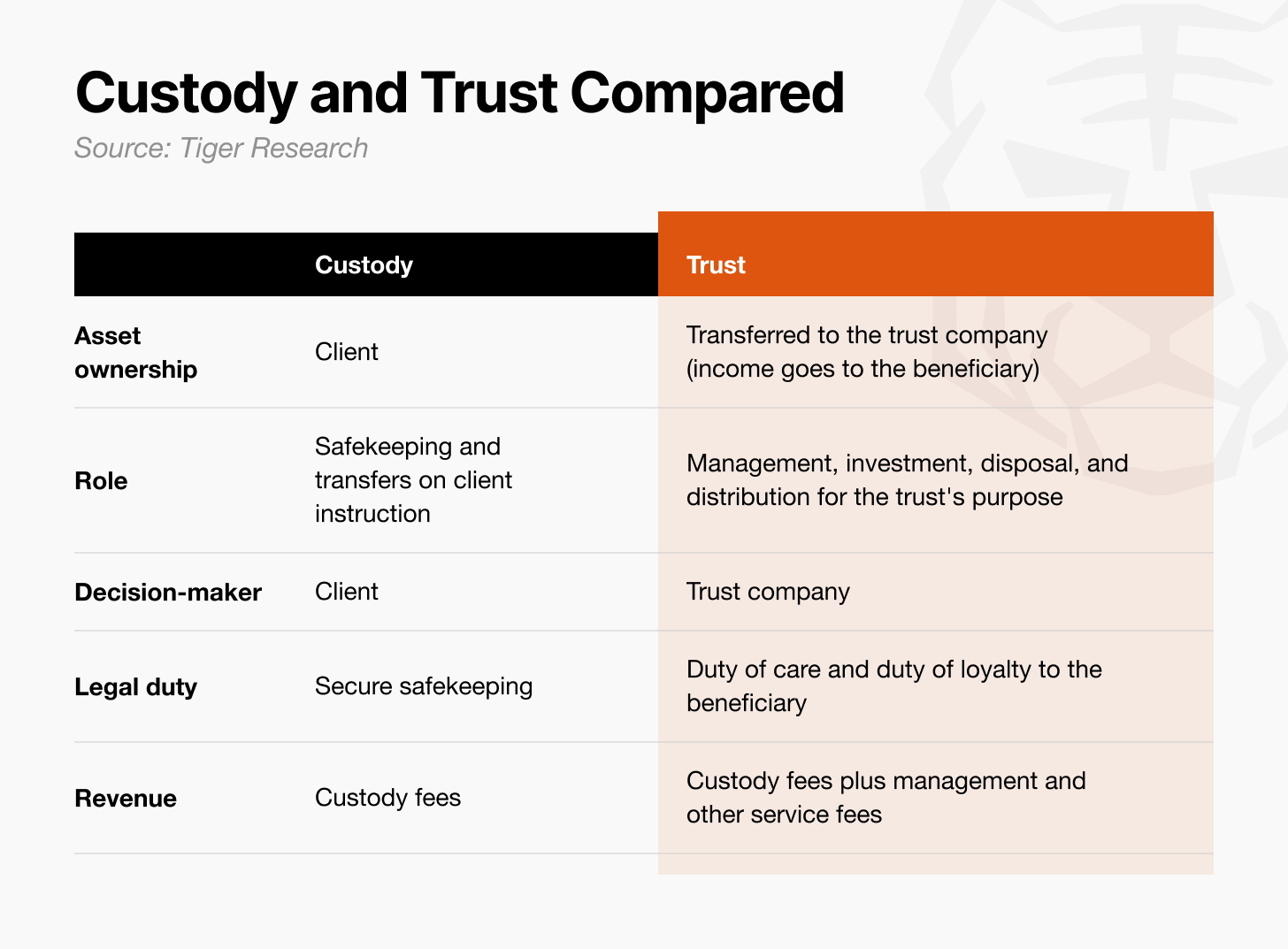
Custody and trust services are often confused. Both involve holding client assets, but the provider’s responsibilities differ.
Custody is a service that holds client assets on the client’s behalf. The client remains the owner, and the custodian’s role is limited to safekeeping. In a trust, by contrast, the client (the settlor) transfers assets to a trust company (the trustee), which then manages, invests, and disposes of them according to the purpose of the trust.
Any income from those assets goes to the person the client designates (the beneficiary). A trust company works much like someone entrusted with managing a family’s wealth, who invests it and distributes it to family members at set times. Because the trust company makes its own decisions about the assets, it has a legal duty to put the beneficiary’s interests first.
Both involve holding client assets, but custody focuses on safekeeping while trust services focus on management and investment.
3. A Repeating Cycle: From Safekeeping to Trust Services
Until now, most digital asset custody services have focused on holding assets securely. In the early market, custody demand came mainly from spot and futures trading, which required no complex management structure. As financial products based on real-world assets (RWA) have become more widely available, however, the need for trust functions that can carry out investment instructions and manage complex investment structures has grown quickly.
This shift closely mirrors the development of traditional finance. During the American Civil War in the 1860s, expanded government bond issuance sharply increased demand for secure storage of debt securities. Later, as pooled investment vehicles such as funds emerged, custody work grew into a specialized trust industry.
3.1. Safe Deposit Companies: From Safekeeping to Estate and Collateral Management
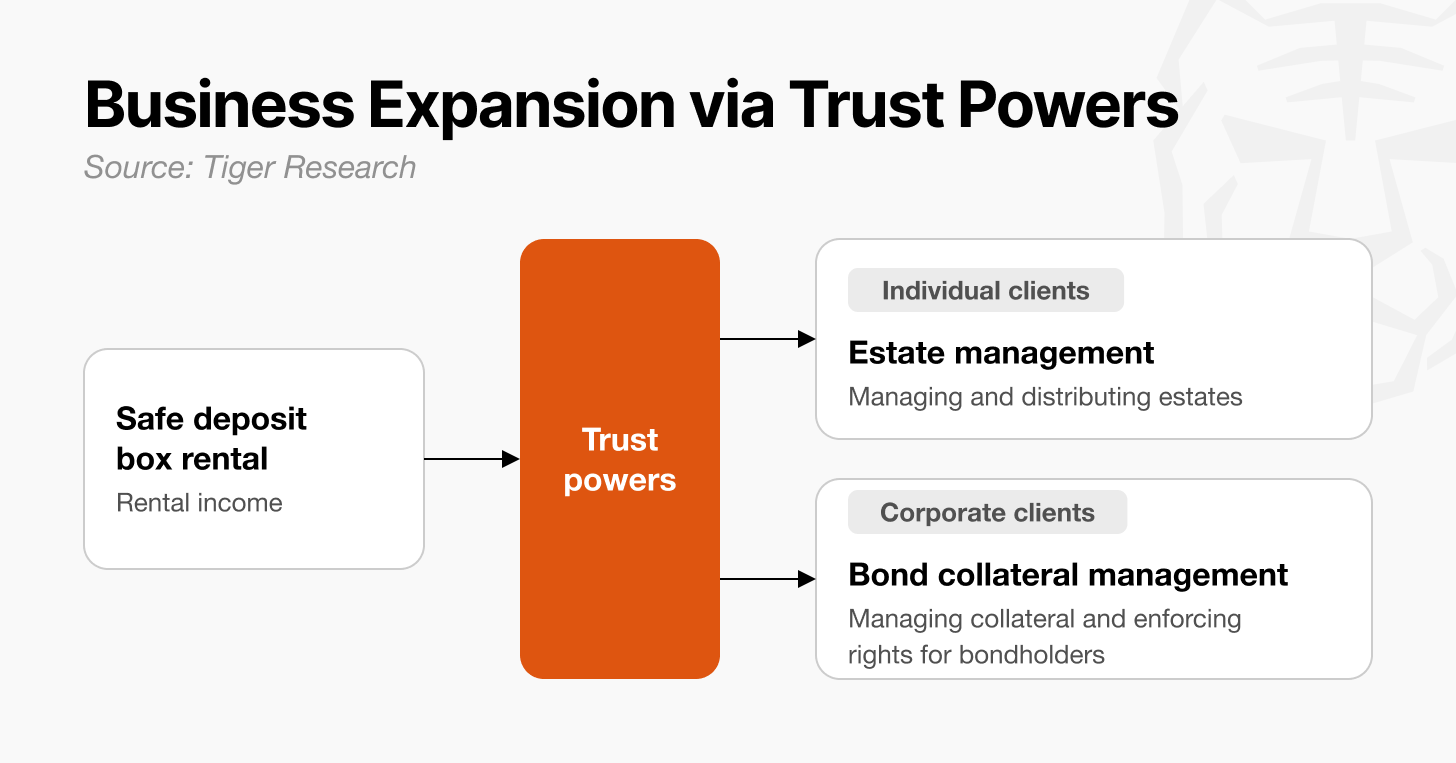
Safe deposit companies in Boston and Rochester are leading examples of firms that started in safekeeping and expanded into trust services. Both initially earned rent by leasing safe deposit boxes to customers. After adding trust services, they expanded into administering individuals’ estates and managing corporate bond collateral.
They were able to expand because their customers faced problems that safekeeping alone could not solve. Once they obtained the authority to provide trust services, the safe deposit companies could address these additional client needs.
For individual customers, the problem was inheritance. When a customer died, the securities in the box had to be sorted and distributed to heirs, but a company that only rented out boxes had no authority to do so. With trust powers, safe deposit companies could take responsibility for managing and distributing property after death.
A typical arrangement would invest the estate to pay the surviving spouse income for life and then pass the principal to the children after the spouse’s death.
For corporate customers, the problem was bond collateral management. When a company issued bonds to many investors, it needed a party to manage the collateral on behalf of the bondholders and enforce their rights in the event of default. Trust companies took on this work, which bondholders found difficult to handle individually.
In 1883, the Boston company became the trustee managing the collateral for American Rapid Telegraph’s $3 million bond issue, and when interest went unpaid, it filed to foreclose on the collateral on behalf of the bondholders.
These historical cases show that safe deposit companies grew by adding legal authority to a trusted safekeeping system and taking on work that customers found difficult to handle themselves.
Customers who trusted these firms to safeguard their assets were also willing to let them manage those assets. Trust powers gave the firms the legal authority to administer estates and manage collateral. The companies applied capabilities built through safekeeping to the next problem their customers faced.
Custodians can grow by addressing similar unmet client needs, which means looking not only at how much their assets under custody have grown, but also at what else the clients who own those assets need.
3.2. State Street: From Holding Fund Assets to Managing Them
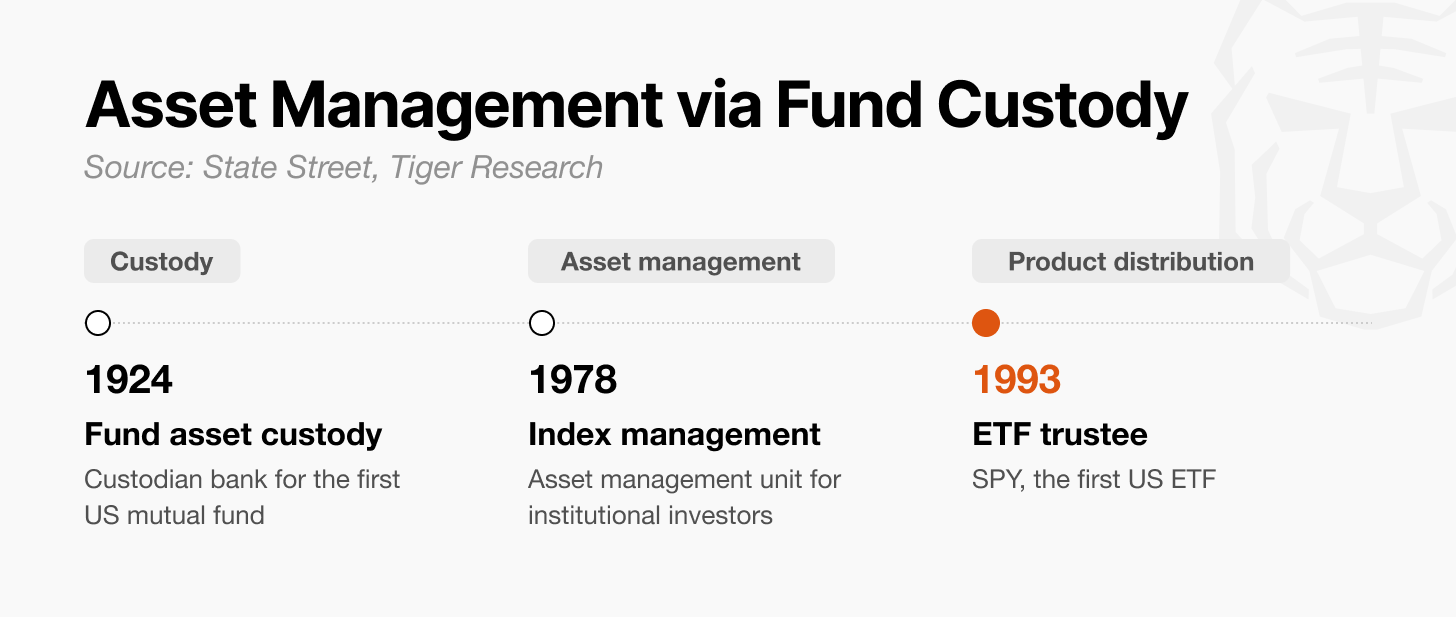
State Street is an example of a firm that moved from holding fund assets to managing them directly. In 1924, it became the custodian bank for the first US mutual fund, and in 1978 it established an asset management unit for institutional investors. Having safeguarded assets managed by other firms, State Street began earning investment management fees of its own.
Handling both custody and asset management allowed the firm to offer clients more services. Clients could have their assets held and managed within the same group, and the firm could offer investment products to clients already using its custody services. The firm could grow by providing more services to existing clients, not only by finding new ones.
Its first asset management business also started with services that drew on its existing capabilities. State Street initially focused on index management and cash management. Index management in particular required the ability to buy assets in line with an index, process trades, and maintain holdings records, all work the firm had already been doing as a custodian bank.
The firm later broadened the client base for its products. In 1993, together with the American Stock Exchange, it launched SPY, the first US ETF, turning the index management it had offered to institutions into a product that individuals could easily buy and sell on an exchange. The business progressed from custody to asset management, and from asset management to product distribution.
State Street applied the experience it gained from handling trading, settlement, and recordkeeping for fund assets to index management, then launched an ETF that extended its client base to individual investors.
Digital asset custodians can likewise find their next business in the assets they hold and the clients they already serve, by looking at what clients want beyond safekeeping and adding first the services they are best placed to provide. Helping clients put those assets to use matters as much as growing assets under custody.
4. How Digital Asset Custodians Are Moving Into Trust Services
Digital asset custodians are moving beyond simple safekeeping and expanding into trust services. They are obtaining or applying for trust charters and broadening the services and products they offer clients.
Leading examples are Anchorage, BitGo, Agora, and Catena. Anchorage and BitGo are expanding into stablecoin issuance and settlement, while Agora and Catena are preparing to offer investment advisory and asset management. Their directions differ, but all four are looking for new revenue from the assets they hold.
4.1. Anchorage and BitGo: Adding Banking Services to Custody
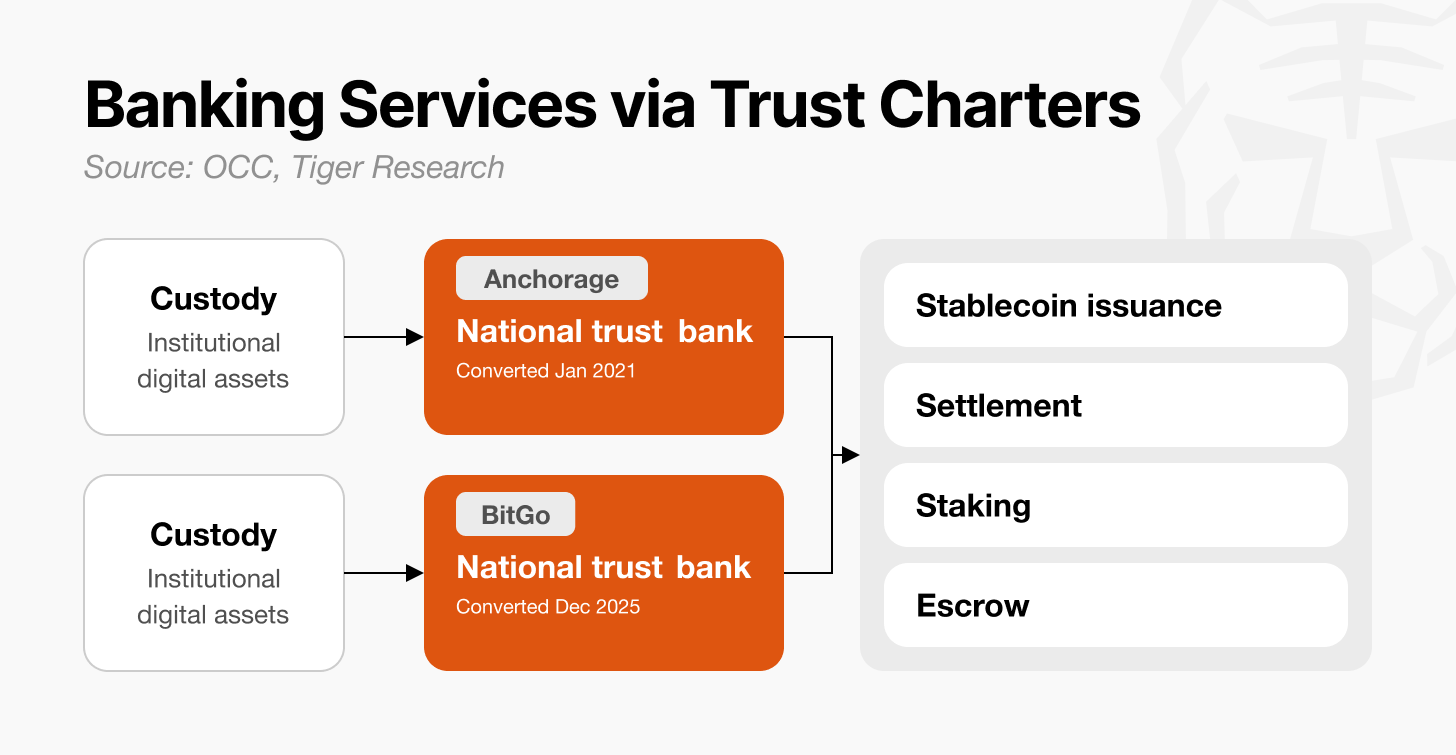
Safe deposit companies once expanded from safekeeping into estate and collateral management. In digital assets, Anchorage Digital and BitGo are following the same path. Both started by holding digital assets for institutions and now provide the financial services clients need to put those assets to work.
Both are authorized to provide trust services as well as custody. Anchorage in January 2021 and BitGo in December 2025 converted from state-chartered trust companies into national trust banks supervised by the Office of the Comptroller of the Currency (OCC).
Since then, their business has broadened from institutional Bitcoin and Ethereum products to RWA and stablecoins. Through their trust banks and affiliates, they are adding trading, settlement, collateralized lending, and staking to custody. In stablecoins, they also act directly as issuers, handling issuance, redemption, and reserve management.
Their competitors are no longer limited to other custodians. They can also compete for institutional clients with traditional banks entering the digital asset business, because they already have a client base and experience processing digital asset transactions.
As the markets for institutional Bitcoin and Ethereum products, RWA, and stablecoins grow, so does their opportunity to provide more of the financial services traditionally offered by banks.
The two companies have grown large enough to compete with traditional banks for clients in digital assets.
Their competitive strengths are the institutional clients they have already secured and their experience handling digital asset financial operations. While traditional banks expand their digital asset businesses, the two companies can establish themselves early by handling trading, settlement, and financing for existing clients.
By the time banks enter this market, Anchorage and BitGo may already be established as major competitors.
Just as safe deposit companies grew into banks by way of trust services, the two companies are growing from custody specialists into firms that handle digital asset finance for institutions.
Firms that have grown through custody and trust services may eventually become global banks. If clients anywhere in the world can deposit digital assets with them and easily handle the financial services they need, these firms could be used much like a local bank.
4.2. Agora and Catena: From Holding Assets to Managing Them
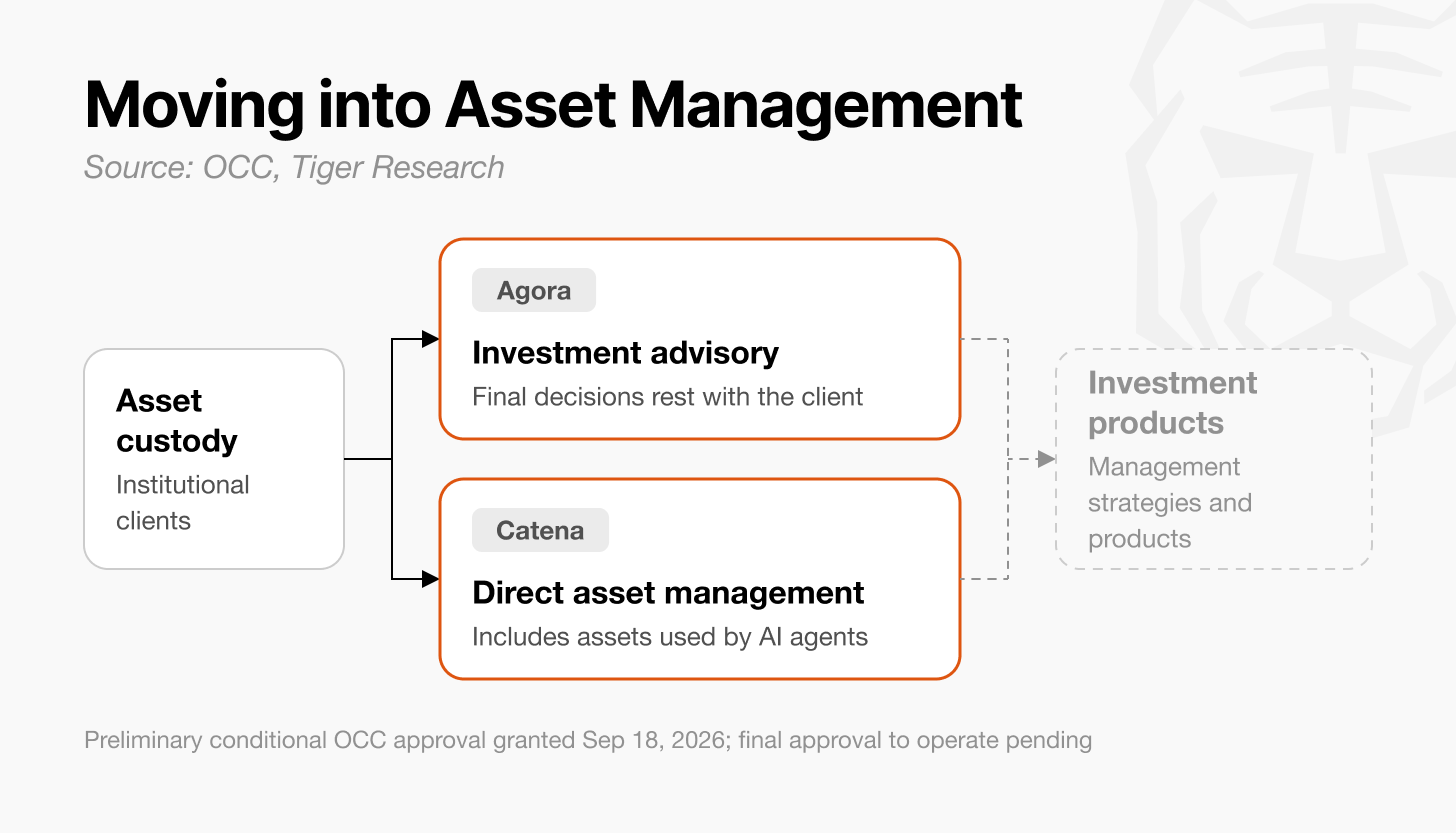
State Street applied its experience holding fund assets to asset management and later broadened its client base through ETFs. Agora and Catena are likewise preparing to add investment advisory and asset management to custody, moving beyond holding client assets to advising on where and how to invest them.
On September 18, 2026, both received preliminary conditional approval from the OCC to establish national trust banks. They must still meet opening conditions, including capital and operational requirements, and obtain final approval before they can begin operations.
Their advisory and asset management businesses through trust banks are therefore still in preparation and not yet at a stage where revenue or performance can be assessed.
Once approved, Agora plans to recommend investment opportunities and sources of yield to institutional clients that hold assets with it, with final investment decisions left to the client. Catena plans to manage assets directly under terms agreed with clients, and also to manage assets that AI agents use on behalf of companies. Their approaches differ, but both aim to add investment advisory or asset management to custody.
Their early moves matter because, in digital asset management, understanding the market and building a strategy ahead of others is itself a source of competitive advantage.
In DeFi, earning yield by lending assets, providing liquidity, and combining multiple services works differently from traditional finance, so it takes time to learn where returns come from and what risks they carry. This is why even firms with extensive asset management experience in traditional finance would find it difficult to enter this market without first developing the necessary expertise.
If Agora and Catena analyze investment opportunities and prepare management strategies early, they may be able to stay ahead of financial institutions that enter later. Once they begin operations and build a track record in performance and risk management, that gap could widen.
If the two companies build digital asset management experience before traditional financial institutions do, they could use it to secure a clear lead in the market. If they then launch products that retail investors can easily access, they could grow large enough to rival traditional asset managers.
5. Custody Is Now the Baseline: Preparing for What Comes Next
Holding digital assets securely is a custodian’s core function. Custodians will increasingly compete on the services they offer beyond safekeeping. As DeFi and RWA markets grow, clients want to invest their assets, use them as collateral, and trade them.
Tokenized Treasury funds are one example. Investors can do more than hold the fund and earn yield: they can use it as collateral to borrow stablecoins and put those toward other investments, so a single asset serves several financial transactions. For financial firms, helping clients use existing products in more ways becomes as important as creating new ones.
This also gives custodians room to expand. For institutions to use digital assets for investment and trading, they need asset transfers, settlement, and collateral management in addition to secure safekeeping. A custodian that already holds the assets and can also handle this work can take on a larger role in its institutional clients’ financial transactions.
Trust services are one way to take on the management and investment of those assets. A trust company can manage, invest, and distribute assets in line with the client’s objectives and the terms of the trust.
By expanding services through trust banks and affiliates, as the companies above have done, a custodian could grow into a firm that offers some of the services traditionally provided by banks, securities firms, and asset managers.
Obtaining a charter alone will not grow the business, however. Custodians need to build the services clients need, manage assets securely, and earn trust through actual results. Custodians that build experience in digital asset management and trading first may also gain an edge over traditional financial institutions.
A year ago, the focus was on the growth of the custody industry itself. The question now is what the companies holding those assets can do next. The coming year may be when companies that have been preparing to offer trust services launch them and win clients. If custody is the baseline requirement, the services custodians build on top of it through trust charters will determine who leads in the next stage.
🐯 More from Tiger Research
Read more reports related to this research.Banks That Do Not Wait for Regulation: Europe’s MiCA as the Execution Standard for Stablecoins
One Year Under the Trump Administration: Changes in the U.S. Crypto Industry
Disclaimer
This report has been prepared based on materials believed to be reliable. However, we do not expressly or impliedly warrant the accuracy, completeness, and suitability of the information. We disclaim any liability for any losses arising from the use of this report or its contents. The conclusions and recommendations in this report are based on information available at the time of preparation and are subject to change without notice. All projects, estimates, forecasts, objectives, opinions, and views expressed in this report are subject to change without notice and may differ from or be contrary to the opinions of others or other organizations.
This document is for informational purposes only and should not be considered legal, business, investment, or tax advice. Any references to securities or digital assets are for illustrative purposes only and do not constitute an investment recommendation or an offer to provide investment advisory services. This material is not directed at investors or potential investors.
Terms of Usage
Tiger Research allows the fair use of its reports. ‘Fair use’ is a principle that broadly permits the use of specific content for public interest purposes, as long as it doesn’t harm the commercial value of the material. If the use aligns with the purpose of fair use, the reports can be utilized without prior permission. However, when citing Tiger Research’s reports, it is mandatory to 1) clearly state ‘Tiger Research’ as the source, 2) include the Tiger Research logo. If the material is to be restructured and published, separate negotiations are required. Unauthorized use of the reports may result in legal action.


