

Key Takeaways
JPMorgan is the world's largest dollar-clearing bank, handling $12 trillion a day, and its blockchain unit Kinexys is building products to process these payments around the clock.
The Blockchain Deposit Account (BDA), which lets corporates move funds at any hour, is its main product, with estimated daily volume of about $3.5 billion, or roughly 0.03% of JPMorgan's total payments, assuming BDAs still account for half of Kinexys's total volume.
JPM Coin, which turns deposits into tokens, has recorded only 48 transfers on Base since its first issuance, and the intraday repo service, which lends funds for a matter of hours, has not disclosed figures since 2022.
JLTXX, a tokenized fund, by contrast reached $800 million in net assets within two months of launch, most likely because stablecoin issuers placed their reserves in it.
The results are still small, but JPMorgan is gradually expanding its blockchain business on the foundation of the payments clients and deposits it already has.
1. Kinexys: The Blockchain Unit of a Bank That Settles $12 Trillion a Day
JPMorgan is the world's largest dollar-clearing bank, processing roughly $12 trillion a day across 120 currencies. Its payments business posted record revenue of $19.3 billion in 2025 and, in the third quarter of 2026, generated the most revenue of any business within the Corporate & Investment Bank (CIB), firmly establishing it as one of the group's core sources of revenue.
JPMorgan has recently been moving its core payment rails onto blockchain to automate payment processing, run it around the clock, and improve efficiency, and Kinexys sits at the center of that shift.
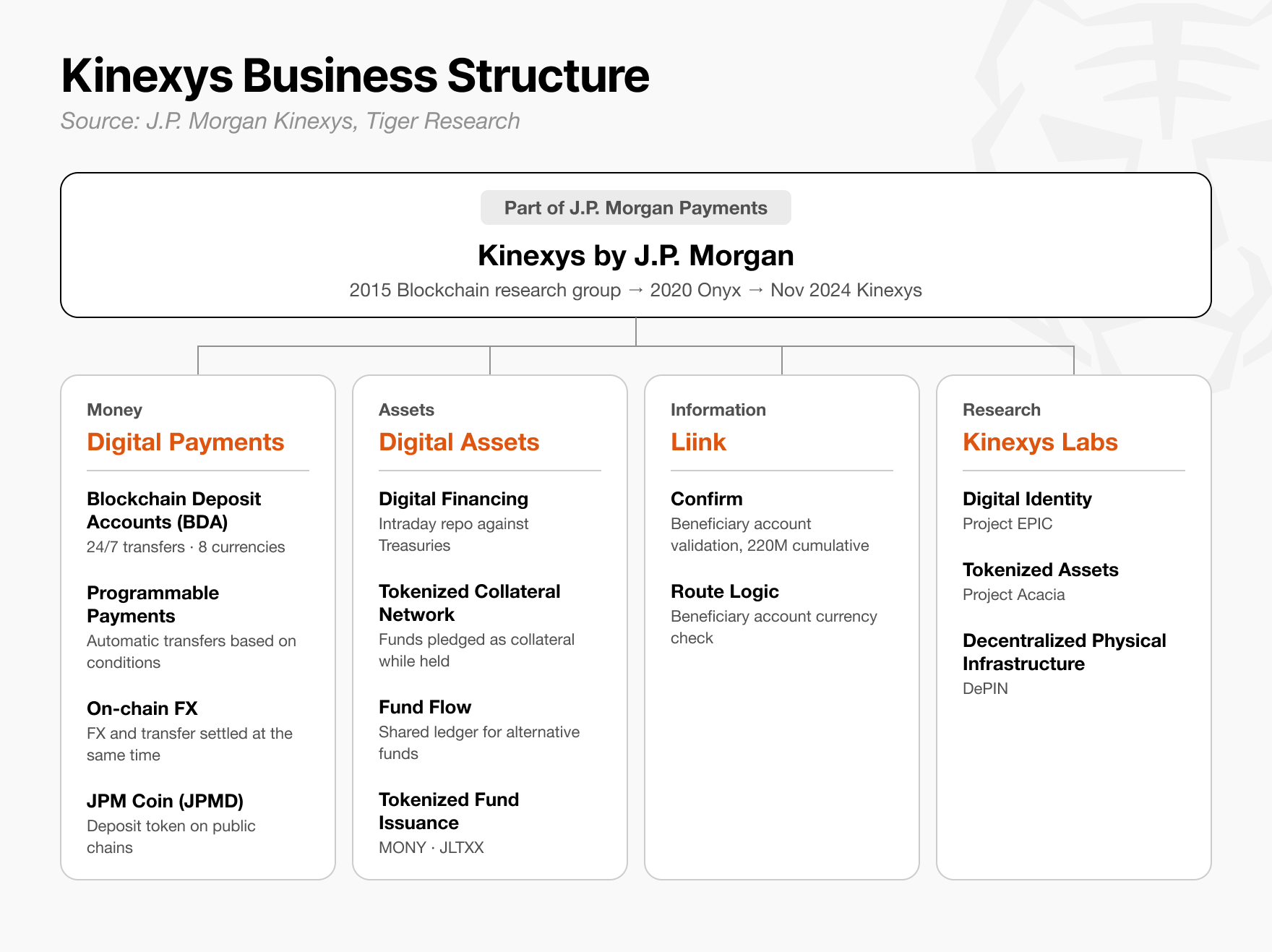
Kinexys is both an internal business unit and a key platform. Its roots date back to a blockchain research group established in 2015, and it took its current name in November 2024.
Kinexys aims to build financial infrastructure that is "programmable, always on." Its goal extends beyond individual tokenization projects to infrastructure on which deposits and assets move on a single ledger around the clock and settle automatically according to preset conditions.
Kinexys brings together blockchain-based payments, asset tokenization, and services and capabilities developed through Liink and Kinexys Labs, across private and public blockchain networks.
2. BDA: Deposit Accounts That Settle 24/7
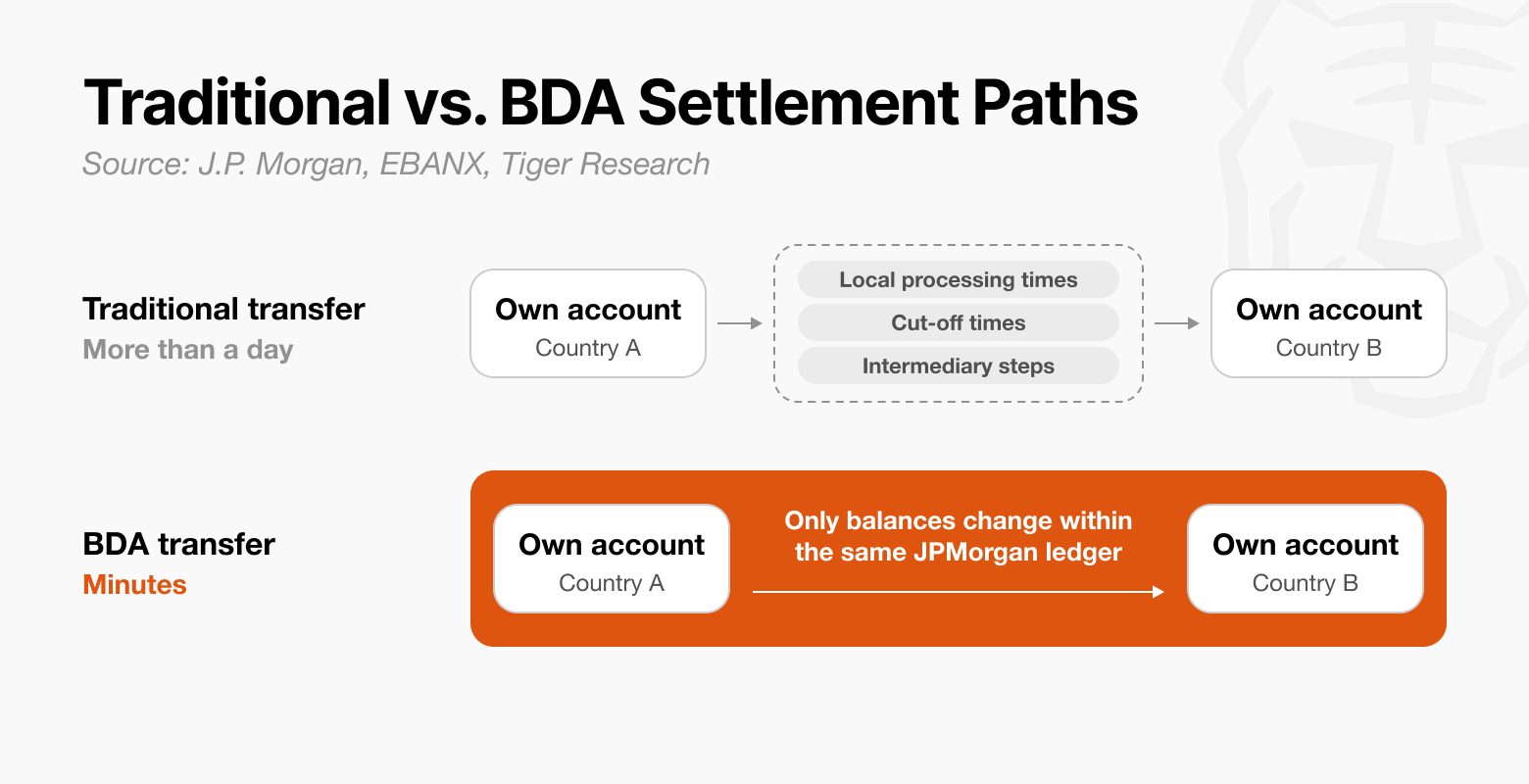
Kinexys's main service is the Blockchain Deposit Account (BDA). It is a deposit account on a blockchain operated by JPMorgan, designed so that corporates can move and settle funds 24 hours a day without being tied to banking hours.
This works because of how the ledger is structured. Transfers between BDAs only change balances within the same JPMorgan-operated ledger, so they settle immediately, including at night and on weekends, without waiting for banking hours. BDAs also support programmable payments that move funds automatically once set conditions are met, as well as on-chain FX.
Payments company EBANX is a leading example.
Using Kinexys BDAs, EBANX reduced the time needed to transfer funds between its accounts across roughly 20 countries from more than a day, caused by country-specific processing times and intermediary steps, to a few minutes.
Because settlement happens in real time within JPMorgan's ledger, EBANX can confirm receipt regardless of time zone, which has allowed it to reduce the buffer funds it holds in each account.
According to a 2025 report Kinexys published with the MIT Digital Currency Initiative, BDAs processed more than $1 billion a day. Kinexys's total daily volume at the time was over $2 billion, meaning BDAs alone accounted for half of its transaction volume and were a major contributor to its activity.
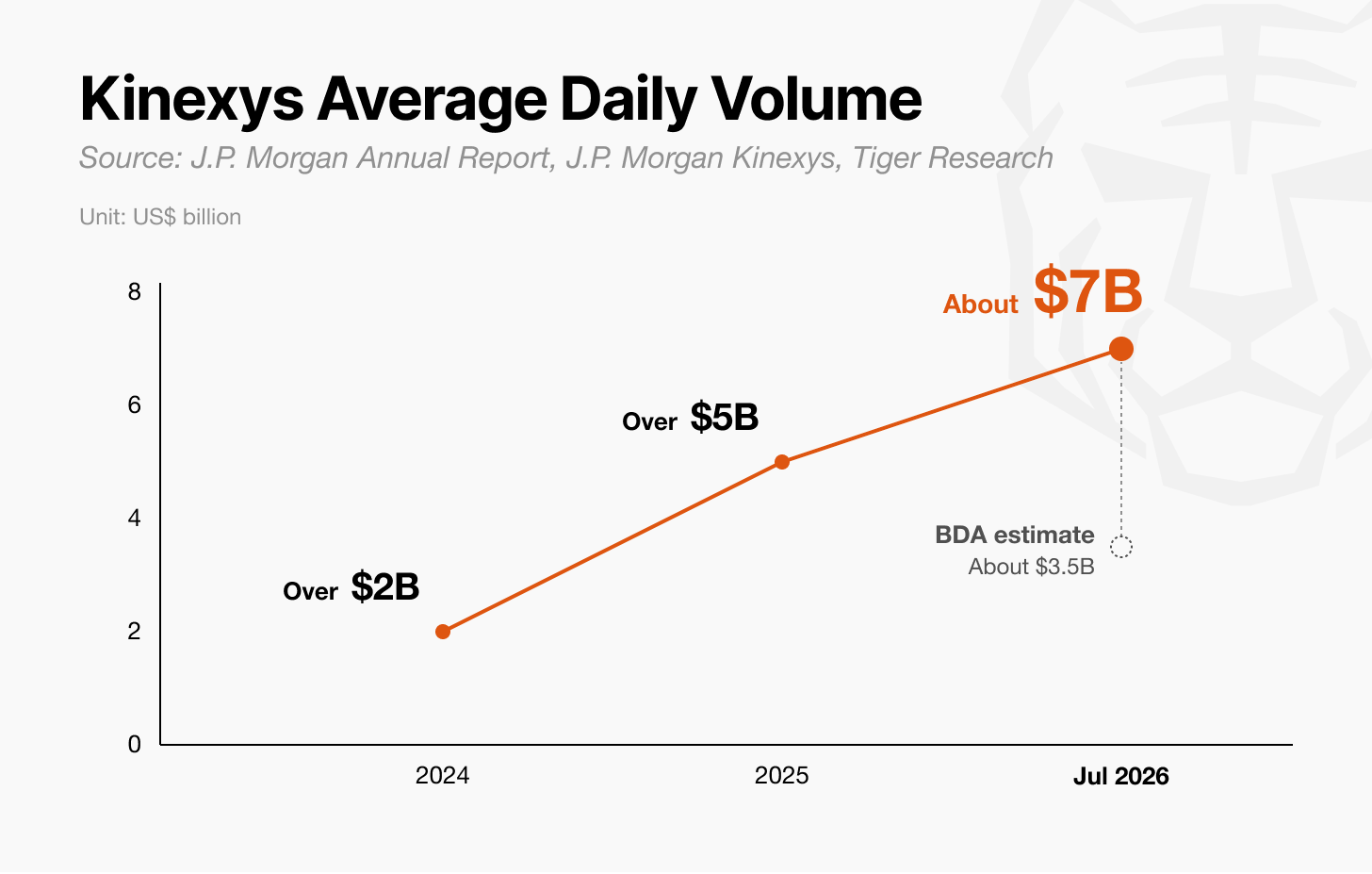
JPMorgan has not disclosed BDA figures separately since then, but Kinexys's total volume has grown steadily. Average daily volume rose from more than $5 billion in 2025 to roughly $7 billion in July 2026. Assuming BDAs still account for about half of the total, as they did in January 2025, current BDA daily volume can be estimated at about $3.5 billion.
Even including repo, these figures remain small relative to JPMorgan's overall payments volume. Kinexys's total daily volume of $7 billion is about 0.06% of the payments business's daily volume (roughly $12 trillion), and the BDA estimate of about $3.5 billion is about 0.03%.
BDA is a commercial service through which real corporate funds already move. Compared with JPMorgan's overall payments volume, however, it is still at an early stage, used mainly by a limited number of companies to move funds between their own entities. Its volume continues to grow, which indicates that the service is proving useful.
3. JPM Coin (JPMD): Deposits Moving onto Public Chains
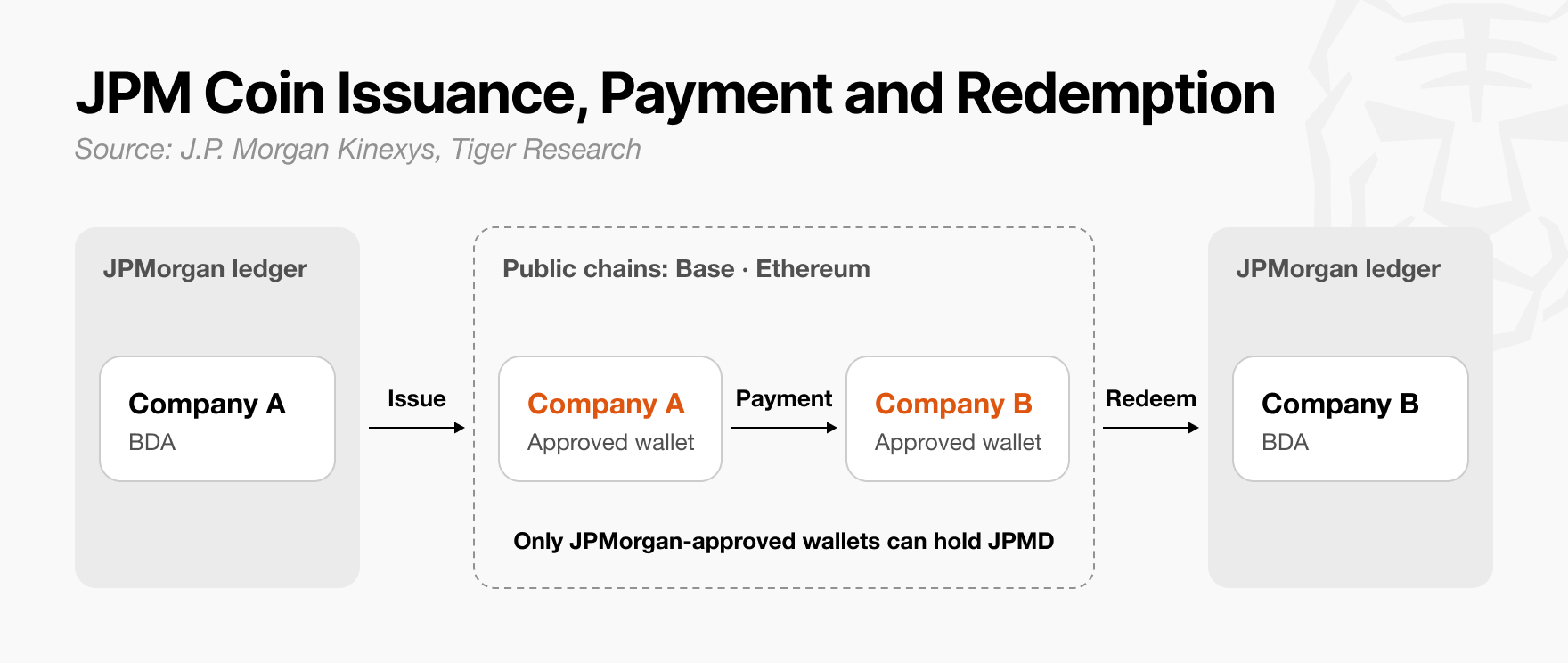
JPM Coin (JPMD) turns BDA deposits into tokens on public blockchains. The aim is to let deposits that were previously usable only among JPMorgan clients be used on blockchains outside the bank.
A company issues JPM Coin from its BDA balance, uses it to pay for transactions on Base or Ethereum, and can later redeem the tokens for funds credited to its BDA. Ownership is restricted, however, since only wallets approved by JPMorgan can hold the token.
JPMorgan's goal is to settle public-chain transactions directly in bank deposits.
Until now, institutions that wanted to pay in dollars on public chains have mostly had to use stablecoins. B2C2, which took part in testing at launch, expected JPM Coin to provide "real-time, onchain settlement with the assurance of a regulated USD deposit" for the same reason. JPMorgan has not, however, quantified the resulting cost savings.
On-chain data shows the following issuance and usage of JPMD by chain.
Base: Since the first issuance in June 2025, there have been only 48 transfers, and none at all since February 20, 2026. Outstanding supply as of November 3 is about $1 million, roughly 0.02% of USDC supply on the same chain (about $4.3 billion).
Ethereum: No tokens have been issued on the Ethereum version launched later, and no clients beyond the initial testing participants have been identified as actual users.
Contrary to expectations, JPM Coin has seen almost no real use, despite being issued across 2025 and 2026. Given that BDA took about three years to establish real use cases, however, JPM Coin is still at a very early stage and could begin to see broader adoption in early 2027.
4. Digital Financing: Intraday Repo That Reduced One Institution's Borrowing Rate by 56%
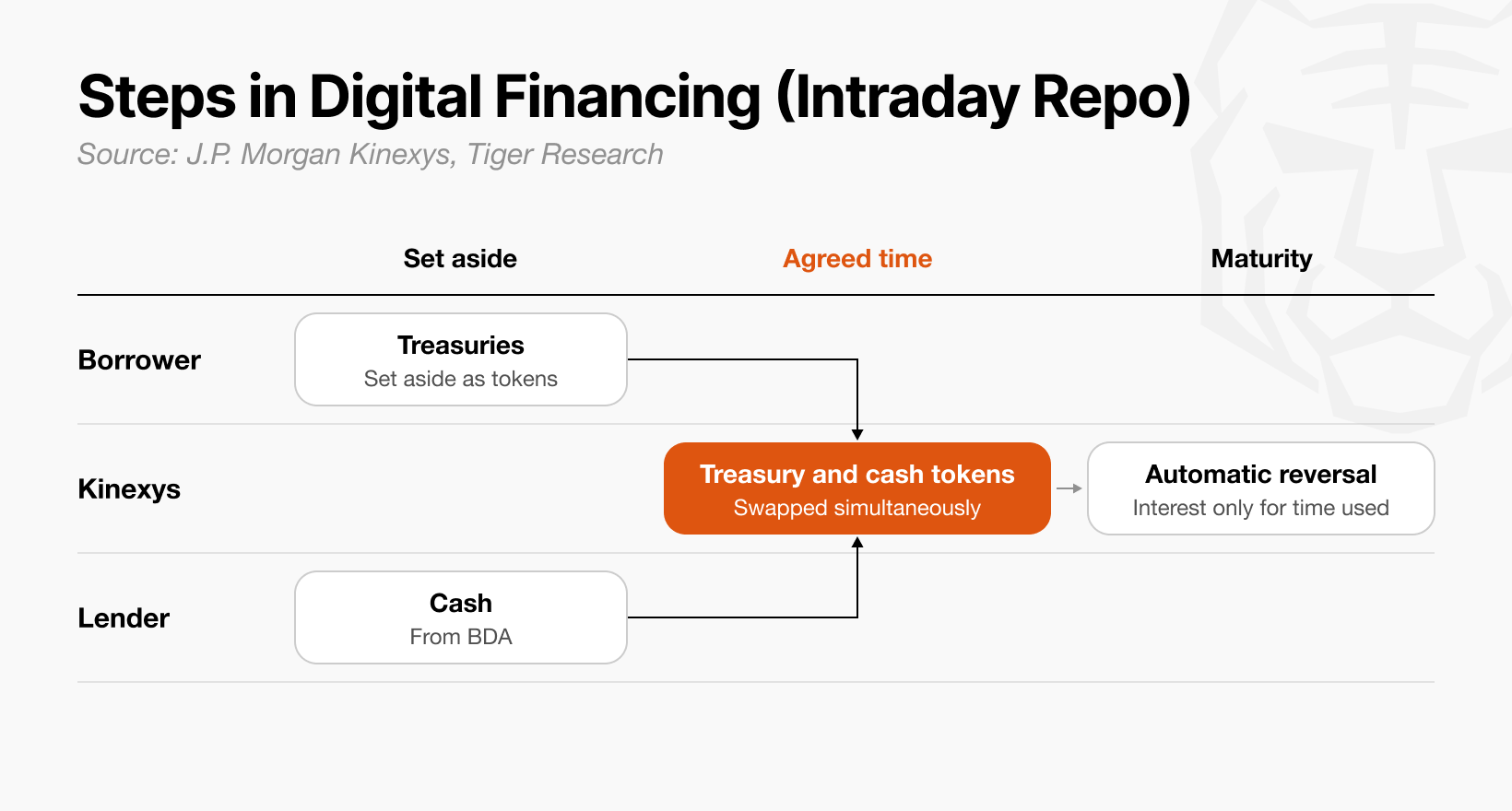
Digital Financing is an intraday repo service that lets institutions borrow for a matter of hours against Treasuries.
Financial institutions such as banks and broker-dealers sometimes need funds for only a few hours during the day to meet payment obligations. Digital Financing lets them obtain short-term funding at a lower rate than a bank's intraday credit line.
The borrower sets aside Treasuries and the lender sets aside cash, both in tokenized form, and the two are exchanged simultaneously at the agreed time. Because maturity can be set to the minute, the borrower pays interest only for the time used, and the cash leg is funded through BDAs.
This has lowered borrowing costs. According to a JPMorgan case study, one global financial institution cut its borrowing rate by 56% by using Digital Financing instead of a bank intraday credit line.
The problem is that it is hard to verify whether the service is still used at that scale. In a 2022 report, JPMorgan stated that cumulative repo volume had exceeded $430 billion since the service launched in November 2020, but it has not published repo figures since.
Broadridge's DLR, a competing blockchain repo platform, averaged $359 billion in daily volume as of September 2026. Even measured against JPMorgan's 2022 figures, DLR's daily volume alone exceeds half of JPMorgan's cumulative volume at the time, a substantial gap in scale.
ICMA also named DLR and Kinexys as blockchain repo platforms that have reached commercial scale, while assessing that JPMorgan's impact on the overall market remains limited.
5. Tokenized Funds: $800 Million in Two Months, Aimed at Stablecoin Reserves
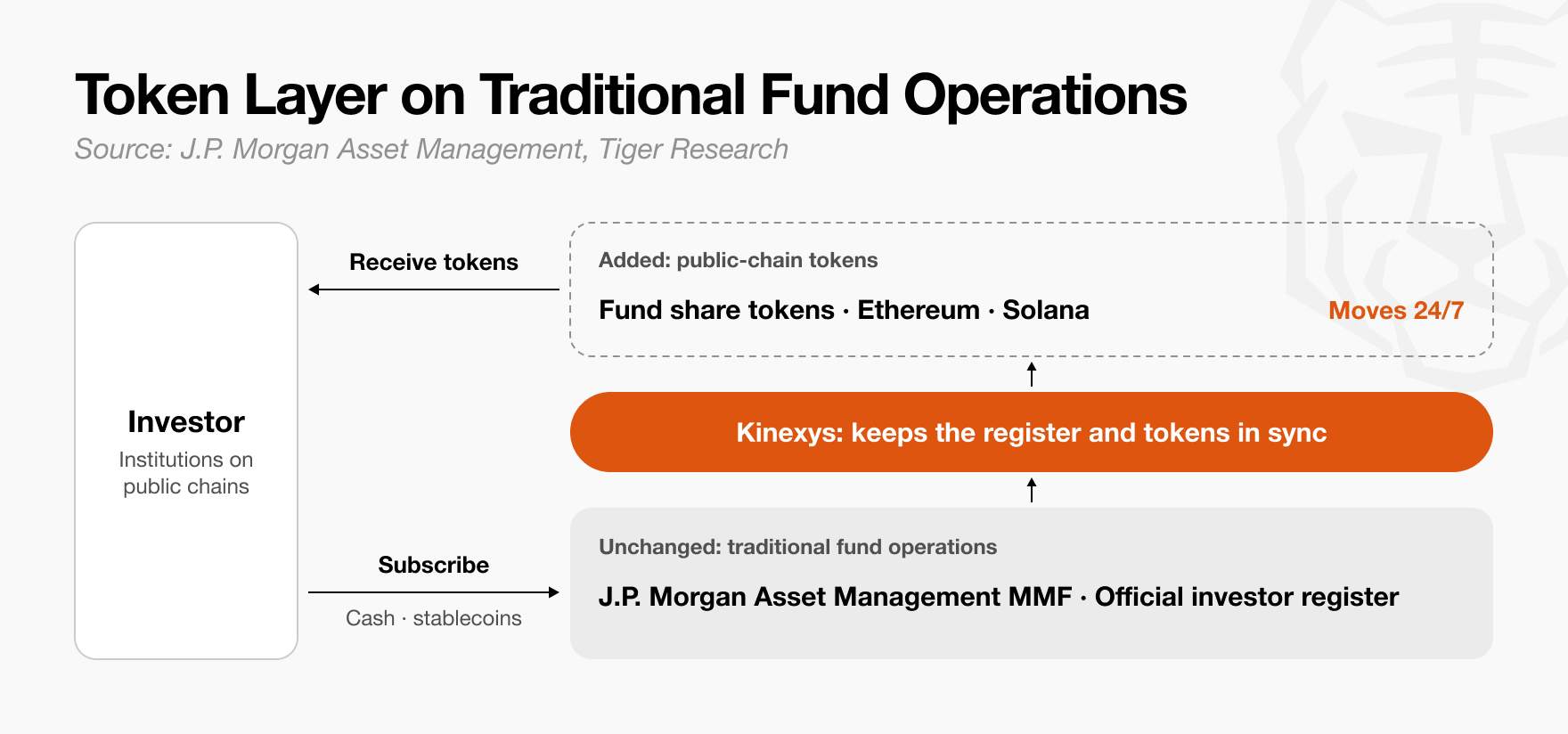
These tokenized funds represent shares in J.P. Morgan Asset Management's money market funds (MMFs) as tokens on public blockchains. They were created to bring institutional money held on public chains into JPMorgan funds.
Stablecoin issuers are the main institutions holding large sums on public chains. For every $1 of stablecoins issued, an issuer must hold $1 in safe assets such as Treasuries as reserves, and many place these reserves in MMFs to earn interest.
The problem is timing. Stablecoin holders can ask to redeem their coins for dollars on-chain even on a Saturday night, but ordinary MMF shares exist only as entries on the fund manager's books and cannot be sold or moved until business hours resume on Monday.
Tokenized funds leave this register in place and issue an equivalent number of tokens on the blockchain, with Kinexys keeping the register and the token supply in sync. Issuers can therefore hold reserves as MMF tokens and earn interest while still being able to move them on-chain immediately when needed, including at night and on weekends.
On-chain token transfers do not necessarily mean immediate cash redemption or an immediate transfer of legal ownership, however, since legal ownership of fund shares follows the fund's register of investors.
JLTXX, which JPMorgan launched in May 2026, also targets this demand and was designed for use by stablecoin issuers under the GENIUS Act. Its prospectus states that stablecoin issuers are expected to hold the fund's shares as part or all of their reserve assets.
JLTXX launched with $100 million from JPMorgan, and its net assets grew to $800 million by the end of July, two months later, according to SEC filings. As of November 3, on-chain supply across Ethereum and Solana totaled about 795 million tokens.
The buyers of JLTXX have not been named. SEC filings as of the end of September show that depository institutions such as banks hold about 84% of shares of record and non-financial companies hold about 16%. Taken together with the design purpose stated in the prospectus, this suggests the money most likely came from stablecoin issuers or the banks that hold their reserves.
JLTXX's rapid growth does not mean it is clearly ahead of the market. As of the end of September, JLTXX ($628.5 million) was similar in size to competitor Franklin Templeton's on-chain fund ($668 million) and still well behind BlackRock's BUIDL (about $2.08 billion), according to rwa.xyz.
The market JLTXX targets, however, is only beginning to grow.
U.S. Treasury Secretary Scott Bessent has projected that the stablecoin market, currently about $300 billion, could grow tenfold by 2030 under the GENIUS Act, and the amount issuers already place in MMFs is substantial. Circle, the issuer of USDC, held about $62.5 billion, roughly 84% of its reserves, in a single dedicated government MMF as of the end of September, about 80 times JLTXX's current size.
If JLTXX wins reserve mandates from issuers one at a time, it could grow to several dozen times its current size.
The stablecoin market, however, stood at about $295.5 billion in November, roughly where it was a year ago, so it remains to be seen when this projection will materialize.
6. Ten Years of Kinexys and the Next Ten: Lessons for Financial Institutions
JPMorgan has invested across the firm for more than a decade, starting with a blockchain research group in 2015 and moving through Onyx to today's Kinexys.
Backed by a firmwide technology budget of more than $15 billion a year, it has fully integrated blockchain into the core infrastructure of its payments business.
CEO Jamie Dimon openly acknowledged at Investor Day that "we spent too much on it," which shows that JPMorgan's commitment has gone well beyond basic R&D. This sustained commitment of resources and investment clearly distinguishes it from other financial institutions.
In 2026, JPMorgan has emphasized a new direction, stating that "we need to roll out our own blockchain technology" to compete with new blockchain competitors. It has also said that blockchain will eventually replace traditional financial infrastructure, and it is putting more weight behind practical service expansion through Kinexys, including crypto-collateralized lending and the launch of public on-chain MMFs.
Kinexys's decade offers clear strategic lessons for traditional financial institutions adapting to changes in financial infrastructure.
Rather than building a new chain without a clear purpose or launching standalone services with little substance, JPMorgan started from the strengths of its core business: its existing payments clients, for whom it processes $12 trillion a day, and its deposit ledger.
It first proved the efficiency of its internal infrastructure through BDA, including 24/7 real-time settlement and transfers between affiliated entities, and then expanded step by step into on-chain markets with products such as JLTXX.
Many financial institutions face pressure to deliver quick results. JPMorgan's blockchain business, however, has developed over more than a decade, building on its deposit ledger, liquidity, and existing payments clients. For institutions developing their own blockchain strategies, the lesson is to start with established strengths and expand through practical use cases.
🐯 More from Tiger Research
Read more reports related to this research.Banks That Do Not Wait for Regulation: Europe’s MiCA as the Execution Standard for Stablecoins
Below the Surface: How Canton Network Is Reshaping Capital Market Infrastructure
Disclaimer
This report has been prepared based on materials believed to be reliable. However, we do not expressly or impliedly warrant the accuracy, completeness, and suitability of the information. We disclaim any liability for any losses arising from the use of this report or its contents. The conclusions and recommendations in this report are based on information available at the time of preparation and are subject to change without notice. All projects, estimates, forecasts, objectives, opinions, and views expressed in this report are subject to change without notice and may differ from or be contrary to the opinions of others or other organizations.
This document is for informational purposes only and should not be considered legal, business, investment, or tax advice. Any references to securities or digital assets are for illustrative purposes only and do not constitute an investment recommendation or an offer to provide investment advisory services. This material is not directed at investors or potential investors.
Terms of Usage
Tiger Research allows the fair use of its reports. ‘Fair use’ is a principle that broadly permits the use of specific content for public interest purposes, as long as it doesn’t harm the commercial value of the material. If the use aligns with the purpose of fair use, the reports can be utilized without prior permission. However, when citing Tiger Research’s reports, it is mandatory to 1) clearly state ‘Tiger Research’ as the source, 2) include the Tiger Research logo. If the material is to be restructured and published, separate negotiations are required. Unauthorized use of the reports may result in legal action.


