

Key Takeaways
While financial institutions that waited for regulation to be finalized are only now weighing whether to enter, banks that structured their business early have secured corporate payment networks and opened a gap that later entrants will find hard to close. European banks that moved as soon as the rules were set already hold the lead in the market.
Starting the review only after legislation passes is too late. Only banks that have settled on a model, whether issuing from the bank itself, issuing through a subsidiary, or providing infrastructure services, and have already costed the 30% segregated deposit requirement and the regulatory expenses at each stage can launch a service the day the law takes effect.
Without a white paper verification process that carries legal liability for management, and without redemption and recovery plans in place, the launch date slips indefinitely even once licensing opens.
On the day regulation takes effect, banks will not start from the same position. While a bank that waited for the final legislation is still beginning its paperwork, a bank that has completed its profitability analysis and partnerships with MiCA as the benchmark can start capturing transaction flows immediately. Regulation opens the door to every bank equally, but market share goes to those that finished preparing first.
Why look to Europe: a regulatory gap versus execution under clear rules
While the rest of the world is still weighing how to manage the risks of stablecoins, Europe settled the entry requirements, reserve management rules, and redemption obligations early through MiCA, the Markets in Crypto-Assets Regulation. Once the regime was clear, European banks entered the market without hesitation, and their experience has become the strongest real-world evidence available to regulators elsewhere that have yet to set clear guidelines.
Because moving only after regulation is complete is already too late, banks in countries whose stablecoin rules are still unsettled need to design their business models before those rules are in place.
A stablecoin business involves more than minting tokens and obtaining a license. Before the law is finalized, banks need to prepare for three core decisions.
First, the business model: the bank has to decide whether to issue tokens directly or to provide related services, such as distribution and custody, for another issuer.
Second, the reserve management framework: the bank has to determine how reserves will be segregated and invested to meet the legal requirements that apply to the issuing entity.
Third, the redemption mechanism and customer protection: the bank has to work out how it will return principal promptly during a surge of redemption requests, and how it will structure its disclosures.
The reference point for all three decisions is MiCA’s rules on e-money tokens (EMTs), the category covering stablecoins pegged to a fiat currency.
This report analyzes how Europe regulates EMT issuance and related services, and sets out the practical preparations a bank facing a regulatory gap can start now. Each decision is covered in the same order: the core decision to make now, the relevant MiCA provisions, and what the bank can do in advance. Because MiCA defines the legal boundaries without deciding a bank’s business model or monetization strategy, the European precedent is used here to spell out the decisions that banks outside the EU need to make ahead of their own regulation.
1. The first decision: issue directly, or provide only the services needed
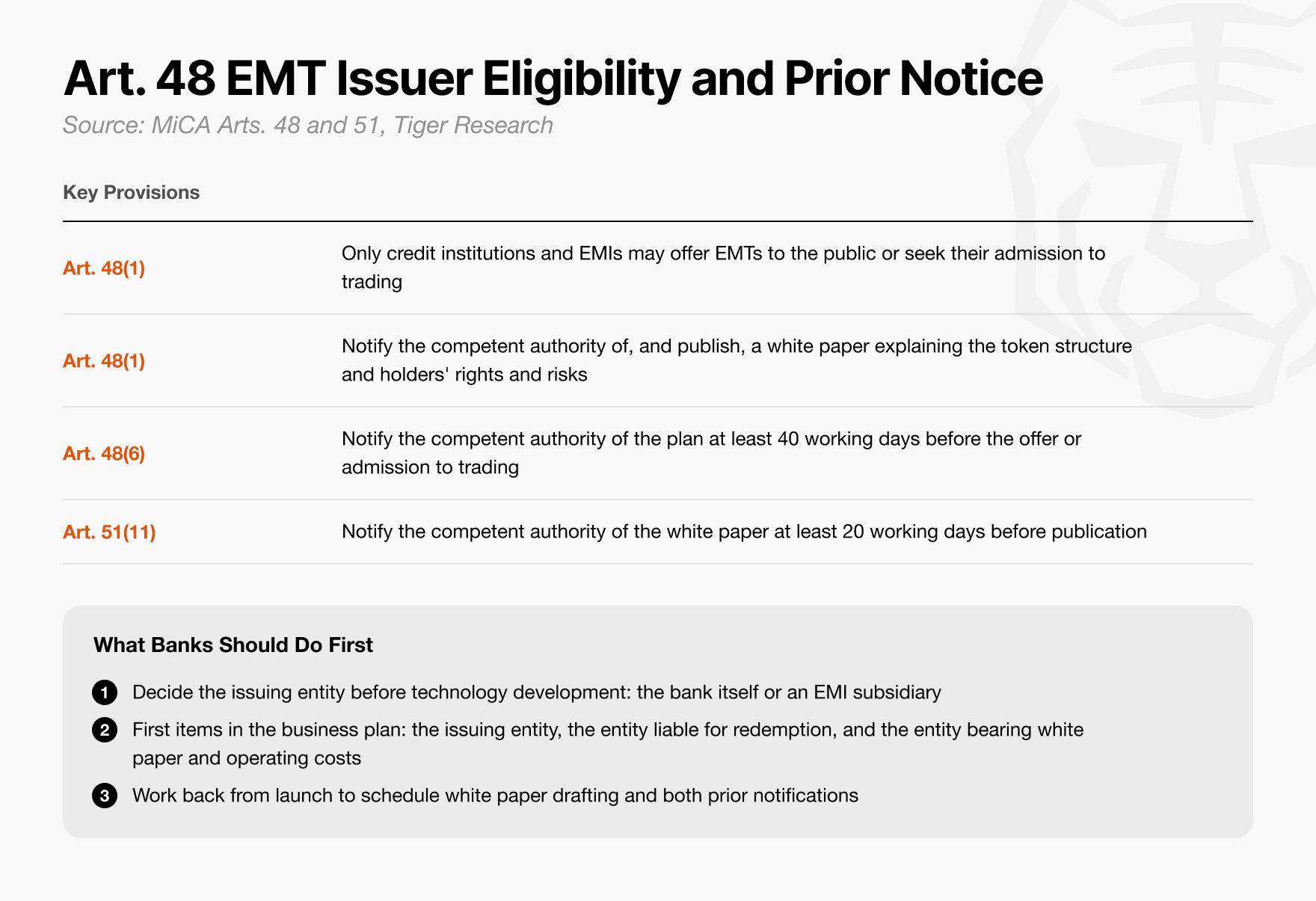
The business structure for issuance comes before the technology.
In the EU, only banks and electronic money institutions may issue EMTs. An electronic money institution (EMI) is a company that lets customers pay or send money using funds loaded into an e-wallet or similar account. Besides issuing directly, a bank can also set up a separate subsidiary, obtain an EMI license for it, and issue EMTs through that entity.
Both licenses permit stablecoin issuance, but the legal and capital requirements that come with them differ substantially. A bank therefore needs to settle the governance question first, choosing between issuance from the bank itself and issuance through a subsidiary according to its business objective: whether it wants to shield the parent bank from prudential risk, or to lead with the credibility of its traditional banking infrastructure.
Before issuance, a stablecoin also requires publication of a crypto-asset white paper, a disclosure document comparable to the one required for a financial product. Unless the white paper, covering the token’s legal structure, how the reserve assets are managed, and the risks to holders, is drafted and reviewed from both a financial and a legal standpoint first, even a well-built technical implementation will have to be substantially reworked at the commercialization stage.
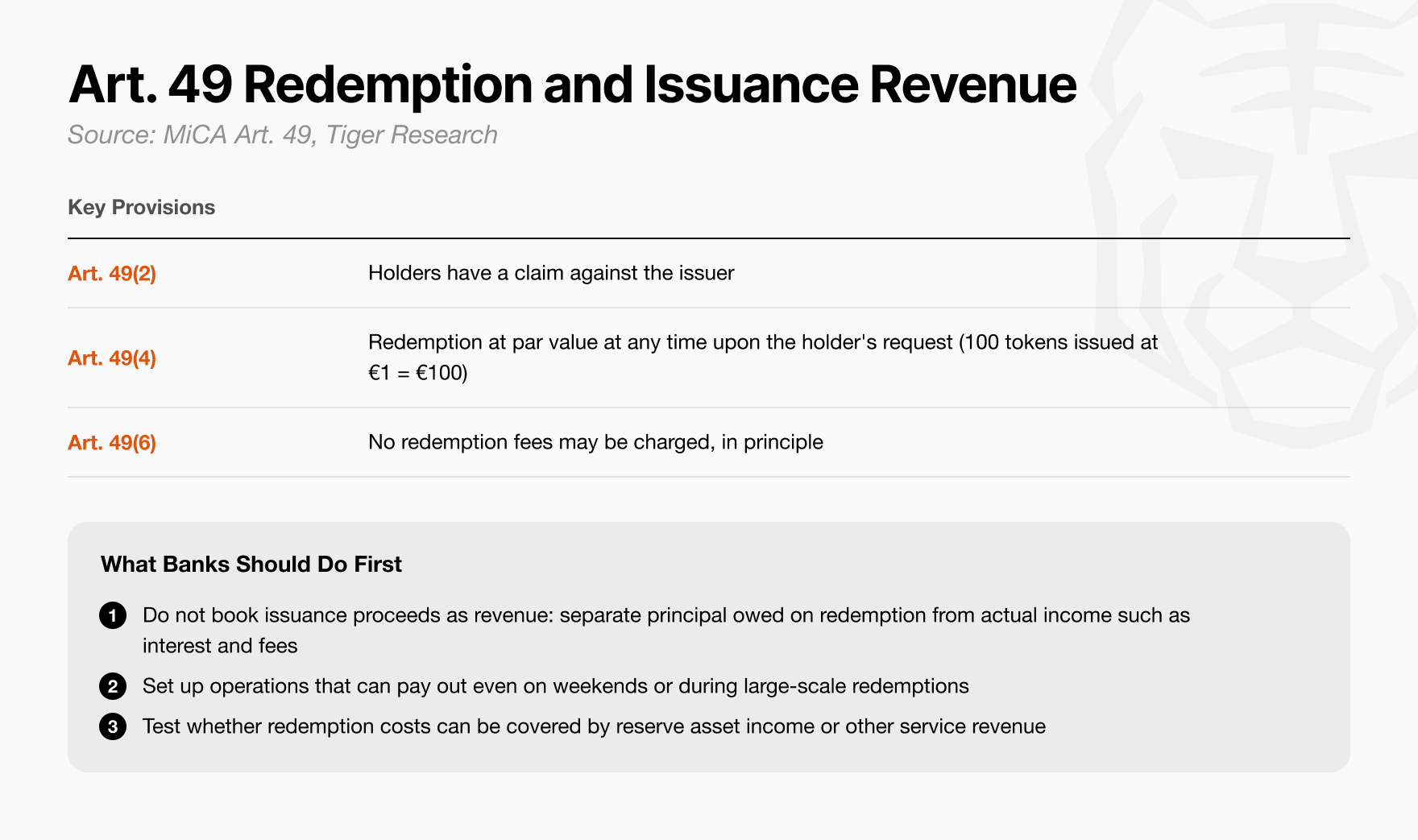
A redemption process for returning customer funds, and a revenue model that can carry its cost, need to be in place first.
Under Article 49 of MiCA, an issuer must redeem an EMT at par value whenever the holder requests it. Redemption fees are prohibited as a rule, and the redemption conditions must be clearly set out in the white paper. This means the funds received at issuance cannot be treated as revenue, and the issuer has to be able to raise and pay out the necessary cash even when redemption requests arrive all at once.
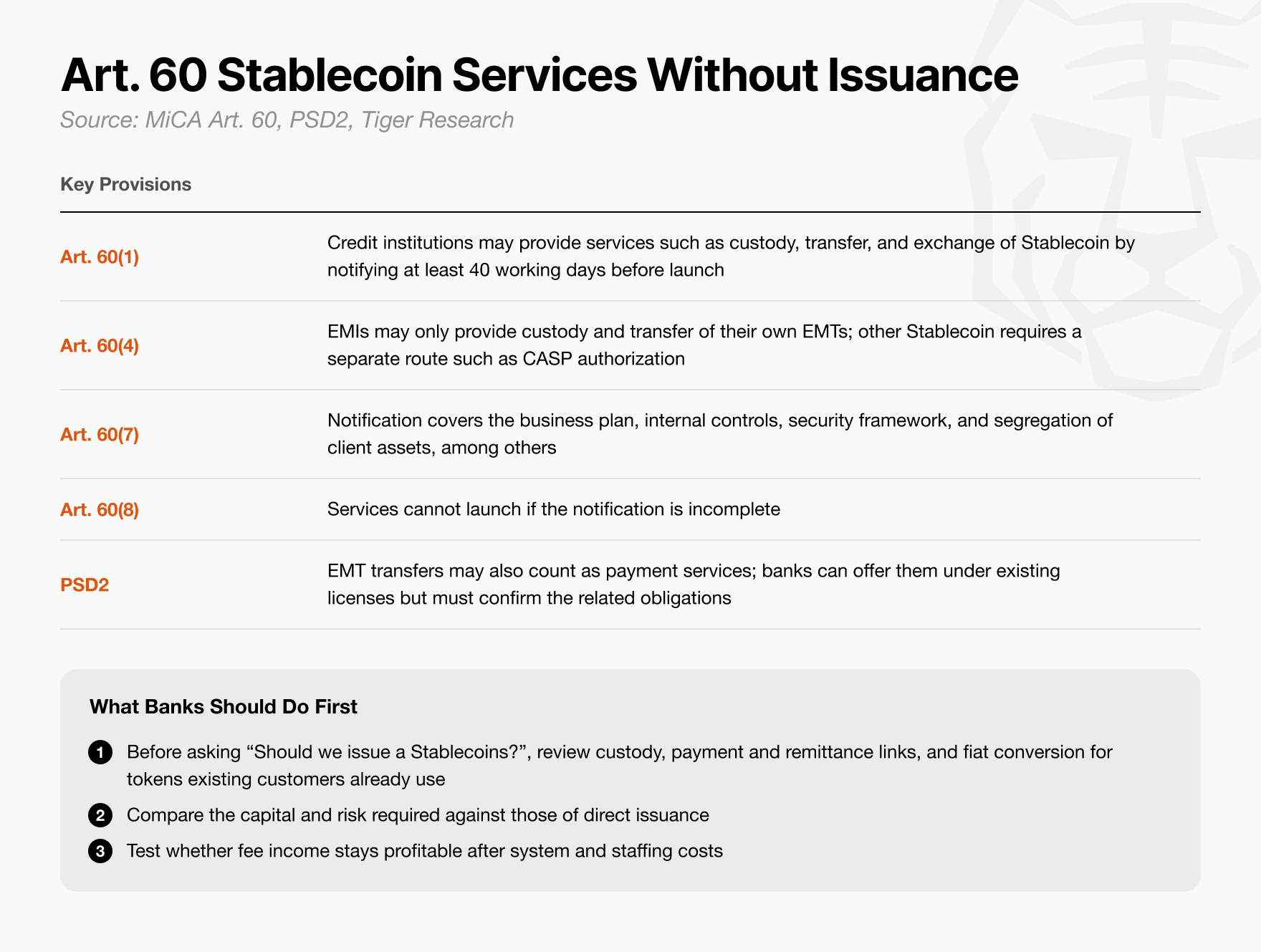
A bank can earn revenue from stablecoin services without issuing a stablecoin of its own.
MiCA does not require a bank to issue its own stablecoin in order to run a stablecoin business. Under Article 60, a bank can provide services around tokens issued by other companies, including holding them in custody for customers, transferring them to other parties, and exchanging them for fiat currency, and it can charge fees for those services.
The permitted scope differs by type of institution, however. A bank can handle tokens issued by third parties after a prior notification under Article 60(1), whereas an EMI, even after notifying under Article 60(4), may only provide custody and transfer services for the EMTs it has issued itself. For an EMI to handle third-party tokens, it needs a separate authorization as a crypto-asset service provider (CASP), so a bank that wants to handle a range of tokens has to weigh the cost and benefit of acting through the parent bank against obtaining the additional authorization for a subsidiary.
Overlap with payments regulation also needs to be checked. Transferring tokens on a customer’s behalf can qualify both as a crypto-asset transfer service under MiCA and as a payment service under the revised Payment Services Directive (PSD2). A banking license does not exempt the bank from PSD2 requirements such as strong customer authentication (SCA) or liability for unauthorized or defective transactions, so consistency with the financial laws already in force needs to be reviewed in advance.
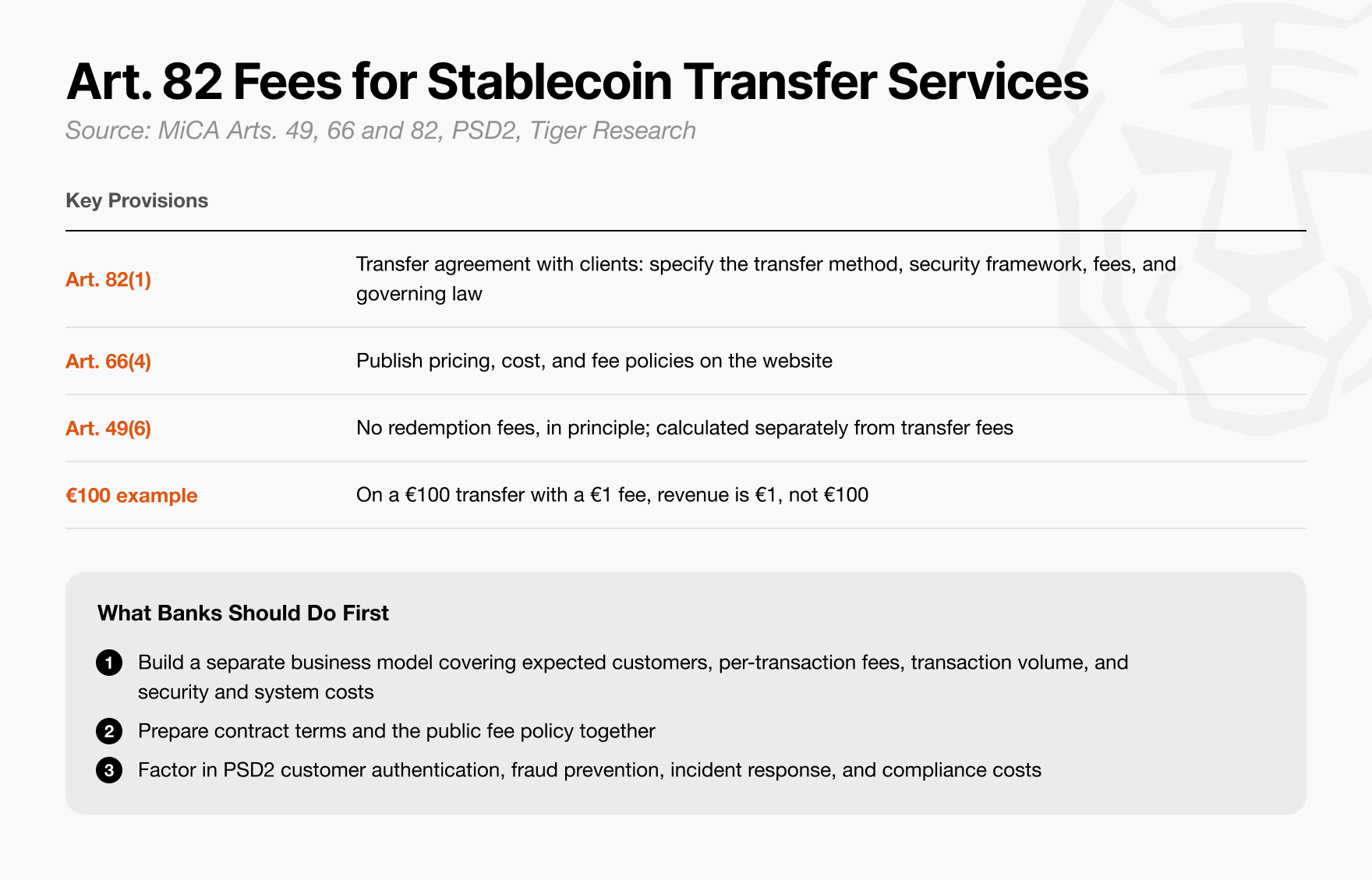
The fee structure and break-even point of transfer services need to be examined in advance.
Under MiCA, a provider of crypto-asset transfer services must specify in its client agreements the transfer method, the security arrangements, the fees, and the governing law, and must publish its pricing and fee policy on its website.
A bank therefore needs to test, from the planning stage, whether the fees it sets can cover its operating costs, because a per-transaction fee only yields a real margin after system operating costs, staff costs, and the compliance costs of SCA, fraud detection systems (FDS), and incident response have all been deducted.
Since redemption into fiat currency cannot carry a fee as a rule, the bank also has to separate, in both its accounting and its operations, the transfer services it can charge for from the redemption process it must provide free of charge, and calculate profitability on that basis.
2. The second decision: reserve management to match the issuer’s regulatory status
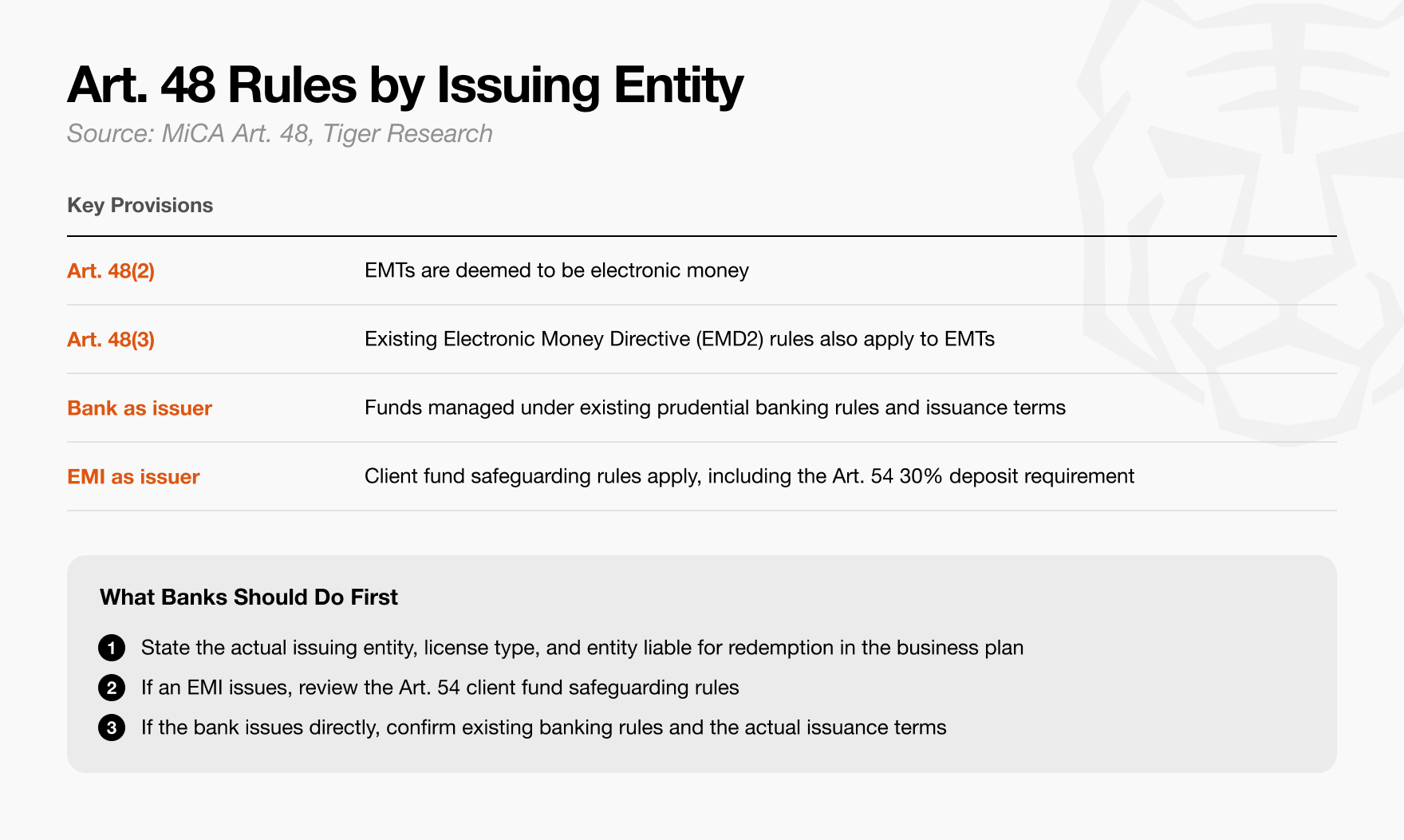
A bank needs to confirm which rules apply to the issuing entity before deciding how to manage customer funds.
Article 48 of MiCA treats EMTs as electronic money, and the Electronic Money Directive applies wherever MiCA has no specific provision. The applicable rules nonetheless differ depending on whether the actual issuer is a bank or an EMI: a bank issuing directly remains under banking regulation, while an EMI must meet separate requirements for safeguarding customer funds. A bank preparing the business thus has to decide at the outset which entity will issue, under which license, and which entity will carry the redemption liability to customers.
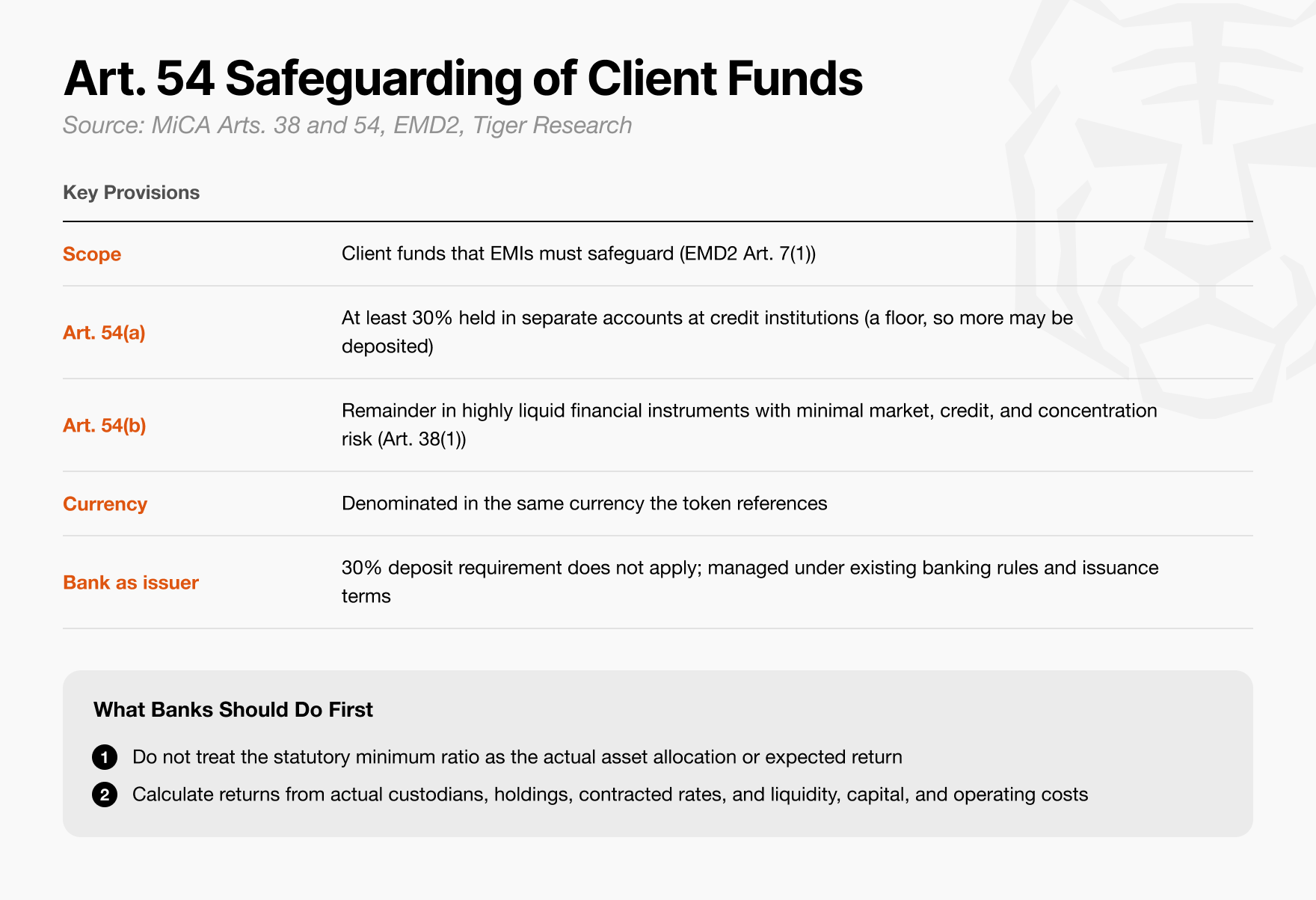
A bank needs to decide where customer funds go and in what proportions, and calculate viability from actual yields and management costs.
Under Article 54 of MiCA, an EMI that issues EMTs must deposit at least 30% of the funds it receives from customers in separate accounts at other banks. The remaining funds may only be invested in secure, low-risk, highly liquid assets denominated in the same currency. The 30% deposit requirement does not apply when a bank issues directly.
A bank issuing through an EMI subsidiary needs an allocation strategy, worked out in advance, that accounts for the 30% liquidity deposit, the yield on the safe assets, and the cost of maintaining the accounts. Even in a country where regulation is not yet complete, a bank can use MiCA’s 30% segregated deposit requirement as a benchmark to run viability scenarios for each issuing structure ahead of time.
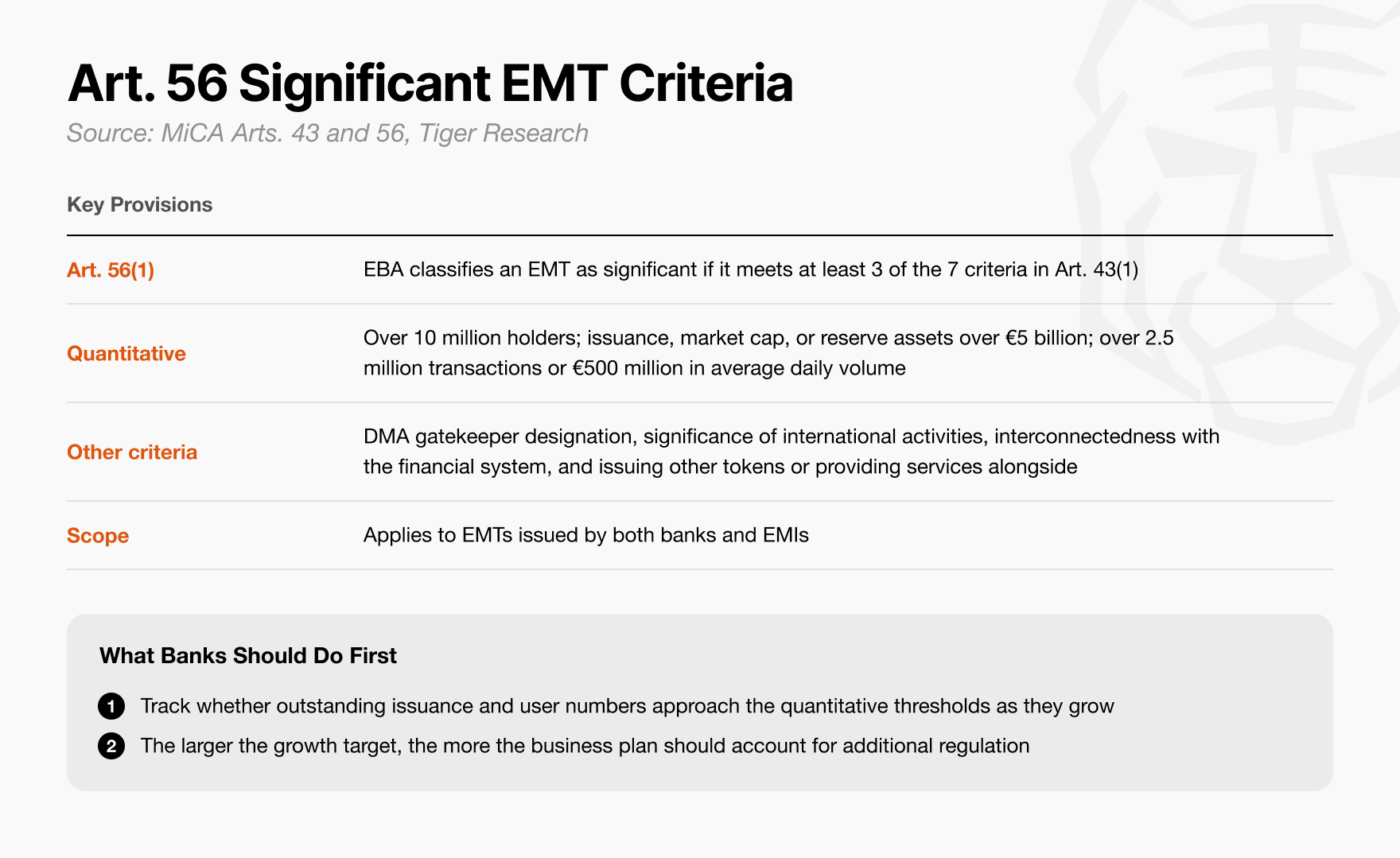
Not every stablecoin faces the heaviest regulation, but costs need to be estimated stage by stage.
Under Article 56 of MiCA, the European Banking Authority (EBA) designates a stablecoin as a significant EMT only when it meets several demanding criteria at the same time, including thresholds for the number of holders, market capitalization, and transaction volume. Not every token on the market is subject to the highest tier of regulation from the outset.
Of the 45 EMTs notified in the EU, USDC is the only one that has met these criteria and been designated a significant EMT. The other 44 are issued and circulate normally under the general framework. A bank entering the market does not need to budget from day one for the compliance costs that apply to the largest stablecoins.
The regulatory burden does change sharply at the moment of designation, however. For an EMI subsidiary in particular, Article 58 raises the reserve and own-funds requirements substantially and adds direct supervision by the EBA.
The bank’s profit-and-loss scenarios therefore need to be staged, separating the minimum cost of initial entry from the additional capital it would have to raise if growth later pushed its token into the significant EMT category.
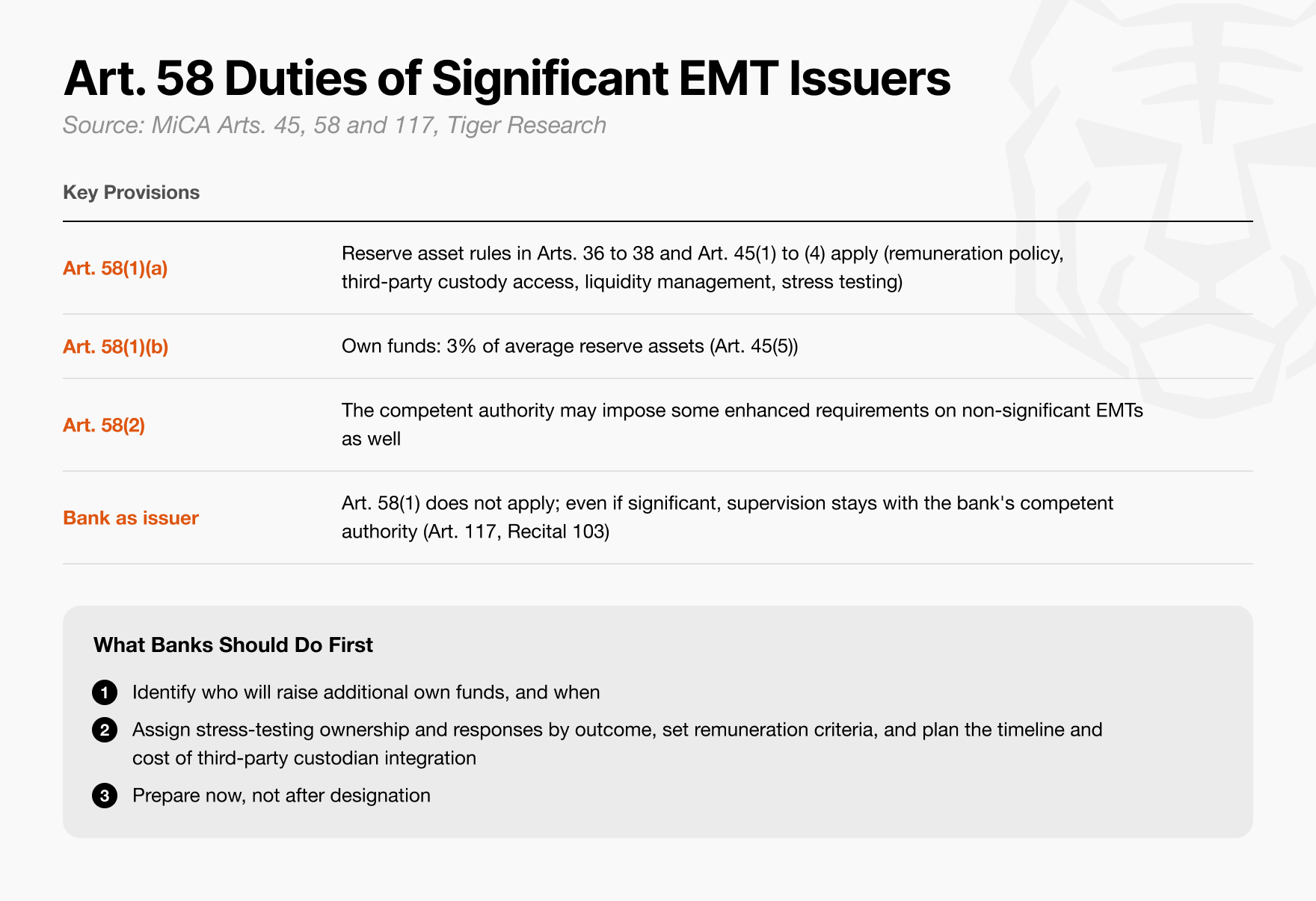
When choosing the issuing entity, a bank needs to account for the capital and risk management costs that follow designation as a significant EMT.
Under Article 58 of MiCA, an EMI issuing a significant EMT must hold own funds equal to 3% of its average reserve assets, must regularly test whether it could pay out under a surge of redemption requests, and must have its reserve assets independently audited every six months.
The additional obligations in Article 58(1) do not apply to a bank issuing directly, which remains under the traditional banking supervisory framework. An EMI, by contrast, may be required by its supervisor to meet some of the enhanced requirements even before its token is designated significant. For a bank considering issuance through an EMI subsidiary, this means deciding who will raise the additional capital and when, and building the staff and costs of risk management, audits, and integration with external custodians into its business plan.
3. The third decision: design redemption procedures and customer communications together
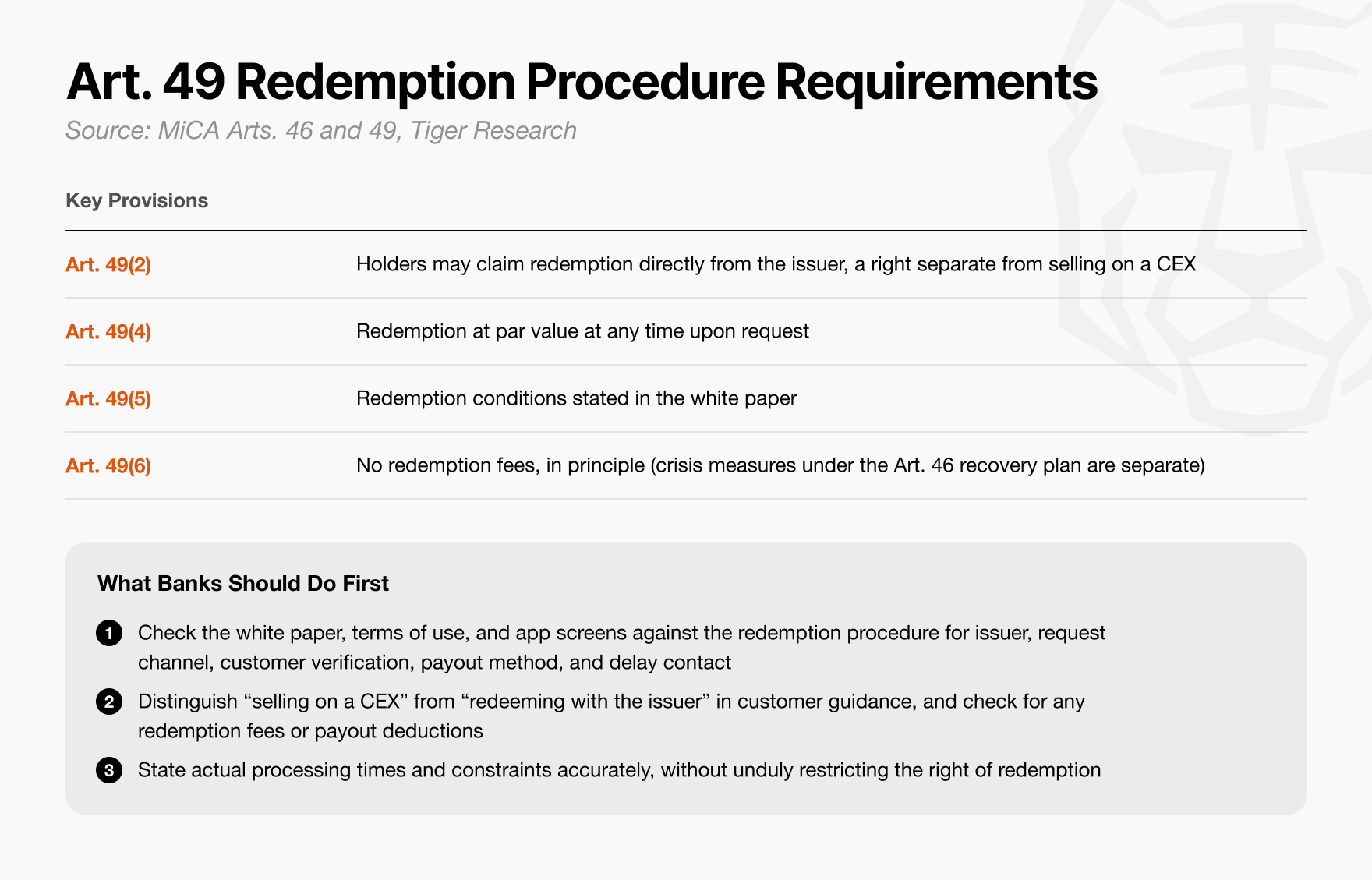
A bank needs to prepare the redemption procedure and the customer guidance together, so that a customer who requests redemption actually gets the money back.
Under Article 49 of MiCA, an EMT holder can demand redemption at par from the issuer at any time, separately from the option of selling the token on a CEX(Crypto-asset Exchange). The issuer must set out the redemption conditions clearly in the white paper and may not charge a redemption fee as a rule. The one exception is a liquidity fee charged in a crisis under the conditions and procedures laid down in the issuer’s recovery plan.
In practice, a bank needs to define the procedure and the responsible staff for every step, from the channel that receives a redemption request through customer verification and token retrieval to payment. The white paper, terms of service, and app screens also need to give consistent information on the issuer, the redemption channel, the payment method, processing times, and whom to contact in case of delay.
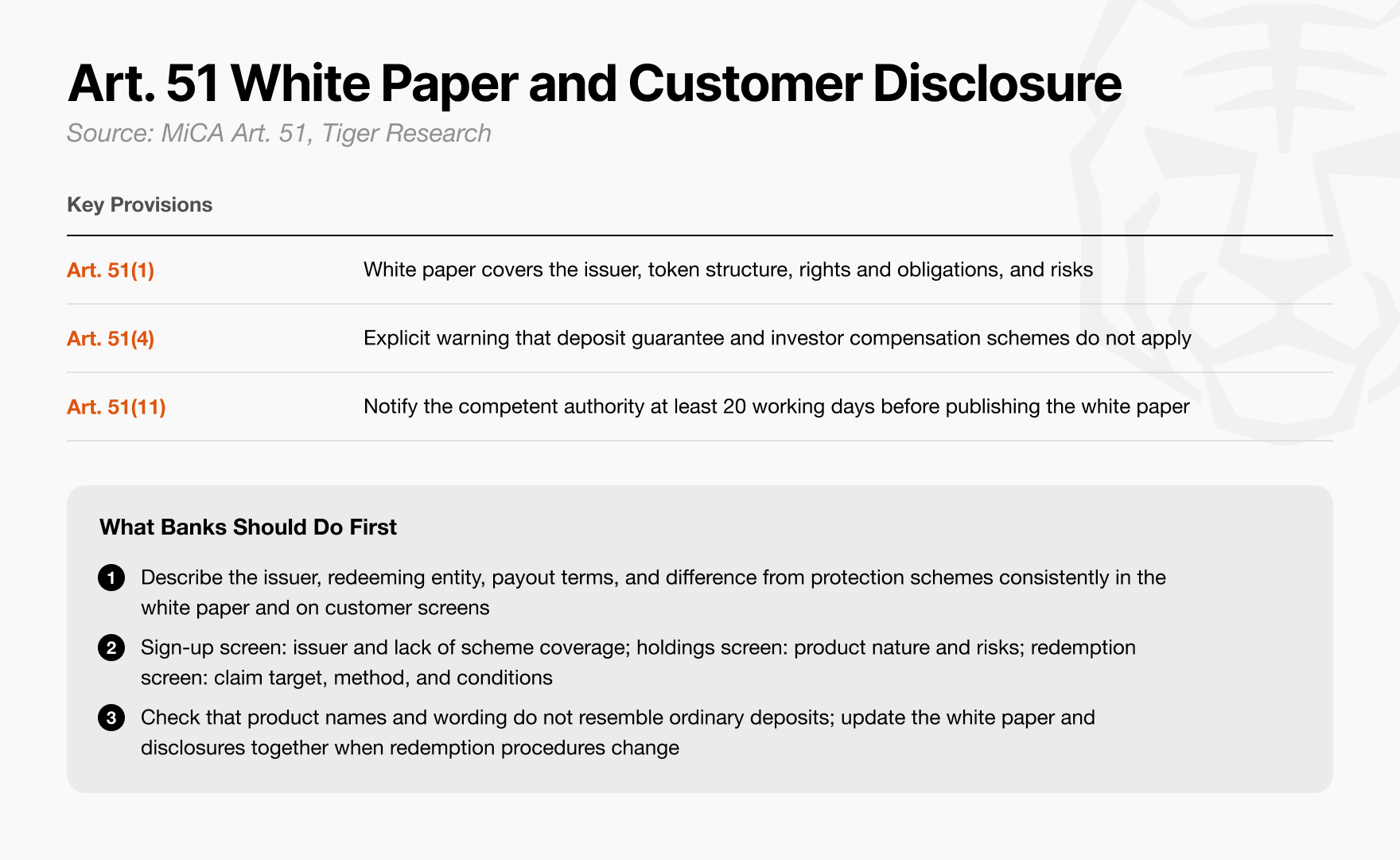
The white paper and service screens need to explain the product’s nature and the scope of protection consistently, so that customers do not mistake the stablecoin for a bank deposit.
Article 51 of MiCA requires the white paper to describe the issuer, the structure of the token, and the rights, obligations, and risks of holders. In particular, it must carry an explicit warning that EMTs are not covered by deposit guarantee schemes or investor compensation schemes. The issuer must also notify the white paper to its competent authority at least 20 working days before publication, so the drafting and review period has to be built into the launch schedule.
Product names and marketing copy also need to be checked so that they do not give the impression of deposit-like protection. Whenever the redemption procedure or payment terms change, the white paper and customer communications have to be revised together, so that what customers were told continues to match how the service actually operates.
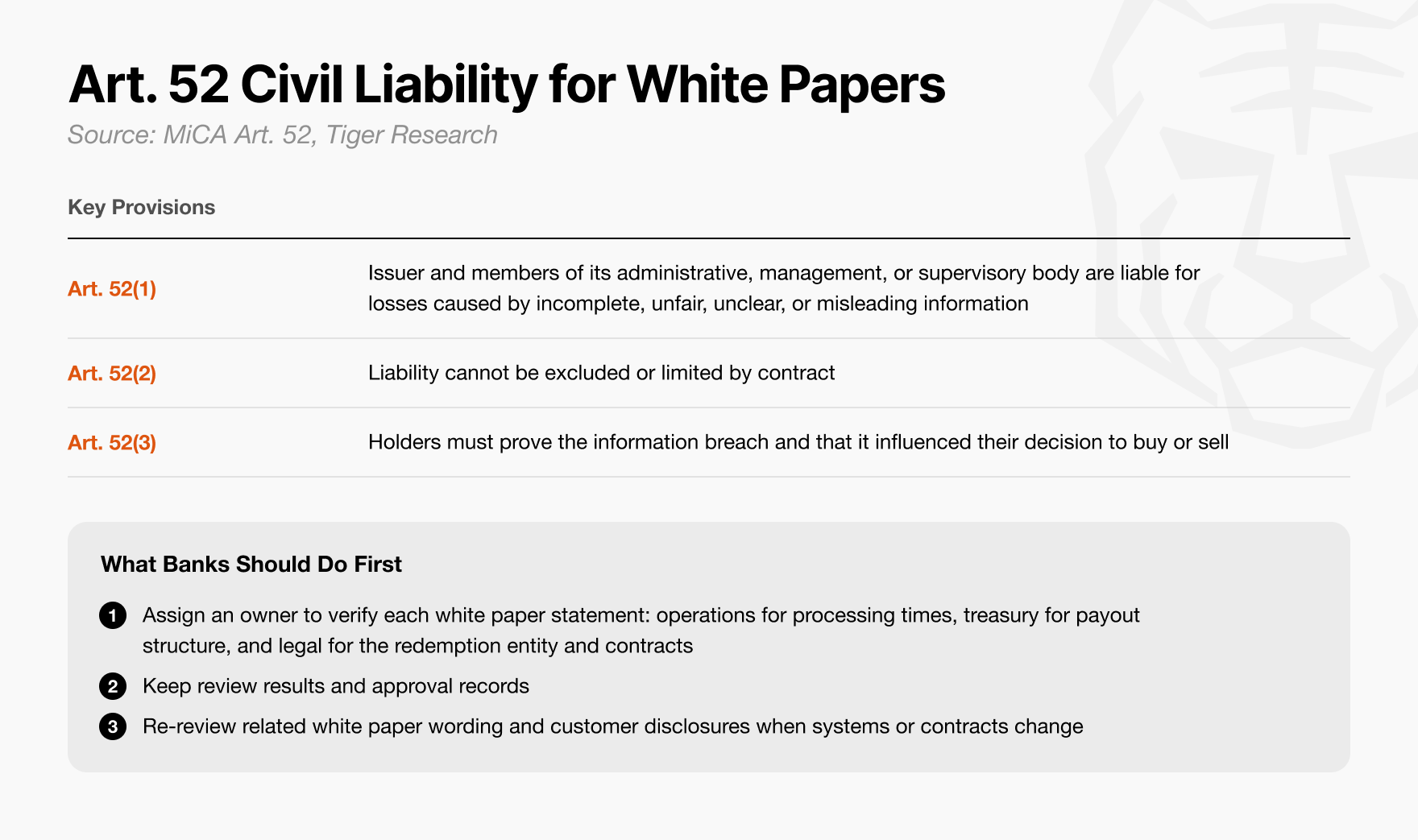
A bank needs to decide who verifies and approves the white paper’s contents, and keep a record of the basis and review history for each statement.
Under Article 52 of MiCA, if a holder suffers a loss because the white paper is incomplete, unclear, or misleading, liability for damages falls not only on the issuer but also on the members of its management and supervisory bodies. This liability cannot be excluded or limited by contract or by terms and conditions.
A bank therefore needs an approval structure, set up in advance, that assigns responsibility for each section of the white paper and ensures its reliability: operations signs off on the redemption process, treasury on liquidity and reserve management, and legal on the entity carrying the redemption obligation and on legal risk. Each department’s review basis and approval records should be kept systematically, and an ongoing monitoring process should update the white paper’s wording whenever operating systems or contractual terms change.
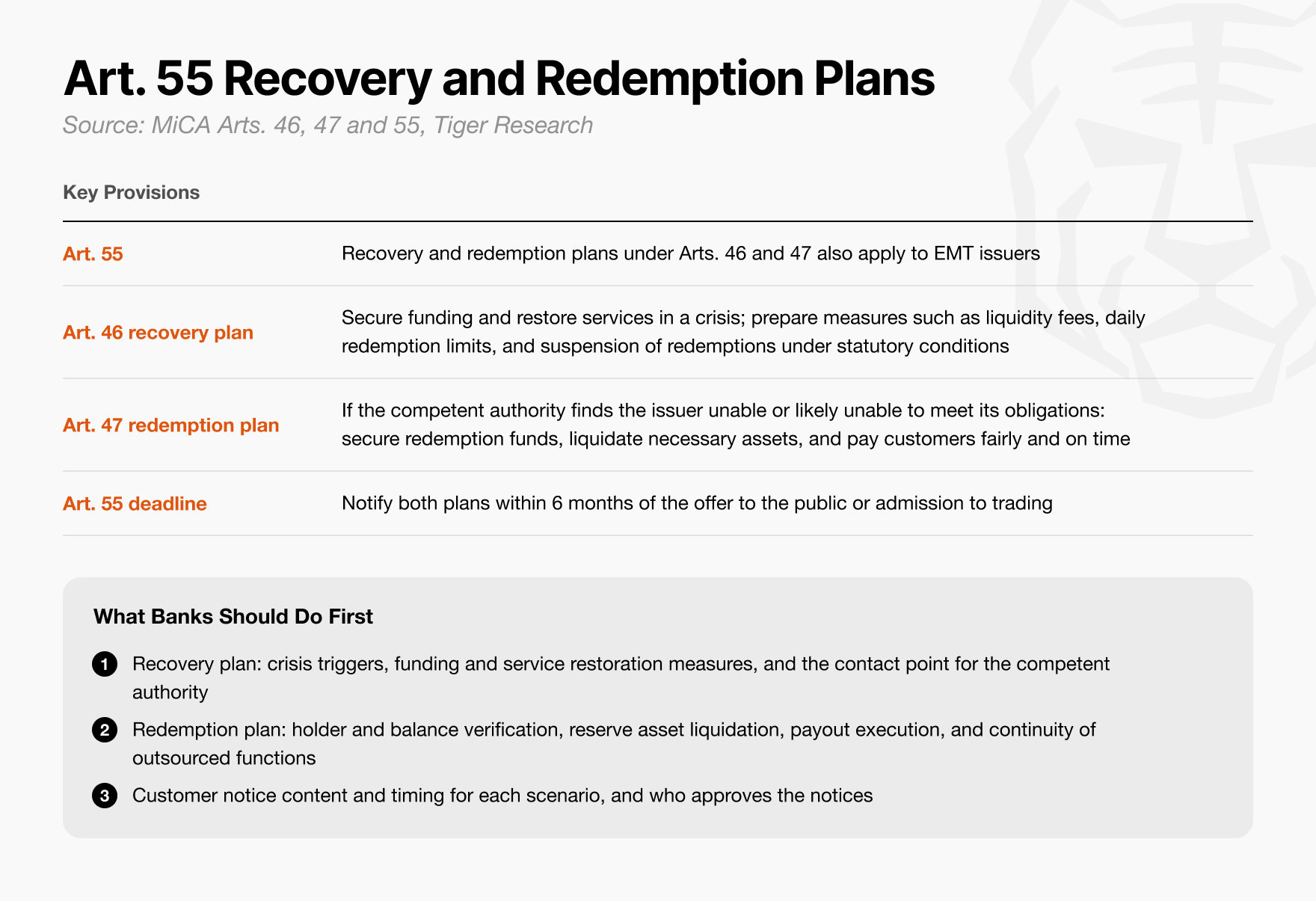
A bank needs both a recovery plan for managing a crisis and a redemption plan for winding down the business.
Article 55 of MiCA requires every EMT issuer to maintain both a recovery plan and a redemption plan.
The recovery plan sets out how the issuer would raise liquidity and restore normal operations in a crisis such as a run of large-scale redemption requests. The redemption plan, by contrast, covers the orderly wind-down: when the supervisor concludes that the issuer can no longer operate normally, or when the business has to be closed, the reserve assets are liquidated promptly and the remaining funds are returned to customers on an equitable basis.
This means a bank needs more than a recovery manual covering emergency funding routes and decision-making. It also needs a prepared wind-down scenario for the worst case: one that can identify each customer’s share in real time, liquidate and distribute the assets, and carry out the required disclosures to customers.
What banks can prepare now, regardless of regulation
The sections above used MiCA to set out what a bank needs for issuing a stablecoin, managing the funds behind it, and handling redemption. MiCA gives countries that are still drafting their rules a clear reference point, but the actual business will have to follow whatever final law each country adopts. That does not mean a bank has to sit idle until its domestic legislation is settled: there are clearly defined areas where a bank can assess viability and prepare before the law takes effect.
The first is a realistic comparison of costs and benefits against traditional finance.
The concrete benefit to customers and to the bank from adopting a stablecoin needs to be verified in numbers. That means calculating the fee savings and the reduction in settlement time compared with traditional SWIFT-based cross-border transfers, and checking whether a real margin remains for the bank after system build and operating costs are deducted. This work gives the business its first outline, including which customer segments to target, such as B2B trade settlement or small-value cross-border remittances.
The second is a feasibility review of the business model: solo issuance, joint issuance, or distribution.
The business model should be chosen according to expected profitability. A bank can issue on its own, act as an infrastructure provider distributing tokens already in circulation, or join other banks in setting up a joint issuer. In Europe, a group of financial institutions is pursuing joint issuance of a euro stablecoin through the Qivalis consortium, an arrangement that spreads the cost of building the infrastructure and the redemption framework while letting each bank concentrate on developing the services at its own customer interface.
The third is validating real demand and securing the network early.
Rather than waiting for the law to be finalized, a bank can identify the pain points of customers with frequent cross-border payments, such as importers, exporters, and fintech companies. It can demonstrate the time and cost a stablecoin would save them, and open partnership discussions early with the local banks and payment providers abroad that it would need.
When regulation is finalized, banks will not be starting from the same position. A bank that has prepared carefully against a clearly established framework such as MiCA, and has already validated customer demand and business viability, can move straight to execution. A bank that waited for the final rules will only then be starting its review of business models.
A completed regulatory framework can open the business to every bank, but it cannot give back the time, or the early market position, that the banks which prepared first have already secured. Instead of waiting passively for domestic regulation to be completed, a bank is better served by using international frameworks such as MiCA as a reference now, to confirm customer demand, test business viability, and build the partner infrastructure it will need.
🐯 More from Tiger Research
Read more reports related to this research.73.7% of Korean Crypto Investors Oppose the Crypto Tax: What Concerns Them?
The Era of Industry: Q3 2026 Crypto Industry Investment Report
Disclaimer
This report has been prepared based on materials believed to be reliable. However, we do not expressly or impliedly warrant the accuracy, completeness, and suitability of the information. We disclaim any liability for any losses arising from the use of this report or its contents. The conclusions and recommendations in this report are based on information available at the time of preparation and are subject to change without notice. All projects, estimates, forecasts, objectives, opinions, and views expressed in this report are subject to change without notice and may differ from or be contrary to the opinions of others or other organizations.
This document is for informational purposes only and should not be considered legal, business, investment, or tax advice. Any references to securities or digital assets are for illustrative purposes only and do not constitute an investment recommendation or an offer to provide investment advisory services. This material is not directed at investors or potential investors.
Terms of Usage
Tiger Research allows the fair use of its reports. ‘Fair use’ is a principle that broadly permits the use of specific content for public interest purposes, as long as it doesn’t harm the commercial value of the material. If the use aligns with the purpose of fair use, the reports can be utilized without prior permission. However, when citing Tiger Research’s reports, it is mandatory to 1) clearly state ‘Tiger Research’ as the source, 2) include the Tiger Research logo. If the material is to be restructured and published, separate negotiations are required. Unauthorized use of the reports may result in legal action.


