

FOMO grips crypto firms. From exchanges to security companies, they are racing to launch AI-powered services. We examine why they are making this move now.
Key Takeaways
Crypto firms across exchanges, security, payments, and research are simultaneously rolling out AI services
Unlike past cycles, proven revenue-generating companies like Coinbase and Binance are leading. AI has shifted from narrative to operational necessity
Adoption motives differ by sector: exchanges aim to prevent user churn; security firms fill audit blind spots; payment infrastructure targets the emerging agent economy
Having a feature and actually using it are different problems. AI FOMO and competitive pressure are accelerating adoption beyond demonstrated need
Real demand and competitive anxiety are both at play. Distinguishing value-creating adoption from label-only adoption is the key question
1. Crypto Firms Are Now Offering AI Services
AI is the most closely watched sector in global markets today. General-purpose tools like ChatGPT and Claude have entered daily life, and platforms like OpenClaw have lowered the barrier to building agents.
The crypto industry was late to this wave, but is now integrating AI across every vertical.
What AI services are these firms offering, and why are they entering this market?
2. How Crypto Firms Are Adopting AI
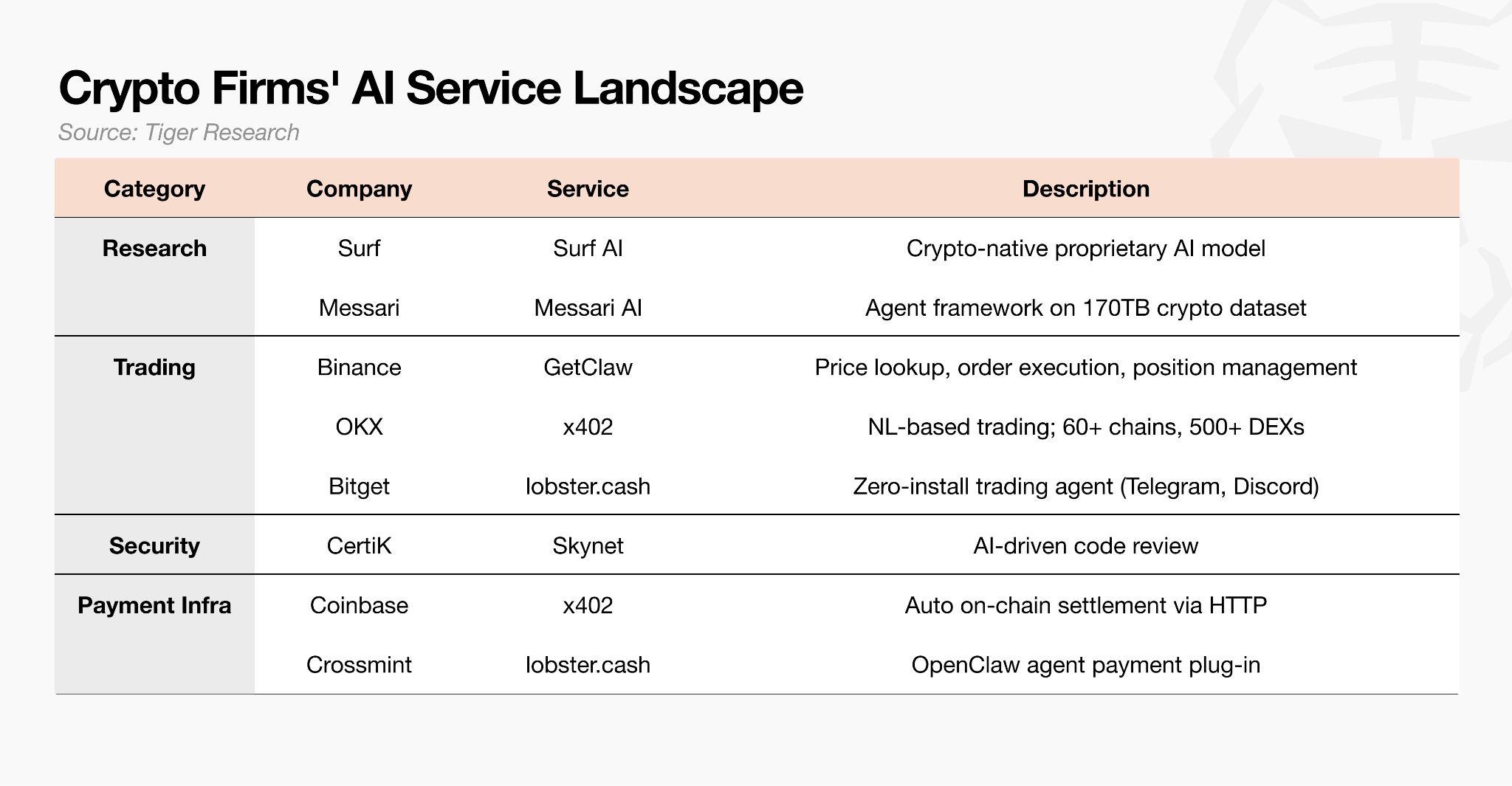
2.1. Research
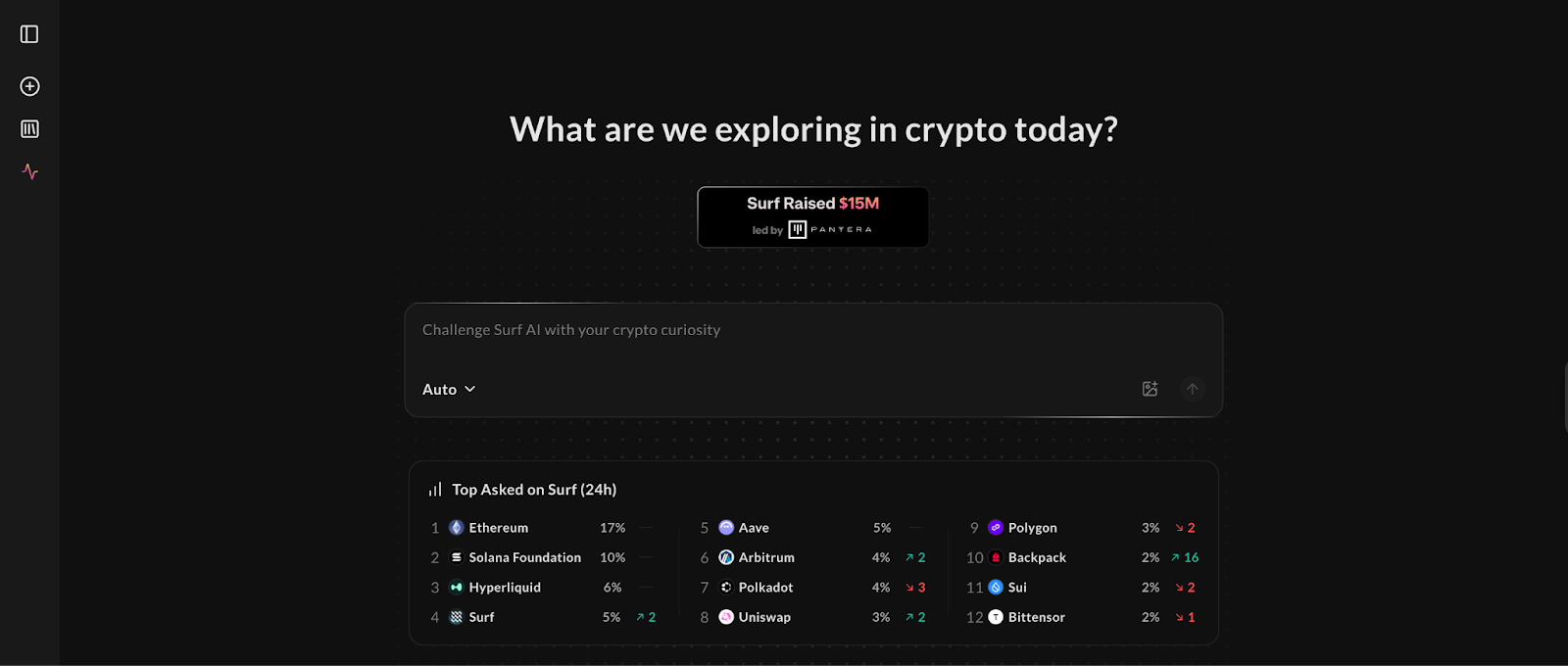
Crypto research has a structural problem: on-chain data, social sentiment, and key metrics are scattered across platforms, and verification is difficult. General-purpose AI frequently returns inaccurate answers for crypto queries.
Projects like Surf address this by offering crypto-specific AI research tools that consolidate dispersed data sources. Among all AI use cases in crypto, research has the lowest entry barrier for general users, requiring no coding or trading expertise.
2.2. Trading

Exchanges are leading AI adoption in trading.
Approaches vary. some expose proprietary trading data directly to users; others let users issue natural-language commands to AI agents that handle analysis through execution in a single step.
Exchanges have offered APIs for years. The difference now is an added layer: interfaces like MCP and AI Skills enable non-developers to access exchange functions through AI agents. Tools once limited to developers are now accessible via natural language.
This aligns with a broader community shift. Non-developer users are increasingly building automated trading strategies through AI agents, with no code required. They describe a strategy, and the agent builds and runs the algorithm.
For exchanges, this is both an opportunity and a threat. As AI-powered users grow, loyalty to any single exchange weakens because agents can execute trades anywhere. Exchanges adopt AI for a simple reason: to attract users quickly and keep them active on the platform.
Trading involves real asset management, demanding higher judgment and accountability than research. But as entry barriers fall, this domain is also opening to general users.
2.3. Security / Audit
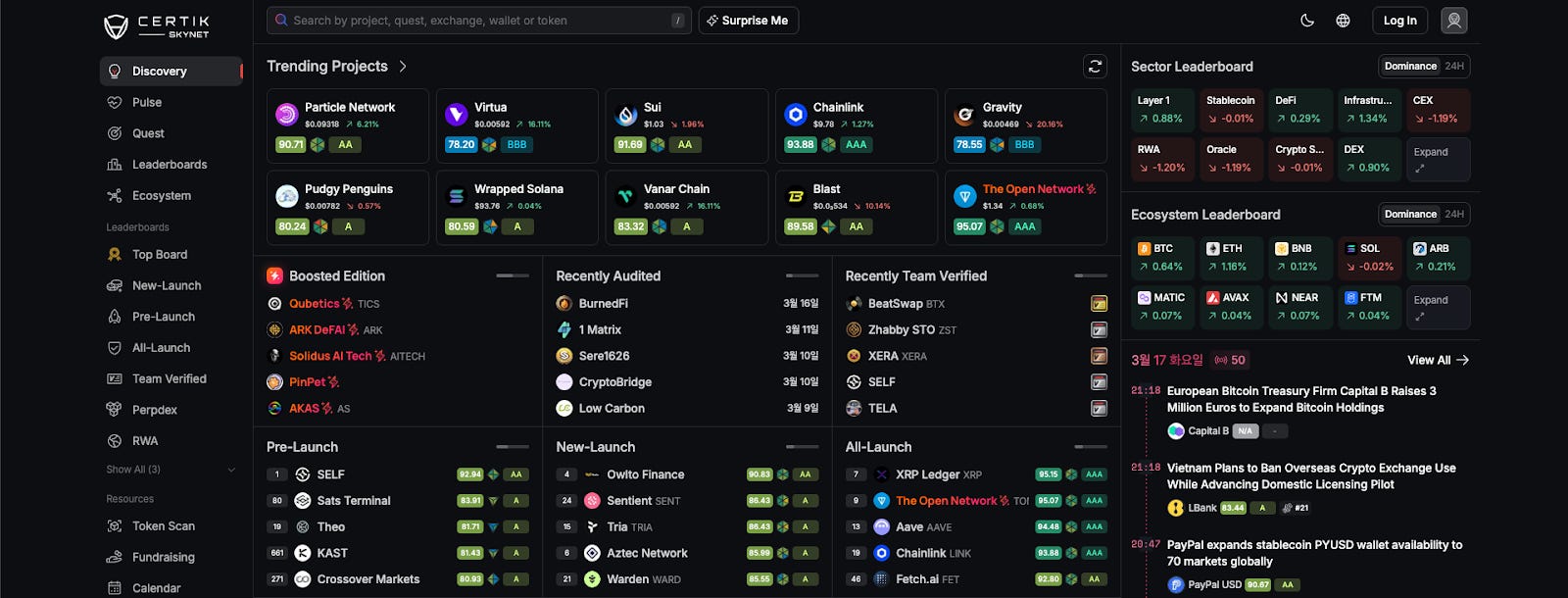
Smart contract auditing has traditionally relied on manual line-by-line code review, a process that is slow, costly, and inconsistent across auditors. AI is now integrated into the workflow: AI scans the code first, then human auditors perform a targeted deep review. This increases both speed and coverage without replacing auditors.
CertiK is a leading example. The firm previously faced criticism when audited projects were later exploited. However, those incidents occurred outside the audit scope. An audit examines code at a fixed point in time; it does not include ongoing monitoring.
CertiK addressed this gap with AI. It added real-time post-audit monitoring and delivers it via a public dashboard. Because the expanded coverage is AI-driven rather than labor-intensive, it benefits both CertiK and the projects it audits.
In security, AI adoption is not about disrupting existing services. It extends the scope of human work: improving precision at audit time and filling post-audit blind spots. For blockchain security firms, AI is not a new business line but a tool to address existing weaknesses.
2.4. Payment Infrastructure
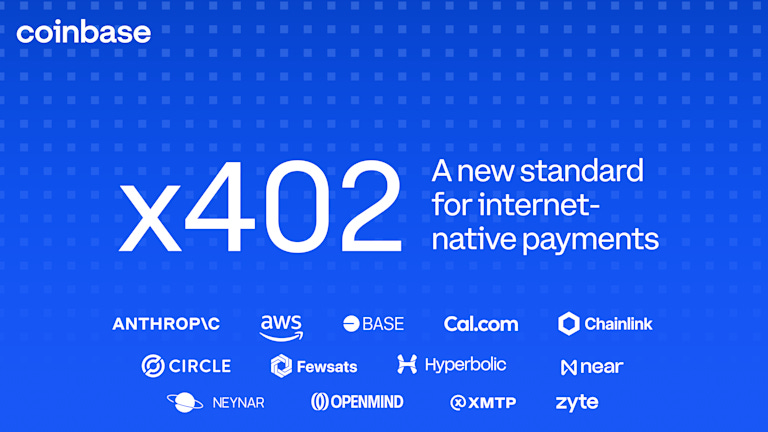
AI agents need payment rails to participate in economic activity: paying for APIs, purchasing data, and buying services from other agents. The most natural payment method for agents is an on-chain wallet paired with stablecoins.
Two models are emerging. The first is a universal protocol that embeds payments into HTTP requests, enabling automatic on-chain settlement the moment an agent accesses a paid API. The second is agent-specific payment plugins, where agents execute payments only within permissions and limits pre-set by humans.
Payment infrastructure is the area most closely tied to stablecoins. However, because the paying entity is an AI agent rather than a human, fully operational models do not yet exist.
Circle, the USDC issuer, is also gaining attention. The company published a proposal to connect its Gateway payment infrastructure with the x402 protocol and invited developers and researchers to review and contribute.
This is not yet a mature market. But markets have already started pricing in this trajectory. One key driver behind Circle’s stock price appreciation has been the AI agent payment narrative. Payment infrastructure will take longer to materialize than the sectors above, but it has established itself as one of the most prominent macro themes in the current market.
3. Why Crypto Firms Are Entering AI Now
When ChatGPT launched in November 2022, neither AI nor crypto was ready. AI models were impressive but could not reliably execute tasks. Crypto was reeling from the FTX collapse and a full-blown trust crisis.
AI has advanced dramatically since then. Within the past year, all major models became significantly more capable and practically useful. Crypto, by contrast, merely “used” AI during the same period: AI-branded memecoins, non-functional AI agents, and marketing-driven claims. Decentralized AI infrastructure projects continued to emerge, but when compared honestly against equivalent AI-native services, their quality fell clearly short.
The gap is now widening further. In the AI industry, infrastructure such as MCP (enabling agents to call external tools directly) and OpenClaw (enabling no-code agent building) has made the agent era tangible. Crypto firms are only now starting to move.
What is different this time is who is moving. It is not new startups branding themselves with AI. It is companies with proven revenue models: Coinbase, Binance, and Bitget. These firms have no reason to launch AI services as a marketing exercise. What drives them is not today’s revenue but the fear of falling behind: FOMO.
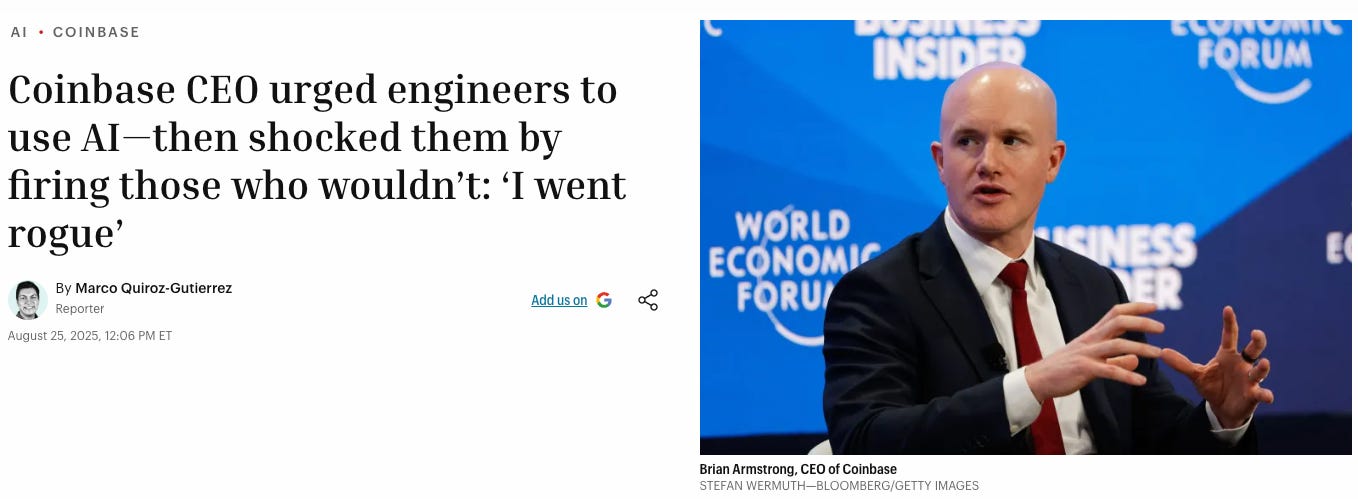
The intensity of that urgency is visible in Coinbase CEO Brian Armstrong’s actions. He issued a company-wide mandate for all engineers to onboard AI coding tools within one week and fired employees who did not comply.
But a clear-eyed view is also warranted. Take trading automation as an example. Agents can check prices and propose strategies, but how many users will actually trust an agent with their money for live trades? And is x402 being applied in the real world yet?
Ultimately, crypto’s AI adoption is not about chasing a trend. With the AI era now visible, firms are moving to avoid losing their position. Having a feature and actually using it remain different problems. But who is moving matters?

Think of the AI industry as a swimming pool filling with water. Those who jumped in before only pretended they could swim. The ones jumping in now are former national-team surfers. No one knows how high the water will rise or whether the pool will become an ocean. But crypto will not drown at the center of it.
🐯 More from Tiger Research
Read more reports related to this research.Disclaimer
This report has been prepared based on materials believed to be reliable. However, we do not expressly or impliedly warrant the accuracy, completeness, and suitability of the information. We disclaim any liability for any losses arising from the use of this report or its contents. The conclusions and recommendations in this report are based on information available at the time of preparation and are subject to change without notice. All projects, estimates, forecasts, objectives, opinions, and views expressed in this report are subject to change without notice and may differ from or be contrary to the opinions of others or other organizations.
This document is for informational purposes only and should not be considered legal, business, investment, or tax advice. Any references to securities or digital assets are for illustrative purposes only and do not constitute an investment recommendation or an offer to provide investment advisory services. This material is not directed at investors or potential investors.
Terms of Usage
Tiger Research allows the fair use of its reports. ‘Fair use’ is a principle that broadly permits the use of specific content for public interest purposes, as long as it doesn’t harm the commercial value of the material. If the use aligns with the purpose of fair use, the reports can be utilized without prior permission. However, when citing Tiger Research’s reports, it is mandatory to 1) clearly state ‘Tiger Research’ as the source, 2) include the Tiger Research logo. If the material is to be restructured and published, separate negotiations are required. Unauthorized use of the reports may result in legal action.


