

In the first half of 2026, no single narrative ran through the entire market. Even so, stablecoins, RWA, meme tokens, DeFi, and prediction markets each survived or grew despite the downturn. This report looks at the 2026 crypto market as one that is no longer driven by a single narrative but is instead searching for product-market fit across a diversified set of sectors.
Key Takeaways
A single narrative once pulled the whole market along. The market now moves according to genuine demand.
Even in a depressed market, established sectors including stablecoins, DeFi, RWA, and meme tokens have continued to survive.
In the end, only projects that find product-market fit and generate real revenue from real users will survive.
1. The Narrative-Driven Crypto Market of the Past
In the crypto market, narrative has been the central force that concentrates participant attention and pulls in liquidity. Sectors that drove major market cycles, such as DeFi Summer, were each given a distinct narrative, and the market has repeated a cyclical pattern in which liquidity moves to the next narrative as soon as the previous one fades.
At a broad level, the crypto market has passed through four major cycles in which a single narrative dominated the entire market:
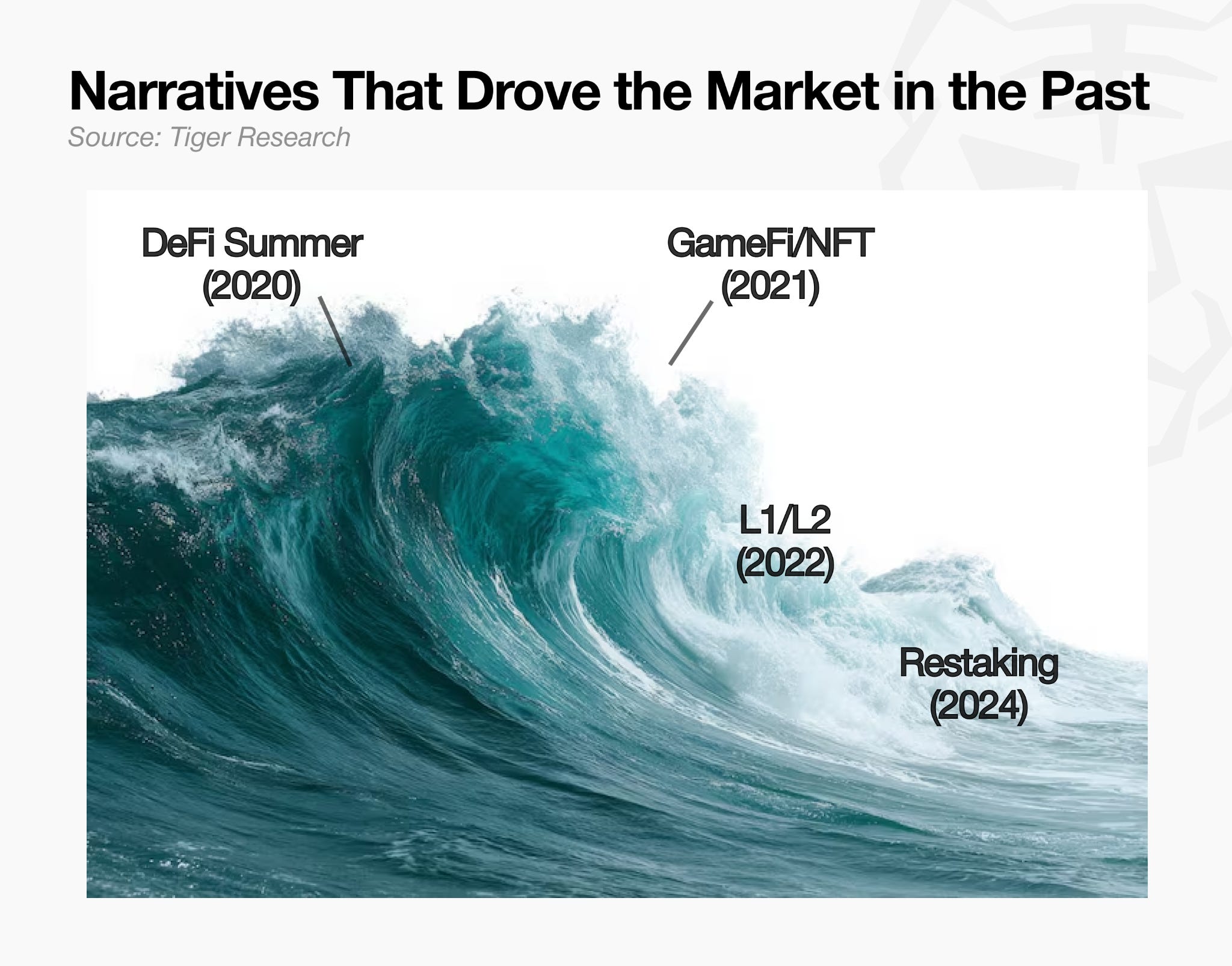
2020: DeFi
2021: NFT/P2E/GameFi
2022: L1/L2 competition
2024: Restaking
Among narrative-driven growth stories, GameFi produced the most extreme outcome.
Major traditional game publishers including Square Enix and Ubisoft entered the space, and the gaming sector drew $2.5 billion in inflows in the first quarter of 2022 alone. But sectors that could not demonstrate real product-market fit did not last. Axie Infinity, the sector’s flagship title, saw its average monthly player count fall 99.7%, from a peak of 2.8 million in January 2022 to roughly 8,000 in May 2026. It is a clear example of how quickly a narrative built mainly on justification and capital can collapse.
2. The Narratives Consumed Last Year
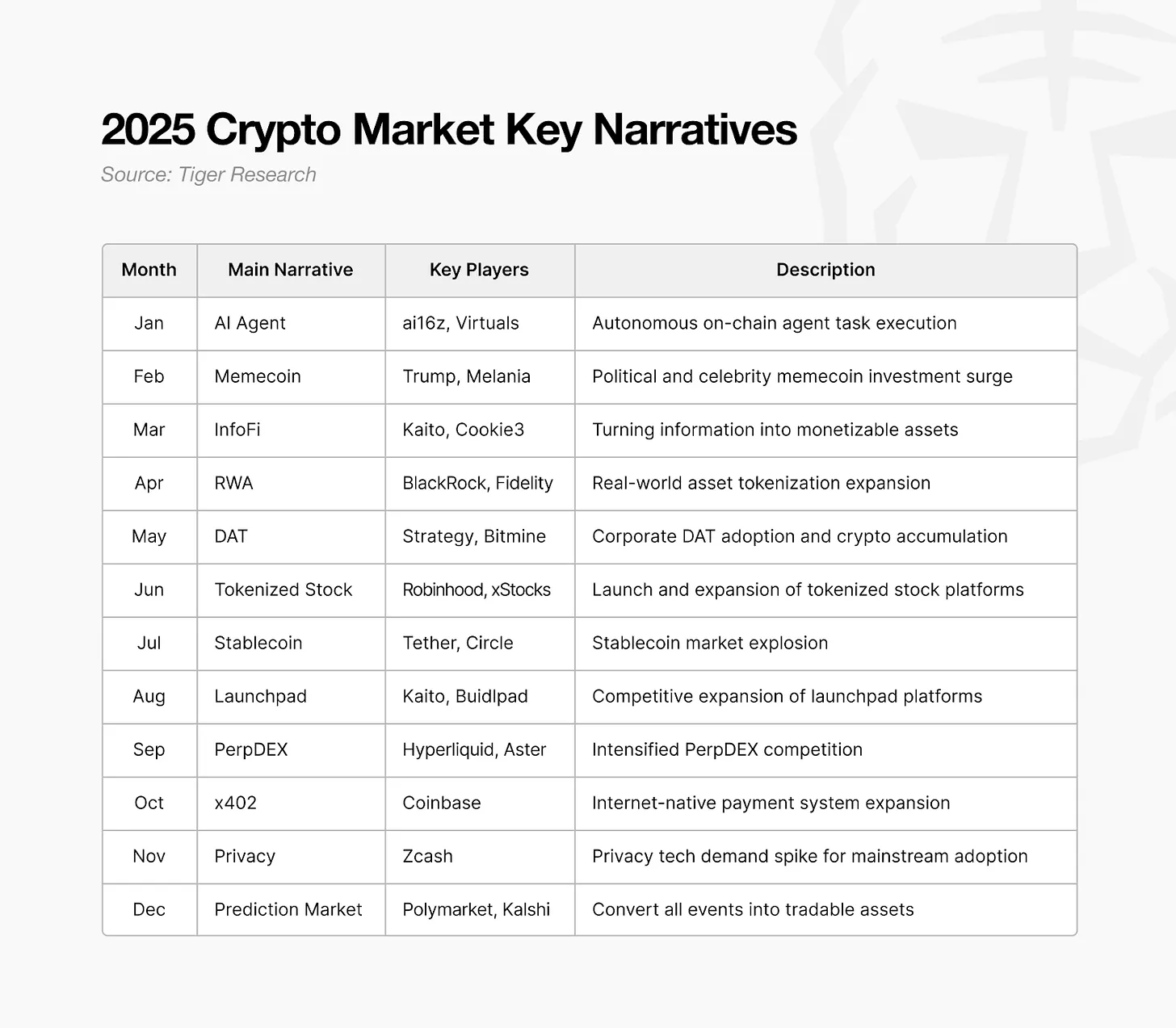
As covered in our previous report, 2025 marked the peak of this pattern of narrative consumption. After the AI agent narrative, a new one emerged nearly every month, and the pace of rotation kept accelerating.
On the surface this looked highly wasteful, but it is hard to deny that this rapid churn of narratives was what kept retail investor attention engaged and, in doing so, became a core driver of the market as it stands today. Even so, the market’s underlying demand for these past narratives was directed at the token itself rather than at the problem the product was meant to solve.
3. Innovation in Supply Without Demand
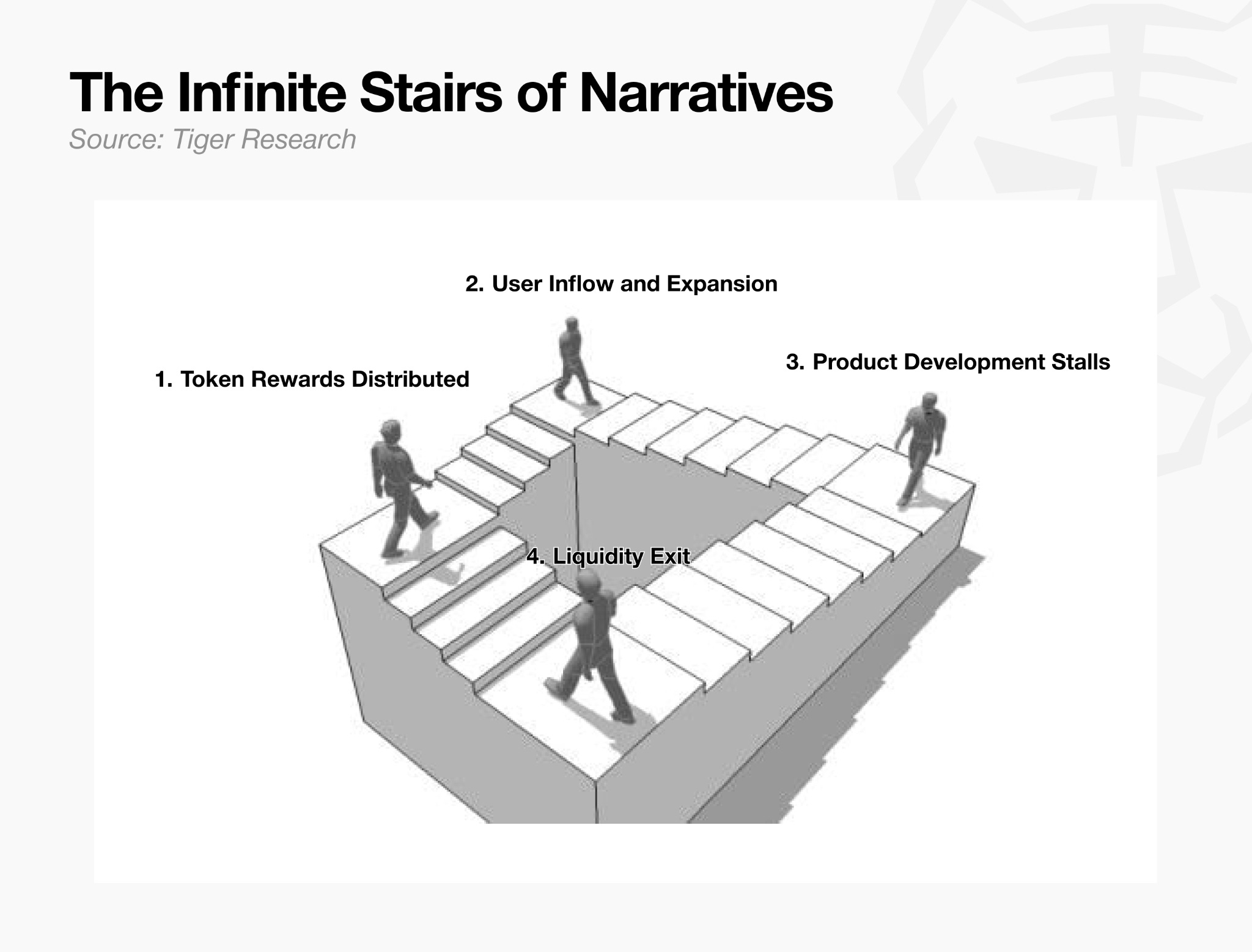
One example illustrates how most past narratives developed.
A decentralized social media project appears, framed around the problem that existing platforms monopolize revenue and leave creators inadequately compensated. It presents a vision of lower fees and of returning content ownership and revenue to creators.
Token rewards: early participants receive token rewards, and as stories spread of people earning income simply by being active on the platform, market interest grows.
User inflow and expansion: similar projects follow, issuing tokens around a minimum viable product and drawing users in through airdrops and liquidity incentives, and the ecosystem’s market capitalization and trading volume expand quickly.
Stalled product development: the token price and the scale of rewards start to outpace the product itself. Once fundraising and the initial distribution are complete, development and user growth stall, and the original problem of creator compensation remains unresolved.
Liquidity exit: there was never a large enough user base that felt this problem acutely, and the capital that had flowed in was chasing price appreciation rather than the product, so once the narrative peaked, liquidity and users left just as quickly.
This pattern repeated across several narratives, and the market eventually came to recognize that innovation in supply without underlying demand carries little meaning. It began to confirm that only projects generating real revenue and holding onto a stable user base mattered, and it became clear that only projects demonstrating genuine product-market fit would survive.
4. 2026: The Era of PMF That Creates Demand
Where past narratives built and supplied solutions without underlying demand and tried to manufacture demand afterward, the PMF era works the other way around: products are built to match demand that already exists among customers. The market is moving toward genuine products in which user numbers and revenue grow alongside the product and the brand, rather than one in which only token market capitalization rises.
The five sectors covered here were selected based on three criteria: usage indicators such as trading volume and revenue over the first half of 2026, the trajectory of new players entering the space, and growth in market capitalization. These criteria matter because they are difficult to manufacture artificially, all at once and over a short period.
The sections below trace the problem each sector originally set out to solve and the direction in which its leading players are now expanding.
4.1. Stablecoins: From a Volatility-Free Payment Instrument to Cross-Border Settlement Infrastructure
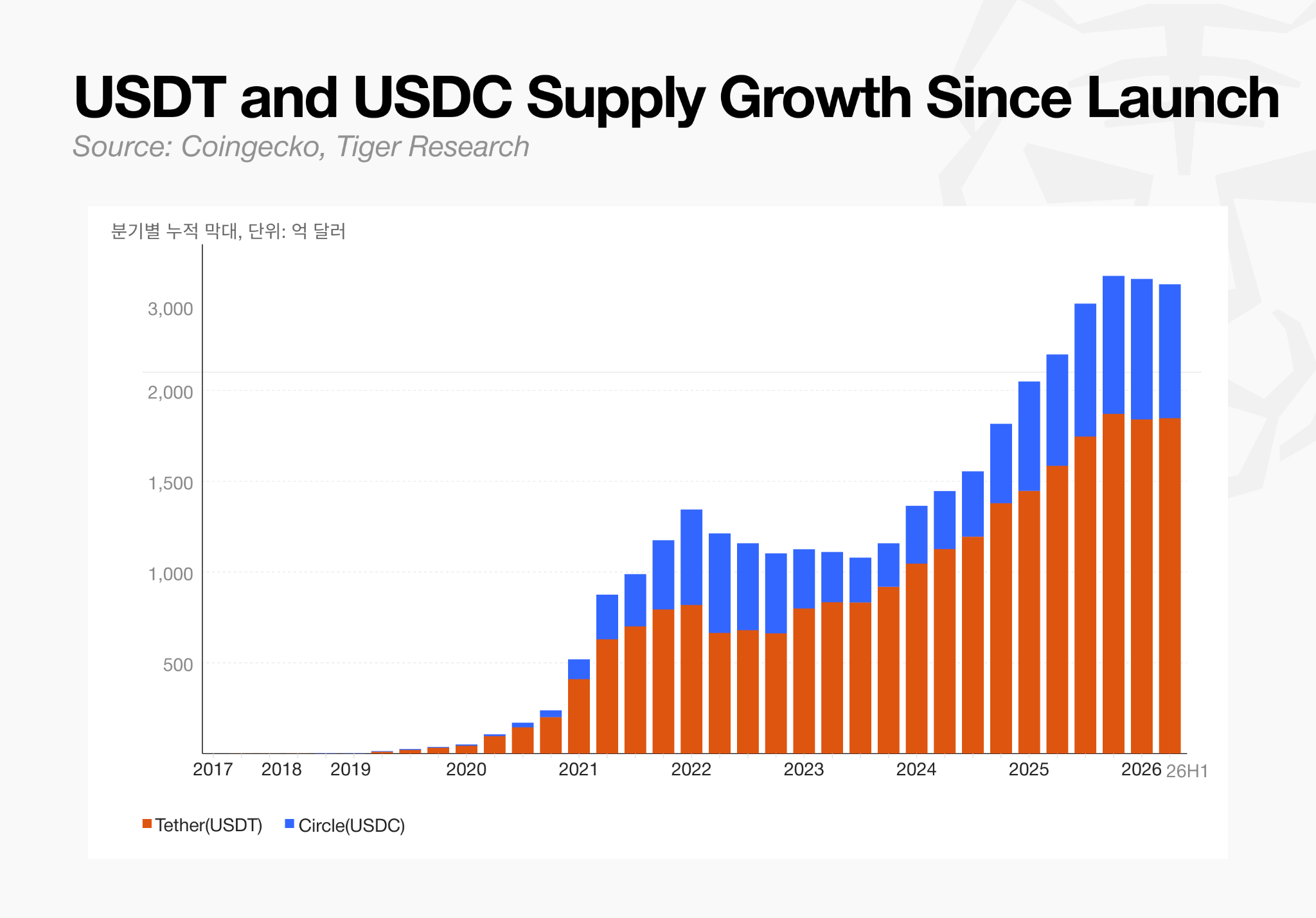
Stablecoins are tokens pegged to the value of fiat currency and used as a means of payment and settlement. The category’s market capitalization stands at $304.2 billion, close to its all-time high of $321 billion.
Tether(USDT): market cap of $184.08 billion, monthly settlement volume of $1.79 trillion (up 63% month over month), $10.2 trillion in cumulative settlement over the past 12 months, more than $10 billion in net income in 2025, and $141 billion in Treasury holdings.
Circle(USDC): market cap of $73.25 billion, the default stablecoin across major exchanges such as Coinbase and institutional settlement channels.
Stablecoins started out as a way to trade crypto without exposure to volatility. Their role has since broadened to cross-border remittances and on-chain payment infrastructure.
Growth is now taking more varied forms. In June 2026, more than 140 traditional companies, including Visa, Mastercard, Stripe, Coinbase, and BlackRock, announced OUSD (Open USD, from Open Standard) as a consortium. Non-dollar stablecoins pegged to national currencies such as the Korean won, the Japanese yen, and the euro are also becoming more common. Their combined market cap remains small at $1.2 billion, but the number of wallets holding them grew thirtyfold, from 40,000 in January 2023 to 1.2 million in March 2026.
Stablecoins are no longer just a fixed-value payment instrument. They are evolving into settlement infrastructure that operates independent of borders and time zones.
4.2. DeFi: Built to Replace Banks, Now Part of Financial Infrastructure
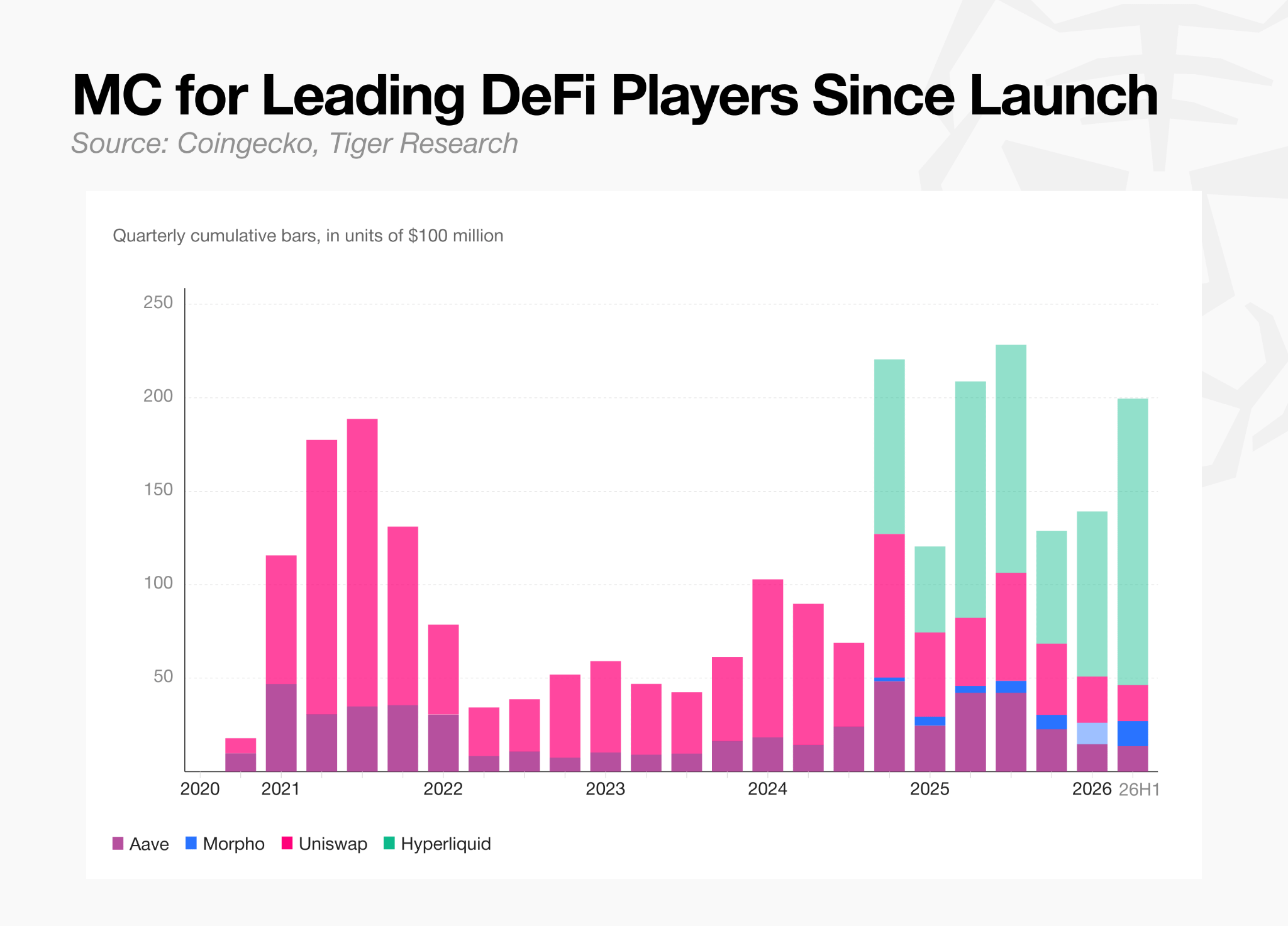
DeFi refers to smart-contract-based finance that enables lending, trading, and derivatives without a centralized intermediary.
Aave: market cap of $1.397 billion, TVL of $14.53 billion, annual revenue of $119 million, the leading DeFi lending protocol.
Morpho: market cap of $1.302 billion, TVL of $7.497 billion, annual revenue of $0 (its $222 million in annual fees goes entirely to lenders), briefly overtook Aave in market cap from late May through June before Aave regained the lead in July.
Uniswap: market cap of $2.287 billion, TVL of $3.14 billion, annual revenue of $850 million, the leading decentralized exchange with $2.66 billion in 24-hour trading volume.
Hyperliquid: market cap of $13.47 billion, TVL of $6.07 billion, annual revenue of $874 million, accounting for about 76% of the perpetual futures DEX category’s market cap and roughly 20% of DeFi overall, with an on-chain perpetuals market share as high as 70%.
DeFi began in 2020 on the decentralized premise of returning the profits earned by intermediaries such as banks to users directly.
Today, it persists less on that ideology than on institutional demand for on-chain financial infrastructure. Morpho and Aave provide the vault risk management and lending infrastructure institutions want, Uniswap supports trading in the assets institutions want to trade, and Hyperliquid supports trading in traditional assets rather than crypto alone.
Each has moved in a direction somewhat different from its founding ideology, but it was precisely this willingness to pivot decisively toward real demand that allowed these protocols to survive and grow.
4.3. RWA: From Democratizing Traditional Assets to Efficiency
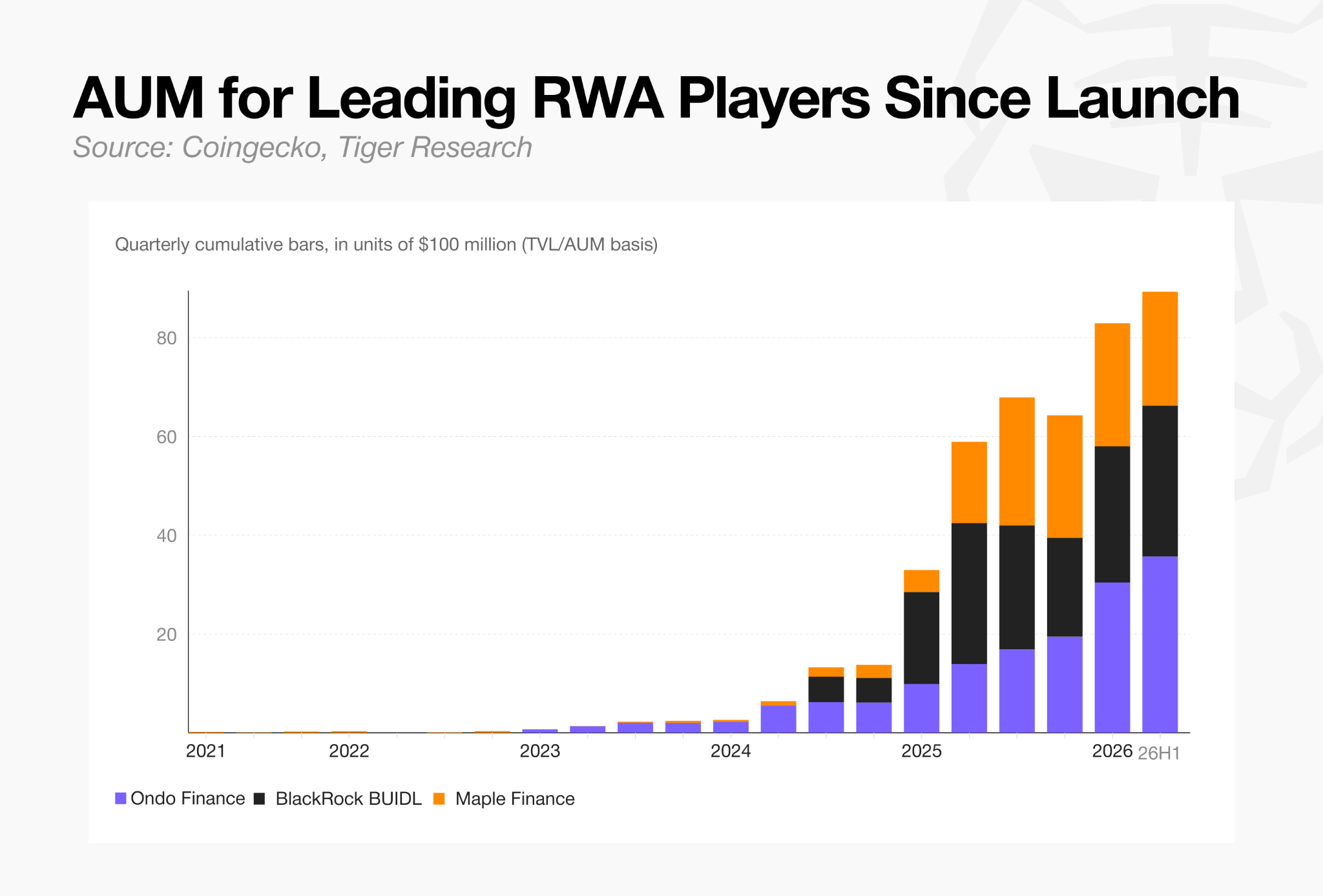
RWA refers to the tokenization and on-chain distribution of traditional real-world assets such as Treasuries and private credit. The category’s market cap is $65.2 billion, with tokenized Treasuries the largest subcategory at $13.4 billion.
Ondo Finance: TVL of $3.52 billion, ONDO market cap of $1.75 billion, a leading provider of tokenized Treasury infrastructure.
BlackRock BUIDL: AUM of $2.4 billion, with no market cap in the conventional sense since it is a NAV-linked fund token, the largest single tokenized Treasury fund.
Maple Finance: SYRUP market cap of $218 million, with $4 billion in private credit AUM, exceeding BlackRock BUIDL.
RWA set out to bring traditional asset management on-chain in order to improve settlement speed and accessibility. Its initial customer base was not institutional. The sector began with synthetic asset exchanges that used the fact that on-chain markets sat outside existing regulation to lower the barriers to trading real-world assets. Today, however, institutions make up the sector’s largest user base.
Tokenized equities are a development worth watching closely. Adoption by traditional institutions such as Securitize and the DTCC is increasing. In July 2026, the DTCC began live trading of tokenized securities with more than 50 institutions, and Securitize listed its own shares, SECZ, on the NYSE while simultaneously issuing tokenized shares across multiple chains, including Avalanche and Solana. Centralized exchanges such as Binance (bStocks) and Kraken (xStocks) are also expanding their tokenized equity offerings across various countries. The tokenized equity category’s market cap reached $2.3 billion in mid-July 2026, nearly double its level since first crossing $1 billion in March.
Trading volume for these assets on decentralized exchanges remains minimal compared with DeFi, and most collateral use still relies on permissioned, whitelisted structures. Deeper on-chain integration, comparable to DeFi’s money-lego composability, will likely take more time. For now, the sector is still in the stage of proving the usefulness of on-chain asset management.
4.4. Prediction Markets: From Simple Betting to a Market-Leading Trend
Prediction markets are on-chain contract markets in which participants bet on the outcomes of real-world events. The category’s market cap is $9.58 billion, the most recently formed of the five sectors covered here.
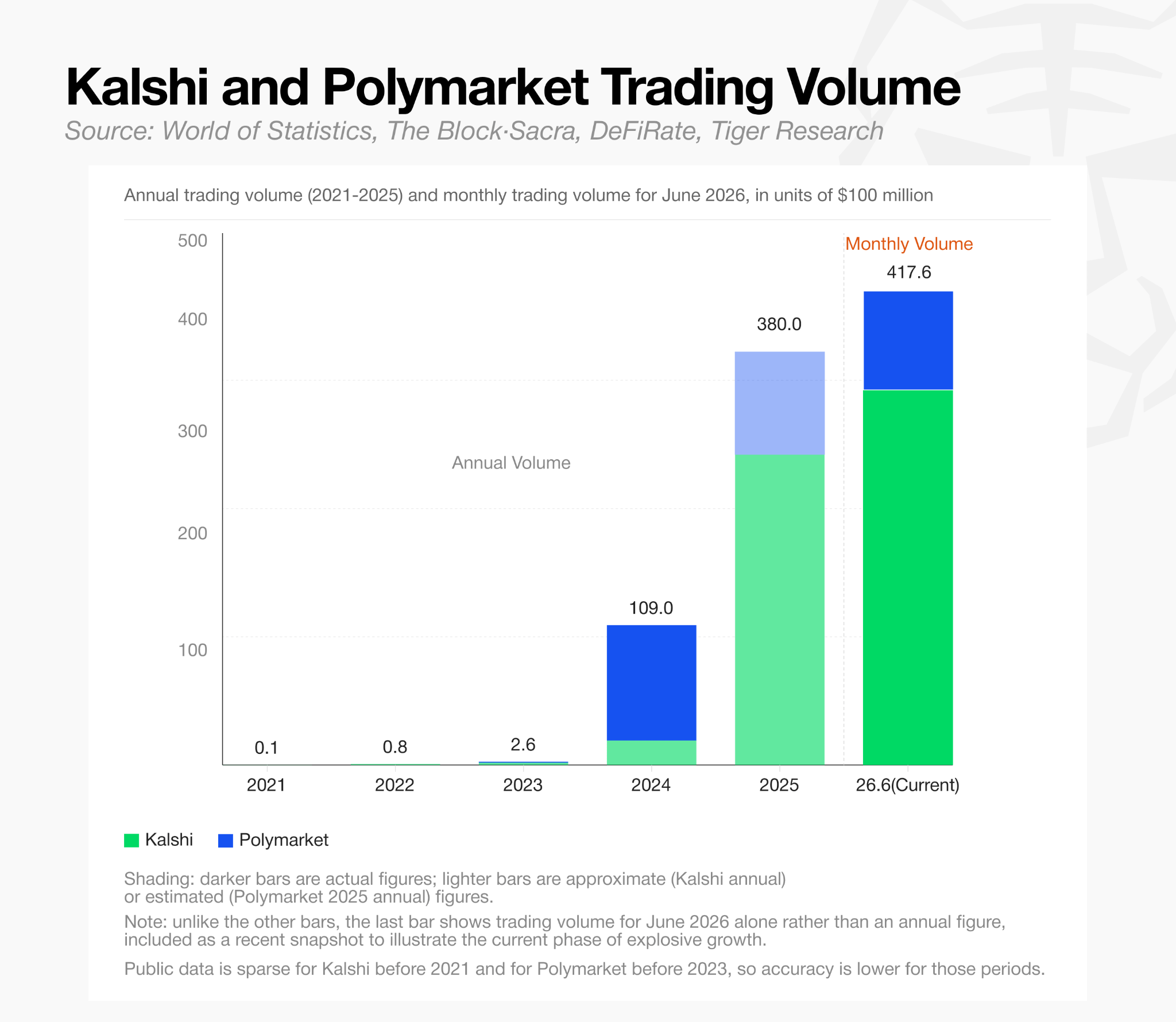
It is also worth noting that the two platforms that actually dominate the sector, Kalshi and Polymarket, do not yet have tokens.
Kalshi: has raised $2 billion in cumulative funding at a $22 billion valuation, an 11x multiple on funding raised. Its June trading volume of $31.5 billion (up 87.4% month over month) already exceeds that valuation.
Polymarket: has raised roughly $1.6 billion in cumulative funding at a $9 billion valuation. June trading volume on its main platform outside the U.S. reached $10.26 billion (up 45% month over month), and annualized revenue has exceeded $1 billion since it gained approval to operate in the U.S.
The World Cup was both an opportunity and a challenge for prediction market platforms. It drove a sharp surge in trading volume through June, but after the final on July 19, combined open interest across the two platforms fell nearly 20% from its early-July peak of roughly $2 billion. Since sports contracts accounted for roughly 80% of total trading volume during the tournament, volume is likely to stay soft until the next major event, the U.S. midterm elections.
Regulatory risk also remains active. On July 21, 2026, a Washington state court issued a preliminary injunction barring Kalshi from selling sports event contracts on the grounds that they constitute illegal gambling under state law.
Before 2024, prediction markets did not even exist as a distinct category. Today, they are the fastest-growing segment of the crypto market. What sets this sector apart is that its growth has been demonstrated not through token market cap or TVL, but through real trading volume and revenue generated by drawing users from outside crypto into the on-chain ecosystem. This stands as one of the clearest examples to date of blockchain technology becoming part of everyday use for a broad audience.
4.5. Meme Tokens: From Simple Speculative Assets to a Liquidity Bootstrapping Strategy
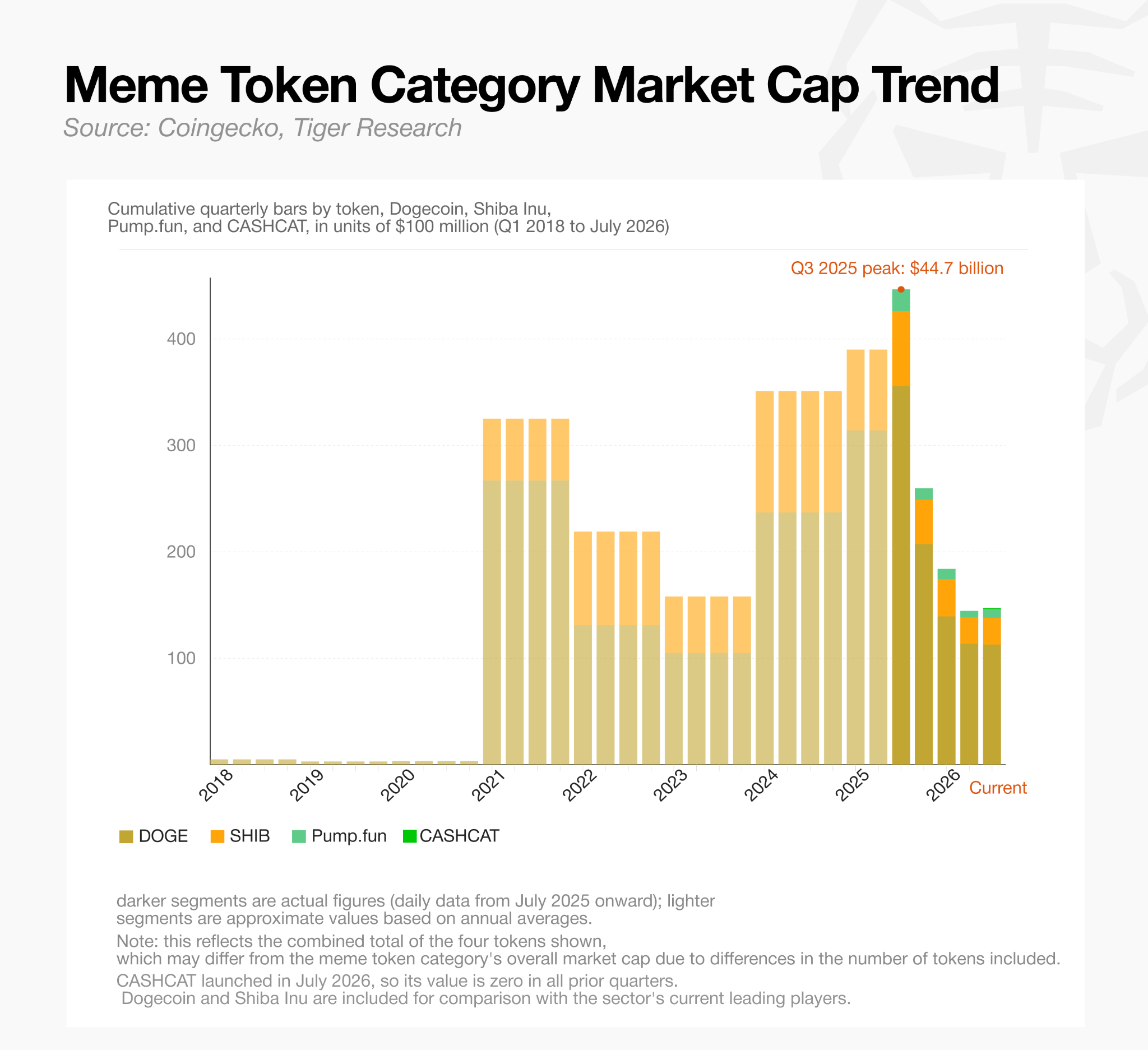
The last sector is meme tokens. Unlike the other sectors discussed above, meme tokens have no clear utility. Their value comes from community and attention. The category’s market cap is $25.68 billion, larger than that of prediction markets.
Dogecoin ranks first at $11.22 billion, followed by Shiba Inu at $2.5 billion. Together, these two tokens account for 53.4% of the entire meme token category’s market cap, showing that once a token claims a symbolic position within the sector, even loosely, it tends to hold that position.
Pump.fun and CASHCAT are highlighted here not for their market cap ranking but for their symbolic significance.
Pump.fun: market cap of $806 million, notable for raising $600 million in its public sale in July 2025 in just 12 minutes.
CASHCAT(Robinhood chain): its market cap rose more than 2,100% within a week of launch, peaking above $200 million before falling roughly 75% from that peak to $59 million by July 17.
As the Robinhood chain case in July 2026 shows, meme token narratives can still momentarily pull in liquidity across an entire chain, a pattern seen in past cycles. The Robinhood chain’s TVL expanded sharply, from $17 million on July 3 to $312 million on July 13, and daily DEX trading volume climbed as high as $846.8 million on July 10, driven largely by the meme token $CASHCAT.
The practical value of meme tokens lies in attracting early users and easing onboarding. A new chain or application can use a meme token to build a community quickly and naturally encourage activity such as bridging assets or trading on a DEX. Some of the users drawn in this way go on to use other DeFi services or applications within the ecosystem and stay active there, making the meme token an effective entry point and marketing channel.
In the end, meme tokens function less as long-term holdings and more as an initial tool for quickly bringing together users and liquidity. Whether that early attention can be converted into genuine product usage and lasting retention within the ecosystem is what determines success or failure.
5. What It Takes for a Project to Survive
The projects that have survived to this point have secured genuine demand that brings users back repeatedly, and they have demonstrated it through clear performance indicators such as trading volume, TVL, and fee revenue.
Demand in the 2026 market is concentrated at two distinct ends of the spectrum. At one end is speculative demand seeking high volatility and immediate rewards. Meme tokens, perpetual futures DEXs, and prediction markets absorb this demand effectively through rapid trading cycles and high capital turnover. At the other end is genuine financial demand for the stable custody, transfer, and efficient management of assets. Stablecoins, RWA, and DeFi infrastructure are fulfilling these core financial functions of payment, collateral, yield generation, and risk management.
Real product-market fit forms when a sustainable revenue structure and network effects are added to this base. A token’s price can generate initial attention, but long-term survival is determined by usage frequency, retained capital, revenue, and operational capability.
KBW, taking place in late September 2026, will offer a close view of this shift as it unfolds. Bo Hines, CEO of Tether U.S., Jeff Yan, co-founder of Hyperliquid, Johann Kerbrat, SVP of Robinhood Crypto, and Christine Moy of Apollo are among the leading figures driving these changes who will appear on stage together. Through conversations with key leaders in stablecoins, perpetual futures DEXs, and asset tokenization and RWA, attendees will be able to see firsthand the shift that has so far only been visible in the data.
Tiger Research is the exclusive research content partner for KBW 2026.
🐯 More from Tiger Research
Read more reports related to this research.DeFi Lending Is Modularizing: The Risk Management War Among Morpho, Euler, and Aave
Still 1990: Crypto Cards: $1.5 Billion a Month, but Not Yet Infrastructure
Disclaimer
This report has been prepared based on materials believed to be reliable. However, we do not expressly or impliedly warrant the accuracy, completeness, and suitability of the information. We disclaim any liability for any losses arising from the use of this report or its contents. The conclusions and recommendations in this report are based on information available at the time of preparation and are subject to change without notice. All projects, estimates, forecasts, objectives, opinions, and views expressed in this report are subject to change without notice and may differ from or be contrary to the opinions of others or other organizations.
This document is for informational purposes only and should not be considered legal, business, investment, or tax advice. Any references to securities or digital assets are for illustrative purposes only and do not constitute an investment recommendation or an offer to provide investment advisory services. This material is not directed at investors or potential investors.
Terms of Usage
Tiger Research allows the fair use of its reports. ‘Fair use’ is a principle that broadly permits the use of specific content for public interest purposes, as long as it doesn’t harm the commercial value of the material. If the use aligns with the purpose of fair use, the reports can be utilized without prior permission. However, when citing Tiger Research’s reports, it is mandatory to 1) clearly state ‘Tiger Research’ as the source, 2) include the Tiger Research logo. If the material is to be restructured and published, separate negotiations are required. Unauthorized use of the reports may result in legal action.


