

Compliance hiring is growing even as overall crypto hiring declines. What has changed in a market where new postings have fallen sharply?
Key Takeaways
The crypto job market has not recovered to its 2022 peak. According to Coincub, new crypto jobs reached 66,494 in 2025, a 47% rebound from the prior year, but still below the 2022 high.
The contraction deepened in 2026, with new postings on major job boards falling roughly 80% year-over-year in January.
Among 2,932 active postings in H1 2026, engineering ranks first at 34.1% and compliance/legal ranks second at 10.4%. Active postings are concentrated in regulatory compliance and technical development.
By sector, CEX (30.8%) and stablecoins/payments (13.4%) together account for nearly half of all postings. Gaming and NFTs represent 2.4%.
In a market driven by token sales, demand was concentrated in community and token sale roles. As the market has shifted toward institutional participation, the ability to manage product operations and regulatory compliance has become more important.
1. The 2021-2022 Hiring Peak and Where the Market Stands Today
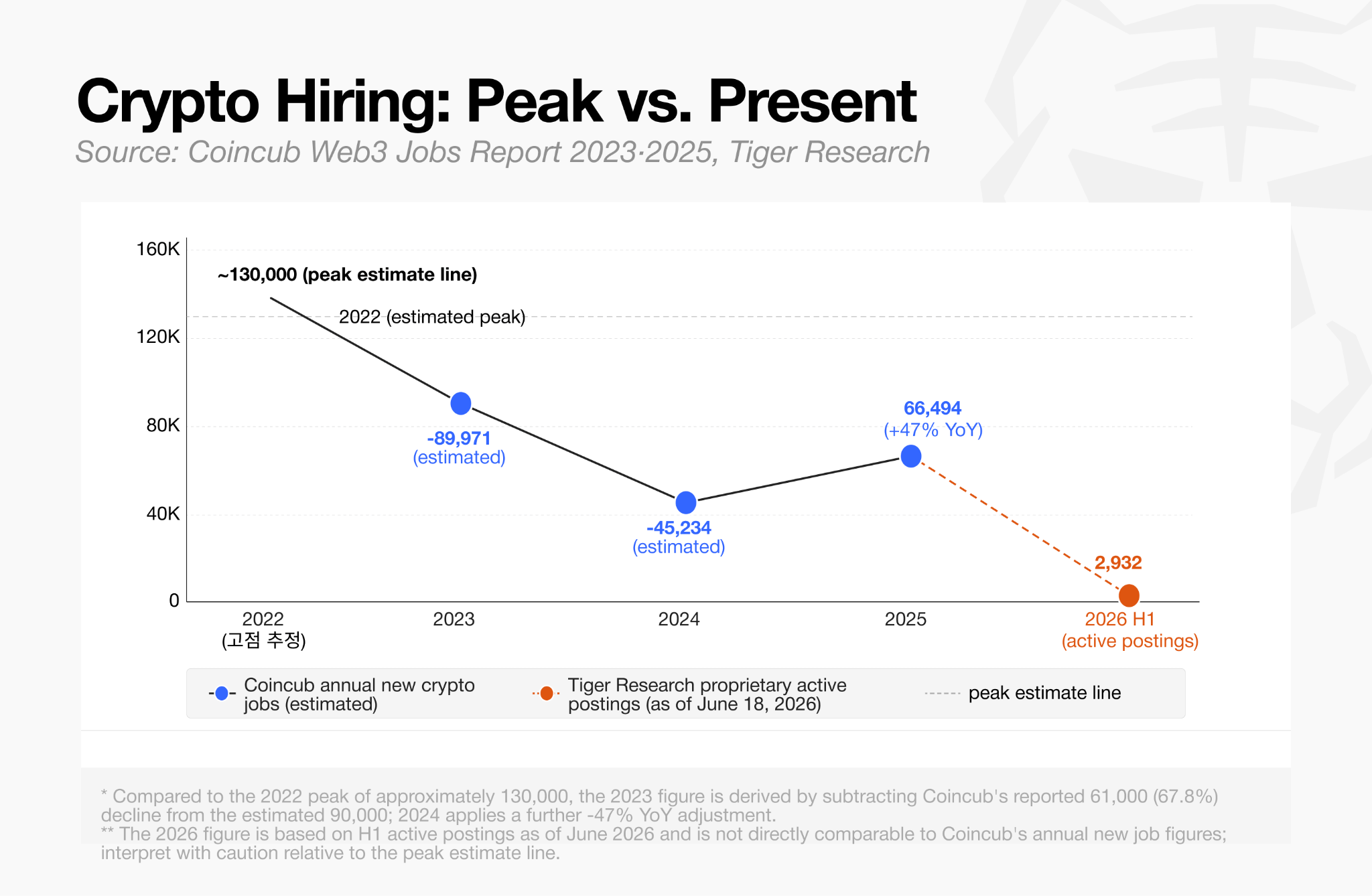
The most active hiring period in crypto was the stretch from late 2021 through the first half of 2022. Bitcoin and Ethereum reached all-time highs, NFT trading volumes surged, and DeFi TVL reached hundreds of billions of dollars.
Centralized exchanges expanded aggressively to support global operations. At the time, Coinbase had more than 250 open roles, Kraken more than 300, and Binance more than 600. DeFi protocols and NFT marketplaces absorbed engineers and marketers simultaneously, and the GameFi boom drew game studios into the hiring pool as well. Expansion took precedence over proving profitability.
New postings fell sharply from the second half of 2022 onward. Crypto-related jobs declined roughly 40% between 2022 and 2023 across most countries in North America and Europe. The collapse of FTX in November 2022 deepened the slowdown, and the market has not recovered to its peak since.
To assess the current state of crypto hiring and read market direction from the data, Tiger Research compiled a proprietary dataset of 2,932 active postings as of June 2026. The data was collected through manual tracking of web3.career, cryptocurrencyjobs.co, direct career pages of major firms (Greenhouse, Ashby, and Lever), and Korean local job platforms (Wanted and Jobkorea). DAO contributor roles, freelance positions, and contractor arrangements are excluded.
2. Major Crypto Firms Continue to Cut Headcount in H1 2026
Restructuring had been underway well before the first half of 2026. Consensys carried out layoffs in the second half of 2025, and the trend extended into 2026 across major exchanges including Coinbase, Gemini, Crypto.com, and Kraken.
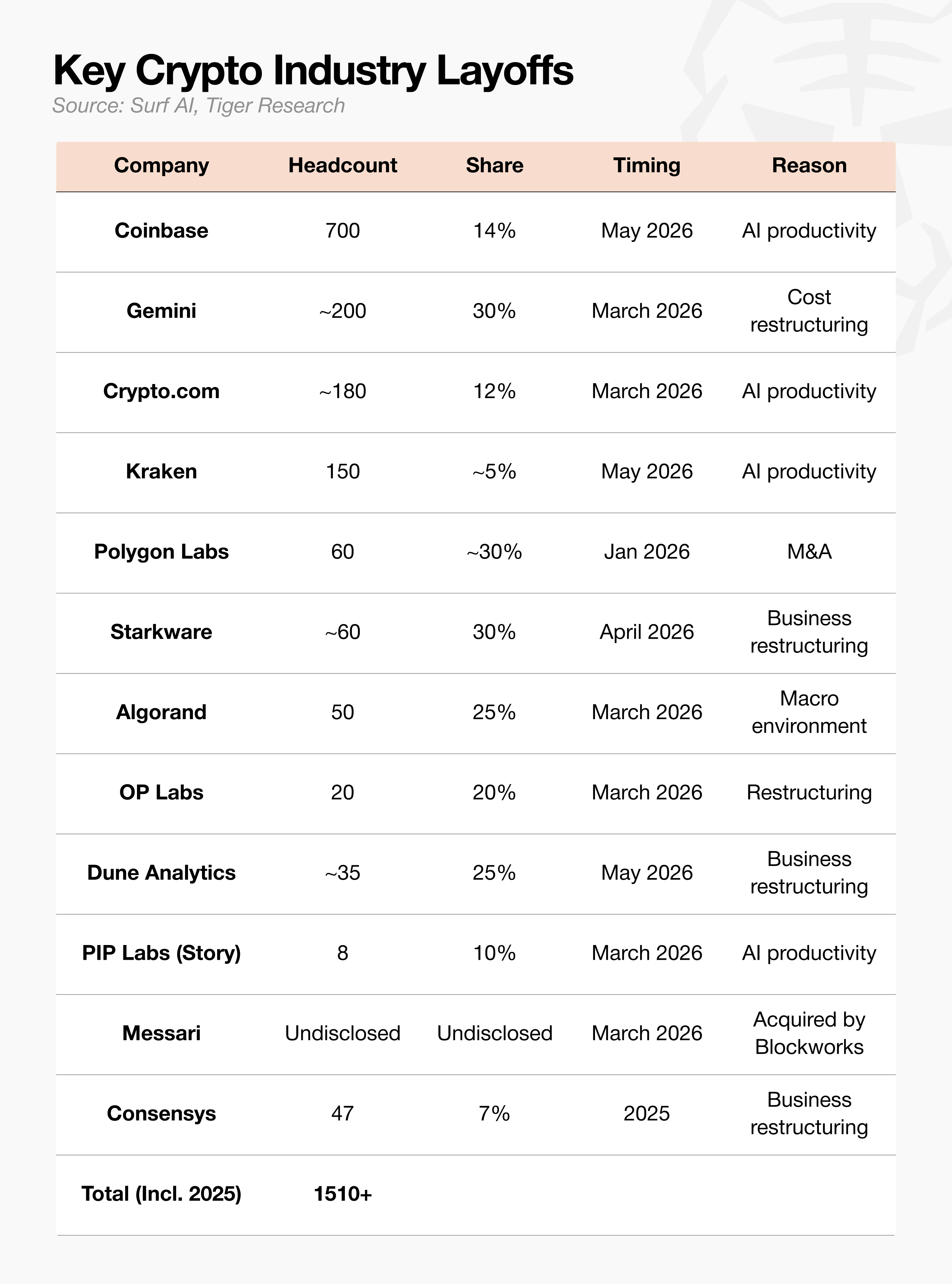
March saw the highest concentration of layoff announcements in H1 2026, with six firms: Gemini, Crypto.com, Algorand, OP Labs, PIP Labs, and Messari all disclosing cuts in the same month. The first quarter of 2026 brought a combination of rising geopolitical tensions stemming from Iran and broader market weakness, and firms that needed to reset their strategic direction appear to have converged on March as the moment to act.
The stated rationale varied by firm. Algorand cited the macro environment and declining token prices. Crypto.com and Gemini pointed to AI integration. Coinbase announced a pivot toward becoming an “AI-native company.”
For some firms, repeated rounds of cuts ended in an acquisition at a fraction of their former valuation. Messari conducted three consecutive rounds of layoffs beginning in 2023 and was acquired by Blockworks in June 2026 for approximately $10 million. Having once been valued at $300 million, Messari’s trajectory captures the reality of the market in concentrated form.
3. Hiring Is Concentrating in Specific Regions
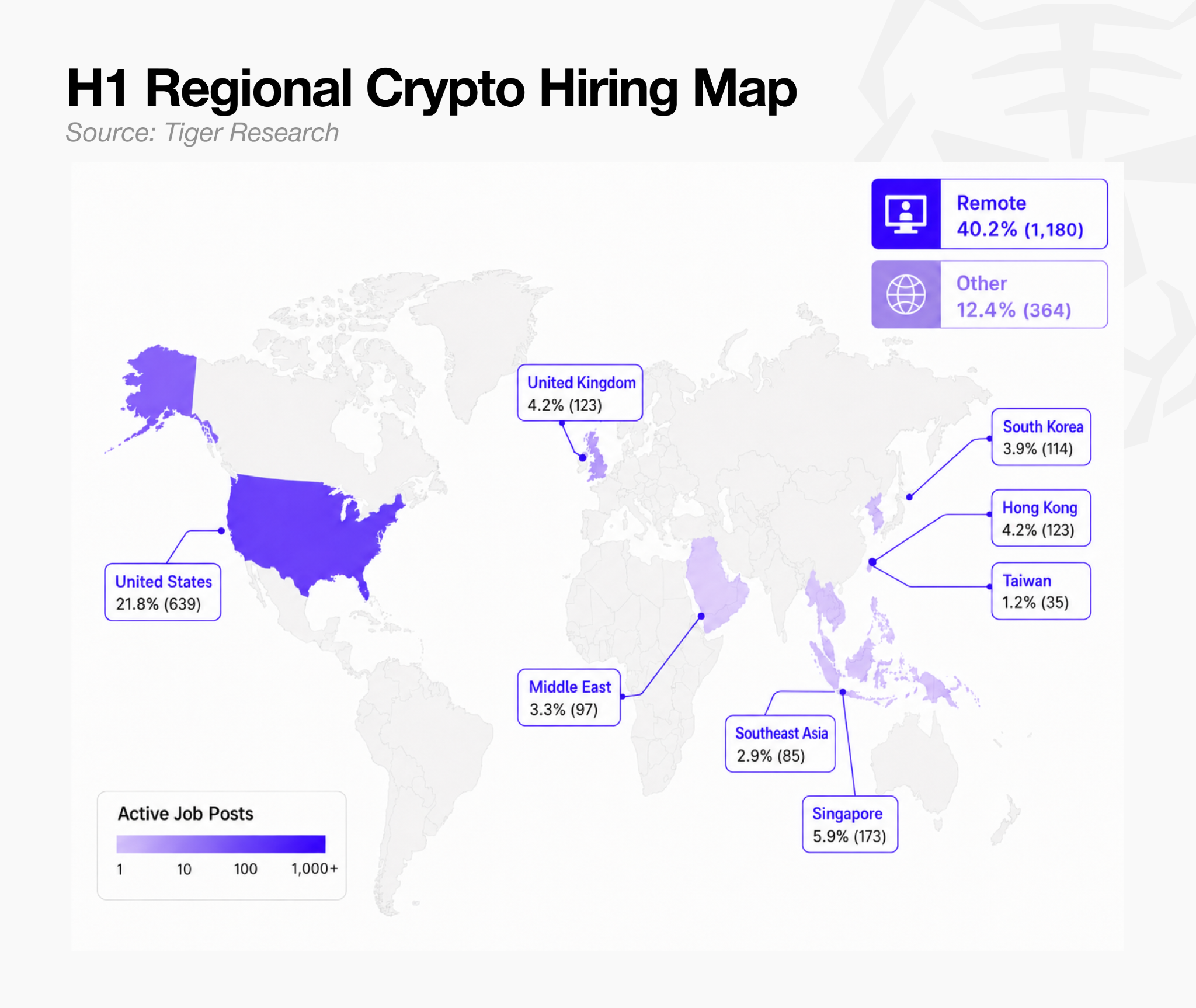
Crypto remains an industry with a high proportion of remote work. Among active postings in H1 2026, remote positions account for the largest share at 40.2%, or 1,180 postings.
Excluding remote roles, office-based hiring is concentrated in jurisdictions with established regulatory frameworks or limited regulatory unpredictability, including the United States (21.8%), Singapore (5.9%), and Hong Kong (4.2%).
The crypto industry once positioned itself as borderless, but as it has evolved into one that requires active regulatory engagement and local operations, its hiring structure is gradually consolidating around established regulatory hubs.
4. Compliance Roles Are on the Rise
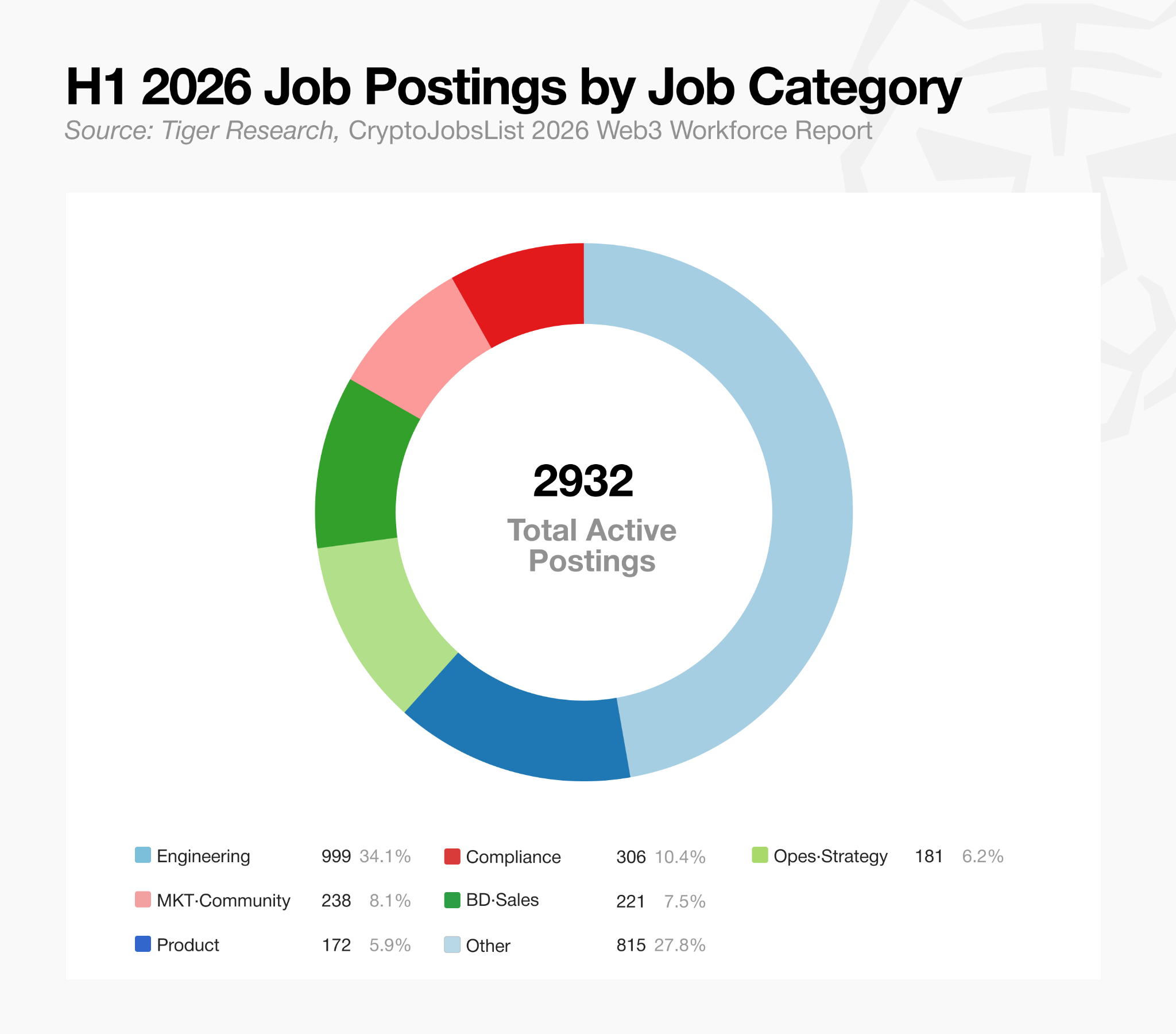
Engineering ranks first among H1 2026 active postings at 34.1%, or 999 postings, indicating that demand for technical development has held up even as the broader crypto market has contracted.
The more notable shift is compliance and legal settling into a clear second place. This category was not tracked as a separate line item in the Tiger Research 2023 Global Crypto Jobs Report, yet within three years it has grown to account for one in ten of all active postings.
The pattern is sharper within exchanges. Among 904 exchange postings, engineering leads with 275 openings (30.4%), followed by compliance and legal at 145 (16.0%) and BD/sales at 61 (6.7%). Compliance postings outnumber BD/sales by a factor of 2.4, suggesting that exchanges are allocating more headcount to regulatory defense than to business expansion.
The compliance hiring trend can be traced in part to the full implementation of the EU’s MiCA framework, which made CASP licensing mandatory as of December 30, 2024. European exchanges and asset managers have been expanding their compliance teams around the same period.
The same dynamic is visible in Korea. Following the implementation of the Virtual Asset User Protection Act in July 2024, domestic exchanges have seen rising demand for compliance personnel. This helps explain why Korea’s share of compliance postings (18.4%) is nearly double the global average (10.4%).
The roles workers most want to see automated are equally clear.
In a survey conducted by CryptoJobsList, content creation and community management were most commonly identified as the functions workers want to see automated. Both involve repetitive tasks and emotional labor rather than high technical complexity, making them candidates for early displacement. Survey data also identifies them as the roles practitioners believe should be displaced by AI agents first. Hiring demand for these functions is declining at the same time that those already in the field identify them as prime automation targets.
5. CEX Dominance and the Rise of the Stablecoin Sector
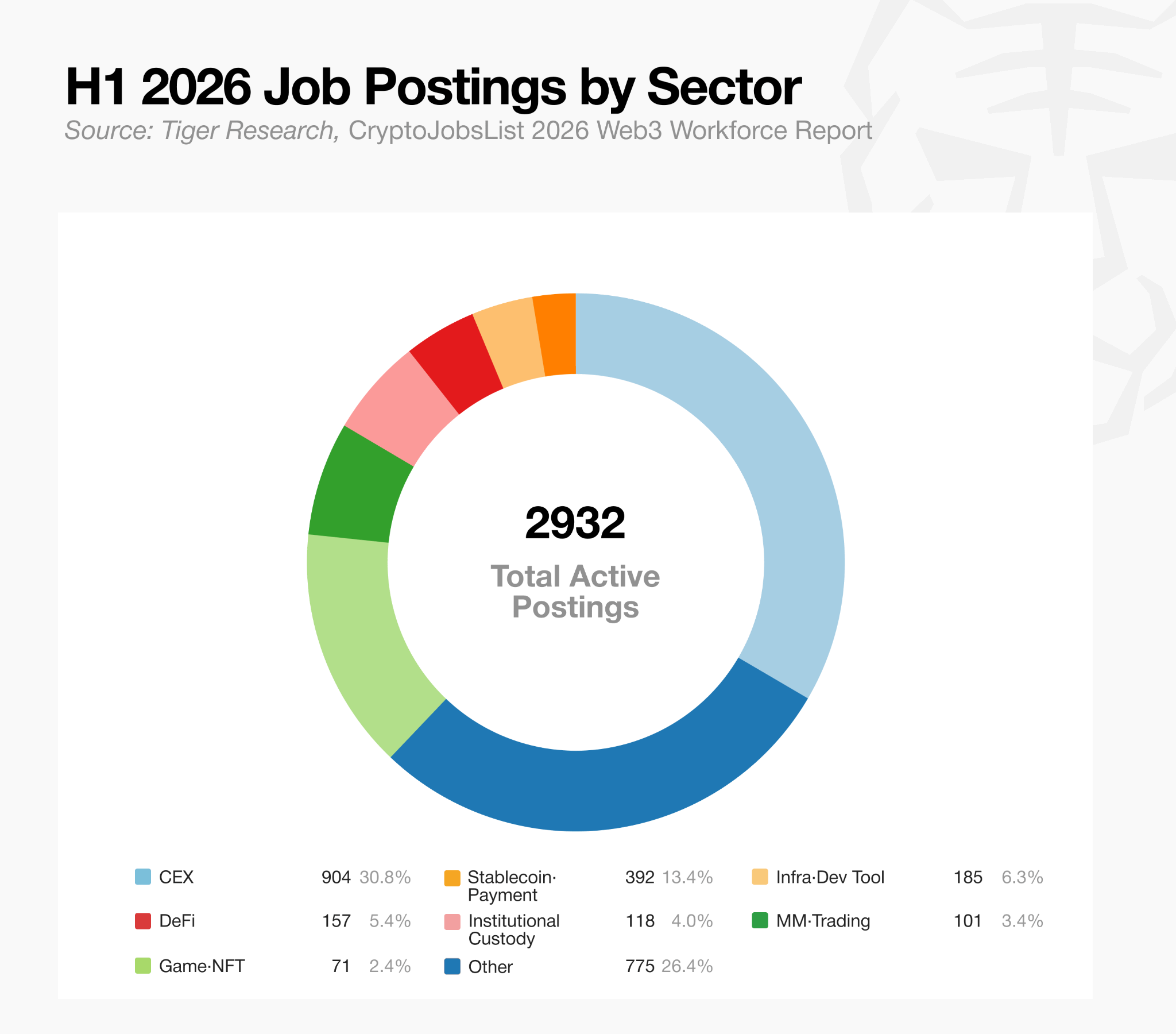
CEX accounts for 904 postings, or 30.8% of the total, representing close to one-third of all active roles. Major exchanges including OKX (267 postings), Bybit (138), and Binance (135) drive this sector.
Stablecoins and payments ranks second at 392 postings (13.4%). However, Tether alone accounts for 224 of those postings (57.1%), with Ripple contributing a further 104 (26.5%). Together the two firms hold 83.6% of the sector, which means the figures reflect concentration among a small number of large firms rather than broad-based hiring growth across the sector. The second half of the year may look different. With stablecoin-related legislation advancing in the United States, the hiring environment for this sector is expected to shift materially in H2.
Market making and trading has reached 101 postings (3.4%), enough to constitute a standalone sector. Key firms include B2C2, GSR, Keyrock, and Wintermute. This category did not appear as a separate classification in the 2023 report. Its emergence reflects the entrenchment of institutional liquidity provision and asset management within crypto market infrastructure.
Gaming and NFTs account for just 71 postings (2.4%). This sector led hiring across the market during the GameFi boom of 2022 and 2023, but its share has since fallen below that of market making, which was a minor category at the time.
Hiring within the market is no longer driven by cyclical sensitivity. It has consolidated around sectors that emphasize structural stability: exchanges, payments, and regulatory infrastructure.
6. The Crypto Hiring Market After AI Adoption
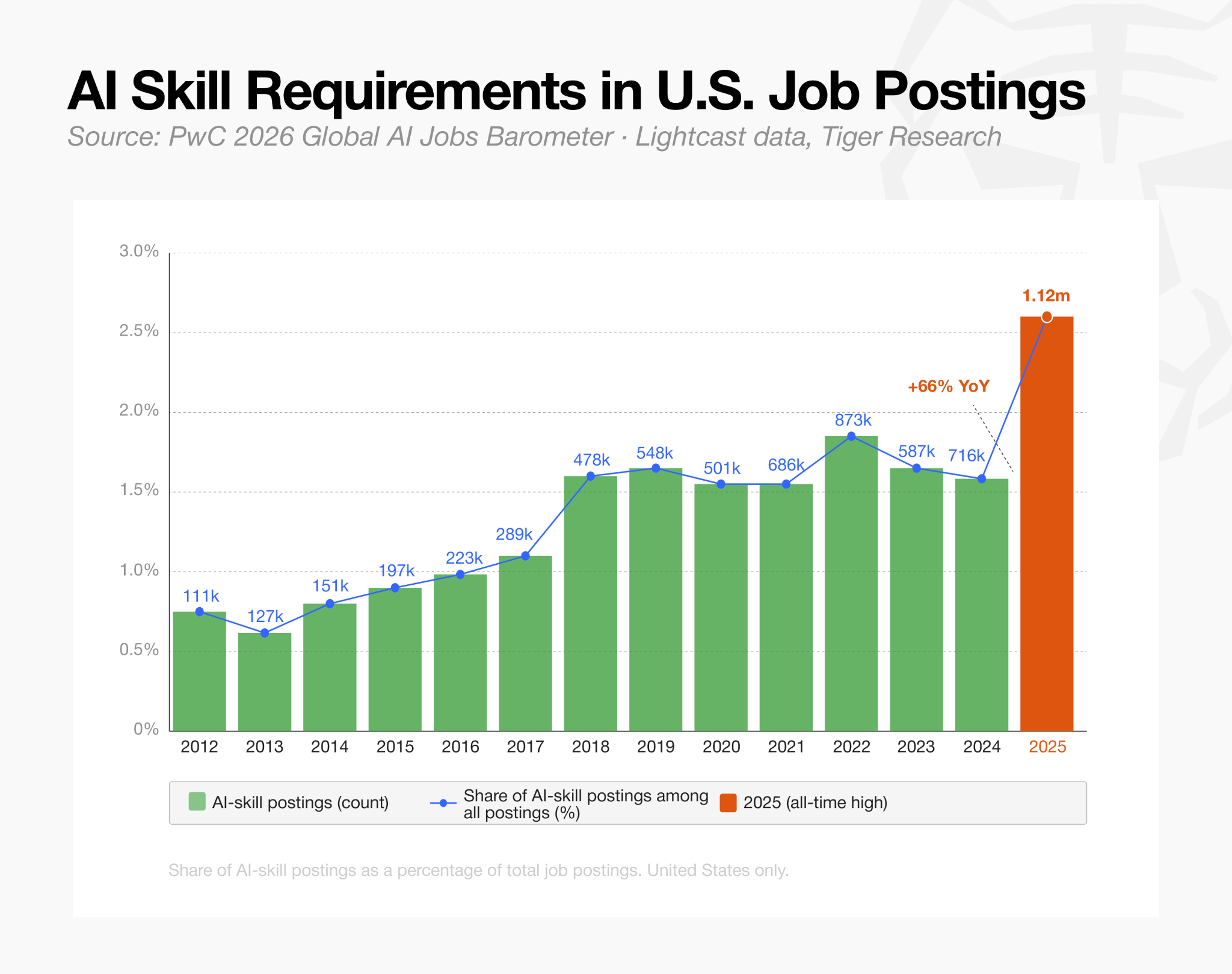
The AI industry points in the opposite direction over the same period. The PwC 2026 Global AI Jobs Barometer, which analyzed more than one billion job postings across six continents, found that U.S. postings requiring AI-related skills reached approximately 1.12 million in 2025, up 66% year-over-year and representing 2.8% of all postings.
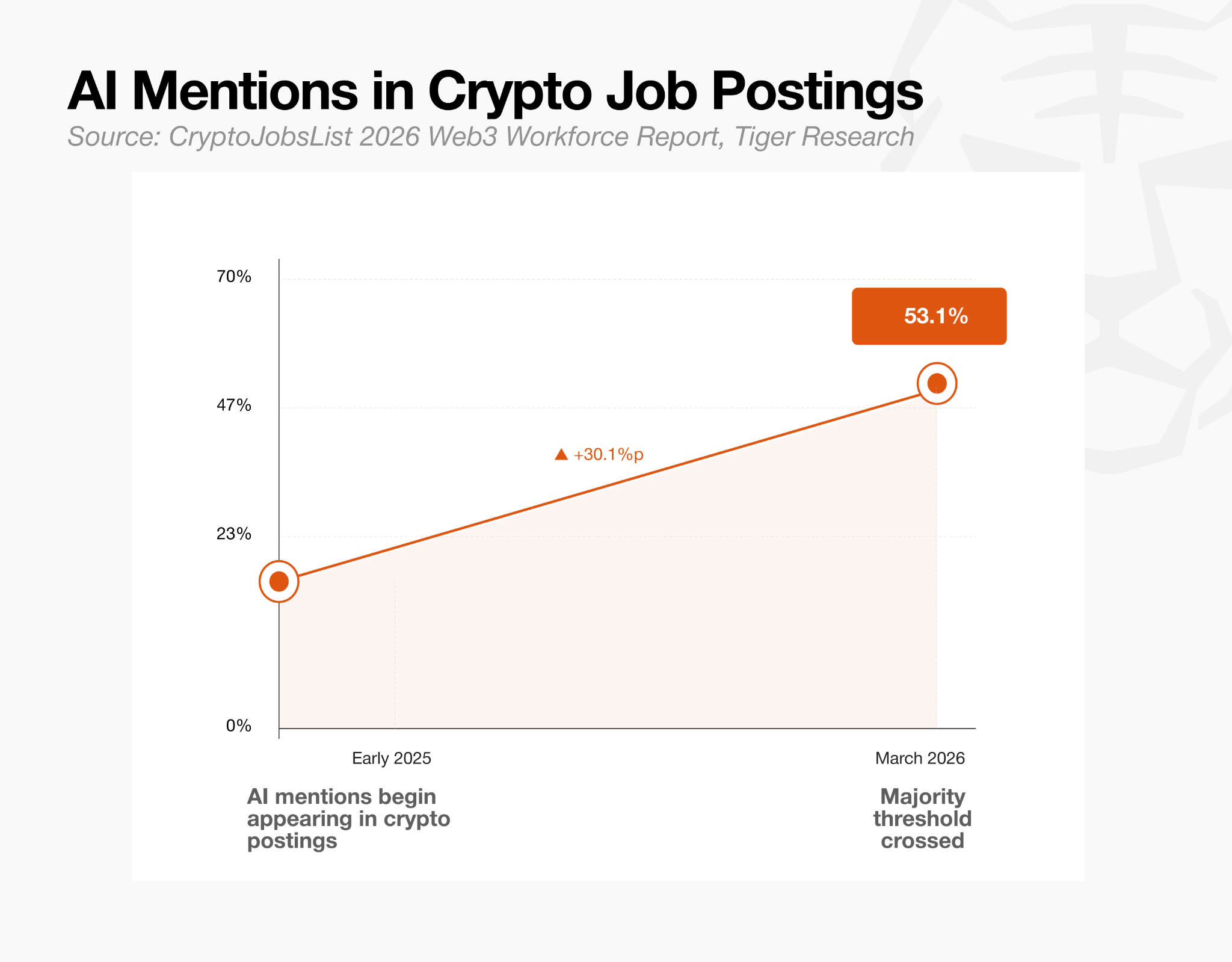
Crypto is following a similar pattern. The share of crypto job postings that mention AI skills rose from 23% in early 2025 to 53.1% by March 2026.
Taken together, AI is generating new roles across industries broadly, while the crypto market is restructuring toward higher productivity with a smaller workforce.
7. Contraction and Selectivity in the Crypto Hiring Market
The global crypto hiring market has not simply contracted in scale; the nature of the work being hired for has changed fundamentally.
The center of gravity has shifted from marketing to regulatory compliance and infrastructure operations. Roles focused on promoting tokens and growing communities, which were prevalent during the bull market, have declined sharply. Demand for people who work with operating systems directly, whether in exchange operations, stablecoin infrastructure, or on-chain risk management, has remained stable or grown.
Conversations with practitioners in the field reflect the same shift. Projects no longer describe themselves as looking for “degen” hires. Having moved past the early stage when few understood the industry, the blockchain sector is now applying the kind of rigorous, exacting hiring standards long associated with traditional finance and fintech.
The changes underway in the crypto hiring market reflect an industry that has passed through a speculative phase and is settling into the institutional mainstream. The market no longer seeks people who build elaborate illusions; it seeks specialists who can construct and demonstrate real infrastructure.
Appendix: Data Sources
Proprietary Data (2,932 postings) — web3.career / cryptocurrencyjobs.co / direct career pages (Greenhouse, Ashby, Lever, Polymer) / manual tracking of Korean platforms / manual LinkedIn sample / collection date: June 18, 2026
External Sources
LinkedIn, January 2022: crypto job postings up 395% versus 2020
CFTE, 2022: crypto and Web3 accounted for 67% of new tech hires
Coincub Blockchain Jobs Report 2023: blockchain hiring in North America and Europe down approximately 40% between 2022 and 2023
LinkedIn Jobs on the Rise 2026
LinkedIn 2026 Grad’s Guide: AI Engineer ranked first in growth; U.S. AI postings up 639,000 (AI Engineer up 75,000)
WEF/LinkedIn 2026: AI created 1.3 million new jobs; AI expert roles exceeded 3% of all LinkedIn postings
CoinDesk, March 21, 2026 (original data: Up Top, William Burleson): new postings in January 2026 down approximately 80% year-over-year, averaging 6.5 per day
Coincub Web3 Jobs Report 2025: 66,494 postings, up 47% year-over-year, below 2022 peak
CryptoJobsList 2026 Web3 Workforce Report: share of postings mentioning AI rose from 23% to 53.1%
web3.career 2025 Intelligence Report: remote postings down 50% year-over-year
GENIUS Act: signed into law by President Trump on July 18, 2025
Tiger Research 2023 Global Web3 Jobs Report
Official layoff announcements by individual companies (2025–2026)
Blockworks acquisition of Messari announced June 12, 2026; Surf: layoff data verification
🐯 More from Tiger Research
Read more reports related to this research.On-Chain to RWA. The New DeFi Base Built on Yield-Bearing Stablecoins
DeFi Lending Is Modularizing: The Risk Management War Among Morpho, Euler, and Aave
Disclaimer
This report has been prepared based on materials believed to be reliable. However, we do not expressly or impliedly warrant the accuracy, completeness, and suitability of the information. We disclaim any liability for any losses arising from the use of this report or its contents. The conclusions and recommendations in this report are based on information available at the time of preparation and are subject to change without notice. All projects, estimates, forecasts, objectives, opinions, and views expressed in this report are subject to change without notice and may differ from or be contrary to the opinions of others or other organizations.
This document is for informational purposes only and should not be considered legal, business, investment, or tax advice. Any references to securities or digital assets are for illustrative purposes only and do not constitute an investment recommendation or an offer to provide investment advisory services. This material is not directed at investors or potential investors.
Terms of Usage
Tiger Research allows the fair use of its reports. ‘Fair use’ is a principle that broadly permits the use of specific content for public interest purposes, as long as it doesn’t harm the commercial value of the material. If the use aligns with the purpose of fair use, the reports can be utilized without prior permission. However, when citing Tiger Research’s reports, it is mandatory to 1) clearly state ‘Tiger Research’ as the source, 2) include the Tiger Research logo. If the material is to be restructured and published, separate negotiations are required. Unauthorized use of the reports may result in legal action.


